 CompanyGraph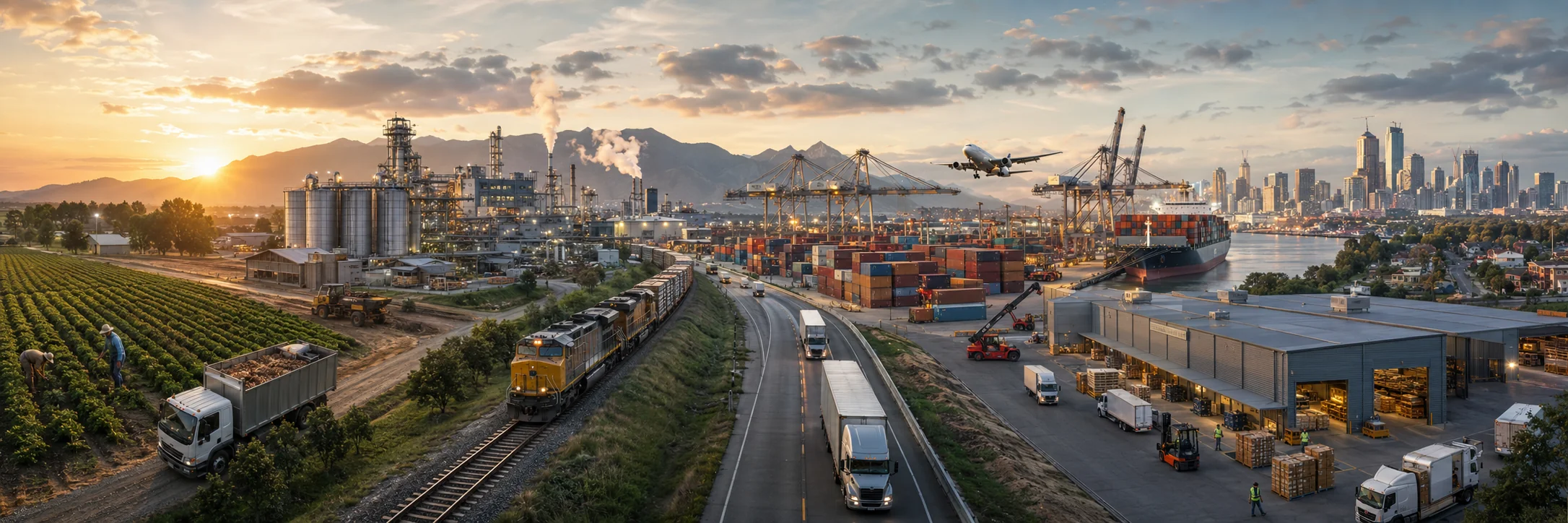
A supply chain is a continuous physical process divided among organizations. It carries a function, material, energy, information, money, and responsibility from origin to use and through whatever remains afterward.
What a supply chain actually carries
A supply chain is often described as a sequence of companies moving products. That description is too thin. A tree can grow material, a deposit can be mined, and a crop, device, fuel, food, or electrical service can be transformed or delivered while remaining suitable for a particular use. The chain also carries the instructions, test results, payments, permissions, and feedback that make those transformations possible.
The object is not the underlying need. People need nutrition rather than a packaged food unit, accessible nutrients rather than fertilizer products, clinical function rather than a device count, and light, heat, motion, or computation rather than kilowatt-hours. A product may be necessary under present conditions without being the only physically possible way to supply the function.
Begin with the physical function
Before following companies, ask what must happen in the material or living system. Coffee must retain the physical history that can produce a desired cup; blood must retain biological function and identity; electricity must arrive at the required place and moment; water must remain suitable and pressurized for its use and return; a chip must remain compatible with its qualified design; a beam must retain the geometry and material condition that carry its load.
This distinction separates biological requirement from organized demand. Harvest removes nutrients, but fertilizer demand also grows when manure, residues, food waste, and wastewater cannot return to fields. Many lithium-ion batteries need lithium compounds, but the exact chemistry, vehicle range, and manufacturing geography can enlarge the required mining, refining, qualification, infrastructure, inventory, and duplicated-capacity requirements. The analysis must establish both the unavoidable function and the conditions making the present volume appear necessary.
Follow the complete physical journey
Map origin, transformation, storage, transport, use, repair, recovery, and retirement. At each stage identify what enters, what leaves, what consumes time, and what can no longer be restored. Drying can preserve coffee while mould damage cannot be reversed. A forest can grow a new tree, but not before a replacement timber supply exists. A used tyre can be retreaded, ground, burned, or discarded; those routes preserve different amounts of completed work.
The chain crosses ecological and technical boundaries that ownership does not erase. Water can remain in the global cycle while becoming locally unusable. A mine can contain lithium while a cell plant lacks qualified material. A refinery can have crude while the required product is unavailable. The physical process continues when an invoice ends.
Money changes feasible action
Money is not an explanation added after the physical story. It determines which actions can occur before a crop spoils, a tree matures, a ship sails, a batch is released, or a repair window closes. Equipment, land, storage, labour, testing, maintenance, safety margins, and working capital must be available at the right time.
A payment measures a contract boundary, not the whole process. A coffee picker paid by basket may not have time for selective harvesting. A rail shipper may have grain but no financed route to a vessel. A construction contractor may need to finance protection before progress payment. A farmer may have manure surplus while another field needs nutrients, but not the hauling, storage, and timing to move it.
The method therefore asks who can act, what the action requires, when money arrives, what the contract recognizes, and which physical burdens remain outside the transaction.
Separate condition, record, and claim
Physical condition is what happened to the material, people, land, water, equipment, and surrounding system. Recorded condition is what a sample, meter, audit, grade, certificate, database, or test captured. A communicated claim is what another participant or user was told.
A bill of lading can establish a shipment; it cannot establish usability at the destination. A temperature logger observes exposure at its sensor; it does not prove potency. A certificate can establish compliance with its scope; it cannot prove conditions it did not inspect. A traceability system can preserve a lot identity; it cannot reconnect material that was physically mixed without preserving that identity.
Controls are partial repairs. They are valuable when their result changes a feasible action, but more records do not automatically create equipment, money, authority, or a return path.
Look for delayed feedback
Many failures become visible after the cause has moved, mixed, aged, or been retired. A coffee defect appears in the cup. A transfusion error can appear in a patient. A semiconductor failure appears in an installed system. A blackout is observed after fuel, maintenance, weather, and dispatch decisions have accumulated.
Detection and correction are different events. Feedback reaches a cause only when identity survives, the cause is still reachable, the right person receives the information, and that person has the material means and authority to change the next action.
Keep residuals inside the account
Every production process uses inputs and leaves outputs. Fertilizer can leave nitrogen in water; mining creates tailings; refining creates sulfur and wastewater; sterilization creates packaging and chemical burdens; data centers create heat and electronic waste. A named co-product or recycling route is not evidence that the output reached its intended use.
A complete account follows saleable output and displaced output together. It asks who must cool, contain, treat, return, repair, monitor, remediate, or safely isolate what remains after the primary service has been delivered.
How to read the articles in this category
Each article begins with its own object and visible journey rather than a fixed outline. Fertilizer is about accessible plant nutrients; blood about biological function joined to identity; electricity about place, time, and balance; water about changing local usability; coffee about irreversible history and lost resolution. The same analytical discipline is underneath them, but the structure belongs to the subject.
Read for how a useful function is supplied through a product or service, the handoff where information or material is lost, the payment that makes an action possible or impossible, and the feedback that can or cannot return to its cause.
Inside CompanyGraph
CompanyGraph can help map organizations, facilities, assets, contracts, handoffs, and declared relationships. It can show where a function or responsibility crosses a boundary. It cannot replace direct evidence of physical condition, unrecorded work, ecological consequence, patient outcome, or the authority and money needed to change the next result.