 CompanyGraph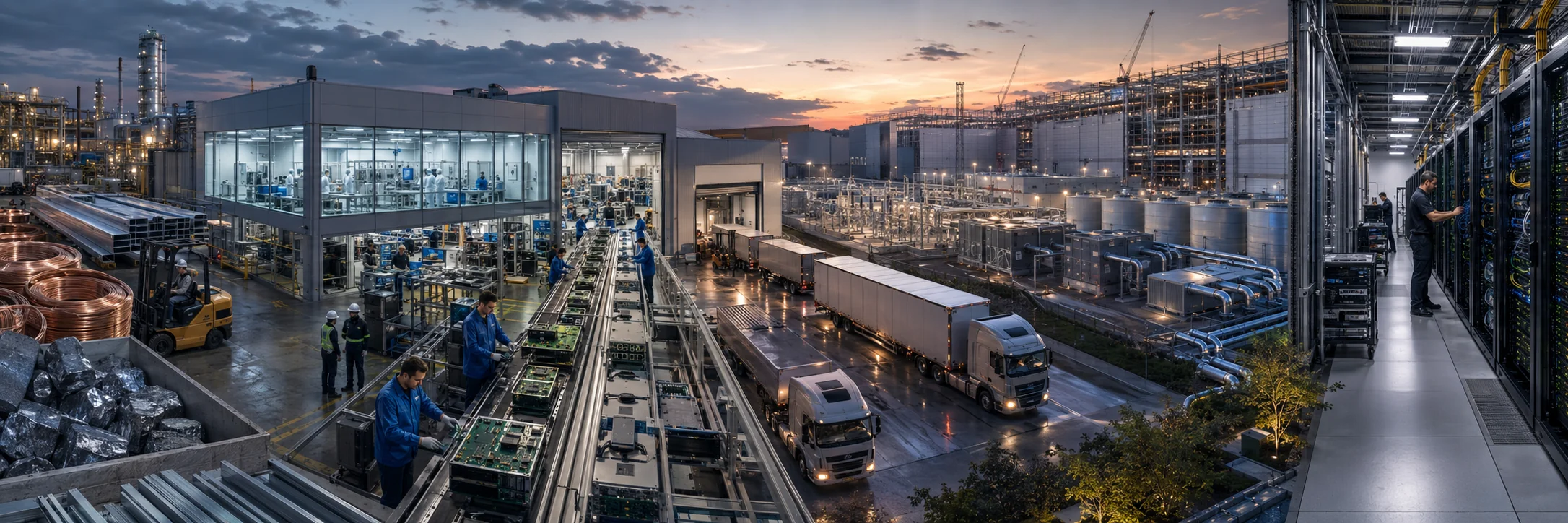
Follow electricity and fiber into a data center, through servers, cooling, networking, operations, and retirement. Compute is useful only when power, heat removal, latency, software, and service continuity remain connected.
A data center is not the service people ultimately need. They need a model to run, a transaction to complete, a video to deliver, a sensor to process, or a database to remain available. The facility is one way to provide those services, using servers, storage, networking, power conversion, cooling, security, and staff as one operating configuration.
A building can have floor space and a utility contract while lacking energized transformers, cooling capacity, fiber routes, qualified servers, or a workload that can run there. Conversely, a large installed IT load can deliver little usable service if software, network paths, maintenance, or power quality fail.
The facility combines several working systems
Servers process and store data; accelerators perform specialized computation; storage systems preserve state; switches and optical links move information; uninterruptible power supplies bridge disturbances; generators or other backup systems support selected loads; and cooling removes heat from the electrical work. The International Energy Agency lists these as components of a data-center facility. Taken together, they mean the facility must be understood as a coupled system rather than a server count.
The required service sets different constraints for a cloud region, a bank transaction system, a research cluster, an edge site, or a content-delivery cache. Latency, availability, storage persistence, security, and workload shape determine whether one facility can substitute for another. A megawatt of uncommissioned equipment does not provide the same service as an operating cluster connected to the right users and data.
A power contract is not a grid connection
Power enters through a grid connection, switchgear, transformers, distribution boards, power supplies, and rack-level conversion. Each boundary has voltage, fault, redundancy, maintenance, and protection requirements. A utility may report generation or contracted capacity while the site still lacks the substation, feeder, protection settings, or energization date needed to run its load.
Data-center demand is continuous enough that annual electricity totals alone do not establish reliability; power quality, interruption duration, backup, and recovery matter too. The IEA distinguishes physical electricity consumed by data centers from contractual procurement claims. A power-purchase agreement can finance generation or allocate contractual electricity attributes, but it does not guarantee local, real-time electricity at a server inlet during an outage.
Chips become servers through a qualified configuration
A processor or accelerator is an input, not a working compute service. Boards, memory, storage, firmware, network interfaces, power supplies, cooling plates or heat sinks, drivers, and operating software must be compatible. An operator may have enough chips in the abstract while lacking the exact board revision, memory, optics, or tested software stack needed for the intended workload.
Qualification attaches a component to a design, thermal path, firmware version, test method, and support process. A server that passes a factory test can still fail after rack integration because of airflow, vibration, power transients, cable routing, or software configuration. A shipment record describes movement; it does not establish a commissioned cluster.
Racks turn power into heat
Nearly all electrical power used by IT equipment becomes heat that must leave the rack, room, and facility. Air-cooled systems move heat through fans, room air, heat exchangers, chillers, and sometimes cooling towers. Liquid-cooled systems put a coolant path closer to high-power components and transfer heat through a cooling-distribution unit or other heat exchanger.
The DOE data-center design guide explains that liquid cooling, warmer water, dry coolers, and economizers can alter energy and water requirements, but each depends on equipment, climate, water chemistry, controls, and maintenance. A cooling nameplate is not heat removal at every rack inlet.
Cooling must carry heat somewhere
Evaporative cooling towers reject heat by evaporating water and discharging blowdown to control dissolved minerals. Closed loops recirculate water within part of the system, but still need heat exchangers, pumps, treatment, and a final heat sink; they do not automatically eliminate site water use. The Department of Energy describes how IT heat moves through room air, chilled water, condenser water, and cooling towers, and how water-use effectiveness measures one defined boundary.
Water use, electricity use, ambient temperature, humidity, and equipment condition interact. A dry cooler may reduce freshwater demand but require more electrical or capital capacity; a liquid loop may reduce fan work while adding pumps, chemistry, and leak controls. The DOE describes a project in Southwest Virginia that is testing abandoned-mine water as a subsurface cold-energy reserve for data-center cooling, including circulation and reinjection. The project demonstrates that a cooling option is a site-specific physical system, not a label attached to a facility.
Fiber and network paths constrain location
Compute must exchange data through optical fiber, routers, switches, cables, and upstream networks. Latency, route diversity, peering, congestion, and physical access determine which users and data can be served. A facility with abundant electricity can still be unsuitable for a latency-sensitive workload if the fiber path is long, fragile, or not connected to the required network.
Network capacity is also a maintenance condition. A cut cable, misconfigured route, failed switch, or expired certificate can separate operating servers from the service they are supposed to provide. A dashboard that shows a live rack does not establish that the external path, identity, or data dependency is available.
A building is not capacity
Floor area, rack slots, transformer nameplate, cooling plant rating, generator output, and installed servers are different observations. A site can have empty space but no utility feeder; it can have energized power but no cooling-water allocation; it can have commissioned racks but no trained team or software license; it can have a full room but insufficient network or storage to run the intended workload.
Capacity also has a time dimension. A reserved megawatt, a permit, a delivery date, and a tested rack are steps on a path, not interchangeable units. The IEA notes that a data center can become operational faster than the broader energy system can plan and build the infrastructure that supplies it, creating a physical timing mismatch.
Money and interconnection timing decide what can be built
Construction and operation require money before the service earns it: land, utility deposits, transformers, switchgear, generators, cooling plants, fiber, servers, software, staff, spare parts, and working capital. A utility interconnection request can be accepted while the customer still lacks the transformer order, substation work, or cash to reach energization.
The IEA estimates that grid constraints could delay around 20 percent of global data-center capacity planned for construction by 2030. That is a planning estimate, not a claim about every project, but it shows the timing problem: a developer can have a site, servers, and a power request while the feeder, transformer, or substation is still years away. A smaller project with an existing connection and lower-density workload may deliver service sooner even with fewer nameplate megawatts. Financing and payment timing determine whether the developer can order the transformer, reserve cooling equipment, and keep the project moving while it waits.
Users experience completed work, not nameplate capacity
Users experience completed jobs, response time, data durability, and recovery after failure. Operators schedule workloads around power budgets, thermal limits, maintenance windows, network paths, software compatibility, and service-level commitments. A cluster may be busy but not available for a new job; it may be powered but isolated; it may be healthy in aggregate while one accelerator type is missing.
Telemetry can show temperatures, power, errors, and network events at defined sensors. It can reveal drift, but diagnosis requires tracing those signals through the rack, coolant, workload, and network path before an intervention can be verified.
Expansion and retirement change the material route
Expansion adds concrete, steel, transformers, cables, batteries, servers, racks, cooling equipment, and software state. Retirement may leave a building usable while servers, batteries, refrigerants, circuit boards, and backup generators take different routes. Reuse can preserve a working server or cooling component; material recovery preserves selected metals and plastics while destroying configuration, firmware history, and test evidence.
Backup fuel, batteries, cooling chemicals, wastewater, electronic scrap, and failed components need different routes. NIST treats media sanitization as a disposal decision tied to data sensitivity, while EPA guidance covers electronics reuse, recycling, and separate battery handling. Refrigerants and cooling chemicals still require their own recovery or disposal route. A recycling certificate records that a stream was received; it does not establish secure erasure, safe battery treatment, or reuse of a particular server.
Responsibility extends beyond the building
Keeping the digital service available means connecting the grid connection, power conversion, server configuration, cooling path, network route, software state, operating staff, money, and recovery routes to the result users experience. It keeps physical electricity distinct from procurement claims, installed IT from usable compute, and telemetry from diagnosis.
The relevant participants include utilities, developers, equipment manufacturers, chip and server suppliers, network carriers, cloud and colocation operators, facilities teams, software owners, users, recyclers, water authorities, and regulators. Responsibility is complete only when evidence, resources, and authority can reach the participant able to change the next failure or keep the service available.
Inside CompanyGraph
Explore utilities, substations, developers, data-center builders, chip and server suppliers, cooling manufacturers, fiber carriers, cloud operators, facilities teams, software providers, water authorities, recyclers, and regulators. CompanyGraph can map the participating organizations and handoffs among them; it cannot by itself observe whether a particular megawatt reaches a rack, whether a rack can run the workload, or who holds operational authority during a failure.