 CompanyGraph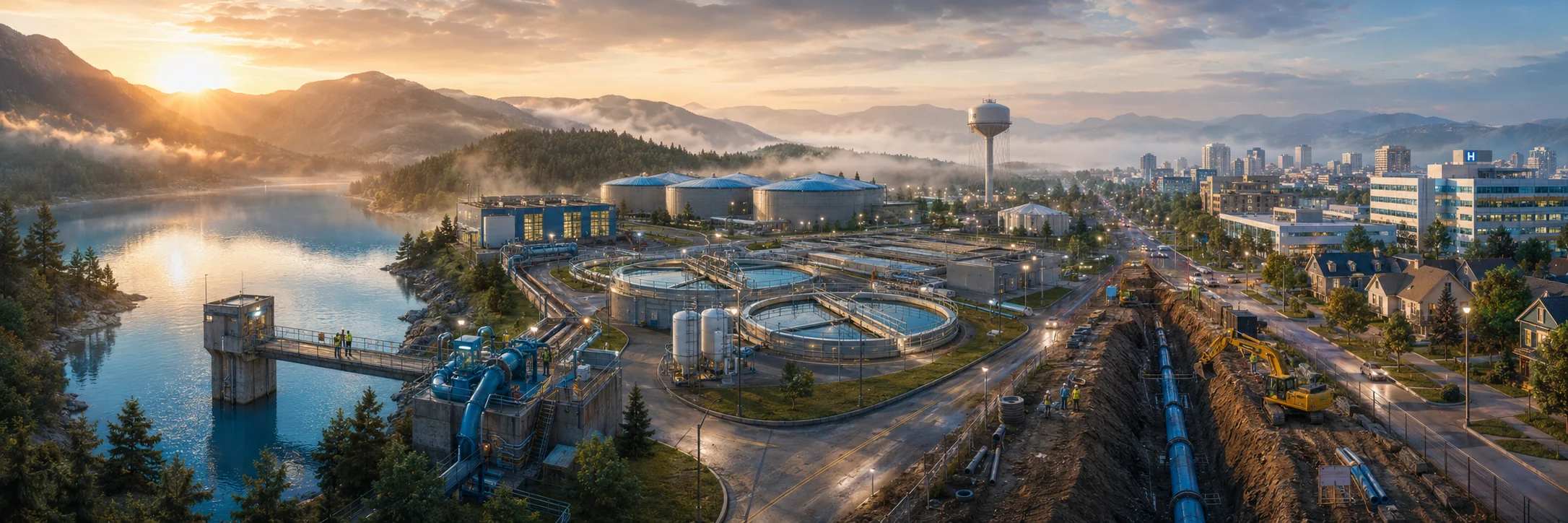
Trace water through source, treatment, pipe, use, wastewater, and return to see where a circulating resource becomes a local shortage.
How water enters, changes, and returns
Rain and melting snow run into streams and reservoirs, soak into soil, or recharge an aquifer, a layer of water-bearing rock or sediment underground. A well or intake removes part of that flow. Surface water commonly passes through processes that gather fine particles, let them settle, filter the water, and control disease-causing organisms; treatment changes with the source and intended use. Pumps, tanks, valves, and gravity then maintain enough pressure to move drinking water through mains, service lines, and building pipes. The route may cover a few kilometres or cross a region through reservoirs, canals, and aqueducts.
After use, the paths divide. Water from sinks, toilets, factories, and drains may enter sewers, pass through wastewater treatment, and return to a river, sea, aquifer, industrial process, or irrigation system. Irrigation water may enter crops, evaporate from soil, move downward toward groundwater, or leave as runoff. Cooling water may circulate repeatedly or return warmer than it arrived. Leaked water may infiltrate soil, enter a sewer, or escape to a place where the supplier cannot recover it.
The molecule has not left the water cycle. Its usefulness may have changed completely. It can carry pathogens, salt, lead, nutrients, heat, or industrial chemicals. It may return downstream, enter the atmosphere, or remain underground longer than the period in which people need it. The physical chain is therefore not source-to-tap delivery. It is a changing loop of withdrawal, treatment, movement, use, collection, treatment, and return.
One substance, several specifications
The human body needs water, but a safe water service requires more than volume. The WHO and UNICEF definition of safely managed drinking water includes a source located on the premises, available when needed, and free from contamination. In 2024, 2.1 billion people still lacked that complete service. A laboratory result cannot compensate for a distant source, an intermittent pipe, or water that becomes contaminated before use.
Other uses require different conditions. Crops need water in the root zone during particular growth stages. A river ecosystem needs flow, temperature, oxygen, and chemistry within ranges that support its organisms. A boiler may need low-mineral water; semiconductor production requires much greater purity; cooling may tolerate a source unsuitable for drinking. Toilet flushing, street cleaning, and some irrigation can use non-potable water, meaning water not intended for drinking, if a separate, safely controlled system exists.
This is why demand cannot be read directly from litres delivered. Food production, hygiene, cooling, and industrial transformation create real water requirements. Present withdrawal also depends on crop and product choice, climate, soil, irrigation method, building fixtures, leakage, recycling equipment, and whether work can move to another season or place. FAO reports that agriculture accounts for about 72 percent of global freshwater withdrawals, mainly through irrigation. That figure identifies where water enters organized production; it does not say that every withdrawal is biologically fixed or that farmers can reduce it without different crops, infrastructure, knowledge, rights, energy, labour, and timely money.
A drinking-water network often supplies one high specification to many uses because one pipe system is simpler to protect than parallel systems. That organization can enlarge treatment and source-water demand, yet separate networks require construction, monitoring, and safeguards that prevent non-drinking water from flowing back into drinking-water pipes. The underlying question is not whether all water should receive less treatment. It is which quality is physically required at each use, and what infrastructure can deliver it without creating a new health hazard.
A withdrawal is not a disappearance
Water accounting separates events that ordinary language often combines. A withdrawal removes water from a river, reservoir, or aquifer. Delivery moves it to a user. Consumptive use is the portion that evaporates, passes through plants into the atmosphere, enters a product, or otherwise does not return to the local environment for immediate reuse. Return flow is released water that reaches a surface or groundwater source again.
The distinction changes what a large number means. The USGS water-use accounting method relates use to consumptive use, wastewater collection, and return flow rather than treating withdrawal alone as consumption. A once-through cooling system can withdraw a large volume and return most of it at a different temperature. A crop may receive less water but return a larger share to the atmosphere through its leaves. In the United States, USGS found that crop irrigation accounted for 90 percent of consumptive water loss from 2010 through 2020, while public supply and power generation accounted for much smaller shares.
Returned does not mean restored. Discharged water can be warmer, saltier, nutrient-rich, or contaminated; it can return below the point where it was needed or during the wrong season. A downstream utility may already be treating water released by an upstream city, making unplanned reuse part of many river systems. Conversely, a leak counted as a distribution loss may recharge groundwater. It still wastes treatment and pumping and may not return to the source, time, or quality relevant to the utility.
How does the loop become a shortage?
When water leaves the useful place or time
Evaporation, water passing through plant leaves, product export, and discharge to the sea can make water unavailable inside a catchment, the land area draining to a common water body, even though it continues elsewhere in the global cycle. Groundwater adds a longer delay. Pumping an aquifer faster than recharge can lower wells, reduce flows to streams and wetlands, increase the energy needed for pumping, and draw poorer-quality water toward the well.
Some damage cannot be repaired by later rainfall. In aquifers containing fine sediments, lower water pressure can let the sediment compact. USGS explains that this compaction can permanently reduce the space available to store water; raising the water level later does not reopen most of the compressed pore space. Supply taken today can therefore shrink the physical storage available tomorrow.
When water returns harder to use
Pollution creates shortage without removing volume. Nutrients and sediment washed from land, leaking sewage, salt from irrigation drainage, industrial discharges, and contaminants in groundwater can make a source unsuitable for a use or require additional treatment, energy, chemicals, monitoring, and disposal of the material removed. Some compounds are difficult to remove routinely. Preventing contamination can preserve several downstream uses at once.
The organization is divided at exactly this point. A drinking-water utility must treat the raw water it receives but may have little authority over farms, roads, mines, septic systems, or land development across the source area. EPA notes that protecting source water can avoid risk and reduce or defer complex treatment. Treatment repairs a defined condition at the plant; source protection acts earlier, before contamination becomes part of the product.
When the network loses control
A pipe leak loses pressurized, treated water from the supplier's controlled path. Repair can recover that capacity, but locating a buried leak requires meters, acoustic equipment, pressure data, excavation, skilled crews, replacement parts, and money before the failure becomes an emergency. Utilities may know that the system loses water without knowing which pipe is responsible.
Pressure is part of safety as well as delivery. A break or pressure drop can allow surrounding water or material to enter through a breach. The energy used to treat and pump the lost water is already spent. Increasing source capacity can temporarily replace the volume while leaving the leak, contamination route, and repair obligation in place.
Why can safe water at the plant change before the tap?
Treatment does not freeze water in a finished condition. During storage and distribution, disinfectant can decline, organisms can grow on pipe surfaces, sediment can accumulate, and water chemistry can react with pipes, solder, and fixtures. Time in the network, temperature, flow direction, and pressure all matter. EPA describes the distribution system as both most of a utility's physical infrastructure and the final barrier against contamination.
Responsibility also changes along this route. In many U.S. systems, the utility operates to the service connection; the property owner controls plumbing beyond it. The physical water crosses that legal boundary without resetting its chemistry. A utility may adjust treatment to limit water's reaction with metal, replace a public main, or manage pressure. A building owner may need to replace internal pipe or a privately owned service line. Neither can correct the whole route alone.
Flint connected source chemistry to household pipe
Flint's water crisis made this interaction visible. The 2014 source change altered water chemistry without adequate treatment to limit corrosion, the reaction between water and metal, increasing lead release from service lines and plumbing. Returning to the previous source and changing corrosion treatment could change the water again, but the deposits and lead-bearing materials already in the route required time, flushing, sampling, and physical replacement.
EPA later sampled consecutive portions of water from Flint homes to identify where lead entered along the plumbing path. Lead service lines were the largest source when present; after their removal, the total mass of lead contributed to sampled drinking water fell by 86 percent on average. A source-water record, plant result, first-draw sample, and sequence of samples through a home answered different questions. The crisis could not be understood by treating any one of them as the complete condition.
Why can new supply be easier to organize than recovery?
Most urban systems were built as separate one-way functions: a drinking-water utility extracts and delivers, a sewer utility removes wastewater, a stormwater system drains rainfall, and another authority manages rivers or groundwater. Their assets, budgets, permits, and service areas do not necessarily follow the same catchment. A treatment plant may discharge reusable water while the supply utility develops a distant intake because no return pipe, storage, treatment agreement, or approved user connects them.
Reuse can shorten the loop. Industrial recirculation, treated wastewater, captured stormwater, rainwater, and recovered irrigation drainage can replace some new withdrawals. EPA calls this fit-for-purpose water: treatment and monitoring are matched to drinking or non-drinking use while protecting people and ecosystems. The option is physical, but it is not free. Concentrated salts and removed contaminants still need management; pumps and treatment use energy; dual pipes need controls that prevent mixing; and a customer must exist near enough to use the recovered flow.
Desalination can create freshwater from the sea or brackish groundwater, so a region is not absolutely limited to naturally fresh sources. It also requires treatment facilities, energy, intake infrastructure, and management of concentrated brine. New supply may be necessary where population, drought, or irreversible contamination exceeds feasible conservation and reuse. But the amount required depends partly on whether existing water is leaked, polluted, sent away, or prevented from returning in usable form.
The organizations meet at boundaries the water crosses
A catchment authority may observe river flow; a drinking-water utility operates the intake, plant, and mains; a household or landlord owns internal plumbing; a wastewater operator controls the return plant; an irrigation district schedules canal delivery; farmers manage soil and crops; industries manage process water; and environmental agencies oversee withdrawals or discharges. The water connects their actions even when contracts and accounts do not.
Each participant has limited feasible moves. A utility can change treatment but not an upstream land use by itself. A farmer cannot switch irrigation equipment or abandon a crop midway through its biological season merely because scarcity becomes visible. A tenant cannot replace a buried service line. A wastewater operator cannot supply reclaimed water without a permitted treatment process, storage, distribution, and a user willing and equipped to receive it.
Money affects these actions before the decision. Leak detection, pipe replacement, household connections, monitoring wells, irrigation controls, and reuse plants require equipment and work before the saved or safer water exists. At the same time, water charges must remain compatible with access to an essential service. A low bill can coexist with deferred repair, while a fully funded system can still exclude a household unable to pay. Service, maintenance, and access must therefore be observed separately rather than compressed into one price.
A map, meter, and sample see different water
A catchment map shows where water can flow, not the volume or chemistry present today. A customer meter records water crossing one boundary; it does not reveal a leak before the meter, a leak inside the building, the quality delivered, or how much returns to the catchment. A monitoring well observes one part of an aquifer. A pressure sensor can expose an abnormal zone without locating the cracked pipe.
A water sample is more specific still. It records the tested properties of water collected at a named point and time using a particular method. A compliant sample at the plant does not establish every tap's condition; a high result in one building does not by itself locate the source. Sampling plans, pipe inventories, online sensors, and computer models of flow and pressure reduce defined uncertainties when records stay connected to place, time, and the physical network.
Permits and rights describe another layer. A withdrawal right records an authorized claim, not necessarily water physically present in a dry year. A discharge permit sets conditions at an outlet; it does not by itself describe cumulative conditions through the whole catchment. The useful control is the one whose observation changes an available action: isolate the main, adjust treatment, stop a discharge, repair a service line, alter pumping, or warn the people exposed.
Supply ends only when water can safely continue
A complete water account follows precipitation and recharge, source condition, withdrawal, pipe and canal loss, delivery, consumptive use, collection, returned quantity and quality, and the flows needed by the surrounding living system. It also records delays: an aquifer may recharge over decades, a contaminant plume may arrive years after release, and a pipe replaced today may remain for generations.
This does not require every litre to return to its original source. Crops must move water through their leaves; people must drink; some wastewater must leave the immediate system; and some regions need imported or newly treated supply. It does require a new withdrawal to be distinguished from replacement for avoidable leakage, pollution, one-pass use, or a missing return path.
The supply chain succeeds when water of the required quality reaches the required use without destroying the conditions that make the next supply possible. Litres delivered remain essential, but the complete product is fit-for-purpose water together with a viable path for the local cycle to continue.
Inside CompanyGraph
Explore the water utilities, treatment operators, infrastructure providers, industrial users, irrigation systems, environmental agencies, and ownership relationships that connect source, use, recovery, and return inside CompanyGraph.