 CompanyGraph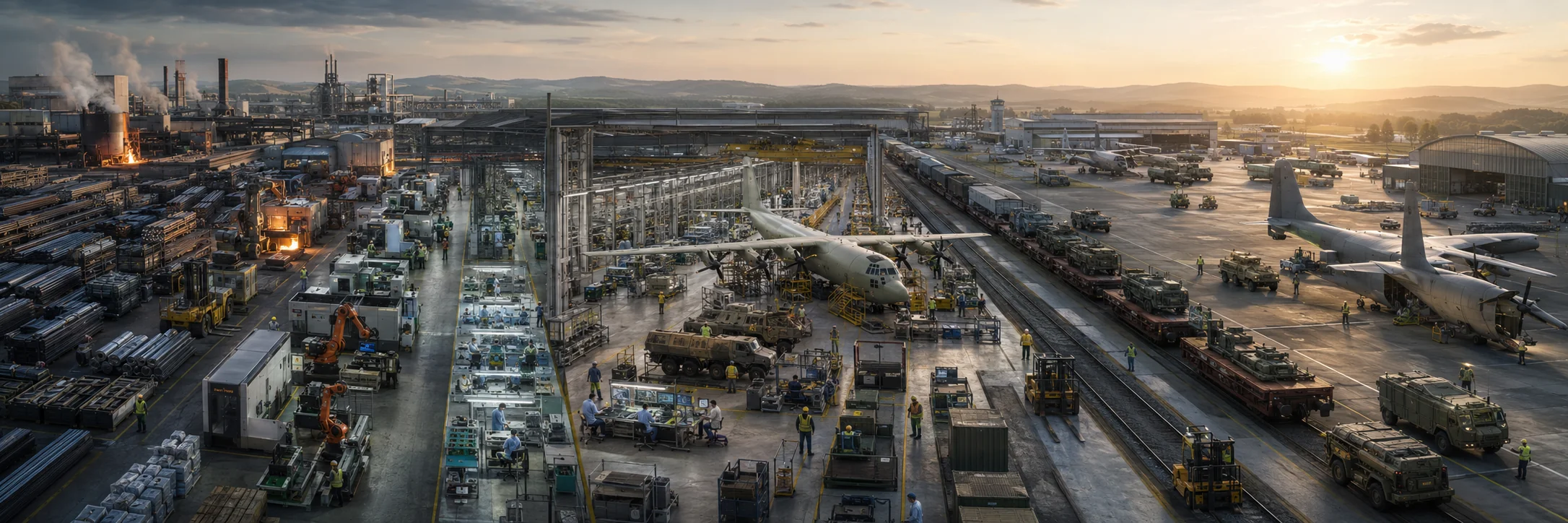
Follow a mission requirement through design, qualification, production, deployment, maintenance, feedback, and retirement. Defense supply succeeds only when the approved system, trained people, support materials, and operating information meet the mission at the required place and time.
Defense systems do not exist to accumulate objects. They are built to produce effects: protect a convoy, detect a threat, keep a communication link open, move a unit, deliver supplies, or control airspace. A vehicle, radar, missile, aircraft, or software service is useful only in relation to a specified task, threat, crew, location, and time.
The physical journey runs from a requirement through architecture, material and component production, qualification, assembly, software loading, training, deployment, maintenance, and retirement. A requirement may remain constant while the parts, supplier, software version, repair route, or operating environment changes. The Government Accountability Office describes the defense industrial base as a network whose capacity must meet both current and future needs; that capacity is tied to qualified processes, people, tooling, security, test evidence, and support, not generic factory space.
A requirement becomes a particular system
A mission requirement becomes limits on mass, power, range, accuracy, environment, safety, communications, cybersecurity, maintainability, and interoperability. Engineers turn those limits into interfaces, materials, software, test plans, and operating procedures. The same component can be suitable for one aircraft or radio and unsuitable for another because the surrounding loads, heat, software, security rules, or repair process differ.
Changing a requirement late can reopen analysis, tooling, qualification, training, spares, and technical documentation. A cheaper or more available component does not become usable merely because it fits physically; its behavior in the approved configuration must be established before the system can rely on it.
A part needs a documented production history
Metals, composites, electronics, batteries, optics, seals, coatings, energetic materials, and software arrive through different manufacturing paths. Heat treatment, bonding, machining, casting, circuit fabrication, firmware loading, and calibration give each item a history. A bill of materials names what should be present; it does not establish how a particular item was made, tested, changed, or stored.
A part becomes eligible for a system when its identity, revision, interfaces, production process, test evidence, and change controls remain connected. Obsolete items, limited production capacity, foreign dependence, and workforce constraints can break that connection at lower tiers. The GAO reports that the Department of Defense has little visibility into much of the supplier network, including raw-material and parts suppliers.
Factory space alone does not create production capacity
A factory can have floor space and machines while lacking qualified operators, secure information systems, approved tooling, inspection capacity, test access, or the material needed for the next lot. Expanding a low-rate line requires those elements in sequence; adding machines alone does not create an approved process.
Inventory has its own history. A stored item can age, require environmental control, lose software support, or remain unusable until the matching component, technical data, and trained crew are present. A procurement record counts a transaction. It does not establish that the item is in the right place, configuration, condition, or readiness state.
The F-35 shows how a spare becomes a readiness problem
The F-35 is a well-documented example, not a model for every defense program; other programs have different architectures, contracts, threats, and sustainment arrangements.
The F-35 makes the chain concrete. In a 2019 review, the GAO reported that spare-parts shortages and repair backlogs kept aircraft on the ground: aircraft were unable to fly nearly 30 percent of the time from May through November 2018, and the Department of Defense had a repair backlog of about 4,300 parts. The problem was not simply too few parts. It involved which variant needed the part, where the aircraft was deployed, whether the part could be moved there, and whether a repair line could return it to service.
The same review found that 44 percent of purchased parts were incompatible with Marine Corps aircraft on a recent deployment because aircraft had been modified over time. The services, international partners, and other customers share a global pool managed by the prime contractor, so a part can exist somewhere in the network without being the right part for the aircraft and mission that need it.
The later trend shows why inventory counts and added spending do not by themselves establish readiness. The GAO reported that F-35 mission-capable rates fell from 67 percent in fiscal year 2021 to 44 percent in 2025, while full-mission-capable rates fell from 38 percent to 25 percent. The updated sustainment strategy requires an estimated $13.7 billion more through fiscal year 2031, including more than $7 billion in parts and other material, while capacity constraints persist for key parts.
Readiness is a daily operating state
Readiness depends on serviceable equipment, trained crews, fuel or energetic material, secure communications, maintenance time, spare parts, technical data, and an assignment the system can actually perform. Mission-capable and full-mission-capable rates answer defined questions about aircraft performance; they do not replace the underlying maintenance, supply, training, and configuration records.
Maintenance is another production line. It diagnoses a fault, isolates the affected configuration, obtains a part or repair, loads software when required, tests the result, and returns the system to service. A reported defect is not a correction, and a corrected component is not a restored mission until the surrounding system and crew can use it.
Tests answer different questions
Qualification tests expose a design or process to defined vibration, temperature, pressure, shock, electromagnetic, reliability, safety, or performance conditions. Acceptance tests sample a production item or lot. Operational tests observe a configured system in a mission context. These tests support different decisions and leave different conditions outside their scope.
A passed test establishes evidence under its stated method; it does not forecast every future failure or prove that a deployed system has the required spares, software, crew, or environment. An inventory record, delivery receipt, acceptance certificate, and readiness report likewise describe different observations. The claim made to a commander or maintainer should not exceed what the underlying record can establish.
Security changes who can see and change the system
Classification, export controls, secure facilities, cleared workforces, and compartmented data protect missions and technologies. They can also limit who may inspect a failure, share a technical drawing, move a part across a boundary, or propose a substitute. The restriction is sometimes necessary, but it changes the path by which evidence and repair can travel.
Configuration management, access controls, and audit trails preserve important records. A secure database is not a physical inspection, and a certification is not present readiness. Information still has to reach the cleared authority with the resources and time to act.
Money pays for the waiting
Defense production consumes money before it produces a mission effect: design engineering, long-lead material, tooling, secure facilities, test ranges, workforce training, spares, and supplier continuity all come first. A contract can reserve work without instantly creating a qualified line, a repair depot, or a deployable configuration.
The F-35 sustainment evidence shows how what a contract pays for can differ from what readiness requires. The 2026 GAO review found that the Joint Program Office paid hundreds of millions of dollars in contractor incentives since 2020, yet the incentive measures did not align with service readiness requirements. It also found that the new strategy depends on private suppliers for more than $7 billion in additional parts and material while industry capacity remains constrained. Money can fund stock, depot repair, and production, but the mission effect arrives only when the paid-for work is the right configuration, in the right place, with the data and people needed to use it.
Field evidence must reach the next lot
A reported fault can improve the next version only if its identity and context travel back to someone able to change the system. The maintainer needs the serial number, configuration, environment, and symptom; engineering needs a way to test the suspected cause; the program office needs authority to change a drawing, inspection, supplier, spare package, or software release; and the next production or maintenance action must use the result.
The F-35 case shows this path in public records. GAO recommended that deployment spare packages be reviewed against modified aircraft, that scarce-part allocation rules identify responsibilities, and that the global network for moving parts have defined requirements and milestones. These are not abstract data improvements: they connect aircraft configuration, part identity, movement, money, and readiness so that a shortage can lead to a different preparation decision.
Retirement has its own material routes
A platform can leave service because its mission, support base, threat environment, legal status, or operating cost has changed even when some components remain physically usable. Demilitarization, classified-data removal, hazardous-material handling, parts harvesting, controlled destruction, and material recycling assign different routes to what remains.
DLA Disposition Services describes a sequence that first offers excess property for reutilization, transfer, or donation, while property with military characteristics may require demilitarization and hazardous property follows monitored disposal. A component can therefore be physically usable yet unavailable for ordinary reuse because its security status and authorized next user matter as much as its material condition.
Reuse can preserve a tested component or completed structure when identity, condition, authority, and a permitted next user are established. Material recovery preserves selected metals and polymers while destroying configuration, security controls, and much of the evidence about the completed system. Retirement is therefore part of the supply chain, not an administrative footnote.
Responsibility cannot end at delivery
Defense responsibility follows the mission from requirement and design through qualified production, deployment, maintenance, feedback, and retirement. A contract, inventory record, accepted item, or readiness percentage can support one part of that chain without proving the system's ability to perform the required mission.
The relevant participants include acquisition offices, program managers, primes, lower-tier suppliers, depots, test organizations, training units, operators, maintainers, and demilitarization teams. Responsibility remains connected only when configuration information, security access, money, material, and authority can reach the people who can still change the next mission outcome.
Inside CompanyGraph
Explore requirements offices, program managers, primes, component and material suppliers, secure software teams, qualification laboratories, depots, training organizations, operators, maintainers, regulators, and demilitarization facilities. CompanyGraph can map the participating organizations and handoffs among them, while leaving operational questions—who actually has a configuration record, clearance, funding, maintenance authority, or supplier visibility—to the underlying systems and evidence.