 CompanyGraph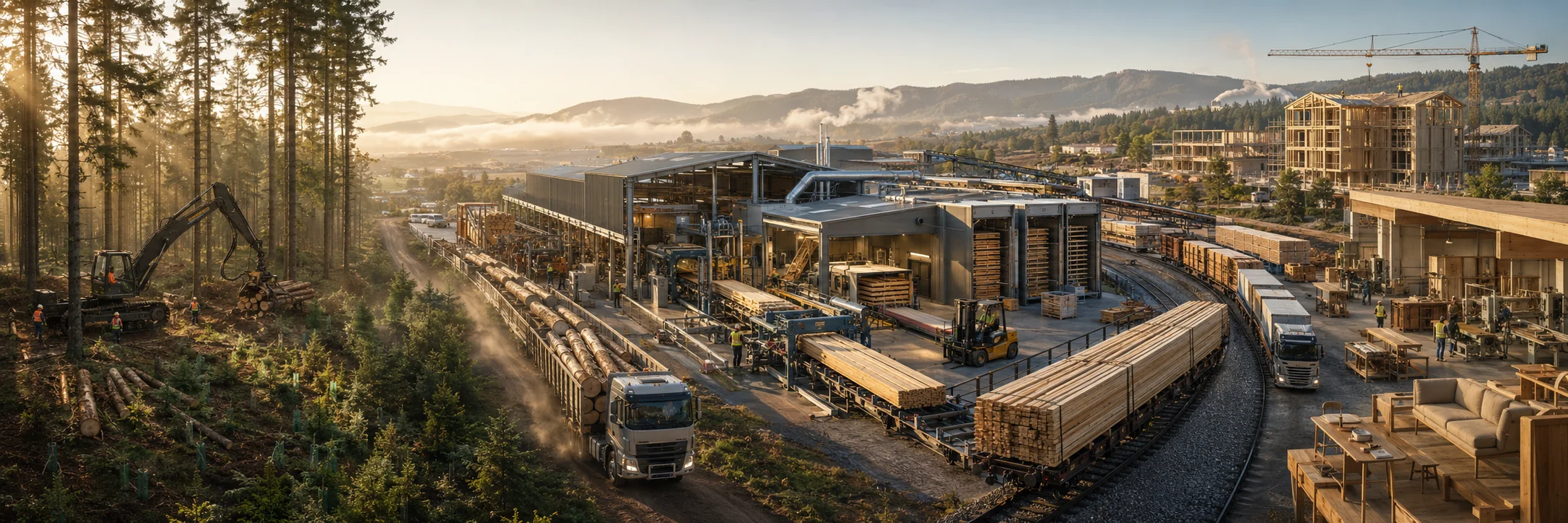
Follow a tree from forest to log, dry graded timber, a building, and possible second use, where every cut preserves some material possibilities and closes others.
A tree does not grow boards
A standing tree is a living structure rooted in soil. Its wood holds the crown against wind, conducts water from roots to leaves, and stores biochemicals. The stem contains successive growth layers, knots where branches enter it, sapwood and sometimes heartwood, juvenile wood, changes in grain direction, moisture, and sometimes internal decay. These features belong to the tree before anyone assigns a product name.
A forest manager marks a stand or individual trees for harvest. A crew fells, delimbs, and cuts each stem into log lengths; skidders, forwarders, cables, or animals move them to a landing. There the logs are measured, sorted, and loaded for a sawmill, veneer plant, pole yard, pulp mill, or another buyer able to use their species, diameter, straightness, and condition.
At a sawmill, scanners and people choose how to open each log. Saws turn the round stem into green boards, while bark, slabs, chips, and sawdust take other routes. Boards are stacked and dried, surfaced to final dimensions, graded, treated or glued where required, and shipped through distributors to fabricators and building sites. Once installed, wood continues exchanging moisture with the air. At removal it may remain a beam, become a smaller piece or panel feedstock, supply energy, enter disposal, or decay.
Wood begins as a living compromise
The properties that make wood useful arose for the tree rather than for a mill. The U.S. Forest Service describes support, water conduction, and biochemical storage as its three basic biological functions. Long cells and cellulose fibres give high strength along the stem. Growth rings, rays, vessels, resin canals, and branch junctions organize other functions across it. The result is direction-dependent material: load, liquid, heat, and dimensional change behave differently along the grain, across the rings, and from the centre toward the bark.
Variation continues between species, between sites, between trees in one stand, and within a single stem. Density, natural durability, stiffness, colour, permeability, and response to drying vary. A knot may be an efficient branch connection in the tree yet interrupt straight grain in a joist. Reaction wood that helps a leaning stem correct its position may distort after sawing. Fast growth creates no universal property change; its effect depends on species, the part of the stem formed, and the property being measured.
People need shelter, load-bearing structures, surfaces, furniture, packaging, communication media, hygiene products, and heat. They do not require a fixed volume of timber to receive those functions. Wood competes or combines with earth, stone, metals, concrete, fibres, polymers, reused components, and digital services. Its low density, machinability, strength relative to weight, appearance, and renewability can make it a practical fit, but the relevant comparison belongs to a named use, place, service life, and recovery path.
Present timber demand includes necessary replacement of worn structures and useful new construction. It can also be enlarged by short product lives, oversized specifications, cutting waste, disposable packaging, difficult-to-repair assemblies, demolition of serviceable buildings, and failure to recover intact members. Physical possibility alone leaves reuse infeasible unless design, labour, storage, testing, timing, and money make the recovered material available to the next project.
Harvest changes a forest, not only an inventory
A forest is more than merchantable stem volume. Living and dead trees, roots, understory plants, fungi, animals, litter, soil, and water flows continue interacting while timber grows. A plantation forest is one kind of planted forest, defined by the FAO as intensively managed and typically uniform in species, age class, and spacing; other planted forests can be organized for restoration or protection. Naturally regenerated forests also span many management histories. These labels describe origins and structure, not a complete ecological result.
Trees therefore have no single biological harvest maturity. A forester may thin an even-aged stand, select particular sizes in a mixed-age forest, remove damaged trees, retain habitat trees, or defer harvest for other land objectives. Species, site productivity, desired dimensions, wood properties, disturbance exposure, regeneration method, and owner obligations alter the timing. Forest inventories estimate species, size, condition, growth, mortality, and removals; they do not reveal every defect inside every future log or establish that forecast growth preserves all forest functions.
Harvest planning determines where machines and consequences travel. Roads, skid trails, stream crossings, landings, felling direction, soil moisture, slope, weather, and the amount of crown and dead material retained affect erosion, compaction, remaining trees, nutrients, habitat, and later regeneration. FAO guidance treats inventory, road layout, directional felling, extraction routes, and post-harvest assessment as connected operations. The UK Forestry Standard similarly evaluates woodland management through biodiversity, soil, water, climate, landscape, and people as well as timber.
Those actions must be feasible before a crew arrives. A landholder may wait years for revenue while paying for planning, planting, thinning, road work, insurance, and protection. Contractors need machinery, trained workers, fuel, repairs, and a safe operating window. Wet soil may make extraction physically damaging at the same moment a mill needs logs; delaying work can protect the site but interrupt payment and mill supply. A contract that pays for delivered volume and grade can recognize the log while leaving retained habitat, road repair, or future stand condition to regulation, certification, a separate payment, or the landholder.
Regeneration cannot be inferred from a truck leaving full. Seed source, planted stock, browsing, competing vegetation, drought, fire, pests, soil condition, and later tending determine what follows. A replanted hectare and the harvested forest may have the same land area while differing in species, age structure, habitat, water movement, and future wood. Renewable describes the possibility of biological regrowth under suitable conditions; equivalent forest functions must be observed separately.
The first cut assigns futures
Once a tree is felled, bucking—the cross-cutting of a stem into logs—assigns its first industrial futures. A crooked or damaged section may become pulpwood or fuel. A straight large-diameter section may be cut for veneer, appearance lumber, structural timber, or poles. Length specifications, taper, sweep, knots, staining, checking, metal contamination, and visible decay affect the choice. The operator must act before sawing exposes the whole interior, so each cut combines observation, market orders, machine limits, and uncertainty.
At the landing, identity is preserved at different resolutions. A log may retain a tag, species, owner, harvest unit, or geographic origin; it may also enter a mixed pile defined only by broad class. Transport then links the forest to a processor that can accept that exact material. Logs are bulky and often wet, so road strength, truck dimensions, loading equipment, distance, rail or water access, and mill schedules shape which physically usable trees can become commercial supply. A standing stem outside an operable and permitted route is not a delivered log.
The sawmill makes another set of irreversible assignments. Debarking exposes the stem. A head saw or band saw opens faces; resaws divide cants into boards; edgers remove wane, the rounded remnant of the log edge; trimmers establish length. Scanning can compare cutting patterns, but the chosen pattern still determines whether clear wood becomes a wide board, several narrow pieces, or chips. Yield must therefore name its boundary: cubic volume of lumber, structural-grade pieces, appearance-grade surface, money revenue, or use of the whole harvested tree can favour different cuts.
Bark, chips, sawdust, and offcuts are material outputs, not a single category called waste. Depending on location and equipment, they can supply pulp, panels, mulch, chemicals, animal bedding, or heat for the mill. The FAO account of sawmilling and drying shows how residue use and kiln energy can be physically coupled. Actual use still depends on a local buyer, clean material stream, storage system, and transport carrying the co-product there.
Drying is a second manufacture
Freshly sawn wood contains water in cell cavities and within cell walls. Early drying removes much of the relatively free water with limited dimensional change. As water leaves the cell walls below the fibre-saturation region, the wood shrinks and its mechanical behaviour changes. Because wood is direction-dependent, shrinkage across growth rings differs from shrinkage toward the centre and is far greater than change along the grain. A rectangular green board is therefore not yet a stable dry component.
Air drying uses time, land, stacking, stickers between layers, roof or yard protection, and suitable weather. Kiln drying adds controlled heat, humidity, and airflow to shorten the process and target a moisture range. The Forest Products Laboratory drying guidance emphasizes that moisture must be controlled during transit, storage, construction, and service as well as inside the kiln. The appropriate target depends on the climate and use the wood will encounter, not on one universal dry number.
Water cannot be pulled out at any speed without consequence. If surfaces dry much faster than the core, stresses can produce surface checks, internal cracks known as honeycomb, distortion, collapse, or locked-in stress that appears during later machining. Species, thickness, initial moisture, grain, prior storage, airflow, and kiln schedule all matter. Some damage can be trimmed away; internal cracking or severe distortion may close the intended high-grade use after the forest and sawing work have already occurred.
Drying also ties physical quality to working money. Slower schedules occupy kilns and hold inventory longer. Faster schedules release saleable stock and cash sooner but may increase degrade if they exceed what the material can tolerate. A kiln operator works with samples, probes, schedules, and experience because no sensor observes every board centre. Buyers who require immediate delivery can narrow the schedule available upstream even when both parties understand the material consequence.
Dried lumber can regain moisture in uncovered transport, a humid warehouse, or a wet building site. A moisture reading captures conditions at particular locations and times rather than reconstructing the drying history or the interior of every piece. Packaging, ventilation, site sequencing, and protection before enclosure complete a process the kiln only began.
A grade makes variation usable
Structural design cannot assign a separate engineering calculation to every piece of biological material. Stress grading groups lumber with similar expected mechanical properties using defined sorting rules and design values. Visual graders observe features such as knots, slope of grain, splits, wane, dimensions, species, and moisture condition. Machine grading measures responses correlated with stiffness or strength and is combined with quality control. The Forest Products Laboratory notes that pieces can vary widely and explains why stress grades are categories rather than identical properties.
A grade stamp is therefore useful precisely because its scope is limited. It identifies a grading agency or mill, species group, grade, and condition required by the applicable system. Its scope stops short of the exact breaking strength of that board, the full history of the tree, protection during later storage, connection quality, or the load eventually imposed in a building. Appearance grades answer different questions from structural grades, and treatment marks answer different questions from either.
Origin claims form another evidence layer. Forest-management certification evaluates defined practices and conditions in a forest unit. Chain-of-custody certification controls claims as material passes through owners and processors. Under the FSC system, a transfer route can preserve claims through segregation, while percentage and credit systems allocate claims according to qualifying inputs over a product group and period. FSC’s own description distinguishes these transfer, percentage, and credit controls. A certified claim may therefore represent a controlled material-accounting relationship without identifying the particular tree inside a particular mixed product.
These controls repair genuine information problems. A designer needs reliable design categories; a buyer may need evidence about legal or managed origin; a regulator may need the harvest plot. Combining them into a general label of “sustainable quality timber” would erase their boundaries. Physical suitability, source claim, legal compliance, forest condition, and installed performance remain different observations.
Engineered wood rearranges variation
Solid-sawn lumber keeps much of the tree’s original grain pattern in one piece. Engineered products divide wood into veneers, strands, flakes, particles, fibres, or laminations and rearrange them. Plywood crosses veneer directions; oriented strand board aligns strands in layers; glued laminated timber joins graded laminations into larger members; laminated veneer lumber and cross-laminated timber build sections with selected orientation. Particleboard and fibreboard use much smaller elements.
Rearrangement can distribute local defects, use smaller trees or mill residues, create large dimensions, and make properties more controllable. The Forest Products Laboratory’s chapter on wood-based composites explains that element size, geometry, orientation, layering, adhesives, pressure, and processing conditions determine the result. “Engineered” names a manufactured property system; different panel and beam products nevertheless remain physically distinct.
Control introduces new dependencies. Veneer quality, strand moisture, adhesive mixing, spread rate, pressing temperature, bond cure, layer orientation, and factory testing must remain within specification. A strong piece of wood can enter a weak bond, and a correct factory panel can later be damaged at an exposed edge. Resins, coatings, preservatives, fire treatments, fasteners, and mixed facings may extend service or enable a function while complicating later separation, indoor-emission requirements, recycling, or combustion.
The material also loses some biography as it becomes more uniform. A solid beam can sometimes reveal species, grain, holes, and damage directly. A panel combines thousands of elements whose individual origins and positions no longer matter to ordinary use. That loss is part of how variability is controlled. Recovery then depends more heavily on product identification, known treatments, bond durability, condition, and a next process designed for the composite actually present.
The building keeps changing the timber
Delivery to a site is not the end of manufacture. Carpenters cut members, drill holes, make notches, install connectors, and assemble walls, floors, roofs, bridges, or furniture. Each operation changes load paths and possible future dimensions. Connections can govern the performance of an otherwise sound member; water entering around a roof penetration can reach wood that left the mill dry and correctly graded.
Wood remains hygroscopic, meaning it exchanges moisture with surrounding air and liquid water. Seasonal humidity can cause modest swelling and shrinkage; leaks, trapped construction moisture, ground contact, or failed drainage can create much larger changes. Fungi that decay wood need suitable moisture, temperature, oxygen, and food. Under proper conditions wood can serve for centuries, while the same biological degradability becomes a failure mechanism when assemblies keep it wet.
Durability is therefore produced by a sequence: choose a suitable species or treatment, shed rain, separate wood from wet ground where possible, ventilate cavities, allow drainage and drying, detail vulnerable ends and joints, inspect, and repair water entry. Preservatives can protect defined exposure zones, but treatment penetration and retention vary with species, process, and cut surfaces. They also create handling and end-of-life requirements. A treatment record cannot substitute for a missing flashing detail or years without inspection.
Fire evidence requires similar boundaries. Wood is combustible. Large timber can also form a char layer that slows further penetration, and protected assemblies can meet specified fire-resistance periods. Performance depends on member dimensions, exposed area, encapsulation, adhesive behaviour, connections, cavities, fire stopping, sprinklers, occupancy, and the tested assembly. The Forest Products Laboratory treats material burning, charring, compartment containment, detection, and suppression as distinct parts of fire safety. Performance of the completed building still depends on how the rated panel is assembled and protected.
Many failures become visible far downstream. A warped board may be rejected at installation, when the mill can still inspect its batch. Hidden decay may appear after a leak has persisted through several owners, when the harvest unit and drying data are irrelevant but design and maintenance records matter. Feedback must travel to the participant able to change the cause: forest manager, mill, kiln, product factory, designer, installer, building operator, or recovery contractor. Sending every complaint to the timber supplier confuses material defect with complete assembly history.
The same harvest can serve once or several times
Wood from one harvest can enter a long-lived structural member, a repairable floor, a pallet used repeatedly, a panel, short-lived paper, fuel, or residue. These routes do not preserve the same function or delay the next harvest for the same length of time. Counting tonnes used or diverted from landfill treats an intact beam, shredded fibre, and combustion as if the material work retained were equivalent.
Carbon accounting adds another distinction. Trees remove carbon dioxide while growing, and harvested wood transfers some of that carbon from vegetation into products. The IPCC’s harvested-wood-product guidance models products in use, wood burned for energy, and wood in disposal as different pools and flows. Carbon present in a beam is real stored carbon, but that fact alone is insufficient to establish a complete climate result. Changes in the source forest and soils, regeneration, processing energy, displaced materials, product life, reuse, burning, decay, and the chosen time boundary remain part of that result.
At building removal, speed and separation determine what remains possible. An excavator can rapidly turn a structure into mixed debris. Deconstruction takes buildings apart selectively so members, flooring, doors, and panels can retain identity and geometry. The U.S. EPA recommends design for adaptability, disassembly, and reuse, but physical design is only one condition. Labour, site time, safe access, storage, transport, a buyer, and permission to use reclaimed material must also be available.
Structural reuse needs proportionate evidence. A recovered beam may have useful dimensions and old, dense wood, while also carrying nail holes, notches, splits, concealed decay, fire exposure, treatment, or an unknown load history. Forest Products Laboratory research identifies the lack of straightforward recognition in grading and design standards as a barrier to reusing framing lumber from building removal. Testing every piece can cost more than new lumber; accepting it without evidence can move an unknown condition into the next structure. Designing connections for removal and retaining product records can make the later decision less expensive.
When whole-member reuse is unavailable, remilling can create smaller sections; clean wood can feed particle or fibre products; uncontaminated residuals may supply energy. Each step preserves less completed work and usually makes the next separation harder. The European Commission’s research on cascading wood through successive material uses finds potential benefits alongside timing and energy trade-offs. Treatments, paints, adhesives, gypsum, metals, and dirt determine which routes are safe and technically acceptable, so a recovery claim needs the actual destination rather than an intended category.
Keeping the next use reachable
A dependable timber chain begins before felling and continues after a product’s first service. Forest management must retain or restore the soil condition, water regulation, regeneration, species and age structures, and habitat functions required by its stated objective. The log must reach a processor that can preserve its best available use. Drying and grading must match the destination. The building must keep the material within the moisture, load, connection, and fire conditions assumed in design. When removal becomes necessary, it should be organized so that an intact next use remains physically and organizationally reachable.
No single record can prove that complete result. A forest inventory estimates stand condition. A harvest permit defines allowed work. A log scale measures dimensions or volume. A grade assigns design properties. A moisture meter samples present moisture. A chain-of-custody claim controls origin information. A fire test observes an assembly under a stated method. A recovery receipt records a destination. Each becomes more useful when it remains connected to the material and to a decision that can still change what happens next.
Complete responsibility can remain divided among the companies that own the forest, mill, building, and recovery yard, provided the chain preserves the relationships among forest condition, material properties, service exposure, and future use across those boundaries. Timber is renewable only through living regeneration; durable only through suitable design and care; reusable only while geometry, condition, evidence, and demand remain connected.
Inside CompanyGraph
Explore the forest managers, nurseries, harvesting crews, landings, hauliers, sawmills, kilns, graders, engineered-wood plants, distributors, designers, builders, inspectors, maintenance providers, deconstruction teams, and recovery routes that connect a living tree to each successive material use inside CompanyGraph.