 CompanyGraph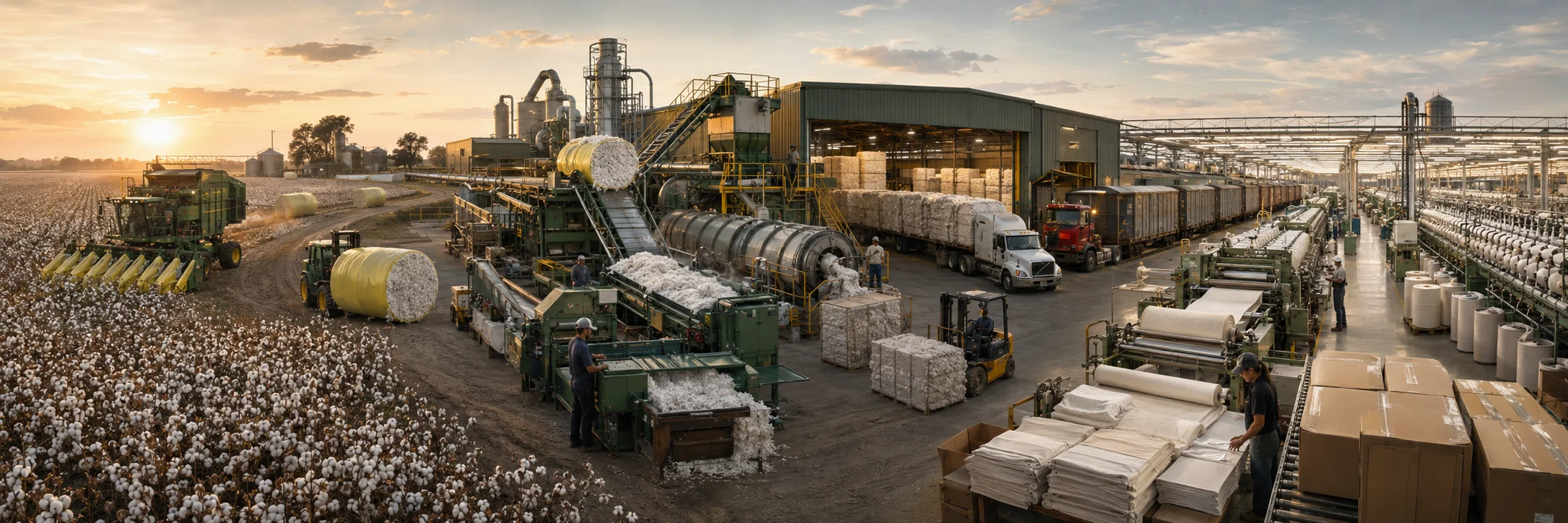
Follow cotton from boll to gin, bale, yarn, fabric, garment, use, and recovery. The fiber works only when its length, strength, moisture, contamination, and process history remain compatible with the next job.
A field supplies seed cotton, not a finished textile. People need a shirt that fits, a dressing that absorbs, a cord that carries load, a towel that dries, or a textile process that can reliably produce those functions. Cotton is one route to them. The plant grows lint around a seed; the chain separates, grades, spins, forms, colors, cuts, sews, uses, and eventually sorts the resulting material.
A bale can be available while a spinner lacks the required staple length, micronaire, strength, cleanliness, or delivery date. A garment can contain cotton while failing to provide fit, durability, absorbency, or skin safety. The physical journey therefore changes what the next participant can still do at every boundary.
A cotton supply begins with a fiber function
Cotton is a plant-grown cellulose fiber. Its length, fineness, maturity, strength, and color depend on variety, growth conditions, maturity at harvest, and handling. A mill may need a yarn with a defined count, evenness, strength, hairiness, and moisture behavior; a medical product may need absorbency and cleanliness; a garment may need softness, abrasion resistance, and dimensional stability.
Those requirements do not make every cotton product inevitable. Polyester, lyocell, wool, paper, or a different design can provide overlapping functions in some uses. Substitution is bounded by heat, moisture, skin contact, purchase price, production and maintenance expense, equipment, standards, and the behavior required after washing or sterilization. A market's synthetic-fiber share reflects how producers and buyers have arranged the supply, not the disappearance of the underlying need for a textile function.
The plant makes seed cotton, not a bale
The boll opens in the field with lint attached to seed and mixed with leaves, stems, soil, moisture, and sometimes foreign material. Harvest timing changes weather exposure and trash load. The USDA Economic Research Service describes seed cotton as the harvested material transported to a gin, where fibers are separated from seed and pressed into lint bales.
Before ginning, the crop is biological material with uneven maturity and a field history. A module or trailer combines material from a place and time; it does not make every boll identical. Moisture, storage duration, heating, and contamination can close options before a gin begins its work.
Cotton responds to water, temperature, pests, soil condition, and the timing of flowering and boll opening. Irrigation can protect yield while drawing on a basin or river; drought can reduce both plant growth and the water available for later crops. Pesticide selection, storage, application, worker protection, and runoff also change the field and watershed conditions that the lint record does not show. EPA's Agricultural Worker Protection Standard addresses pesticide exposure for agricultural workers and handlers, and EPA notes that pesticide runoff can reach streams, wildlife, and drinking-water supplies. A bale record cannot measure those exposures or what entered the surrounding water. The FAO describes cotton water requirements and water-efficiency choices in relation to climate, soil, and management rather than as one universal water number.
A producer's available decisions about seed, planting date, irrigation, pest control, harvest method, and insurance depend on water access, money, equipment, weather, labor, insurance terms, and local methods; the eventual lint price is not known in advance. A weather event can reduce yield, quality, or both. A region can produce enough bales by mass while lacking the grade that a particular spinner booked, because the useful variable is a distribution of fiber properties rather than a single tonne total.
Ginning separates lint from seed and field debris
A gin removes foreign material, separates lint from seed, dries or conditions the stream, cleans it, and compresses lint into a bale. It also produces cottonseed, gin trash, dust, and other residues. The USDA Agricultural Research Service explains that ginning can preserve fiber quality but cannot restore quality lost to variety, weather, or field handling.
Ginning settings are therefore a trade-off. More cleaning can remove trash while increasing fiber breakage or neps; gentler settings can preserve length while leaving more foreign material. The gin gives the bale a new physical form and a record of the ginning operation, but it does not establish how the yarn, fabric, or finished product will behave later.
A bale is a quality distribution, not uniform fiber
Classing samples a bale and assigns measurements such as length, strength, micronaire, color, and trash. The USDA cotton-classing program makes those observations useful for trading and mill planning. A classing result describes the sampled lot under its method; it does not make the bale chemically or physically uniform from edge to core.
Merchants and mills blend bales to obtain a workable distribution. That blending can stabilize yarn behavior while reducing the resolution of field identity. A contract, warehouse receipt, or classing record can connect a bale to a declared lot, but the spinner still has to open, condition, and process the material under its own control limits.
Spinning turns loose fibers into yarn
Opening, carding, drawing, combing, roving, and spinning align and twist fibers into yarn. Each operation changes the distribution of short fibers, neps, dust, strength, and evenness. A bale that meets a classing specification can still create waste or unstable yarn if its blend, moisture, machinery, draft, or settings do not match the mill.
Yarn count and strength are process results, not properties of a bale alone. The mill can adjust blend, twist, speed, and tension, but it cannot create staple length that was never present. Waste becomes comber noil, fly, dust, and other streams; some may find a lower-grade use, while some leave as residue or become difficult to identify.
Fabric adds geometry, chemistry, and shade
Weaving interlaces yarns under tension; knitting forms loops; nonwoven routes bond fibers without the same yarn path. Sizing, scouring, bleaching, dyeing, printing, finishing, and coating then change absorbency, hand, colorfastness, stretch, flame behavior, and dimensional stability. Water, salts, dyes, auxiliaries, heat, and wastewater become part of the process boundary. The U.S. Environmental Protection Agency identifies dyeing, printing, bleaching, and finishing as textile processes that generate wastewater, so a fabric inspection cannot establish what was discharged or treated.
A shade recipe and a lab dip establish a target under defined conditions. They do not guarantee that a long production run will match after a different water chemistry, machine, lot blend, or drying history. A fabric roll is now a different material with its own width, weight, shrinkage, defects, and inspection record.
Money and timing protect quality after harvest
Cash must arrive before planting, irrigation, pest control, harvest, ginning, and shipping decisions close. A farmer who cannot finance a timely harvest may lose quality even if the crop is still standing; a gin that cannot carry seed cotton or pay promptly may delay intake; a spinner may reserve a blend months ahead because the required fiber distribution cannot be replaced at short notice.
The USDA Farm Service Agency's Marketing Assistance Loan program provides eligible cotton producers interim financing at harvest, using the crop as collateral so they can delay sale and store it when prices are low. That program gives qualifying producers cash and storage time after harvest, but it cannot restore fiber quality already lost to weather, moisture, or handling. Money changes equipment, labor, storage, and timing; it does not change the plant's biology or make every quality claim true. The grading and loan examples in this section are U.S.-specific; the fiber and process mechanisms apply more broadly.
Garment production assigns fit and identity
Cutting turns fabric width into pattern pieces and scrap. Sewing joins flexible panels under seam, tension, and dimensional constraints; closures and elastics affect fit and movement; labels communicate fiber content and care; coatings and finishing change surface and performance. A fabric roll can be saleable while a cutting plan loses too much usable area or a sewing line lacks the skill, time, or equipment to produce the required construction.
Orders, forecasts, lead times, and payment terms determine which factory actions can actually be carried out. A garment count does not establish that the right sizes, shade lots, seam strength, or care behavior reached the intended users. The finished object carries a production history that cannot be read from the cotton percentage on a label alone.
Washing, drying, abrasion, sunlight, body oils, detergents, repairs, and alterations change strength, color, shrinkage, and fit. A garment can leave the first owner while remaining useful to another person, or it can become unsuitable for the original function while its fiber remains recoverable. Care instructions and actual care are different observations.
Repair can preserve a cut and sewn object; resale can preserve the whole garment; reuse as wiping cloth can preserve absorbent function but not fit; fiber recovery can preserve some cellulose while destroying yarn and pattern geometry. These routes do not preserve the same completed work.
A collection bin, export bale, sorter, and recycler each assign a next route. Sorting can identify fiber content, color, condition, and contamination, but a destination label does not establish the final use. Blends, elastane, coatings, finishes, buttons, zippers, and residues complicate mechanical or chemical recovery.
Wastewater, dye residues, lint, dust, mixed fibers, and rejected garments also require routes. A recycling tonnage can establish material entering a defined process; it does not prove that an intact garment was reused, that recovered fiber met a new specification, or that every residue was safely handled.
Responsibility follows the fiber
Responsibility follows fiber quality from field and gin through yarn, fabric, garment use, and recovery. It requires information, money, and authority to reach the participant who can still change the next physical result.
Inside CompanyGraph
Explore the farms, irrigation systems, harvest contractors, gins, classing offices, merchants, spinning and fabric mills, dyehouses, cut-and-sew factories, brands, retailers, repairers, sorters, recyclers, and wastewater operators that connect cotton from seed to service and back.