 CompanyGraph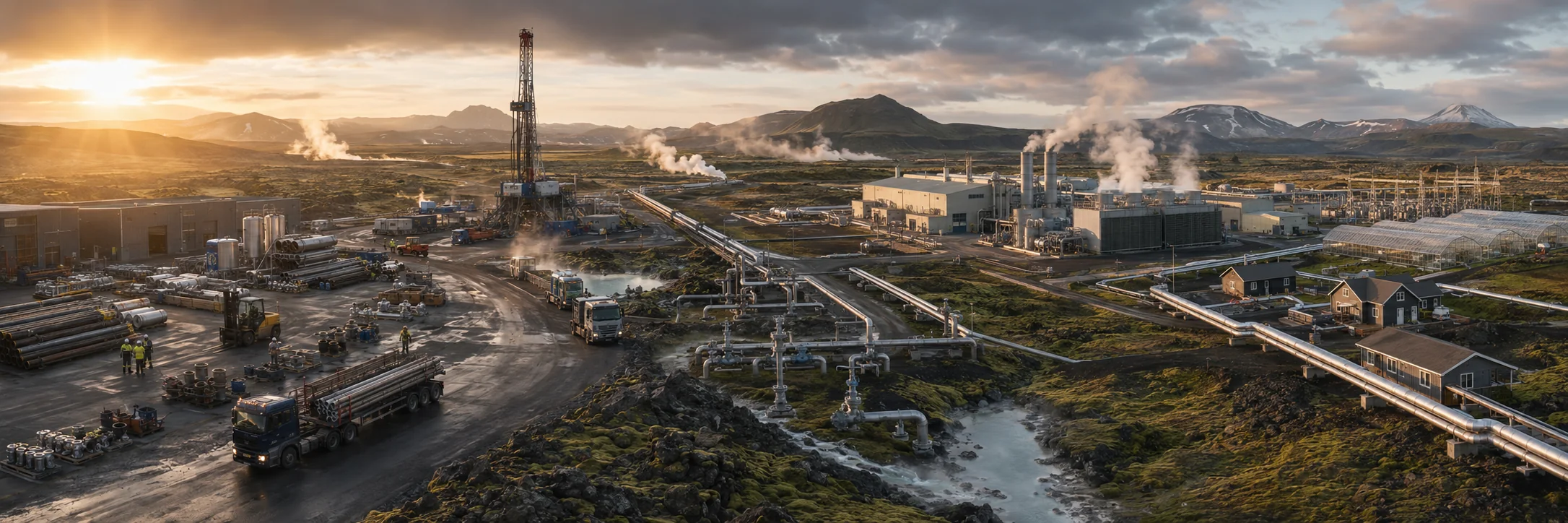
Follow geothermal heat from subsurface exploration through wells, fluid handling, electricity or direct heat, reinjection, monitoring, and closure. The resource is a site-specific heat-and-fluid system linked to wells, a surface plant, and receiving users.
People need electricity, hot water, space heat, cooling, or industrial heat at a particular place and time. Geothermal projects can provide those services by bringing heat from underground to a surface plant or building system. The detailed journey here follows geothermal power and the wells that support it, while noting where direct-use and heat-pump systems follow different paths.
The U.S. Department of Energy describes geothermal as usable for electricity, heating, cooling, and energy storage. The output therefore is not “geothermal energy” in the abstract. It is a specified flow of electricity or heat delivered through equipment that remains within its operating limits.
A viable reservoir needs heat, fluid, and permeability
A conventional hydrothermal resource contains hot rock, water or steam, and pathways through which the fluid can move. If one of those conditions is missing or poorly connected, a hot temperature reading alone does not establish a productive reservoir.
DOE identifies heat, water, and permeability as the three principal elements of a hydrothermal resource. Surface signs such as hot springs, altered rock, or shallow temperature gradients can guide exploration, but they do not directly reveal the temperature, flow rate, pressure, chemistry, or connected volume that production wells will encounter.
Exploration narrows uncertainty; drilling tests the reservoir
Geologists combine surface mapping, remote sensing, geophysics, temperature measurements, existing wells, and regional data to build a subsurface model. The model can identify a promising area, but production depends on conditions at depth and on the relationship between wells. A well may reach hot rock without finding enough fluid, permeability, or sustainable flow.
Drilling creates information as well as infrastructure. The borehole must be designed for depth, temperature, pressure, corrosive fluids, and the rock’s mechanical behaviour. Casing and cement isolate formations and keep the well open; logging, pressure tests, flow tests, and fluid samples turn an underground possibility into a more specific production estimate.
Wells carry hot fluid to the surface
Production wells bring geothermal water or steam upward; injection wells return cooled fluid or separated brine to the reservoir. Pumps, valves, separators, filters, heat exchangers, and gathering lines keep the wellfield connected to the surface plant.
Temperature and pressure change as fluid rises. Dissolved minerals can precipitate, gases can come out of solution, and corrosive chemistry can damage casings, turbines, pumps, or heat exchangers. Heat is the resource; the fluid carries it to the surface, while its pressure and chemistry create operating constraints that must be sampled and managed.
Three plant cycles turn heat into electricity
EIA describes dry-steam, flash-steam, and binary-cycle geothermal plants. A dry-steam plant sends reservoir steam directly to a turbine. A flash plant depressurizes hot water so part of it becomes steam for the turbine. A binary plant transfers heat through a heat exchanger to a secondary fluid with a lower boiling point; the geothermal water does not enter the turbine loop and is returned underground.
The plant choice follows the reservoir’s temperature, pressure, fluid chemistry, flow rate, and environmental requirements. Dry-steam and flash systems need particular high-temperature conditions. Binary systems can use lower-temperature water but add heat exchangers, a secondary working fluid, pumps, and controls. A plant’s nameplate capacity does not establish that the wells can sustain that output over the intended operating period.
Dry-steam and flash plants can bring carbon dioxide, hydrogen sulfide, and other gases to the surface with the geothermal fluid. EIA explains that binary plants normally keep geothermal fluid separate from the turbine working fluid, while steam-based plants may require gas control and reinjection measures.
Reinjection supports reservoir management
After heat is extracted, operators commonly reinject cooled water or separated brine. Reinjection can support pressure, reduce surface disposal, and return fluid to the subsurface, but it does not guarantee that the same water will reach the production wells at the right temperature and time.
Production and injection wells must be placed and operated as a connected field. Excessive withdrawal, poor connection, scaling, chemical change, or an unexpected fracture path can reduce flow or cool the production zone. Reservoir models are updated with pressure, temperature, flow, chemistry, and seismic observations as the field operates.
Geothermal heat can serve buildings directly
A reservoir may supply a district-heating network, greenhouse, bathing facility, or industrial process instead of—or in addition to—an electricity plant. Direct use avoids one conversion step, but still needs wells, pumps, heat exchangers, distribution pipes, water treatment, controls, and a customer whose demand matches the resource. Shallow ground-source heat pumps follow a different route: they exchange heat with near-surface ground and do not require a hydrothermal reservoir.
Heat is less transportable than electricity. A hot-water project can be physically productive yet commercially unusable if the network is too far away, the building temperatures are incompatible, or the customer cannot finance the connection. A power project has its own interconnection, transmission, and balancing requirements.
Surface equipment makes the resource operable
Turbines and generators are only part of a geothermal plant. Separators, condensers, cooling systems, pumps, transformers, switchgear, control systems, chemical treatment, and emissions or brine-management equipment determine whether the plant can start, synchronize, ramp, and remain available.
Geothermal plants do not need a daily fuel shipment, but they are not maintenance-free. Wells can require workovers; pumps, turbines, heat exchangers, seals, and electrical equipment age; and mineral deposits or corrosion can reduce flow and heat transfer. The usable service is the measured electricity or heat that remains available after these conditions are accounted for.
Geothermal projects remain tied to their sites
Conventional hydrothermal resources are unevenly distributed. EIA reports that U.S. geothermal plants are concentrated in the West and that nearly 90% of capacity added from 2000 through 2020 was binary-cycle. A reservoir may be close to a city, an industrial heat load, or transmission—or it may require new roads, substations, pipelines, and long-distance transmission.
Surface equipment can be standardized or modular, but the resource, well design, reservoir tests, and field arrangement remain site-specific. Each project repeats exploration, well construction, reservoir testing, surface design, permitting, and interconnection. Drilling firms, casing, cement, high-temperature tools, pumps, turbines, and specialist crews become part of the available project schedule.
Money must arrive before the well proves itself
Capital is needed for leases, exploration, access roads, drilling, casing, cement, well testing, plant equipment, transmission, heat networks, insurance, and working capital. Revenue begins only after a resource is demonstrated, permits are secured, the plant is commissioned, and a buyer accepts the electricity or heat.
DOE notes that wellbore casing and cementing can represent roughly 30–40% or more of overall well costs in enhanced-geothermal work. A developer may prefer a lower-cost well design, but temperature, pressure, chemistry, and lifetime requirements can mean that design does not meet the project’s physical requirements. A power-purchase agreement, heat contract, grant, loan guarantee, or risk-insurance arrangement changes which drilling and plant sequence a project can finance; it does not change what the reservoir contains.
Enhanced geothermal creates a managed reservoir
Enhanced geothermal systems address a missing natural condition. DOE describes EGS as injecting fluid into hot rock to create or reopen fractures, circulate water, and bring the heated fluid back to the surface. The project must then manage injection pressure, flow paths, well integrity, heat decline, water balance, and induced seismicity. DOE’s environmental analysis describes monitoring and mitigation for seismicity associated with subsurface fluid movement.
EGS and closed-loop concepts may expand the places where geothermal heat can be used, but they are not the same as an already proven hydrothermal reservoir. A demonstration can establish performance at one site without proving a universal drilling cost, flow rate, or seismic response elsewhere.
Measurements cover different parts of the field
Temperature logs, pressure tests, flow rates, fluid chemistry, wellhead conditions, reinjection records, microseismic monitoring, plant meters, and grid meters observe different parts of the system. A production test describes one well under tested conditions; a plant meter records delivered output. Neither alone establishes long-term reservoir sustainability, induced seismicity, brine handling, or the result of another energy choice.
Closure leaves wells, fluids, and equipment
When a project ends, operators must decide how to plug or monitor wells, isolate production and injection pathways, manage remaining brine and chemicals, remove turbines, generators, heat exchangers, pumps, pipes, transformers, and working fluids, and restore or repurpose the site. A binary plant’s closed surface loop does not remove the need to manage the geothermal reservoir and wellbores.
Some equipment may be reused or recycled, while casing, cement, contaminated materials, and inaccessible downhole components require other routes. A closed project can leave useful records about the reservoir and wells, but those records do not make a new site interchangeable with the old one.
When output changes, the cause must be reachable
If flow declines, a well fails, chemistry changes, or seismicity increases, the people able to investigate and respond need the relevant measurements, skills, equipment, money, and authority. The same evidence must remain usable when the project is repaired, expanded, or closed.
Inside CompanyGraph
Explore land and mineral-rights holders, geological surveyors, drilling contractors, casing and cement suppliers, reservoir engineers, plant builders, utilities, heat-network operators, industrial and building users, lenders, insurers, regulators, monitoring teams, maintenance firms, and closure contractors. CompanyGraph can map the organizations and handoffs among them. It cannot by itself establish a reservoir’s flow, a well’s integrity, a plant’s remaining output, or who is authorized to change the project; those require the underlying tests, records, and responsible people.