 CompanyGraph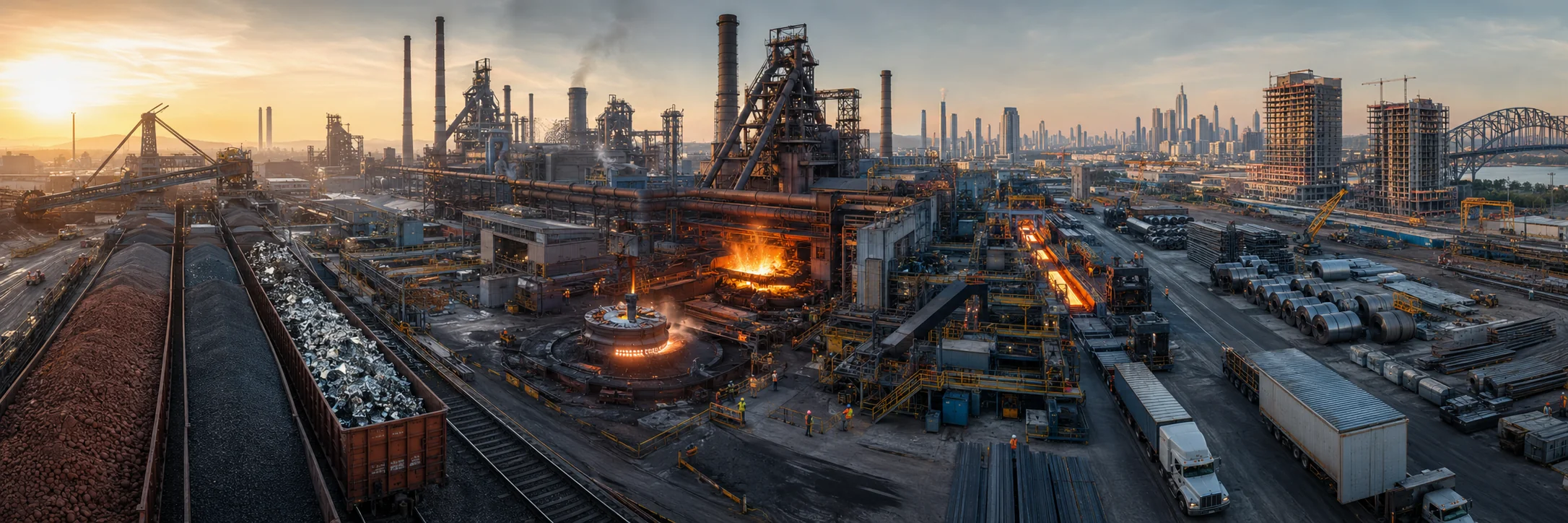
Follow iron from ore and discarded objects into a specified steel part, and see what remelting preserves—and what it erases.
From rock and scrap to a specified part
Steel begins through several routes. In an ore-based route, miners extract iron-bearing rock, crush and separate it, and prepare an iron-rich feed. A blast furnace uses carbon-rich coke and hot air to remove oxygen from that feed, producing liquid iron with more carbon than most finished steel can contain. A basic oxygen furnace then refines that iron into steel. Another route removes oxygen from ore without melting it, producing direct-reduced iron that can enter an electric furnace.
Steel also begins with objects that already exist. Offcuts from factories and discarded vehicles, appliances, machines, rails, cans, and structures are collected, dismantled, cut or shredded, separated, graded, and delivered as scrap. An electric arc furnace commonly melts this material, often together with direct-reduced iron or pig iron. Basic oxygen furnaces also use scrap. The routes overlap before the liquid metal reaches its specification.
Steelmakers adjust the molten composition, remove or bind some unwanted elements, add alloying elements, and cast the steel into slabs, blooms, or billets—large intermediate shapes suited to later rolling. Mills turn those shapes into coil, sheet, plate, beams, rail, bar, wire, or pipe. Service centres and fabricators cut, bend, machine, weld, coat, and assemble them. The part then carries load, contains pressure, resists wear, or performs another physical job, sometimes for decades. When that service ends, it may be inspected for reuse, remanufactured, melted as scrap, exported, stored, or lost.
The job comes before the tonne
People do not need steel tonnage as an end in itself. They need structures that carry loads without collapsing, vessels and pipes that contain fluids, tools and rails that resist wear, vehicle bodies that deform in controlled ways, surfaces that resist corrosion, and machines that keep dimensions under heat and force. Steel supplies these functions through a useful combination of strength, stiffness, toughness, formability, weldability, temperature resistance, magnetic behaviour, availability, and repairability.
Wood, concrete, aluminium, cast iron, polymers, composites, and other materials can perform some of the same work. They do not offer the same combination under every load, environment, shape, production method, or maintenance regime. Particular steels are therefore necessary for many systems as presently designed. That does not make the present number of tonnes physically fixed.
Steel demand changes with the service being added, but also with design and organization. Higher-strength grades can sometimes deliver the required load capacity with less mass. Extending a bridge or machine’s life delays replacement. Reusing a beam preserves a finished component. Preventing corrosion or fabrication loss reduces the material that must return through a furnace. Conversely, premature demolition, difficult disassembly, unrecovered scrap, short product lives, and standards that exclude suitable reused components can increase demand for newly rolled steel.
Safety margins and redundancy cannot simply be labelled waste; they protect against uncertainty, variation, damage, and consequences of failure. The relevant question is whether a specified mass is needed for the named function and service conditions, not whether it exceeds a theoretical minimum. The IEA steel roadmap distinguishes changes within steelmaking from downstream measures such as improved manufacturing yield and longer building life because both alter primary material demand through different mechanisms.
Steel properties are made, not found
“Steel” names a large family of iron-based alloys. Carbon content matters, but so do manganese, chromium, nickel, molybdenum, silicon, vanadium, niobium, boron, and many other elements in small or large amounts. Some are deliberately added. Others are limited because they interfere with forming, welding, surface quality, toughness, corrosion resistance, or another required property.
Chemistry is only part of the result. The arrangement and size of phases and grains inside the metal—its microstructure—change as steel is cast, rolled, forged, cooled, reheated, quenched, tempered, or otherwise treated. The same nominal chemistry can behave differently after a different thermal and mechanical history. Section thickness matters because the centre and surface may heat and cool at different rates. NIST’s account of a carbon-steel reference material puts the relationship plainly: composition and heat treatment together determine properties such as strength, hardness, durability, and temperature resistance.
A grade therefore does not describe a pile of iron atoms. It sets limits and test requirements for material intended to perform defined work. Depending on the specification, those can include chemical composition, yield and tensile strength, elongation, impact toughness, hardness, dimensions, surface condition, weldability, or performance at a particular temperature. Producing more liquid steel does not establish that the required grade or form exists.
The distinction also prevents a common recycling error. Melting a suitable grade does not permanently destroy the ability to make useful steel; the melt can be refined and processed into a new grade. But the properties of the old object do not automatically carry through the furnace. They must be recreated through controlled composition, casting, rolling, and heat treatment, while residual elements already in the scrap remain within acceptable limits.
The furnace name does not tell you what entered it
The industry is often divided into a blast-furnace/basic-oxygen route and an electric-arc route. That is a useful equipment distinction, not a complete description of material origin. The integrated route charges scrap into the basic oxygen furnace as well as using ore-derived liquid iron. An electric arc furnace can melt entirely scrap, but it can also use direct-reduced iron, hot-briquetted iron, or pig iron to supply cleaner iron units and control composition. The World Steel Association’s raw-material map shows both routes using mixtures rather than sealed input systems.
The physical transformations are different. A blast furnace continuously reduces and melts prepared ore with carbon and produces a stream of high-carbon liquid iron. It is integrated with coke making, ore preparation, gas handling, power, and downstream steelmaking, and it operates most steadily over long campaigns. Output can be adjusted and a furnace can be banked, idled, relined, or closed, but these are managed plant-wide actions rather than the simple pause of a small batch machine. Stable operation narrows the operator’s short-term choices; it does not physically compel the sale of a fixed output for twenty years.
An electric arc furnace melts charges in batches and can change operating schedules more readily. Its usable output still depends on scrap or other iron units of the right condition, electricity and network capacity, electrodes, oxygen and carbon inputs, refractories, workers, casting, rolling, finishing, maintenance, and customer qualification. An idle electric furnace is not instant capacity for every steel product.
The furnace label also does not establish emissions. Conventional blast-furnace ironmaking uses carbon both as energy and as the chemical reducing agent that removes oxygen from ore, so carbon dioxide is formed within the process. Direct reduction can use natural gas, hydrogen, or mixtures; electric melting inherits the conditions of its electricity and iron inputs. Scrap generally avoids the energy-intensive reduction of new ore, but electric furnaces still use electricity, electrodes, fuels, and other materials. DOE’s industrial decarbonization assessment describes future electric furnaces as using mixes of scrap and virgin iron precisely because route, feed quality, and energy supply have to be considered together.
Scrap returns on the product’s clock
Scrap appears on different schedules. New or prompt scrap—trimmings, rejected parts, and offcuts from manufacturing—can return within days or months and often has a known, relatively consistent composition. Obsolete scrap arrives when a product leaves service. Packaging may return quickly; vehicles, machinery, pipelines, buildings, bridges, and energy infrastructure can hold steel for years or generations.
This delay separates steel demand from scrap availability. A growing town may need new reinforcing bar, beams, pipes, and vehicles before an equivalent local stock is old enough to dismantle. Even perfect future collection could not return steel that is still performing useful work. Primary iron from ore is therefore needed when total in-use stocks are expanding, when scrap is unavailable in time, or when its composition cannot meet the intended grade.
The regional scrap supply records earlier production and use. A mature industrial region can generate large obsolete flows; a rapidly industrializing region may consume much more steel than it retires. Scrap can travel, but collection, dismantling, sorting, contamination, freight, export rules, and buyer specifications decide which material is actually available to a furnace. USGS notes that remelting scrap uses substantially less energy than producing steel from ore, while also treating ready availability of suitable scrap as a real input condition rather than an automatic loop.
Ore supply has a different map. Iron-bearing material is mined in many countries, and lower-grade material can be concentrated before use. Economical deposits, railways, ports, mine scale, and product quality shape trade. In its 2026 summary, USGS reports that iron ore is mined in about fifty countries while Australia and Brazil each supply about one-third of exports. That concentration describes current export capacity; it is not evidence that usable iron exists only in two countries.
Scrap carries companions
A discarded steel object rarely consists of one clean grade. Vehicles combine high-strength sheet, castings, fasteners, stainless parts, electric motors, copper wiring, coatings, adhesives, glass, and plastics. Buildings combine beams, reinforcing bar, cladding, bolts, weld metal, paint, concrete, and services. Shredding and magnetic separation can recover iron-rich material, but magnetism does not identify the original steel grade or remove every attachment.
Some accompanying elements oxidize into slag or can be removed during refining. Others, especially copper and tin, are difficult to remove economically once dissolved in liquid steel. Repeatedly mixing contaminated scrap can raise these residual concentrations. They may be tolerable or useful in one grade and harmful to hot rolling, surface finish, ductility, or another property in a different grade. “Recycled content” alone cannot show whether the feed fits the intended product.
Steelmakers manage the problem by buying defined scrap grades, separating manufacturing loops, inspecting and sorting, blending different scrap sources, and adding lower-residual scrap or ore-derived iron to dilute unwanted elements. These actions consume equipment, information, time, material, and money. DOE identifies removal of copper and tin from steel scrap as an active technical challenge, not a task routinely solved by melting.
A scrap delivery record names a supplier, weight, and commercial grade. Visual inspection or sensors observe selected features. A sample of the molten batch—called a heat’ shows the chemistry after inputs have been combined. If that result is outside the target, the steelmaker may change the blend, add cleaner iron, redirect the heat to another grade, or reject it. The measurement helps control the present batch; it may not reveal which dismantling or sorting decision introduced the residual element.
A tonne does not reveal a grade
A reported shortage of steel is incomplete until the missing function is named. Reinforcing bar cannot replace thin automotive sheet. Structural plate is not qualified pressure-vessel plate. Rail, electrical steel, bearing steel, tool steel, stainless sheet, wire rod, and pipeline steel require different chemistries, dimensions, surfaces, processing, tests, and approvals. Even two products of the same grade may not substitute if thickness, width, flatness, coating, delivery condition, or certification differs.
Mill capacity is similarly specific. A site may be able to melt more tonnes while its caster cannot make the required intermediate shape, its rolling mill cannot reach the required gauge, or heat-treatment and coating lines are full. Changing product mix requires compatible equipment, rolls and tooling, planned sequences, process knowledge, testing, and sometimes customer approval. Aggregate crude-steel capacity does not state the availability of finished products.
Between mill and user, service centres hold coil, plate, bar, and sections; cut material to size; and bridge the difference between a mill’s production batch and a fabricator’s smaller order. Inventory makes some responses faster, but holding every grade and dimension consumes space and working money. A project with a technically acceptable alternative may still be unable to use it before drawings, welding procedures, procurement terms, regulators, insurers, or customers approve the change.
Prices influence which physical actions remain available. Separately collecting low-residual scrap costs more than mixing it. Keeping a reusable beam intact requires careful dismantling, storage, inspection, and a future buyer; selling it by weight to a scrap processor may pay sooner. Mills need money before ore, alloys, scrap, energy, and work become saleable coil or plate. Fabricators must buy material before the completed structure is paid for. These conditions explain repeated outcomes without reducing them to participants preferring waste or low quality.
The mill ships steel; the customer creates the part
A mill can deliver the correct grade and still not deliver a functioning bridge, pressure vessel, vehicle, or tool. Fabrication continues to change the material. Cutting can create heat or edge damage. Cold bending changes local strength and ductility. Machining introduces surfaces and stress concentrations. Welding melts a narrow region and heats the surrounding steel, changing microstructure and leaving residual stress. Coating and surface preparation affect corrosion protection. Assembly decides how forces pass between parts.
The material test report connects a shipment to evidence from its production heat. For common structural products, it can include the heat number, steel grade, nominal size, chemical analysis, and tensile-test results. The American Institute of Steel Construction explains those report requirements and their connection to ASTM specifications.
The report is essential but limited: chemistry and tensile specimens represent defined samples; they do not inspect every point, later weld, loading, or coating. Piece marks and project traceability can connect divided pieces to the mill report when failure consequences justify the work. AISC explains that boundary.
Failure reads the full history
Steel can meet its original tests and fail later because the complete part experiences conditions the mill specimen did not. A load can exceed the design assumption. Repeated smaller loads can grow a fatigue crack. Corrosion can remove thickness or create a crack-starting pit. Low temperature, hydrogen, wear, fire, a fabrication defect, an unsuitable repair, or a change in use can alter the margin that once existed.
The visible break is the last event in a longer history. Its cause may lie in material selection, steelmaking variation, rolling, heat treatment, geometry, welding, erection, environment, operation, inspection, or several of these together. NIST’s fatigue and fracture work includes research on nominally similar stainless-steel welds whose fracture toughness differed substantially with welding process and microstructure. The example is specialised, but the lesson is general: a grade name alone cannot predict the condition created in a joint.
Diagnosis needs the failed part and fracture surface where possible, loading and environmental history, drawings, grade and heat identity, fabrication and repair records, inspections, and comparison with unaffected material. Replacing a broken component restores immediate service; it does not necessarily prevent recurrence. Feedback must reach whichever participant can alter the relevant specification, metallurgy, detail, welding procedure, coating, inspection interval, or operating condition.
Maintenance has the same material and financial boundary. Cleaning, painting, monitoring, repairing drainage, replacing sacrificial components, or arresting an early crack may extend service and delay new steel production. The organization responsible for maintenance needs access, time, records, skilled work, and money before failure. If construction and operation are separated by contracts and decades, the participant able to prevent corrosion may not receive the savings from longer life, while the material consequence continues across that boundary.
Reuse keeps what remelting destroys
Reusing a steel component can preserve more completed work than recycling it. A suitable beam, rail, sheet pile, pipe, machine frame, or building frame already contains ore reduction or scrap melting, alloy control, casting, rolling, fabrication, and shape. Continued use or direct reuse avoids repeating some of those transformations. Remelting is still valuable, but it deliberately removes the old geometry and joins the material to a new heat.
Reuse is not automatic. The component must be accessible without destructive demolition, separable from concrete and other materials, safe to handle, documented or testable, free of unacceptable damage and contamination, and suitable for a new load and environment. Standard dimensions, reversible connections, drawings, piece identification, protected storage, and a market that can match available components to projects all expand the feasible path. Welded or composite assemblies may make scrap recovery easier than intact reuse.
When reuse is not suitable, recycling returns iron and alloy content and generally uses much less energy than making new iron from ore. Collection and grade-aware sorting improve what that material can become. Recovery also produces real losses: some steel remains embedded, is exported without its history, oxidizes into slag, is dispersed in small products, or goes to disposal. Counting a product as “recyclable” describes a physical possibility, not a completed return.
Demand for new iron falls most when several actions remain connected: use only the steel needed for a defined function, protect the part through its intended life, adapt and reuse it where its condition permits, recover it when service ends, preserve grade information before mixing, and make clean iron available where residuals or growing stocks still require it. UNEP’s material-efficiency assessment treats longer life, more intensive use, reuse, and recycling as distinct strategies because none substitutes perfectly for the others.
Inside CompanyGraph
Explore the miners, scrap collectors, iron and steel producers, rolling and finishing mills, service centres, fabricators, asset owners, and recovery relationships that connect iron-bearing material to specified steel functions inside CompanyGraph.