 CompanyGraph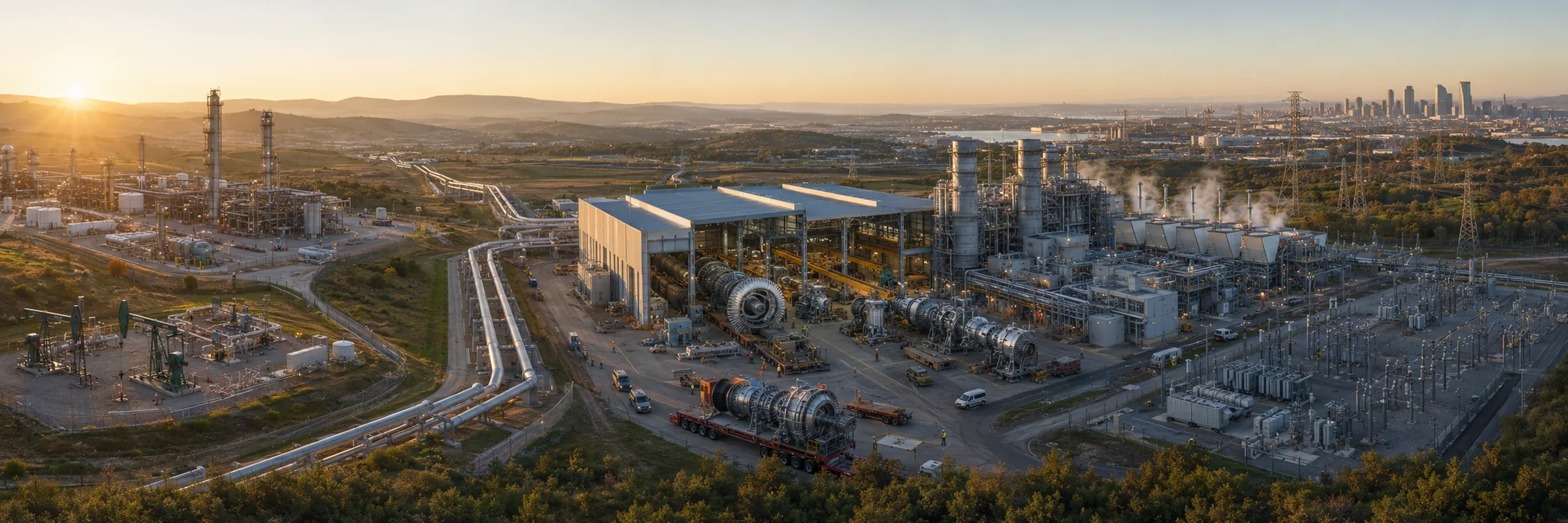
Follow natural gas from processing and pipeline delivery through turbine conversion, grid dispatch, maintenance, emissions, and retirement. A gas plant supplies electricity only when fuel, machinery, controls, and the grid can work together at the required moment.
People and businesses need electrical services—light, motors, heat, cooling, communication, and computation—not a quantity of gas or a generator’s nameplate rating. A gas-fired plant is one way to turn chemical energy into electricity when the grid needs it. Its useful output depends on fuel pressure and composition, machine condition, start and ramp capability, grid connection, and the dispatch decision that calls it.
The U.S. Energy Information Administration distinguishes simple-cycle and combined-cycle natural-gas plants. The difference is physical: a simple-cycle unit uses the combustion turbine’s generator, while a combined-cycle plant sends hot exhaust through a heat-recovery steam generator and an additional steam turbine. Gas can also fuel steam-turbine or reciprocating-engine plants; the detailed route here follows combustion-turbine and combined-cycle units because their fuel, heat-recovery, and dispatch constraints make the chain visible.
Gas arrives as a prepared fuel
Gas at a wellhead is not automatically suitable for a power turbine. Gathering lines carry raw gas to processing plants, where water, hydrocarbon liquids, sulphur compounds, carbon dioxide, nitrogen, and other impurities may be removed or separated. The resulting pipeline-quality gas is metered, compressed, and moved through transmission systems.
EIA describes processing, transportation, and storage as separate parts of natural-gas delivery. A plant therefore receives a specified fuel condition, not simply methane from an identified field. Heating value, pressure, contaminants, and the ability to change flow can affect combustion, emissions, maintenance, and available output.
Pipeline capacity is part of the plant
Most gas-fired generators do not keep weeks of fuel beside the turbine. They depend on a pipeline connection, compressor stations, upstream supply, and a contract that reserves transport capacity and sets curtailment priority. Underground storage and pipeline linepack can support high-demand periods, but the amount and timing available to a power plant depend on the surrounding network.
Fuel delivery can be firm or interruptible. EIA explains that interruptible arrangements can be curtailed when higher-priority customers use available capacity, while firm arrangements reserve a higher-priority service. A turbine can be mechanically ready and still be unable to run at its scheduled output because fuel cannot arrive with the required pressure and volume.
A combustion turbine turns hot gas into shaft work
In a combustion turbine, a compressor draws in air and raises its pressure. Fuel burns in the compressed air, producing hot expanding gas that turns turbine blades. The shaft drives a generator, and the generator sends electrical power through transformers and an interconnection to the grid.
The hot gas is much hotter than the metals that contain it. The Department of Energy describes turbine cooling, heat-resistant materials, and heat-recovery steam generators as limits and opportunities in this conversion. Cooling air, coatings, combustion controls, lubrication, vibration monitoring, and clean fuel paths keep the machine within its design envelope.
Heat recovery creates a second turbine
A simple-cycle plant releases most of the combustion exhaust heat after the gas turbine. A combined-cycle plant captures part of that heat in a heat-recovery steam generator, makes steam, and sends the steam through a separate turbine and generator. The extra equipment increases capital, water, controls, start-up coordination, and maintenance, but under comparable load and ambient conditions it can reduce fuel required per unit of electricity.
DOE gives simple-cycle efficiency ranges of roughly 20–35% and describes combined-cycle systems reaching around 60% in advanced designs. The relevant comparison is fuel input per delivered electrical service under a stated load and operating condition, not an efficiency number detached from the plant’s actual dispatch.
Controls and cooling make nameplate capacity usable
A plant needs more than turbines and generators. Transformers, switchgear, protection systems, fuel valves, cooling equipment, water treatment, emissions controls, control-room software, auxiliary electricity, and trained operators determine whether the unit can start, synchronize, ramp, and remain stable.
Maintenance history matters because hot sections, bearings, heat-recovery surfaces, valves, pumps, and generators age under different loads. A unit may be available at reduced output, unavailable until a planned outage, or restricted by a component, environmental limit, or grid condition. Nameplate megawatts are a rating under specified test conditions; ambient temperature, auxiliary load, degradation, environmental limits, fuel conditions, and the grid connection determine how many net megawatts are operable and deliverable in a particular hour.
Dispatchability is a grid service
Simple-cycle units generally start and change output faster than combined-cycle units, although exact times depend on design, temperature, prior operating state, and operating procedures. Combined-cycle units can provide efficient energy over longer runs and can also be operated flexibly when designed and maintained for cycling.
EIA describes combined-cycle units as an important source of flexible generation in the United States as more renewable capacity connects to the grid. The plant’s contribution may be energy, capacity, ramping, reserves, voltage support, or some combination. A plant that runs few hours can still be valuable for reliability, but low running hours leave more fixed cost to recover through capacity payments, ancillary services, or other arrangements.
Useful heat changes the location equation
A gas plant can send exhaust or steam heat to an industrial process or district-heating network. DOE describes combined heat and power as the production of electricity and useful thermal energy from the same fuel. The recovered heat is useful only when a customer, pipe, heat exchanger, and operating schedule are close enough and funded enough to receive it.
Heat demand can also constrain electric dispatch. A plant supplying process steam or district heat may have to operate when heat is needed, or invest in backup boilers and storage to preserve electrical flexibility. Capturing heat can raise total fuel utilisation, but it does not make every plant a suitable combined-heat-and-power site.
Contracts decide whether readiness can be paid for
Building a plant requires land, permits, turbines, generators, pipeline and transmission connections, water or air-cooling systems, emissions controls, construction labour, commissioning, and years of maintenance. Revenue may come from energy sales, capacity payments, ancillary services, heat sales, or a regulated return. Each payment recognises a different service and arrives on a different schedule.
A developer choosing simple-cycle or combined-cycle equipment is therefore making a long-lived commitment under uncertainty about fuel prices, grid demand, renewable output, storage, regulation, and future operating hours. A firm gas-transport contract may cost more than an interruptible one but can make availability during peak demand more likely. Financing determines which configuration and which contracted transport capacity a project can secure before construction begins.
Emissions travel through the whole chain
Burning natural gas in the turbine produces carbon dioxide and nitrogen oxides, and the plant may also emit other pollutants depending on its equipment and controls. EPA reports that coal combustion is more carbon-intensive than natural gas for electricity generation, while fossil-fuel power remains a major source of greenhouse-gas emissions. A lower direct carbon intensity than coal is not the same as zero emissions.
The gas chain also includes wells, gathering systems, processing, compressors, transmission, storage, and combustion. EPA estimates methane emissions separately across production, processing, transmission, storage, and distribution; those releases or equipment failures upstream are not visible in a turbine’s electrical meter. Whether gas generation reduces or increases system emissions also depends on what it displaces and on the time and boundary used for comparison. The plant’s stack records only one part of that result.
Measurements describe different parts of the operation
A gas meter records fuel flow and pressure. A heat-rate calculation relates fuel input to electrical output under stated conditions. A turbine control system reports commands and alarms. A grid meter records electricity at the interconnection. An emissions monitor samples a defined exhaust stream. A maintenance record documents work performed.
These records are useful together, but none alone proves the plant’s future reliability, the complete fuel condition, the cause of a failed start, or the environmental result of a counterfactual dispatch. A high availability statistic can coexist with a local pipeline constraint; a compliant emissions reading can coexist with an unobserved upstream release; a paid capacity obligation can coexist with a unit waiting for a part.
Retirement leaves equipment and obligations
Closing a plant requires more than stopping combustion. Operators must isolate gas and electricity connections, drain or manage oils and chemicals, handle catalysts and water-treatment materials, remove or secure turbines, generators, transformers, boilers, and cooling systems, and decide which equipment can be reused, recycled, or disposed of safely.
A pipeline spur, transmission upgrade, cooling intake, or workforce may outlive the unit that justified it. Repurposing a site for storage, renewable generation, industry, or another fuel may be possible, but it requires new engineering, permits, financing, and evidence about the existing equipment. A plant described as transitional can still create long-lived financial and material commitments.
The plant’s duty continues after generation
Reliable gas-fired generation requires a connection from gas quality and delivery through turbine condition, control settings, grid dispatch, emissions, maintenance, payment, and retirement. When a unit fails to start, someone needs enough information, authority, skilled labour, parts, and money to trace the failure toward the fuel contract, pipeline, machine, grid instruction, or maintenance decision that can still be changed.
Inside CompanyGraph
Explore gas producers and processors, storage operators, pipeline companies, fuel marketers, turbine and generator manufacturers, engineering contractors, plant owners, grid operators, heat customers, maintenance firms, regulators, lenders, insurers, and recovery operators. CompanyGraph can map the organizations and handoffs among them. It cannot by itself establish a unit’s fuel pressure, mechanical condition, emissions, dispatch instruction, or who is authorized to operate, repair, or retire the unit; those require the underlying measurements, records, and people responsible for the plant.