 CompanyGraph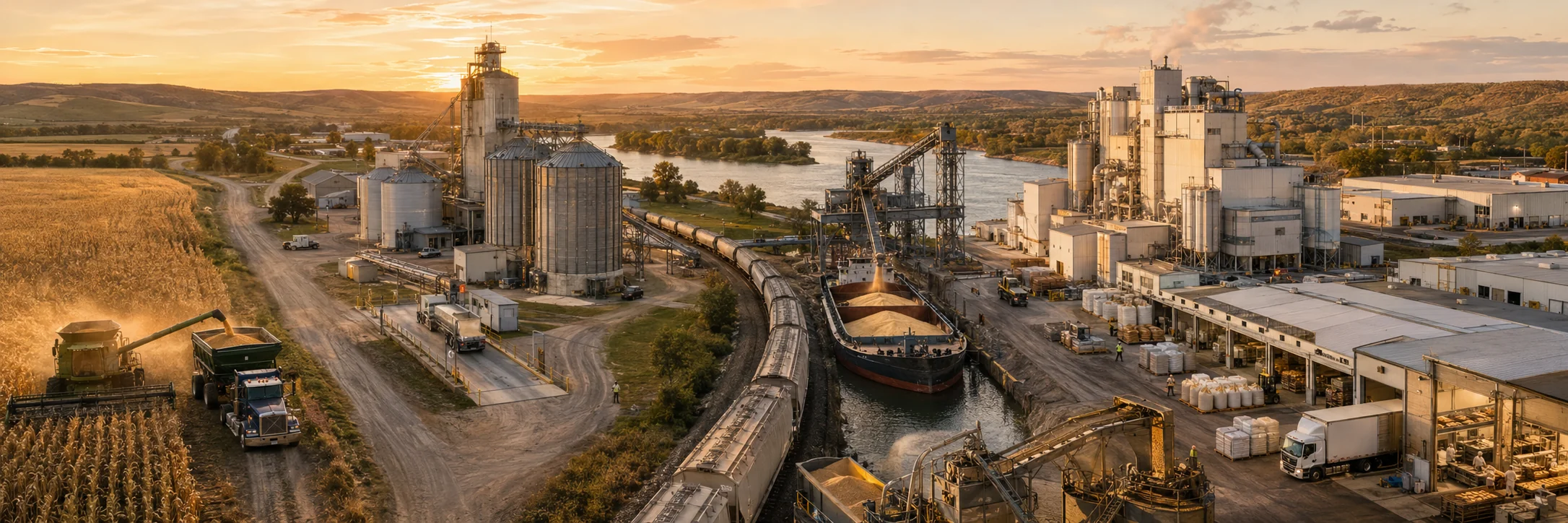
From a living seed in a field to a graded load, stored reserve, mill, feed ration, or meal—and why moisture, identity, timing, and transport decide what grain can still do.
A grain journey begins as a living seed
Wheat, maize, rice, barley, sorghum, and other cereal grains begin as seeds on a plant. Sunlight, water, soil nutrients, temperature, and farm work turn a seed into a harvestable kernel. A combine cuts or gathers the crop, separates kernels from stalks and cobs, and sends a bulk load to a farm store or elevator. There the load may be dried, cleaned, sampled, blended, stored, sold, moved by truck, rail, barge, or ship, and finally milled, cooked, fermented, fed to animals, or used for starch and fuel.
The physical journey matters because a kernel is not yet the service the user needs. People need calories, protein, and other nutrients; animals need a ration that supports growth or production; a mill may need wheat with a specified protein and falling-number range; an ethanol plant needs a dependable starch feed. Grain is one way to supply those functions, and present demand is enlarged or redirected by livestock feeding, biofuel production, trade rules, storage arrangements, and the location of mills and ports. A tonne of grain in a bin therefore does not establish that the required food, feed, or industrial input is available where and when it is needed.
Grain is also a living material after harvest. The seed respires, exchanges moisture with the air, and remains vulnerable to insects, fungi, mechanical damage, and temperature changes. FAO's storage guidance explains why moisture and temperature control are physical work, not passive holding. The biological and storage mechanisms described here apply broadly across cereal grains; the grading, moisture-discount, futures, stocks, and transport examples that follow are principally U.S.-specific. The chain converts a seasonal biological pulse into a usable flow by paying for drying, aeration, cleaning, testing, storage, and movement.
What the harvest has to preserve
Before harvest, a crop must reach maturity without losing too much yield to weather, disease, lodging, birds, or shattering. Harvest timing is a material compromise. Cutting too early can leave grain wet and expensive to dry; waiting can expose the crop to storms, sprouting, field fungi, or losses from standing plants. The farmer's available response depends on machinery, labor, fuel, weather windows, credit, and access to a nearby dryer or elevator.
The combine produces a mixed bulk stream rather than a set of identical kernels. It contains grain of different moisture and maturity, broken kernels, chaff, weed seeds, soil, insects, and sometimes damaged or moldy material. Cleaning can remove some foreign matter, and drying can remove water, but neither operation restores a kernel whose starch, embryo, or structure was damaged in the field or during harvest. A load can meet a weight target while losing milling yield, germination capacity, or feed safety.
Processing requirements differ by crop and use. Wheat for bread can require protein and gluten-forming behavior; rice may need milling yield and a low share of broken kernels; malting barley requires germination performance; maize for wet milling needs starch and kernel condition; feed grain may be accepted within a different range of moisture, test weight, and mycotoxin limits. The user is buying a defined behavior, not —“grain—” in the abstract.
Storage is an active biological control
Drying slows the seed's respiration and reduces the conditions that allow storage fungi and insects to multiply. Aeration moves heat and moisture through the grain mass. Monitoring looks for hot spots, condensation, insects, and changing moisture. FAO notes that stored cereals are living seeds: respiration converts stored nutrients and oxygen into carbon dioxide, water, and heat, while high moisture increases the risk of fungi and pests. The safe moisture level depends on grain type, temperature, storage duration, damage, and aeration rather than on one universal number.
Some losses can be repaired by cleaning or further drying; others cannot. A wet load can be dried before mold develops, but drying does not reliably eliminate toxins already produced. FDA's mycotoxin guidance notes that processing may reduce some toxins without completely removing them. Excessive heat can reduce baking or germination performance. Broken kernels create more surface for infestation and may change the value of a lot. The longer a load remains in storage, the more its condition depends on continuous equipment, inspection, electricity, pest control, and trained work.
Storage also changes the timing of sale. A farm with a sound bin can wait for a later buyer, while a farmer without storage may need to deliver immediately after harvest when local elevators are congested. The physical difference is not a preference for patience; it is access to a dry, ventilated structure and the money to operate it. USDA estimates on-farm stocks through a probability survey and enumerates off-farm stocks at known commercial facilities; neither method records every lot's moisture, age, grade, or usability.
The elevator turns samples into grades and contract terms
At an elevator or inspection point, a sample becomes a set of measurements. Official grade factors determine the numerical grade. Protein, falling number, and mycotoxin results are official criteria that may be reported on request but do not themselves affect that grade. Moisture affects drying and storage; test weight describes bulk density; foreign material and damaged kernels affect cleaning and processing; protein can affect wheat's milling and baking use; falling number can indicate sprouting-related enzyme activity; mycotoxin tests address defined safety questions. USDA's Grain Grading Primer separates grade factors from other measurements. USDA's Equipment Capability Testing program verifies the accuracy of equipment used in official inspection, including moisture meters, dockage machines, mechanical samplers, NIR instruments, scales, and mycotoxin test kits, and its wheat-protein program explains how protein results are used in sale and quality assessment.
The sample is not the lot. A mechanical sampler can draw a representative portion under a defined procedure, but it cannot inspect every kernel or reconstruct conditions before delivery. A grade certificate records the measured properties and the applicable standard; a contract can add moisture, protein, delivery, or safety terms beyond the official grade. Neither document establishes the future stability of the whole bin, the history of every field, or what a processor will obtain after milling.
Once loads are blended, identity changes. An elevator can combine wheat from many farms to fill a customer's grade, or separate a load because its moisture, protein, or contaminants would lower the value of an existing bin. Blending can make a usable specification possible, but it also reduces the resolution at which a downstream defect can be traced to a field, harvest day, dryer, or storage cell.
A moisture number becomes a money decision
A concrete U.S. corn example shows how payment terms alter the physically available action. Extension guidance describes buyers applying a base moisture, then using a discount or —“shrink—” calculation for excess water; the deduction can cover water weight and drying work. A grower who harvests wet corn can sell it as delivered, pay for drying, or store it while arranging drying. Which option remains possible depends on the elevator's schedule, the farmer's cash, fuel and electricity, available bins, weather, and the price offered. Nebraska's documented moisture-discount example shows that buyers can use different schedules and that shrink changes the paid quantity.
The payment record establishes a load weight, moisture result, discount, and ownership or delivery term. It does not establish whether the grain was dried evenly, whether a hot spot remained inside the bin, or whether the farmer could afford the better-preserving route before the buyer's deadline. A low price can make drying fuel, a covered truck, a second storage cell, or a delayed sale inaccessible even when those actions would preserve more usable grain. The pressure follows the timing of money and equipment, not a character judgment about the producer.
Markets shift price risk, not the growing season
Futures and forward contracts separate some price decisions from the date when grain is harvested. The CFTC explains that a farmer can hedge a crop before harvest while a miller or feed buyer can hedge a future purchase. USDA research likewise describes farmers combining futures, options, marketing contracts, and on-farm storage. These instruments can reduce exposure to price changes; they do not create a crop, dry a wet load, add elevator space, or guarantee a vessel and railcar.
Contracts also specify delivery windows, grades, locations, and remedies. A forward sale may reduce price uncertainty while increasing the importance of meeting a moisture or quality term at a particular elevator. A futures position can protect a price relationship while leaving the farmer exposed to basis, storage, transport, and quality costs. The financial record and the physical load are connected, but they are not the same object.
Routes follow fields, rivers, rail, and ports
Grain moves in bulk because kernels are dense and low-priced relative to many finished foods. Trucks gather harvest from fields to local elevators; rail serves long inland movements; barges carry large volumes where navigable waterways exist; ocean vessels connect export terminals to importing regions. The route depends on the origin, crop, season, draft, weather, terminal equipment, and delivery specification. USDA's Grain Transportation Report tracks these modes because a stock in an inland bin is not yet an exportable or mill-ready supply.
Transport corridors are physical constraints. In fall 2022, low Mississippi River water levels limited barge movement and pushed more wheat toward rail, increasing difficulty and cost for exporters. The USDA Economic Research Service documented that episode in its account of U.S. wheat exports and rail dependence. Grain existed in the producing region, but the route that normally connected it to ports had less carrying capacity. A replacement route required available railcars, locomotives, crews, loading slots, and money for the higher transport cost.
At the port, an inspection, bill of lading, or export certificate records a shipment's declared identity, weight, and destination. It does not guarantee that the receiving mill will obtain the same performance after a long voyage, or that a blended cargo can be traced back to every farm. A delayed vessel can cause a delivery window or contract to fail even while the kernels remain physically usable.
Processing changes what the kernel can do
Dry milling removes or separates parts of the kernel. Wheat milling produces flour, bran, and germ; rice milling removes hulls and can separate broken kernels; maize can be ground, wet-milled into starch and co-products, fermented to ethanol, or fed directly. These routes preserve different functions and create different outputs. A flour mill cannot recover a baking property that was lost through sprouting, and an ethanol plant's distillers grains are not the same feed as the whole kernel that entered it.
Processing also redistributes identity. A mill may blend lots to stabilize flour performance or feed composition, then sell a product whose batch is defined by the mill rather than by individual farms. Cleaning screens, magnets, aspiration, heat treatment, and testing control specific hazards and properties. The final product can meet a specification while the original field cause of a contaminant remains difficult to locate.
The chain still has one more physical step after the mill. Flour must be mixed with water, heat, yeast, labor, and a functioning kitchen or bakery before wheat becomes bread or another meal; milled rice must be cooked with water and heat before its stored starch becomes nutrition received by a person. Access to those appliances, ingredients, time, and money is part of whether the grain's intended food function is actually delivered.
What records and controls can establish
Inventory reports count grain at a stated location and date. A scale records mass. A moisture meter samples water content. Protein, test weight, falling number, and mycotoxin tests address their named properties. A contract defines delivery, payment, and remedies. A traceability record preserves entered lot or bin identity. None of these observations alone establishes the complete physical condition of every kernel or the nutritional result after consumption.
Controls are still necessary. A calibrated sampler and moisture meter can prevent a wet load from being silently priced as dry grain. A mycotoxin test can block a contaminated lot from a specified food or feed route. A bin sensor can reveal a hot spot early enough for aeration. But detection is not correction. If grain has already been blended, the person who sees a failed test may not have authority over the original field, storage cell, dryer setting, or payment that made the failure likely.
After the kernel leaves the farm
Food, feed, starch, brewing, and fuel routes consume the kernel's stored energy and separate further outputs. Bran, germ, hulls, screenings, distillers grains, wastewater, and rejected material may become another product, animal feed, treatment residue, or waste. A saleable flour or feed ration does not erase those flows. Their next use depends on composition, contamination, local buyers, processing equipment, and the money to keep the route operating.
The physically available and purpose-appropriate next route is not identical for every grain. A clean lot that can be milled preserves a different function from a contaminated lot that must be diverted. A grain stream used for feed is not automatically interchangeable with a food stream, and burning or digesting it for energy preserves less of the kernel's nutritional work than using it as food or feed. The comparison is physical and purpose-specific, not a moral ranking of every end use.
What disruptions make visible
Weather and transport disruptions expose different boundaries. A drought can reduce yield before a kernel exists. A wet harvest can create a drying queue after the crop has been cut. A hot spot can reduce quality inside a full bin. Low river levels can reduce export throughput while fields and elevators remain stocked. A port closure can leave a vessel, cargo, and buyer waiting on different clocks.
These events are not interchangeable —“shortages.—” A country may have aggregate grain stocks while a mill lacks the protein class it contracted for, a feedlot lacks dry corn at the required location, or an importing region lacks a route that can deliver before its existing inventory runs out. The difference between tonnage, specification, location, timing, and usable function is the difference between a full report and a functioning supply.
What must remain connected after harvest
A complete account would connect the crop's biological conditions to harvest timing, drying, storage, grading, payment, transport, processing, food or feed use, and the handling of every displaced output. It would keep lot identity and test results attached long enough for the person able to correct a moisture, contamination, storage, or transport problem to receive the information, equipment, money, and authority needed to act.
Inside CompanyGraph
Explore how farms, elevators, laboratories, traders, transport corridors, mills, feed users, and recovery routes connect—and where grain condition, payment, information, and corrective authority separate.