 CompanyGraph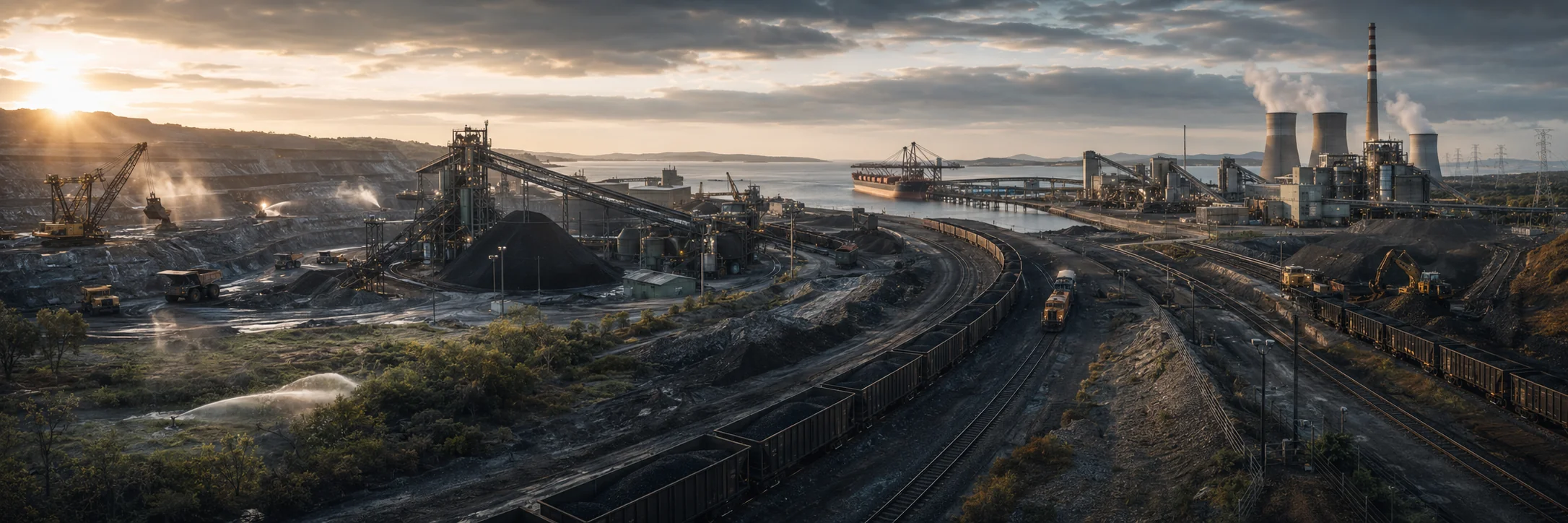
Follow coal from a changing seam through extraction, preparation, transport, combustion, cokemaking, useful service, residuals, and closure. A measured resource is not supply, a delivered tonne is not yet heat or steel, and control of one output does not close the others.
The need is useful service, not coal tonnage
People use the results that coal can help produce: controllable electricity, high-temperature heat, steel and other materials, chemicals, and the services those outputs enable. They do not ultimately require coal as a counted commodity. The distinction matters because a tonne at a mine, a tonne delivered to a boiler, heat released during combustion, electricity sent to a network, and light or motion at the point of use are different physical observations. The U.S. Energy Information Administration describes energy as the ability to do work; fuel is one means of making that ability available in a particular form.
Coal performs different jobs in different processes. Thermal coal supplies chemical energy that a boiler can convert to heat. Some industrial processes use that heat directly. A conventional coal power plant uses it to raise steam, turn a turbine, and drive a generator. Metallurgical coal follows another route: selected coals become coke, which contributes heat, reducing chemistry, and physical support inside a blast furnace. These jobs are not interchangeable, even when both products are sold by mass.
Coal can therefore be necessary under present conditions without making present coal volume inevitable. A grid may depend today on an operable coal unit because replacement generation, transmission, storage, fuel, or demand flexibility is not yet accessible at the needed hour. A blast furnace cannot simply stop receiving suitable coke while a different ironmaking route is still unbuilt or unqualified. That is conditional necessity created by the complete operating system, not proof that coal is a universal biological or technical requirement.
Demand can also be enlarged by the way services are presently organized. Boiler and turbine losses require more fuel than the delivered electrical service contains. Existing furnaces, rail routes, contracts, financing structures, settlement rules, product designs, and slow replacement cycles make some alternatives inaccessible even when their physical principles are known. Avoidable electricity or material demand can enlarge upstream coal demand further. The service requirement, the conversion loss, and the organizational choice should not be reported as if they were the same necessity.
Coal is rock before it is fuel
Coal formed when plant material was buried and changed by pressure, heat, and time. The result is a combustible sedimentary rock, not a standardized block of carbon. It contains carbonaceous matter, water, mineral matter, sulfur, and trace elements in proportions that vary within a basin, a seam, and sometimes a mine face. The EIA’s coal overview distinguishes lignite, subbituminous, bituminous, and anthracite ranks, but rank is only the beginning of a product description.
Combustion does not act on the useful fraction alone. Moisture must be heated and evaporated. Mineral matter travels through the boiler and becomes slag, bottom ash, or fly ash. Sulfur can be divided among gas and captured material. Trace elements can report to flue gas, ash, wastewater, or control residues. The saleable tonne carries the material that can perform the intended function and the material that every later participant must separate, tolerate, capture, use, or contain.
Coal rank describes the degree of coalification and is associated with carbon content, moisture, and heating value. A buyer still needs other observations. An analysis may report heating value, total moisture, ash, sulfur, volatile matter, fixed carbon, size, grindability, ash-fusion behavior, and, for coking coal, the way the material softens and resolidifies. The EIA coal glossary lists tests for grindability, ash fusion, and coking behavior because a boiler, pulverizer, coke oven, and blast furnace encounter different constraints.
The measurement basis also matters. A result stated on a dry basis excludes moisture; an as-received result describes the material in the condition delivered for the sample. Two coals with the same dry heating value can impose different transport and boiler loads if one arrives wetter. Two coals with similar energy content can behave differently in a pulverizer or form ash that softens at different temperatures. “High quality” is therefore incomplete language. Quality is fitness for a defined process and consequence.
A laboratory result describes sampled material under a stated method. Sampling design, preparation, chain of custody, and lot identity determine how far it can represent a changing seam, stockpile, wagon, or ship hold.
A geological resource describes coal known or inferred to exist under stated criteria. A reserve applies further judgments about what is recoverable under specified technical and economic conditions. Neither observation says that coal can reach a customer today. The EIA’s reserve reporting separates the measured coal in the ground from the smaller portions considered recoverable.
Physical access depends on seam thickness, depth, dip, faults, roof and floor conditions, overburden, water, methane, surface land, and the machinery a mine can deploy. Organizational access depends on rights, permits, worker availability, safety systems, finance, and a route to a compatible buyer. Recoverability changes when any of these conditions changes. A price increase can make some difficult material commercially reachable; it cannot remove a fault, create missing rail capacity, or make an unsafe mine plan physically sound.
Mining opens several material streams
Surface mining removes vegetation, topsoil, and overburden before exposing a shallow seam. The operation must decide how soil is stored, where rock is placed, how water moves across the site, and what land form remains. Underground mining creates entries into a deeper seam and must maintain roof support, ventilation, drainage, travel, power, and escape while coal is removed. The EIA’s account of coal mining and transport distinguishes these routes and the machinery they require.
The mine therefore produces more than run-of-mine coal. It moves soil and rock, pumps or redirects water, releases methane from some seams, generates dust, wears equipment, and leaves excavated voids or reconstructed land. Some underground coal remains as pillars or because extracting it would make the roof, surface, or economics unacceptable. Some surface material must remain available for reclamation rather than being treated as disposable cover.
Coal seams can contain methane that is released as pressure changes during mining. Ventilation moves fresh air through working areas and dilutes methane and airborne contaminants. In some mines, drainage systems capture methane before or during extraction; it may be used, flared, or released according to the system and condition. The EPA’s underground-coal-mine reporting description treats ventilation and degasification as different methane streams. A methane sales record does not include all methane released, and methane capture cannot take priority over keeping explosive concentrations away from workers.
Water is equally operational. Mines encounter groundwater and surface inflows, so pumps, sumps, drainage channels, treatment, and discharge routes can determine whether work remains possible. Exposed sulfide minerals can react with air and water to form acidic drainage containing iron, sulfate, and other metals. The Office of Surface Mining Reclamation and Enforcement describes acid mine drainage as a potential long-term consequence of both surface and underground mining. Stopping extraction does not necessarily stop water movement or treatment need.
Roof condition, gas concentration, airflow, pump status, and worker location can change faster than a plan or inspection cycle.
Cutting, drilling, crushing, loading, and transporting coal and surrounding rock can release respirable dust. Particles small enough to reach deep lung tissue are not represented by the visible dust on a surface. Silica-bearing rock can add another hazard. The U.S. National Institute for Occupational Safety and Health explains that respirable coal-mine dust causes coal workers’ pneumoconiosis and that exposure can occur during extraction, transport, and processing.
Water sprays, enclosed cabs, local exhaust, ventilation, maintenance, work practices, and production sequencing can reduce exposure. Each option requires equipment in working condition and enough time, authority, and money to use it.
Disease may become visible after repeated exposure and long after the decisions that created it. Feedback must therefore travel beyond medical detection. It must be able to change cutting methods, ventilation, maintenance, monitoring locations, staffing, and production plans while other workers are still exposed.
Preparation divides rather than purifies
Run-of-mine coal can contain pieces of roof and floor rock, fines, and variable moisture. Preparation plants crush and screen material, then may use differences in density, particle size, or surface behavior to separate coal-rich material from some mineral matter. Cleaning can raise heating value per delivered tonne and remove some ash-forming material and some sulfur associated with minerals. It cannot remove every sulfur compound or trace element. The U.S. Geological Survey’s coal-preparation discussion notes that sulfur bound organically within coal is not removed by ordinary physical washing.
The preparation plant does not make unwanted material vanish. It creates a saleable product, coarse rejects, fine refuse or slurry, process water, dust, and sometimes recoverable secondary coal. Removing mineral matter before long-distance transport can avoid moving and heating it later, but the mine region then receives a more concentrated residual-management task. Water circuits must control fine solids and dissolved constituents; impoundments, piles, filters, or paste systems need physical capacity and stable routes.
Thermal coal and coking coal perform different work
Thermal coal is selected principally to release heat in a boiler or industrial furnace. Its heating value, moisture, ash, sulfur, grindability, and ash behavior affect how much can be handled and how the machine operates. Coking coal must undergo a specific transformation when heated without oxygen: suitable material softens, fuses, releases volatile compounds, and resolidifies as coke with enough strength and pore structure for later use.
Inside a blast furnace, coke is more than a hot fuel. It provides carbon that helps remove oxygen from iron oxides, supplies heat, and maintains a permeable structure through which gases and liquids can move. An EPA technical description of integrated iron and steel production identifies coke’s thermal, chemical, and physical roles. If coke breaks down too readily, the furnace can lose the gas flow and burden support required for stable production.
Alternative iron and steel routes can change coal requirements. Electric-arc furnaces can melt suitable scrap; direct-reduction routes can use other reducing gases or agents; process redesign and material efficiency can reduce primary iron demand. Their accessibility depends on scrap quantity and composition, ore quality, electricity or other energy, qualified equipment, product requirements, and investment timing. The blast furnace requires its functions to be met; it does not prove that only one coal volume or one industrial architecture can ever meet them.
Cokemaking creates several outputs before iron exists
A coke oven heats selected coal in the absence of air. Volatile material leaves the oven as gas and vapors while a carbon-rich solid coke remains. The raw gas can yield coke-oven gas, tar, ammonia-related products, light oils, sulfur compounds, and wastewater after cooling and treatment. The exact recovery route varies by plant. The EPA’s coke-production process description follows these streams from charging through by-product recovery.
Coke quality begins upstream in coal geology and blending, but oven temperature, heating uniformity, residence time, quenching, and handling continue changing it.
Calling gas or tar a co-product names a possible role, not an accomplished destination. A co-product preserves function only when its composition, collection, transport, market, and receiving process are available at the same time. Otherwise it can become fuel, waste, wastewater load, or an emissions-control task.
Coal is commonly bought against a specification rather than as undifferentiated black rock. Contracts can define energy content, moisture, ash, sulfur, size, volatile matter, coking properties, sampling methods, delivery windows, and adjustments when results differ. A power plant may blend sources to keep a boiler and emissions system inside an operating range. A coke plant may blend several coals because no single source supplies every required coking property.
The contract does real coordinating work: it translates a machine’s tolerances into obligations a mine, preparation plant, trader, carrier, and laboratory can act on. A penalty compensates or reallocates a commercial deviation; it does not restore lost generation, reverse slagging, remove an unexpected contaminant, or make unsuitable coke physically support a furnace.
Identity can split and merge. Coal from one seam may enter several products, while a delivered cargo may combine many faces, stockpiles, mines, or traders. After a failure, sample identity, blend history, handling conditions, and equipment state must still lead to someone able to change the cause.
Transport can decide which seam becomes supply
Coal moves by conveyor, truck, rail, barge, and ship. It is bulky relative to the useful energy or carbon service it eventually provides, so distance, grade, port depth, wagon availability, river condition, loading equipment, and terminal capacity can decide which deposit reaches a buyer. The EIA notes that transport expense can exceed mining expense for some coal movements.
A mine-mouth power plant reduces the need to transport coal over long distances. It does not remove geography. The plant instead depends strongly on the local seam, cooling water, ash land, transmission capacity, and the future of one coupled mine-plant system. An export mine depends on rail and port performance as well as ocean freight and receiving terminals. Each arrangement moves the constraint rather than eliminating it.
Rail reservations, port slots, vessels, working inventory, and payment terms determine which physical response remains available after a disruption. A buyer with cash but no wagon cannot move coal. A mine with coal and rail access can still stop if the buyer cannot accept the product or pay on the agreed schedule. Commercial and physical capacity meet at the loading point.
A stockpile stores time, not guaranteed generation
A stockpile separates the timing of delivery from the timing of use. That buffer can protect a plant or coke oven from mine, railway, river, port, or weather disruptions. Reported “days of burn” is an estimate that relates inventory to a consumption rate; the EIA’s stock reporting calculates it from stock levels and past consumption. It is not a promise that the plant can operate for that many days.
Coal in storage continues changing. Rain alters surface moisture and runoff. Wind moves dust. Repeated handling can segregate sizes and increase fines. Oxidation can reduce quality and generate heat; poorly managed accumulations can develop hot spots or fires. Reclaim equipment, conveyors, crushers, and sampling systems determine whether the mass is actually reachable and correctly blended.
Combustion separates saleable coal into gaseous and solid streams
In a pulverized-coal plant, mills grind coal finely and air carries it to burners. Carbon and other combustible constituents react with oxygen and release heat. Much of the carbon becomes carbon dioxide; the added oxygen means the gas mass is not represented by the coal mass alone. Sulfur and nitrogen contribute to gaseous compounds under combustion conditions. Mineral matter melts, fuses, or remains particulate and divides between bottom ash, boiler deposits, and fly ash.
Coal’s carbon intensity should be compared on an energy basis, not simply by tonne. EIA carbon-dioxide coefficients report a higher combustion CO2 factor per unit of heat for coal as a group than for common petroleum fuels or natural gas. Electricity emissions also depend on plant efficiency and auxiliary consumption, so a fuel coefficient alone does not establish emissions per delivered kilowatt-hour.
Combustion makes some upstream variation immediately operational. Moisture and ash require heat and handling without adding the intended combustible energy. Grindability affects mill throughput. Ash-fusion behavior affects deposits and slagging. Sulfur affects the load on sulfur controls. A delivery can comply with each individual contract limit while the combination of properties still narrows stable plant operation.
A coal power plant is a heat-and-water system
Burners release heat in a boiler. Water becomes high-pressure steam, steam expands through a turbine, and the turbine turns a generator. Afterward, a condenser removes heat so the water can circulate again. Cooling towers, rivers, lakes, seawater, or dry-cooling systems create different water, temperature, land, and weather constraints. The EIA’s description of steam-turbine generation shows why the fuel is only one part of the conversion.
Nameplate capacity describes a rated electrical capability under defined conditions. Gross generation is produced at the generator; pumps, fans, mills, controls, cooling, and material-handling equipment consume part of it before net output reaches the grid. Energy generated over a month does not establish power available during a particular hour. A full coal yard does not establish that the boiler, turbine, condenser, water system, emissions controls, ash route, transformer, transmission connection, or grid instruction is available.
Plants designed for a particular coal range can sometimes blend or modify equipment to use another source. The change is not automatic. Boiler heat transfer, burners, pulverizers, sootblowing, ash handling, scrubbers, and permits may all constrain the substitution. What the commodity market calls coal must still fit one physical plant.
Each control catches a different output
Coal plants use different equipment for different material streams. An electrostatic precipitator charges particles and collects them from flue gas; a fabric filter passes gas through filter media. Sulfur-dioxide controls use alkaline reagents in wet or dry systems and create sludge, solids, salts, or gypsum-like material. Combustion controls and catalytic or non-catalytic systems can reduce nitrogen oxides. Mercury capture depends on coal chemistry, combustion, sorbents, and the sequence of other controls. The EPA reports emissions and installed control types separately because no single device represents the complete plant.
Controls need fans, pumps, electrical power, water or reagents, replacement parts, trained operators, maintenance windows, and outlets for captured material. A scrubber unavailable for maintenance can constrain generation even when coal and boiler capacity remain. Strong capture of particles can increase the amount that must be handled as dry ash. Wet sulfur control can create wastewater; the EPA’s steam-electric rules identify flue-gas-desulfurization wastewater, bottom-ash transport water, and combustion-residual leachate as distinct streams.
Captured carbon begins another supply chain
Post-combustion carbon capture can separate a portion of the carbon dioxide from flue gas using solvents, sorbents, membranes, or other systems. In solvent systems, heat is commonly required to release concentrated CO2 and regenerate the solvent. Gas treatment, blowers, pumps, cooling, dehydration, and compression add equipment and energy demand. The National Energy Technology Laboratory distinguishes capture approaches, and its compression guidance explains that captured CO2 must be compressed for pipeline transport and storage or use.
A capture percentage describes a boundary around a particular stream and operating condition. It is not automatically the reduction in emissions per net unit of electricity. Additional fuel or reduced net output, capture-system downtime, uncaptured plant streams, upstream mining and methane, transport, and storage performance affect the complete result. Capture does not remove coal ash, mine water, land disturbance, or worker exposure.
Storage adds site characterization, pipelines, injection wells, pressure management, plume prediction, monitoring, corrective action, well plugging, and post-injection care. The EPA’s Class VI framework requires evidence and financial responsibility across these stages to protect underground drinking-water sources. A mass reported as captured at the plant is not yet a mass demonstrated to remain isolated.
Existing infrastructure narrows accessible choices
Mines, railways, ports, power plants, coke ovens, blast furnaces, transmission lines, water systems, laboratories, and skilled workforces accumulate around one another. Their interfaces can make continued coal use the quickest or only presently reachable way to maintain a particular service. A railway may rely on coal freight, a mine on one power station, a plant on one coal basin, and a community on wages and revenue from all three.
This path dependence does not require participants to behave irrationally. A plant operator may be responsible for near-term reliability but lack authority to build transmission. A mine may have a long-term contract but no power to change the buyer’s furnace. A regulator may approve cost recovery but not control equipment delivery. Workers may reasonably defend income when replacement work, pensions, relocation, or training are uncertain. Each participant can make a defensible local decision that nevertheless keeps the combined system on its existing path.
Nor does installed infrastructure make every current tonne necessary. Utilization can change; maintenance can reduce the fuel and auxiliary electricity required per net unit of generation; services can be supplied by other assets; material demand can be reduced; steel routes can change; and replacements can be built. The important question is which alternatives are physically qualified and organizationally accessible before an existing unit, mine, worker, or community loses the time to move.
Money determines which controls and exits remain open
Money is not an abstract signal added after the physical process. It determines which physical actions can occur. Working money pays wages and suppliers before a coal delivery is settled. Capital pays for roof support, ventilation, dust control, preparation circuits, rail connections, boiler repairs, scrubbers, ash dewatering, water treatment, and replacement generation. Credit terms decide whether inventory can be held through a transport disruption. Insurance, bonds, and regulated reserves affect whether a liability remains funded after revenue falls.
A low mine price can coexist with an unaffordable delivered product when freight is constrained. A plant can be technically repairable but unable to obtain a part or approved expenditure before the grid needs it. A preparation plant may know how to reduce ash yet lack a viable route or money for the resulting refuse. An operator can have a closure plan while the funds needed to execute it remain exposed to bankruptcy, underestimated treatment time, or declining sales.
A high coal price may reflect mine disruption, specification scarcity, wagon shortage, port congestion, currency, credit, or competing demand; a low price may reflect abundance or a producer needing cash despite future closure obligations.
Bottom ash collects below the boiler; fly ash is carried with flue gas and captured by particulate controls. Their composition depends on coal mineralogy, combustion, and control sequence. Some fly ash can perform a useful role in cementitious materials; some bottom ash can enter construction products; some sulfur-control material can become gypsum. These are possible routes, not automatic properties of every batch.
The receiving process needs compatible chemistry, fineness, unburned carbon, moisture, consistency, evidence, transport, and timing. The EPA’s criteria for beneficial use of coal-combustion residuals require a functional benefit, substitution for virgin material, and applicable product or design specifications, with additional demonstrations for certain land placements. A sales category or named market does not establish that the material reached a protective use.
Ash without an accessible use goes to a landfill, surface impoundment, mine placement, or another managed route according to jurisdiction and condition. Leachate, dust, slope stability, liners, covers, drainage, and groundwater monitoring then become part of the supply chain’s residual boundary. Capturing more material from the stack makes that boundary more important, not less.
Closure begins before the final tonne
A surface mine needs a planned land form, stable slopes, soil handling, drainage, revegetation, and a post-mining use appropriate to the site. Underground closure can require sealing openings, controlling subsidence risk, addressing methane, and managing water after pumps or ventilation change. Power-plant closure adds fuel removal, equipment isolation, demolition or reuse, contaminated areas, ash units, wastewater, and the electrical site’s next function.
Reclamation bonds are intended to keep money available if an operator does not complete required work. The Office of Surface Mining Reclamation and Enforcement explains that regulators hold financial assurance and release it in phases as reclamation is completed. The bond is a financial control. Its existence does not prove that the amount matches every future water, land, or treatment condition.
Legacy mines show why timing matters. The U.S. Abandoned Mine Land program addresses hazards and environmental degradation left where earlier mining ended without a complete route. Ash units can similarly require closure, corrective action, and groundwater observation after generation stops. A final sale can remove the revenue stream before the longest obligations have become visible.
Regrading land, replacing soil, installing drainage, planting vegetation, sealing an opening, or closing an ash unit are actions against plans. Stable land, safe water, functioning habitat, controlled methane, protected groundwater, and a viable next use are physical outcomes. They become visible on different timescales and need different measurements.
Reclamation can create valuable new conditions without recreating the previous landscape or ecosystem. Visual greenness alone does not establish soil structure, species composition, water regulation, or long-term slope stability.
A coal system carries human functions as well as fuel. Employment provides income, skill development, identity, schedules, pensions, and purchasing power. Coal businesses and workers can support local suppliers, transport, housing, and public revenue. These are real functions; describing them as waste because another technology uses fewer workers confuses fewer paid labour hours per unit of output with the condition of people and places.
Closure can remove several linked cash flows at once. Workers may need time, recognized credentials, bridge income, relocation support, health care, or a new employer. Local governments may need replacement revenue before maintaining schools, water systems, roads, and emergency services becomes harder. Reusing a site, grid connection, rail corridor, workshop, or workforce can preserve completed work, but only when the next activity is qualified, financed, and ready in time.
Transition announcements, training enrolments, and grant awards do not by themselves establish durable work, comparable income, local access, or a solvent tax base.
Records observe different coal boundaries
A reserve estimate describes coal in the ground under stated assumptions. A mine plan describes intended extraction. A dust sample observes selected worker exposure. A certificate of analysis describes a sample. A weighbridge or draught survey estimates transferred mass. A stock report describes inventory. A stack monitor observes specified emissions. An ash test describes sampled residual. A groundwater well observes one part of an aquifer. A carbon-storage report accounts for another controlled boundary.
All are necessary in the right system. None is a universal representation of “responsible coal.” Their value depends on identity, method, timing, location, uncertainty, and whether the result reaches someone who can still change the process. Combining incompatible measurements into one score can hide the very condition that needs attention.
Traceability also has a physical limit. Coal is crushed, blended, burned, and chemically transformed. After combustion, the original tonne no longer exists as a recoverable object. Useful traceability therefore links lots, samples, equipment conditions, gas and residual streams, and decisions; it does not pretend every atom can retain a commercial label through every transformation.
A slagging problem at a boiler may point to coal blend, ash chemistry, burner conditions, or sootblowing. Weak coke may point to coal selection, blending, oven heating, quenching, or handling. Dust disease may reveal repeated exposure far earlier in the mine. Groundwater contamination may appear after ash placement or mine closure.
Feedback becomes useful when evidence can cross the same organizational divisions that split control. A utility must be able to reach its laboratory, trader, carrier, preparation plant, and mine. A mine must be able to change equipment and production without forcing workers to choose between unsafe exposure and lost income. A regulator or community observation must reach the owner, financial assurance, technical team, and authority able to repair or close the source.
Detection, attribution, authorization, funding, physical correction, and verification are separate events. Delay between them can allow another cargo to be blended, another worker to be exposed, another ash layer to be placed, or closure money to disappear.
Coal supply ends later than the saleable tonne
Dependable coal supply requires more than a reserve, train, stockpile, or compliant delivery. The coal must suit a particular conversion process; extraction must remain physically safe; transport, water, equipment, controls, and residual routes must be operable; and the useful electricity, heat, or material must reach its intended service. A system that claims complete responsibility must also keep dust, methane, mine water, preparation refuse, coke-oven outputs, stack emissions, wastewater, ash, carbon storage, land, and closure obligations connected to evidence and corrective authority.
This does not make records, finance, or responsibility physically part of the rock. It recognizes that the rock’s useful function and its other outputs cross organizations that observe and control different conditions. The chain remains open wherever a material or consequence lacks a reachable route appropriate to its condition and lifetime.
The decisive questions are specific. What function is required at this place and time, and does it truly require this coal route? Which other material streams and changed places are produced while that function is delivered? Can evidence, money, and authority reach the participant able to change the next outcome before a worker is exposed, a plant loses operation, a residual escapes, or the responsible organization disappears?
Inside CompanyGraph
Map where service need, seam condition, mine access, worker exposure, methane and water, preparation outputs, coal specification, transport, stockpile condition, boiler or coke-oven compatibility, stack controls, ash routes, carbon storage, closure money, community options, and corrective authority become separated—and which organizations can reconnect them before useful supply stops or a residual becomes unreachable—inside CompanyGraph.