 CompanyGraph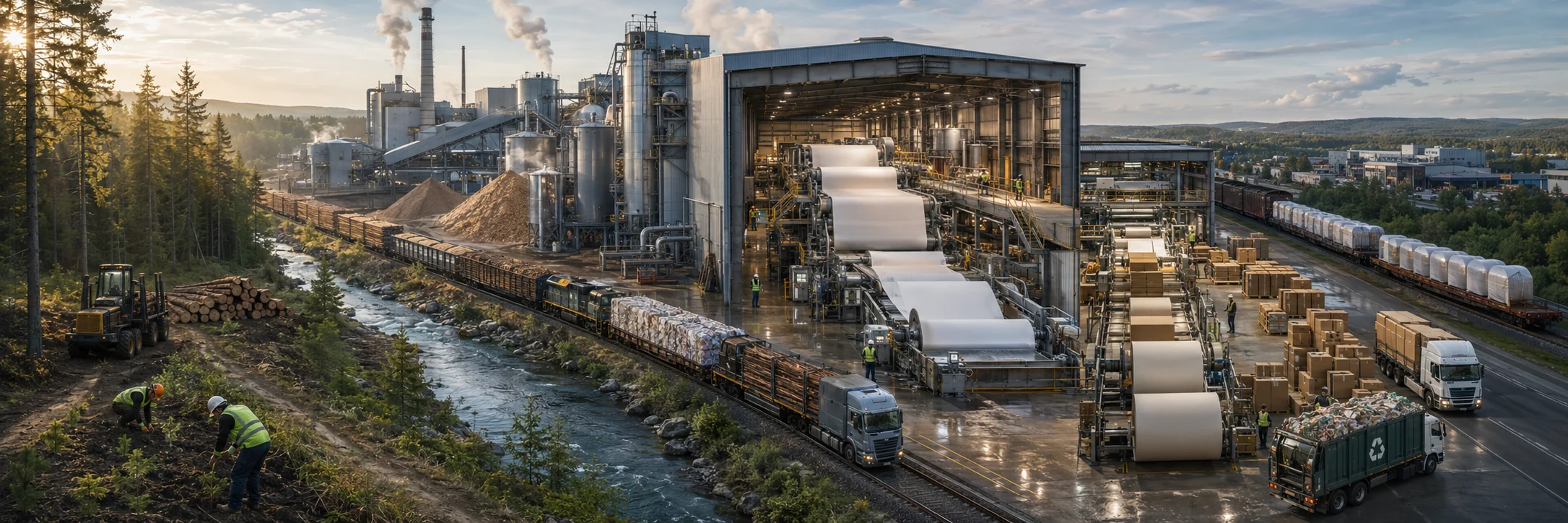
From logs and recovered paper to pulp, sheets, boxes, and tissue—and why fiber history, mill chemistry, and collection decide what can be made next.
Paper is a set of physical functions
A log, a bale of recovered paper, a pulp sheet, a carton, and a tissue are not the same object. They are stages in a chain that begins with plant fiber or previously made paper, separates and prepares that fiber, forms a wet web, removes water, adds coatings or sizing when needed, and converts the finished sheet into a product. After use, the sheet may be reused, repulped, composted, burned for energy, or discarded.
The user may need a printable surface, a barrier around food or medicine, a box that survives stacking, a wipe that absorbs water, or a sheet that filters particles. Those functions are not interchangeable. Paper is one way to provide them, and cellulose is the main fiber in ordinary paper, but specialized products can also use non-plant fibers or other materials. Present demand therefore reflects both physical requirements and the way packaging, hygiene, offices, logistics, and collection systems are currently organized.
In the United States, paper and paperboard made up 67.4 million tons of municipal solid waste in the EPA's 2018 accounting, and about 46 million tons were recycled. Those are useful observations about one country's waste stream in one year, not a measure of all paper made or of how much recovered fiber can replace new fiber. EPA's paper and paperboard data also separate corrugated boxes, newspapers, other nondurable paper, and other packaging because each follows a different recovery path.
Where the fiber comes from
Most ordinary paper fiber comes from wood or recovered paper. Wood can arrive as logs, pulpwood, or chips and residues from sawmills and other processing. Recovered paper arrives after a first use, usually as a sorted stream such as old corrugated containers, office paper, newspapers, or mixed paper. Agricultural residues and other plant fibers also exist, but their availability and properties depend on location and product design. The USDA Forest Service overview of fiber resources emphasizes that a resource's usefulness changes with technology and the product being made.
Wood is not simply converted into white sheets. In chemical pulping, chips are cooked so that lignin, the material binding the fibers together in wood, is separated from the cellulose fibers. Mechanical pulping keeps more of the wood in the pulp but also retains more of the components that affect brightness and fiber behavior. Bark, dissolved lignin, cooking liquor, screening rejects, and wastewater leave by different routes. A mill may burn some organic residues for steam and electricity, but combustion does not make every displaced material disappear.
Recovered paper is repulped in water and screened to remove plastics, wire, grit, and other unwanted material. Deinking mills use washing, flotation, or related separation steps when the grade requires it. The EPA description of papermaking and recycling explains why a mill can use recovered fiber alone or blend it with virgin fiber. The route depends on the fiber length, cleanliness, brightness, strength, and additives that the next product needs.
Fiber has a history that the next sheet inherits
A tree supplies fiber only after growth, harvesting, transport, and preparation. The time varies with species, climate, silviculture, and the product objective, but it is measured in years rather than in a paper machine's operating shifts. A price change today cannot create mature pulpwood tomorrow. It can change planting, thinning, harvest, or procurement decisions whose physical effects arrive later.
Recovered fiber follows a different clock. It becomes available when a product is used and collected, so a box, book, or tissue sheet cannot be recycled before its first service ends. Repulping and drying shorten and damage some fibers. EPA's technical explanation gives five to seven uses as a commonly accepted range, while also noting that long fibers can move into products using shorter fibers and short fibers have fewer later options. That is a rough material tendency, not a promise that every sheet survives the same number of cycles.
Collection quality changes what the recovered stream can do. Food residue, moisture, coatings, laminates, thermal labels, plastic windows, and mixed materials can require extra sorting or can send a portion of the bale to sludge, rejects, energy recovery, or disposal. The useful question is not whether a tonne was collected, but whether the fibers and the cleanliness of that tonne fit a specified next product.
What a pulp mill changes
A pulp mill changes wood into a controlled furnish. A paper mill changes furnish into a continuous sheet. In kraft pulping, spent cooking liquor and pulp-washing water form weak black liquor. After concentration, the liquor is burned in a recovery furnace: its organic material supplies heat for steam, while inorganic chemicals collect as smelt and are processed back toward white cooking liquor. Mechanical, recycled-fiber, and non-wood mills have different input and output patterns. EPA's chemical-wood-pulping description separates these recovery steps from the fiber-forming step.
Water carries fibers, dilutes stock, washes equipment, and helps form the sheet. The web then passes through drainage, pressing, and drying. Water removed from the web is not the same thing as water discharged from the site: some is recirculated, some leaves with sludge or rejects, and some becomes treated effluent. The EPA effluent-guideline page identifies regulated pollutants that vary by mill type, including biochemical oxygen demand, suspended solids, pH, chemical oxygen demand, and several priority or nonconventional pollutants.
Energy enters pulping, pumping, pressing, drying, chemical recovery, and converting. The IEA identifies pulp and paper as an energy-intensive, capital-intensive subsector in which energy prices and upfront investment affect whether a mill can pursue reductions in energy used per tonne or specified grade. An integrated mill may generate steam and electricity from process residues, but that changes the energy balance; it does not remove the need for fuel, maintenance, water treatment, skilled work, or environmental controls.
A grade describes a job, not a rank
Printing and writing paper needs a surface that accepts ink or toner, controlled formation, and often brightness and opacity. Containerboard needs compression strength and stiffness after it is made into a corrugated box. Tissue needs a different balance of softness, absorbency, wet strength, and low basis weight. Food and pharmaceutical packaging can also need barrier properties, sealability, and evidence that the material is suitable for contact.
These grades can share equipment, but they do not become interchangeable because one machine is idle. Furnish, refining, coatings, drying, calendering, and converting settings all affect the resulting properties. The USDA Paper and Packaging Board description distinguishes printing and writing, kraft packaging, containerboard, and paperboard markets. It is a reminder that “paper capacity” is too broad to tell a buyer whether the required grade exists.
Recent U.S. capacity data show the same distinction in numbers: AF&PA reported a 6.9 percent fall in printing-writing capacity in 2024 while packaging-paper capacity increased 4.6 percent. Those figures describe reported U.S. equipment capacity, not guaranteed output or global supply. AF&PA defines capacity as what could be produced with full equipment use, adequate raw materials and labor, and full demand. A machine count therefore cannot establish that a particular roll is available at the required time. AF&PA's capacity account states those limits directly.
Demand moves faster than forests and machines
Digital communication has reduced some printing and newsprint uses, while shipping, food delivery, hygiene, and retail packaging have increased or changed the requirements for other grades. The USDA Forest Service describes this divergence as a long decline in U.S. newsprint and printing-and-writing consumption alongside packaging demand linked partly to e-commerce. The change is not a single global law: it varies by country, income, product, and period.
A machine built for a declining grade may be converted, sold, idled, or closed. For example, a conversion may require changes to stock preparation, approach-flow equipment, drying, coatings, or electrical systems; the exact package depends on the machine and the target grade. It is not guaranteed to produce the required output rate, energy use, conversion cost, or grade compliance for the new product. A new packaging machine can add the required output without restoring the printing capacity that disappeared. This is why aggregate tonnage can coexist with a shortage of a specific basis weight, coating, width, or certification.
Money changes which of those physical actions can be reached. Fiber, chemicals, energy, wastewater treatment, maintenance, and payroll are paid before a finished roll is invoiced and collected. If a buyer pays after delivery while a mill faces an immediate outage decision, the mill must finance the work or run with the existing configuration. A low selling price can make a planned maintenance outage, a cleaner recovered-fiber stream, or a grade conversion difficult to fund even when the action would protect future output. That is a timing mechanism, not a claim that one operator simply prefers lower quality.
Where water, energy, and waste go
A paper mill's product is only one output. Dissolved lignin and hemicellulose, black liquor, bark, ash, screening rejects, deinking sludge, wastewater, air emissions, and rejected rolls follow their own routes. Some are recovered inside the mill; others are treated, sold into another use, sent to a contractor, or disposed of. A saleable roll does not prove that those routes are harmless or even that they were completed as planned.
Effluent rules can require monitoring and treatment, but a discharge permit answers a defined question about a defined outlet and period. It does not describe every upstream exposure, the condition of a receiving stream between samples, or the fate of material sent to another facility. Controls are necessary because the process produces burdens that a paper invoice does not measure; they remain partial controls rather than proof of a complete result.
The same distinction applies to energy claims. A mill may report renewable electricity from black liquor or purchased certificates, while the physical process still has to move wood, water, chemicals, sludge, ash, and finished rolls. Energy accounting can describe one boundary of the operation without establishing the condition of the forest, river, workforce, or receiving community.
What does a bale or roll record actually show?
A recovered-paper bale is usually sampled for properties such as moisture, visible prohibitives, and composition. That sample supports a transaction or a mill-receiving decision; it does not inspect every fiber in every bale. A roll can be tested for basis weight, moisture, thickness, strength, brightness, smoothness, or coating performance. Those measurements answer specific questions about the sampled roll or test piece, not the whole journey from forest, collection bin, or mill effluent.
A concrete payment boundary appears in ReMA's 2026 paper-stock specifications. Buyer and seller can agree in the purchase or shipping agreement on the moisture percentage and the test method. If excess moisture is found, the buyer may request a weight adjustment and, if no settlement is reached, reject the shipment. A mill can therefore measure one condition and change the payment, but the corrective work may belong to the broker or sorting facility that prepared the bale, the collector who separated it, or the packaging and household practices that made it wet. For the next load to improve, bale identity, the measurement result, and the party with money and authority to dry, re-sort, or change collection must remain connected.
A certificate or chain-of-custody document can preserve an entered source, claim, or transfer. It cannot make a mixed bale unmixed, recover a coating that was never recorded, or prove that a downstream converter followed every handling instruction. The accounting method matters: the FSC chain-of-custody standard describes transfer, percentage, and credit systems and requires controls when product ownership changes. A transfer claim can describe the material group sold; a percentage or credit claim can allocate certified input across a product group without asserting that every fiber in a particular sheet came from a certified forest. The communicated claim is therefore narrower than the complete material condition.
Aggregation changes what can be known
Paper fibers from many households, offices, printers, shops, and factories are combined in collection trucks, transfer stations, and sorting facilities. Once streams are mixed, the next mill usually knows a grade and a bale specification rather than the history of each sheet. That aggregation lowers transport cost and makes a continuous furnish possible, but it also reduces the resolution at which a contaminant, coating, or failed recovery route can be traced.
The same thing happens inside a mill. Different pulps and recovered fibers are blended to meet a furnish target, then converted into rolls and cut into sheets, cartons, towels, or boxes. A finished package can be tested against its specification without retaining a practical identity for every tree, bale, chemical addition, and rejected stream that contributed to it. That is not automatically a defect; it is a boundary that limits which upstream causes can be reached when a downstream problem appears.
After use, preserve the sheet before separating it
Reuse keeps the finished sheet and its completed converting work intact when hygiene, security, and function allow it. Recycling breaks the sheet back into fibers and therefore preserves less completed work, but it can return cellulose to another paper product. Composting or energy recovery may be appropriate for contaminated or unrecyclable paper, yet those routes no longer preserve a printable surface, a box's formed geometry, or a tissue sheet's original function. Landfilling retains neither the fiber's next paper use nor its energy without additional recovery.
EPA's 2018 U.S. data illustrate why “paper recycling” is not one outcome: corrugated boxes had a reported 96.5 percent recycling rate, while paper containers and packaging other than corrugated boxes were at 20.8 percent and nondurable paper excluding newspapers at 43.1 percent. Those rates describe a specific national accounting boundary and do not establish that every collected item was made into a new equivalent product.
Paper cannot be assessed by a single end-of-life number. A clean office sheet, a grease-soaked pizza box, a laminated pouch, and a confidential medical record have different safe and physically available next routes. The best route depends on contamination, fiber length, additives, privacy, collection infrastructure, and the next function that can actually be reached.
What must remain connected after use
A complete account would keep the intended function connected to the fiber source, forest or collection condition, pulping and bleaching route, water and energy use, grade specification, converting, payment timing, use, and recovery. It would distinguish what a sample measured from what a certificate claimed and from what a receiving river, worker, household, or next mill actually experienced.
The wet-bale example makes the responsibility loop concrete: the mill can measure moisture and adjust or reject a load, but the next correction may require a broker to change the contract, a sorting facility to add covered storage or re-sorting, a collector to change routes, a packaging designer to reduce water exposure, or a household to keep paper dry. Each action needs money, equipment, and authority before the next shipment. If the bale's identity or the measurement is lost at a handoff, the party able to change the next load may receive only a downgraded claim rather than the cause.
Inside CompanyGraph
Explore how fiber sources, mills, converters, users, collectors, and recovery facilities connect—and where grade, payment, evidence, and responsibility separate.