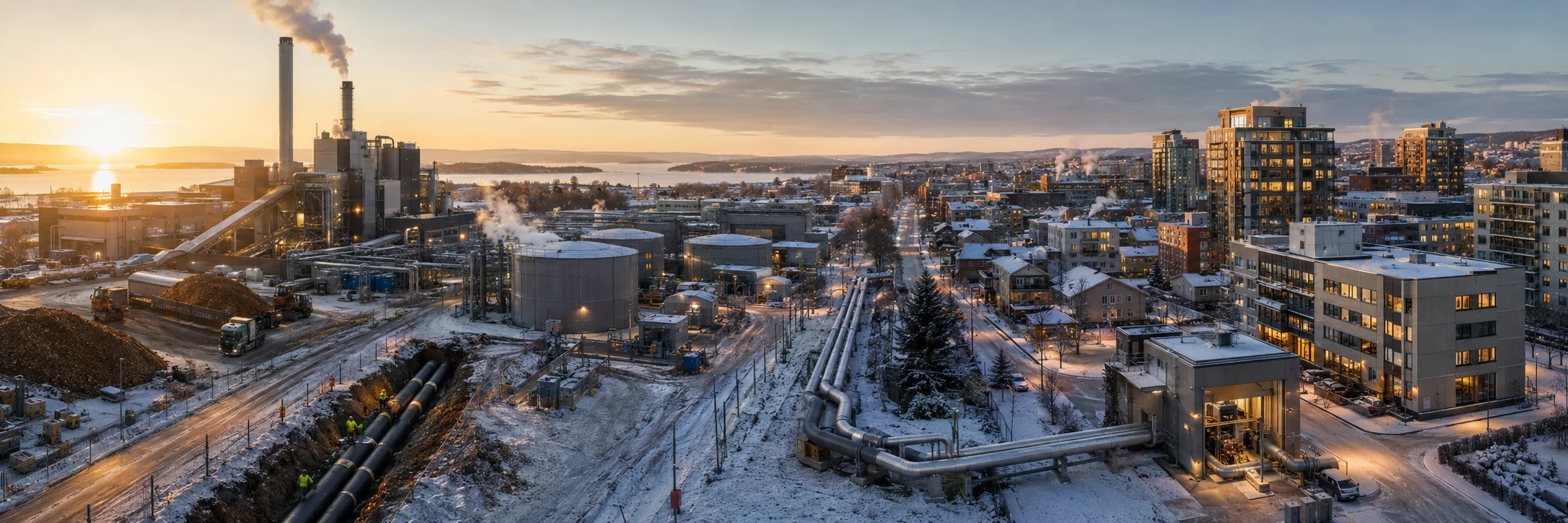
Underground pipe networks requiring decades of amortization and creating geographic permanence that exceeds the lifespan of connected heat sources, combined with the ability to accept heat from any source capable of producing hot water at the required temperature, make the distribution network itself the durable valuable asset while heat production technologies become replaceable components — but only in urban areas dense enough to justify the civil engineering investment.
How underground pipe networks create geographic permanence that outlasts the heat sources connected to them, enabling technology transitions that most energy infrastructure cannot accommodate.
Introduction
A district heating supply chain describes how thermal energy — typically in the form of hot water or steam — is produced at centralized facilities, distributed through underground pipe networks, and delivered to buildings for space heating and domestic hot water. The chain encompasses heat production from diverse sources, a distribution network of insulated pipes buried beneath streets, substations in individual buildings, and the organizational and contractual structures that coordinate production, distribution, and consumption across an urban area.
District heating is urban thermal infrastructure. It exists at the intersection of energy production, civil engineering, municipal planning, and building services — a coordination system that must be physically installed beneath streets, connected to every participating building, and maintained for decades. Unlike electricity or gas networks that deliver a commodity to be converted at the point of use, district heating delivers the end product — heat — directly. This distinction shapes everything about the system: its economics, its governance, its relationship to geography, and its capacity for technological change.
Root Constraints
Network Infrastructure Lock-in
District heating requires underground pipe networks distributing hot water or steam through urban areas. Installation requires excavating streets, laying insulated pipe pairs (supply and return), connecting each building through individual service lines, and restoring the surface above. The civil engineering cost of this installation typically represents fifty to seventy percent of total system cost — far more than the heat production facilities it connects to.
This infrastructure creates geographic permanence that exceeds the lifespan of the heat sources connected to it. A district heating pipe network, properly installed, has an expected service life of fifty to one hundred years. The heat sources connected to it — whether boilers, waste incineration plants, or heat pumps — have service lives of fifteen to thirty years. The network will outlast multiple generations of heat production technology. This asymmetry between network lifespan and source lifespan is not a design flaw. It is the system’s defining structural property.
The installation process creates a one-time disruption that constrains when and where networks can be built. Excavating streets in a functioning city requires coordination with traffic management, water, sewer, electricity, and telecommunications infrastructure already buried underground. The disruption is significant enough that it typically aligns with other major street reconstruction projects. Once the disruption has occurred and the pipes are in the ground, the economic and political barriers to removal are so high that the network effectively becomes a permanent feature of the urban landscape.
Heat Source Flexibility
The same distribution network can receive heat from multiple sources, simultaneously or sequentially over its lifetime. A network originally built to distribute heat from a coal-fired combined heat and power plant can, without replacing any distribution infrastructure, transition to receiving heat from waste incineration, industrial waste heat, large-scale heat pumps, geothermal wells, biomass boilers, solar thermal collectors, or any combination of these sources. The network is agnostic to the origin of the heat it carries.
This source flexibility is a consequence of the physical medium. Hot water is hot water regardless of how it was heated. The network’s technical requirements — supply temperature, return temperature, pressure, flow rate — constrain which sources can connect, but within those parameters, the origin of the heat is irrelevant to the distribution system. A megawatt-hour of heat from a data center’s cooling system is physically identical, from the network’s perspective, to a megawatt-hour from a gas boiler or a geothermal well.
This flexibility makes the network itself the valuable asset, not any particular generation technology. The network is a platform that can accommodate technological transitions without replacement — a property that almost no other energy infrastructure possesses. An electricity grid must accommodate the specific technical characteristics of each generator type. A gas pipeline is useful only for gas. A district heating network can switch its heat source without the network’s end users noticing or needing to change anything in their buildings.
Urban Density Requirement
District heating is economically viable only in areas with sufficient building density to justify the network investment. The cost of installing underground pipes is proportional to the length of trench excavated, while the revenue is proportional to the heat demand of connected buildings. Viability requires enough heat demand per linear meter of pipe to recover the installation cost over the network’s operating life.
This creates a sharp geographic boundary. Dense urban cores with multi-story residential and commercial buildings can support district heating economics. Suburban areas with detached single-family houses typically cannot — the pipe length per unit of heat demand is too great. The boundary is not absolute and varies with local construction costs, energy prices, and policy support, but the underlying physics is clear: distributing heat through pipes incurs thermal losses proportional to pipe length and surface area, and these losses must be offset by sufficient demand density.
The density requirement also interacts with urban planning decisions made decades or generations earlier. Cities built around high-density apartment blocks — common in Nordic countries, central and eastern Europe, and parts of Asia — have the building stock to support district heating. Cities built around low-density suburban sprawl do not. The feasibility of district heating in a given city was often determined by urban planning decisions made long before anyone considered the heating system. Infrastructure path dependency extends beyond the energy system into the built environment itself.
How Constraints Shape the System
The Network as Platform
District heating pipes are energy infrastructure analogous to electricity grids but for thermal energy. Once built, they create a platform that can accept heat inputs from any source capable of producing hot water at the required temperature and pressure. This platform property is what distinguishes district heating from all other heating technologies — it separates the question of how to heat a city from the question of where the heat comes from.
The platform analogy extends to network effects. Each additional building connected to a district heating network increases the total heat demand the network can serve, which improves the economics of the heat production assets connected to it, which enables investment in more efficient or diverse heat sources, which can reduce costs for all connected buildings. The network creates value that no individual building connection could achieve alone.
This platform property also creates natural monopoly characteristics. It is rarely economic to build competing district heating networks serving the same area, just as it is rarely economic to build competing water or sewer networks. The first network to be installed in an area typically serves that area for the lifetime of the infrastructure. This monopoly position creates both opportunities — stable demand base for long-term investment — and governance challenges — pricing power over captive customers.
The Nordic Model: Infrastructure Decisions That Persist
Denmark, Sweden, and Finland heat fifty to sixty percent of their buildings through district heating networks. These networks were largely built during the 1960s through 1980s, initially connected to coal or oil-fired combined heat and power plants. The infrastructure decisions made during that period — which streets to excavate, which buildings to connect, what pipe dimensions to install — still determine the physical structure of these countries’ heating systems today.
What has changed is the heat source. Danish district heating networks that once burned coal now receive heat from waste incineration, large-scale heat pumps, biomass, geothermal, and solar thermal installations. The transition occurred without replacing the distribution network — only the heat production facilities changed. This demonstrated, at national scale, the platform property: the network accommodated a complete shift in energy source without requiring the millions of building connections to be modified.
The Nordic experience also reveals a temporal constraint. These networks were built during a period of extensive urban construction and reconstruction that provided opportunities for concurrent street excavation. Replicating this infrastructure in cities that have already completed their postwar reconstruction would face substantially higher costs and disruption. The window for low-cost network installation aligns with periods of urban transformation, not with periods of stable urban fabric.
System Efficiency: Centralized versus Distributed
Centralized heat production can achieve higher thermal efficiency than individual building boilers for several reasons. Large combustion plants operate at higher temperatures and pressures than residential boilers, capturing more useful energy from each unit of fuel. Flue gas condensation — recovering latent heat from combustion exhaust — is economically viable at plant scale but not at individual boiler scale. Combined heat and power generation produces both electricity and useful heat from the same fuel input, achieving total efficiencies of eighty to ninety percent compared to thirty-five to fifty-five percent for separate electricity and heat production.
However, this efficiency advantage is partially offset by distribution losses. Heat moving through underground pipes loses energy to the surrounding ground, even through insulated pipe walls. Distribution losses in well-designed modern networks run five to ten percent of total heat delivered. Older networks or networks operating at high temperatures may experience losses of fifteen to twenty-five percent. The net system efficiency depends on the balance between production efficiency gains and distribution losses — a balance that favors district heating in dense urban areas and individual solutions in sparse settings.
The temperature at which the network operates is itself a design parameter with system-wide consequences. Traditional high-temperature networks (supply at eighty to one hundred twenty degrees Celsius) can serve all heating needs but suffer higher distribution losses and limit which low-temperature heat sources can connect. Fourth-generation low-temperature networks (supply at fifty to seventy degrees) reduce distribution losses and enable connection of heat pumps, solar thermal, and waste heat sources that cannot produce high-temperature output, but may require building-level supplementary heating for domestic hot water. The choice of operating temperature, made during network design, constrains the system’s technological evolution for decades.
Waste Heat as Resource
Data centers, industrial processes, and waste incineration produce heat as a byproduct of their primary function. In the absence of a district heating network, this heat is rejected to the atmosphere through cooling towers or exhaust stacks — energy that was produced but serves no purpose. A district heating network can capture and distribute this heat to buildings that need it, converting a waste stream into a resource.
The quantities involved are significant. A large data center may reject thirty to fifty megawatts of thermal energy continuously. A municipal waste incineration plant produces heat from material that would otherwise occupy landfill space. Industrial processes in sectors from steel production to food processing generate waste heat at various temperatures. None of these sources were designed to heat buildings, but all produce heat that buildings need.
Connecting waste heat sources to district heating networks requires geographic proximity and temperature compatibility. A data center’s waste heat is typically at thirty to forty-five degrees Celsius — too low for traditional high-temperature networks but suitable for low-temperature fourth-generation networks or as a pre-heating input to a heat pump. The technical viability of waste heat recovery depends on matching the temperature and volume of available waste heat with the network’s operating parameters — a coordination problem that requires both the waste heat producer and the network operator to align their technical specifications and commercial interests.
Lock-in versus Flexibility: A Structural Paradox
District heating presents a paradox that distinguishes it from most energy infrastructure. The network itself creates geographic lock-in — once buildings are connected and individual heating systems removed, switching to an alternative heating technology requires reinstalling equipment in every connected building. The sunk cost of the network and the removal of alternatives create dependency that binds building owners to the network for its operational lifetime.
But within that lock-in, the network enables heat source flexibility that no individual building heating system can match. A building with its own gas boiler is locked into gas. A building with its own heat pump is locked into electricity at the retail rate. A building connected to a district heating network can receive heat from whatever source the network operator connects — gas today, waste heat tomorrow, geothermal next decade — without any change to the building’s internal systems.
This creates a structural property where lock-in at one level (building to network) enables flexibility at another level (network to heat source). The building owner gives up choice of heating technology but gains access to a system that can transition between technologies without building-level disruption. Whether this trade-off is favorable depends on the governance of the network — specifically, whether the network operator uses its source flexibility to pursue cost reduction and decarbonization, or merely to maintain the existing heat source.
The Coordination Challenge
District heating requires agreement between municipalities (who control streets and planning), building owners (who must connect and pay), heat producers (who must invest in generation capacity), and network operators (who must build and maintain distribution infrastructure). These are typically different entities with different time horizons, different financial incentives, and different decision-making processes.
A municipality may support district heating for climate policy reasons but lack authority to require building connections. Building owners may prefer the certainty of individual heating systems they control over dependence on a network they do not. Heat producers may be willing to supply waste heat but unwilling to commit to long-term delivery contracts that constrain their operational flexibility. Network operators need connection density to justify investment but cannot achieve connection density without first building the network.
This coordination problem explains why district heating adoption varies dramatically between countries with similar climates and energy prices. Denmark mandated district heating connections in many areas, removing the coordination barrier by regulatory fiat. Germany, with similar climate and building stock, has far lower district heating penetration because connection decisions remain voluntary and fragmented. The technical and economic case for district heating may be identical in both countries, but the coordination structures differ, and it is the coordination structure — not the engineering — that determines adoption.
Climate Dependence and Geographic Limits
District heating is structurally relevant only in regions with significant heating demand — typically climates where buildings require space heating for four or more months per year. Tropical and subtropical regions have no structural need for heating distribution infrastructure. Temperate regions with mild winters may have heating demand too low to justify network investment. The technology’s geographic relevance is bounded by climate in a way that most energy technologies are not.
Within heating-relevant climates, the system’s value proposition varies with heating intensity. In Nordic countries, heating represents thirty to forty percent of total building energy consumption, making it a large enough cost to justify infrastructure investment. In milder European climates, heating is a smaller share of building energy costs, weakening the economic case for network investment while the civil engineering costs remain similar.
Climate change introduces an additional uncertainty. A network designed for current heating demand patterns will operate in a climate that may be significantly warmer over its fifty to one hundred year lifespan. Reduced heating demand could undermine the economics of networks built under current conditions. Conversely, increased cooling demand could potentially be served by the same network infrastructure operating in reverse — distributing chilled water for air conditioning — but this requires different operating temperatures and potentially different pipe specifications.
System Context
District heating networks exist at the intersection of energy systems, urban planning, and building infrastructure. Their viability depends on decisions made in all three domains, often by different authorities on different timescales. A city’s building density was determined by planning decisions made decades ago. Its heating demand is shaped by building codes and insulation standards that evolve over time. Its available heat sources depend on industrial activity, waste management infrastructure, and geological conditions that are largely outside the energy system’s control.
The relationship between district heating and electricity systems is becoming increasingly important. Large-scale heat pumps can convert surplus electricity into heat for district networks, providing a flexible load that helps balance electricity grids with high renewable penetration. Combined heat and power plants can adjust their electricity output in response to grid needs while maintaining heat supply from thermal storage. This coupling between electricity and heat systems creates operational flexibility that neither system possesses independently.
District heating also interacts with building renovation and energy efficiency improvements. As buildings become better insulated and more energy efficient, their heating demand decreases. This reduces the heat density that district heating networks depend on for economic viability. A network built for poorly insulated 1960s apartment blocks may be oversized for the same blocks after deep renovation. The improvement of building efficiency, while beneficial in aggregate, creates a tension with district heating economics that network operators must manage.
Flows and Visibility
Material flows in a district heating system are dominated by the circulating water itself. Hot water leaves the production plant at the supply temperature, flows through the distribution network to connected buildings, transfers its heat through heat exchangers, and returns to the production plant at a lower temperature to be reheated. The water is not consumed — it circulates continuously in a closed loop. The material flow is the carrier, not the product.
The actual product — thermal energy — is measured at each building connection through heat meters that record the volume of water flowing through and the temperature difference between supply and return. This provides precise measurement of energy delivered, enabling consumption-based billing. The metering infrastructure gives network operators visibility into demand patterns at the building level, allowing optimization of production and distribution.
Financial flows in district heating are shaped by the system’s natural monopoly characteristics. Customers connected to a district heating network typically cannot choose an alternative supplier — there is one network and one operator. Pricing is therefore subject to regulatory oversight in most jurisdictions, with various approaches: cost-of-service regulation, price caps, benchmarking against alternative heating costs, or negotiated contracts with large consumers. The governance of pricing directly affects the system’s ability to attract investment for network expansion and heat source transition.
Capital flows reflect the system’s long time horizons. Network infrastructure requires large upfront investment recovered over fifty or more years. This matches poorly with private capital markets that seek shorter return periods, which is why district heating is predominantly owned by municipalities, cooperatives, or regulated utilities in most countries. The capital structure reflects the infrastructure’s temporal characteristics — long-lived assets require patient capital, and patient capital in infrastructure typically comes from public or quasi-public sources.
What This Reveals About Industrial Structure
- The network outlasts its heat sources — District heating infrastructure persists for fifty to one hundred years while heat production technologies turn over every fifteen to thirty years. This asymmetry makes the network the durable asset and heat sources the replaceable components — inverting the usual relationship between generation and distribution in energy systems.
- Lock-in at one level enables flexibility at another — Building-level lock-in to the network enables system-level flexibility in heat source selection. The trade-off between autonomy and adaptability is structural, not a policy choice — it is embedded in the physics of centralized versus distributed heat delivery.
- Urban density is a precondition, not a variable — District heating viability is determined by building density decisions made generations before the heating system is planned. The energy system inherits constraints from the built environment that it cannot modify.
- Coordination barriers exceed technical barriers — The engineering of district heating is well understood. The coordination between municipalities, building owners, heat producers, and network operators is what determines adoption. Countries with similar climates and technology have radically different district heating penetration based on institutional structures, not engineering capability.
- Waste heat recovery depends on infrastructure, not technology — The technology to capture waste heat from data centers, industry, and incineration already exists. What is often missing is the distribution infrastructure to deliver that heat to buildings. The bottleneck is pipes, not physics.
- Climate bounds the system’s relevance — District heating is structurally meaningful only where sustained heating demand exists. This geographic constraint has no technological solution — it is a property of the climate, not the system.
Connection to CompanyGraph’s Philosophy
The district heating supply chain illustrates how infrastructure permanence and source flexibility can coexist in the same system — a structural property that most energy technologies do not possess. A company’s position within this system depends not on the heat source it operates today but on its relationship to the network infrastructure that will outlast any particular generation technology. Understanding where geographic lock-in creates stability, where source flexibility creates optionality, and where coordination barriers prevent technically viable systems from being built is the kind of structural observation that reveals a company’s actual operating constraints and opportunities.