 CompanyGraph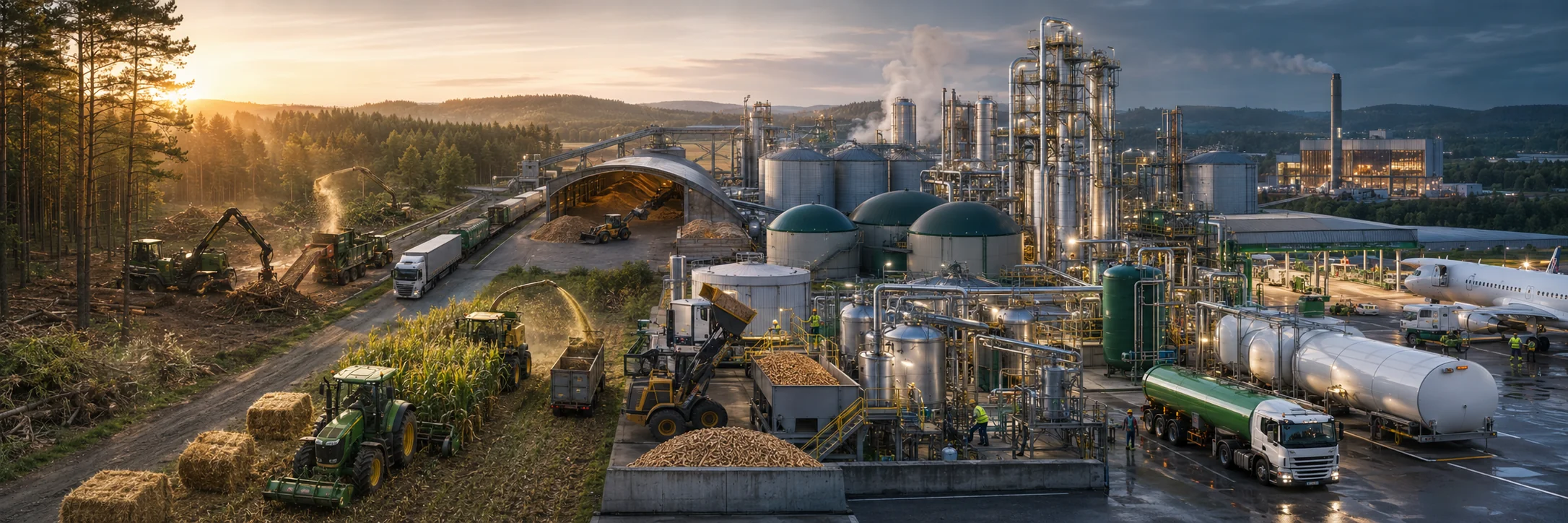
Follow carbon contained in recently living material from its first function through collection, conversion, use, and the land, atmosphere, or material stream to which it returns.
The need is useful service, not biomass tonnage
People and industries do not ultimately require biomass. They require heat at a suitable temperature, motion, electricity at a particular time and place, chemical molecules, cooked food, sanitation, and treatment of organic residues. Biomass can help provide those services because plants store chemical energy and because animals, food systems, forests, farms, and cities continually produce organic material. The US Energy Information Administration groups direct combustion, thermochemical conversion, chemical conversion, fermentation, and anaerobic digestion under biomass energy, but those routes do not deliver the same physical output.
A mill can burn its own bark and black liquor for process heat. A vehicle can use an ethanol blend. A digester can stabilize part of a wet organic stream while producing biogas. A refinery can turn fats or oils into a hydrocarbon fuel. These uses may be valuable under present equipment and resource conditions. None establishes a biological requirement for a particular crop area, pellet shipment, blending volume, or fuel certificate.
Present demand contains both physical need and organized demand. Existing boilers, engines, aircraft, pipelines, waste systems, blending rules, procurement contracts, and settlement methods determine which forms of stored carbon are commercially useful. Better buildings, electrified processes, public transport, different freight patterns, food-loss prevention, material reuse, and another waste-treatment route could change the required fuel volume without changing the underlying service. Biomass can be necessary in a current system without making the current product mix or scale inevitable.
Biomass is not one fuel
Wood chips, dry pellets, corn kernels, sugarcane juice, straw, sewage sludge, manure, landfill gas, used cooking oil, and separated food waste share biological origin. They do not share moisture, ash, particle size, energy density, carbohydrate structure, lipid content, contamination, degradability, storage behaviour, or suitable equipment. Calling all of them biomass is useful for classification and dangerous for engineering.
A wet tonne can contain mostly water or mostly dry matter. A dry tonne can contain accessible sugar, resistant cellulose and lignin, oil, protein, minerals, soil, salts, or plastics. A boiler needs a predictable heating and ash behaviour. A fermenter needs accessible carbohydrates and microorganisms able to convert them. A hydrotreating unit needs fats or oils within limits for water, metals, phosphorus, and other impurities. A digester needs biodegradable material with a composition its microbial community can tolerate. Conversion readiness depends on condition and composition, not biological origin alone.
The Department of Energy's feedstock-conversion research therefore examines composition, structure, flow, variability, and behaviour from handling into the reactor. A feedstock specification is not administrative decoration. It states which physical material a conversion system can actually accept.
Plants use sunlight, water, carbon dioxide, and nutrients to build sugars and then tissues. Roots, stems, leaves, seeds, oils, bark, and wood perform biological functions before anyone assigns them an energy use. Their composition reflects species, soil, weather, growth stage, disease, and management. Harvest preserves some of that stored chemical energy while ending or redirecting the plant's next biological work.
Growth rates matter, but no single photosynthetic efficiency describes the supply chain. An annual crop, perennial grass, plantation, managed forest, algae system, and processing residue have different boundaries and counterfactuals. Comparing a crop's solar conversion with a photovoltaic module can illuminate land use only if the comparison also specifies the final service, storage, conversion losses, land condition, co-products, and time. Electricity, liquid fuel, process heat, and animal feed are not interchangeable outputs.
Biological growth also depends on nutrient and water cycles that energy accounting can hide. Fertilizer can add accessible nutrients; irrigation can alter water availability; harvest exports carbon and minerals; tillage and traffic can change soil structure. The chemical energy in the harvested material is one output from a living system, not a complete measurement of that system's condition.
Residue is a market category, not an empty function
A residue is material left after another participant has taken its primary product. That does not mean the material was physically idle. Crop stalks can cover soil, reduce erosion, return carbon and nutrients, retain moisture, or become feed and bedding. Forest tops, branches, bark, and dead wood can carry nutrients, protect soil, create habitat, decay, or burn in a disturbance. Manure can fertilize land while also creating methane, odour, pathogen, and nutrient-loading problems. Discarded food may still be suitable for people or animals before it becomes digester feed.
The USDA Natural Resources Conservation Service describes how surface residue and organic matter contribute to erosion control, water infiltration, nutrient cycling, soil structure, and biological activity. Forest Service research likewise finds that the effect of biomass removal depends on site conditions and that low-fertility soils can face greater nutrient risk from more complete removals.
Removal can still be appropriate. Excess material can create fire, disease, handling, methane, or disposal problems; a sawmill residue may already be concentrated beside a boiler; a manure lagoon may emit methane that can be captured. The decisive question is not whether the material is called waste. It is which quantity can leave, in what condition, without destroying a more important current or future function.
Harvest changes the next carbon and nutrient cycle
Purpose-grown feedstock makes the land decision explicit. A field or forest can provide food, feed, fibre, timber, habitat, water regulation, stored carbon, recreation, or energy feedstock in combinations that vary over time. Some uses coexist; others displace one another at the same moment. Land competition is therefore real but conditional. It is strongest when additional fuel demand changes crop choice, harvest intensity, or land use, and different when energy uses material already produced by another process.
Even when the crop regrows, the next state is not guaranteed to match the previous one. Soil carbon, fertility, water, species mix, disturbance, and future management affect the result. Replanting records an action. It does not establish survival, equivalent growth, restored habitat, or the carbon stock that would have existed without the harvest.
Market effects can extend beyond the supplying field. A crop redirected from food or feed can be replaced by another producer, another crop, a co-product, lower consumption, or land conversion elsewhere. These responses are difficult to observe from a shipment certificate because they occur through prices and decisions across many locations. That uncertainty is not a reason to assume no effect; it is a reason to state the comparison and evidence.
Moisture is cargo and process condition
Water in biomass contributes mass without the same combustible energy as dry matter. It changes storage stability, grinding, flow, microbial activity, transport, and conversion. In combustion, water must be heated and evaporated before useful heat remains. In some biochemical systems, water is necessary to move material and support microorganisms. Drying can improve transport and combustion while consuming heat and risking dust or fire. Dewatering wet waste can reduce transport mass while producing a liquid stream that still needs treatment.
This is why wet mass, dry mass, and energy content must remain separate observations. A truck scale establishes gross mass. A moisture sample estimates water in a defined sample. Calorimetry measures heating value under a test condition. Compositional analysis estimates ash, carbohydrate, lignin, oil, or other constituents. None alone establishes reactor yield or delivered service.
Densification changes the logistics without creating carbon. Pellets, briquettes, bales, chips, slurries, and oils fit different bins, conveyors, trucks, vessels, and feeders. Size reduction and densification consume power and can make dust. Washing can lower ash or contaminants while moving them into wastewater. Preprocessing makes feedstock more uniform by creating additional material and energy obligations.
Storage is controlled biological change
Harvest does not stop biology. Wet biomass can respire, ferment, rot, heat, lose dry matter, change pH, grow mould, produce gases, or in some conditions contribute to fire. Oils can oxidize. Pellets can absorb moisture and break down. Drying, cooling, covered storage, ventilation, ensiling, chemical treatment, inventory rotation, and fire protection are different ways of controlling those changes.
The Department of Energy's feedstock logistics program treats seasonal storage, moisture management, degradation, material loss, and fire risk as part of making biomass conversion-ready. A storage receipt proves that material entered a facility. Retained dry matter, current moisture, hot spots, microbial condition, and downstream convertibility require further observation.
Seasonality creates another mismatch. Harvest can arrive over weeks while a refinery, digester, or boiler is designed to operate through the year. Storage is the buffer between biological production and continuous industrial utilization. Larger inventory can protect reactor uptime but also holds more money, land, fire exposure, and material at risk of degradation.
Biomass commonly begins dispersed. Increasing conversion capacity requires more material, higher yield per hectare, additional feedstock types, or a larger catchment. As collection extends outward, average distance and the number of farms, forests, waste generators, specifications, contracts, and road movements can rise. A large reactor can have lower money cost per unit when well utilized while requiring a more complex and variable supply system to keep it full.
Local concentration changes the calculation. Bark beside a sawmill boiler, black liquor inside a pulp mill, biogas at a wastewater plant, or wet distillers grains near livestock can avoid a transport or drying step that would be necessary in a distant market. The same material can be a useful local fuel and a poor long-distance commodity. Geography follows feedstock density, moisture, season, existing process heat, roads, pipelines, land application, and alternative users—not only crop yield.
A nominal resource estimate does not establish accessible supply. Some material cannot be removed without harming soil or another use. Some lies beyond an economical or permitted collection radius. Some arrives at the wrong moisture or season. Some lacks reliable ownership or contamination records. The reactor receives only the fraction that is physically, legally, organizationally, and financially reachable.
Conversion routes preserve different functions
Conversion is not a generic box placed after collection. Feedstock structure determines which bonds must be broken, which impurities matter, which microbes or catalysts can work, and which products can be separated. Four broad paths make the differences visible: release heat from relatively dry solids; ferment accessible carbohydrate; transform fats and oils; or digest wet biodegradable material without oxygen.
Plants can combine paths. A biorefinery may burn lignin for process heat, ferment sugars, recover carbon dioxide, and sell a nutrient-bearing co-product. A wastewater facility may digest sludge, burn biogas, and return or dispose of biosolids. Integration can use one stream to support another, but it also couples their reliability. Losing a co-product outlet or boiler can constrain the primary fuel even when the main reactor is available.
Combustion oxidizes biomass to release heat, leaving flue gases and ash. The heat can serve a kiln, boiler, district system, or steam turbine. Performance depends on moisture, particle size, ash chemistry, contaminants, furnace design, air control, and heat demand. A megajoule in dry wood is not automatically a megajoule delivered to a building or process; conversion and distribution intervene.
Gasification uses restricted oxygen or steam to produce a gas rich in carbon monoxide and hydrogen. Pyrolysis heats material with little or no oxygen to produce char, gases, and bio-oil. DOE's overview of thermochemical conversion shows that these intermediate products still require cleaning, conditioning, separation, or upgrading before many final uses. Tar, ash, alkali metals, chlorine, sulfur, and variable composition can damage catalysts and equipment.
Combustion also creates air-pollution controls, not only carbon accounting. Feedstock and equipment affect particulate matter, nitrogen oxides, carbon monoxide, organic compounds, and ash. A renewable origin does not establish clean combustion, and a stack-compliance record does not describe land or carbon consequences upstream.
Yeast can ferment accessible sugars into ethanol and carbon dioxide. Starch crops first require milling and enzymes to release fermentable sugar. Sugar crops begin closer to fermentation. Cellulose and hemicellulose are protected by plant structure and lignin; pretreatment and enzymes must expose and break them down, while inhibitors and variable material can reduce yield. The distinction is physical, not merely a label between conventional and advanced fuel.
The EIA's ethanol overview distinguishes starch, sugar, and cellulosic routes and notes their different commercial status and fuel use. Fermentation is followed by distillation and often dehydration, both of which require energy. Fuel ethanol is commonly denatured where distribution rules require it, then transported, blended or supplied to compatible equipment, and kept within water and product specifications.
Corn does not become ethanol alone. Fermenting its starch leaves protein, fibre, fat, minerals, water, and microbial material in distillers grains and solubles; carbon dioxide is another stream. USDA ERS identifies distillers grains as a major ethanol co-product. Their actual feed use can offset other feed production, but the amount displaced depends on composition, animal ration, moisture, transport, and market. Allocation on a lifecycle spreadsheet is not proof of physical substitution.
Vegetable oils, used cooking oils, and animal fats can enter more than one fuel route. Transesterification produces fatty-acid methyl ester biodiesel plus a glycerol-bearing stream. Hydrotreating removes oxygen with hydrogen and produces hydrocarbon fuels such as renewable diesel and some jet-fuel components. The routes use related feedstocks but produce molecules with different properties and infrastructure compatibility.
EIA explains that biodiesel and renewable diesel differ: biodiesel is generally blended and its feedstock affects cold-flow and stability properties, while renewable diesel is a drop-in hydrocarbon fuel that requires hydrogen and upgrading. A drop-in specification can make the final fuel compatible with an existing engine and pipeline. It does not make the feedstock supply, hydrogen source, land effect, or refinery emissions equivalent to petroleum diesel.
Used oil is not impact-free merely because the crop was grown for an earlier use. Collection, contamination, cleaning, alternative uses, and the previous disposal route still matter. Rising fuel demand can raise the price of used oils and animal fats, change their movement from feed, soap, oleochemicals, or other uses, and eventually draw in more purpose-grown oil. The marginal feedstock can differ from the one named in a single batch.
Anaerobic digestion uses microbial communities to break down biodegradable material without oxygen. It produces raw biogas—mainly methane and carbon dioxide with water and trace contaminants—and wet digestate. Manure, sewage sludge, food-processing water, and separated food waste can suit this route because drying them for combustion would move or evaporate large amounts of water.
Raw biogas can provide heat or power locally. Pipeline injection or vehicle use requires upgrading: carbon dioxide, water, hydrogen sulfide, siloxanes, and other constituents may need removal. EIA's biogas description separates raw gas from pipeline-quality renewable natural gas. Methane capture can avoid emissions from an uncontrolled alternative, but leaks in collection, upgrading, storage, or use can erode that result.
Digestion does not remove mineral nutrients. EPA describes digestate as a wet, nutrient-rich output that may be separated or processed further. It can support crop production only when composition, contaminants, pathogens, storage, transport, application timing, land capacity, and regulation permit. A digester solves part of a carbon and waste-treatment problem while leaving a nutrient and water route to complete.
Every conversion creates more than fuel
A reactor separates and transforms material; it does not turn every input into the named product. Combustion creates heat, flue gas, bottom ash, fly ash, and captured pollutants. Fermentation creates alcohol, carbon dioxide, stillage, wastewater, and co-products. Biodiesel creates glycerol-rich material and wash streams. Hydrotreating creates water, gases, lighter hydrocarbons, spent catalysts, and other refinery streams. Digestion creates gas and digestate.
The disposition of these outputs affects both operation and lifecycle claims. A co-product sale can support plant money flow. Captured carbon dioxide may replace another source. Ash or digestate may return some minerals to land. But naming a possible use reveals neither actual quantity, quality, destination, substitution, nor residual harm. If a feed market saturates, a contaminant exceeds a limit, or land application is seasonally closed, the plant can lose an outlet even while its fuel equipment remains operable.
Allocation methods divide emissions or money cost among products for a stated analytical purpose. The physical plant does not allocate. It emits, separates, recirculates, sells, stores, treats, or discards real streams. A complete account keeps the calculation rule separate from the observed route.
When biomass is burned, its carbon dioxide reaches the atmosphere at combustion. If the source system later removes additional carbon through regrowth, that is a separate event occurring across land and time. Annual crops can regrow on a short cycle; forest carbon stocks can respond over decades; residues might otherwise have decayed quickly, slowly, or contributed to soil; waste methane might otherwise have escaped. The atmosphere receives the net sequence, not the renewable label.
National inventories often report biogenic carbon differently from fossil combustion to avoid counting the same carbon in both energy and land sectors. The IPCC explains that treating bioenergy as zero at the energy-sector stack is an inventory convention because related land-stock changes are reported elsewhere. It does not mean no carbon dioxide left the stack or that every feedstock produces the same climate result.
Time matters because carbon in the atmosphere affects climate while it remains there. Permanence matters because fire, harvest, disease, or land conversion can reverse storage. Scale matters because one stand can regrow while a region's total carbon stock falls, rises, or remains stable. A planting record, forest-area total, or sustainability certificate may inform the analysis without by itself measuring the incremental atmospheric result.
The comparison is always against another future
A lifecycle result requires a baseline. If sawdust would have decayed, its rate and destination matter. If manure would have produced methane in an uncovered lagoon, capture may avoid part of that emission. If used cooking oil would have entered animal feed or another industry, fuel production displaces that use. If a tree would have remained growing or entered a long-lived building, immediate combustion gives the carbon a different path. If an energy crop changes land use, the former vegetation and soil matter.
The National Academies' review of life-cycle analysis for transportation fuels distinguishes assigning emissions to a product from estimating how a decision changes total emissions. Both are legitimate questions, but they need different assumptions. A product carbon score can be internally correct for its method while failing to answer what happens if policy expands the entire market.
This is why universal energy-return rankings or claims that all waste feedstock is automatically superior are unreliable. System boundaries can allocate crop production to the main product and give a residue little burden, yet additional residue demand can change harvest, price, land treatment, and alternative use. The relevant result belongs to a defined feedstock, place, time, process, and counterfactual—not to biomass in general.
Renewable is a source classification, not a lifecycle result
Renewable usually means that the biological source can be replenished on a human timescale under maintained conditions. It does not establish the replenishment rate, land carbon stock, soil condition, biodiversity, water use, air pollution, methane leakage, nutrient return, or displaced product. A renewable fuel can perform its intended machine function while producing a poor result at another boundary.
Conversely, the complexity of lifecycle accounting does not make all bioenergy claims empty. A mill residue burned where heat is needed, landfill methane captured instead of vented, or food-processing waste digested with a feasible nutrient route can connect an existing material stream to useful service. The evidence must show the relevant alternative and outputs rather than relying on the category.
Energy content, renewable eligibility, carbon intensity, and avoided emissions are four different observations or calculations. The first measures chemical potential. The second applies a rule. The third models a defined lifecycle per unit. The fourth compares with another future. Combining them into one green label destroys the distinctions needed to improve the system.
A continuous plant needs variable biology to become regular supply
Conversion plants often carry large capital and staffing commitments and are designed for defined feed composition and operating ranges. Farms, forests, restaurants, landfills, and wastewater systems produce variable material. Weather changes crop yield and moisture. Seasonal harvest changes inventory. A disease or storm changes forest material. Diet, production, and sorting change waste composition. The plant's economic need for throughput does not make the feedstock uniform.
Contracts can specify dry matter, moisture, ash, contamination, particle size, oil quality, or methane potential. Sampling can reject a load or change payment. Preprocessing can blend sources to make a more regular feedstock. These controls improve operation but shift rejected material, water, ash, and uncertainty elsewhere. A certificate of analysis represents a sample and method; the reactor encounters every delivered particle or fluid.
Scale can reduce the money cost of conversion when the plant stays utilized, yet it can increase catchment, inventory, supplier count, and exposure to correlated crop or policy changes. A smaller local plant may fit a concentrated residue stream but lack upgrading equipment or an outlet for co-products. There is no universally correct scale independent of feedstock geography and output routes.
The fuel must still fit the machine
A combustible liquid or gas becomes usable fuel only when its properties fit the relevant specification, equipment, and storage system. Ethanol, biodiesel, renewable diesel, renewable natural gas, and aviation blending components have different water tolerance, energy per volume, cold behaviour, storage stability, material compatibility, blending limits, pressure, and specifications. Engines, aircraft, burners, pipelines, tanks, terminals, and warranties determine what can enter service.
Many biofuels are used through existing petroleum or gas systems. EIA notes that ethanol is commonly blended with gasoline and that higher blends require compatible vehicles, while renewable diesel can meet the petroleum diesel specification as a drop-in fuel. Compatibility preserves existing equipment and distribution work. It can also preserve demand for the wider vehicle, road, refinery, airport, or heating system in which the fuel is used.
A laboratory fuel property, batch certificate, terminal blend record, and engine performance answer different questions. Fuel meeting a specification can still be contaminated in storage. Lifecycle emissions require another calculation. Seal compatibility comes from fuel properties and equipment requirements, not a carbon score. Useful motion or heat must be observed after delivery.
Money determines which material route remains reachable
A farmer may know that more residue should remain on a vulnerable field while a bale payment makes removal the available source of cash. A waste generator may know prevention or edible redistribution preserves more function while disposal or digestion has the accessible contract. A plant may be able to sell wet co-product locally or spend heat and money drying it for distant transport. A forester may have a residue-reduction objective but no buyer able to mobilize equipment for dispersed material.
Working money and timing decide whether material can be covered, dried, tested, segregated, transported, upgraded, held after an off-specification result, or returned to land at the right time. Policy credits can make a previously unmanaged methane stream financeable. They can also raise competition for a limited fat, oil, residue, or land base. The relevant question is which corrective action becomes possible before decay, harvest, storage, or a contract closes the option.
Plant finance also assigns future throughput pressure. Debt and fixed operating commitments can reward keeping a reactor full even when the next feedstock is farther away or has a more contested alternative use. A low feedstock purchase price may coexist with high soil or disposal consequences outside the transaction. A high credit price may reflect policy scarcity rather than additional useful energy.
A credit can travel separately from the fuel
Policy systems translate qualifying pathways into tradable records. Under the US Renewable Fuel Standard, a Renewable Identification Number is generated with qualifying fuel and can later be separated and traded. EPA explicitly describes RINs as compliance credits that may move with or apart from the batch.
This separation is useful: it lets obligated parties fund renewable fuel use without every physical molecule travelling to the same company that retires the credit. It also defines a measurement boundary. Retiring enough valid, eligible RINs can establish compliance with a defined obligation under program rules. It does not identify which engine used the original molecule, measure a forest's carbon stock, observe methane leakage, prove additional fuel production, or establish a better result than every alternative.
Fuel pathways and carbon-intensity scores likewise join feedstock categories, process energy, yields, transport, co-products, and baselines through models and records. EPA's RFS pathway rules make those definitions explicit. The model can guide procurement and investment only if its assumptions remain connected to changing physical conditions.
Use completes the energy path
The useful result appears after conversion and delivery. A boiler must transfer heat at the temperature a process needs. A generator must produce electricity when the connected system can use it. A vehicle or aircraft must convert fuel into safe motion. A digester may need to provide waste stabilization and methane control as well as energy. Gross fuel energy does not measure these services.
Combustion efficiency, heat recovery, engine efficiency, curtailment, transport distance, auxiliary power, and rejected heat affect the final result. High-temperature industrial heat can be harder to replace than low-temperature building heat. A fuel used in an inefficient legacy device may deliver less service than the same feedstock used in combined heat and power near a steady heat load. The best physical route depends on the service and alternatives, not only on fuel yield.
Use also creates the last emissions before return. Carbon dioxide, water, nitrogen oxides, particulates, unburned methane, and other compounds depend on fuel and equipment. Delivered heat or vehicle distance and air quality require separate measurements; a stack measurement likewise cannot describe land condition. All belong in the account.
The return path carries minerals, water, and contaminants
Carbon may leave through a stack, exhaust, leak, product, wastewater, soil application, or disposal. Minerals do not burn away. Combustion concentrates many into ash and pollution-control residues. Digestion retains nutrients in digestate. Fermentation concentrates some non-starch components in co-products and creates wastewater. Pretreatment can move salts, acids, metals, and organic compounds into liquid or solid streams.
Return to land can close part of a nutrient loop only when the material is suitable, the receiving soil needs it, contaminants are controlled, timing and rate fit crop uptake, and transport is feasible. Ash is not universally fertilizer. Digestate is not automatically harmless. Captured carbon dioxide is not permanently stored merely because it was separated. Disposal can control one hazard while abandoning nutrients or carbon.
Waste prevention and preservation of existing material function often sit upstream of energy recovery. Suitable food fed to people preserves more food function than digestion. Reusing wood preserves manufactured form and stored carbon before combustion. Returning crop residue may preserve soil function. Energy recovery becomes appropriate after those possibilities are evaluated, not because energy is the only measurable output.
Biomass supply begins before the energy contract. It begins with a crop, forest, food, animal, wastewater, or industrial system performing another function. It continues through removal, collection, preprocessing, storage, conversion, co-products, qualification, transport, final equipment, emissions, and return. At every boundary, mass, dry matter, energy, carbon, nutrients, water, identity, and money can follow different paths.
A complete account therefore asks what the material would otherwise have done; which service the fuel actually delivered; which land, feed, food, material, or waste function changed; and where every output went. It keeps a weighbridge ticket, moisture result, sustainability claim, pathway score, RIN, stack measurement, and land observation separate enough to show what each establishes. It connects information, material resources, working money, and authority to the people able to change the next harvest, load, process, fuel, use, or return route.
Biomass is neither automatically beneficial because it regrows nor automatically unsuitable because some routes use land and processing energy. Its physical result depends on a specific feedstock, prior function, counterfactual, conversion, service, and time. The decisive achievement is not renewable tonnage. It is useful service delivered while the connected carbon, nutrient, water, ecological, and residual consequences remain observable and correctable.
Inside CompanyGraph
Map where prior material function, feedstock identity, moisture, land condition, storage loss, reactor compatibility, co-product outlets, carbon assumptions, fuel specification, policy credits, delivered service, and return routes become separated—and which organizations can reconnect them before useful material decays, a plant loses balance, or a renewable claim outruns the physical result—inside CompanyGraph.