 CompanyGraph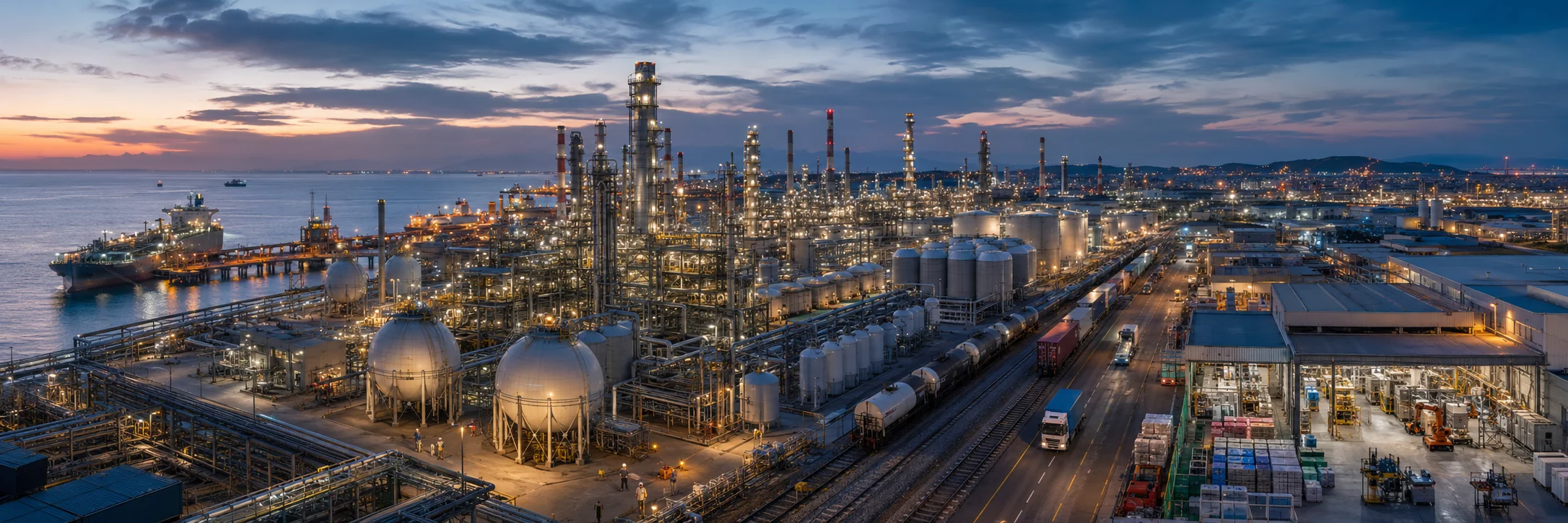
Follow hydrocarbon feedstocks through cracking, separation, derivatives, conversion, use, and recovery. The same chemistry that creates useful materials also fixes co-products, service life, and recovery limits.
A petrochemical chain begins with a material function: a barrier, fiber, solvent, coating, adhesive, detergent, coolant, or chemical intermediate. Feedstock and cracker design then narrow which molecules can be made, downstream reactions narrow which properties can be delivered, and product design determines how long the material remains useful and whether it can return to production.
The route crosses gas processing, refining, chemical plants, converters, users, collection systems, and waste handlers. At each stage, a specification can preserve a needed property while the same decision can make later repair, recovery, or exposure control harder.
The feedstock arrives with another industry’s history
Ethane and propane are hydrocarbon gas liquids separated from natural gas processing or refining. Naphtha is a crude-oil fraction produced in a refinery. These streams already carry decisions about wells, gathering, fractionation, refinery configuration, sulfur removal, storage, and transport before a cracker receives them. Methane leakage during extraction and processing, land and water disturbance, refinery emissions, and the energy used to condition the feedstock belong to this history even when the chemical plant does not record them as its own inputs.
The U.S. Energy Information Administration identifies ethane, propane, butanes, and naphtha as cracker feedstocks that can yield ethylene, propylene, butadiene, and other olefins. Feedstocks can be physically interchangeable only within a plant’s equipment and operating range. Ethane is used almost exclusively for petrochemical cracking in the United States, so recovery, storage, and dedicated pipeline capacity depend on a chemical customer being ready for it.
EIA reported record U.S. ethane production, consumption, and exports in 2024, with higher cracker operating rates driving domestic consumption. A gas processor can recover ethane, send it to a cracker, export it, or leave it in the natural-gas stream when the physical and commercial route is unavailable. The molecule has not changed, but the available use has.
Cracking makes a slate, not a chosen product
A steam cracker mixes feedstock with steam and heats it rapidly in furnaces. The heat breaks hydrocarbon molecules into smaller olefins and other products. Quenching stops the reactions; compression, drying, acid-gas removal, and fractionation then prepare the streams for separate users.
Ethane cracking tends to produce a high share of ethylene. Naphtha and heavier feedstocks produce a broader slate that includes more propylene, butadiene, and aromatic compounds. A plant can adjust feed blend or throughput within limits, but it cannot ask the furnace for only the molecule whose price is highest. Feedstock composition, furnace design, separation columns, heat integration, and operating conditions constrain the output mix.
Separation creates saleable chemical streams
The cracked gas is not yet a shipment of polymer feedstock. It passes through compression, cooling, drying, acid-gas removal, and fractionation columns that separate methane, ethylene, ethane, propylene, propane, butadienes, and aromatics. Each stream leaves with a purity specification, pressure, temperature, storage requirement, and destination.
Cracking, separation, storage, loading, and derivative production can release volatile organic compounds and hazardous air pollutants, including benzene, 1,3-butadiene, ethylene oxide, ethylene dichloride, and vinyl chloride. Valves, tanks, pumps, loading equipment, and flares are physical sources that require leak detection, maintenance, enforcement, and corrective work. EPA’s chemical-plant standards identify these pollutants and require fenceline monitoring for covered processes. A permit describes allowed conditions; it does not itself prevent a leak or establish what workers and nearby communities have breathed.
A purity assay can establish the composition of a sampled stream. It does not establish the condition of every pipe, compressor, valve, or storage tank that carried it, and it does not show whether a downstream catalyst will remain within its operating limits. EPA’s ethylene-production rules address emissions from defined process units, heat-exchange systems, and waste operations. The regulation observes specified sources; it does not collapse the entire chain into one environmental number.
Petrochemical plants produce carbon dioxide from process energy and combustion, wastewater, spent caustic, catalyst residues, off-specification material, flared or vented gases, and heavy fractions. Converters and users add scrap, contaminated packaging, mixed polymers, additives, and products that are difficult to collect. A sale transfers the material; it does not make these streams disappear.
EPA identifies process emissions and other regulated outputs from petrochemical production. A complete route therefore includes feedstock recovery, chemical production, conversion, use, collection, treatment, and the management of residues that no buyer wants.
A derivative fixes the next function
Ethylene can be polymerized into polyethylene, oxidized into ethylene oxide, or converted through intermediate chemistry into products such as vinyl chloride and styrene. Propylene can become polypropylene, acrylonitrile, or propylene oxide. Benzene and other aromatics feed styrene, phenol, nylon intermediates, solvents, and coatings. The reaction, catalyst, temperature, pressure, and purification route create properties that a converter later relies on.
Polymerization is not just a change of name. Molecular weight, branching, crystallinity, additives, and processing history affect strength, flexibility, barrier performance, heat resistance, and how the material can be welded, molded, or recycled. A polyethylene resin for film is not interchangeable with a resin for pressure pipe because the downstream function and qualification differ.
Not all petrochemicals become solid plastic. Ethylene glycol and other liquid intermediates enter coolants, polyester, and solvents; propylene derivatives enter coatings, foams, adhesives, and detergents; aromatic compounds feed solvents, resins, and synthetic fibres; and petrochemical chemistry produces synthetic rubber and surfactants. Their end routes may involve solvent recovery, wastewater treatment, controlled destruction, incineration, or environmental dispersal rather than pellet sorting.
The same chemical may also perform different work after formulation. Plasticizers can make a polymer flexible; stabilizers can protect it from heat or ultraviolet light; pigments and fillers change appearance and stiffness. Those additions help the first use but can complicate later sorting, reprocessing, or safe disposal.
Pellets become products only in the converter
Polymer pellets and liquid intermediates are shipped to converters that extrude film, mold containers, blow-mold bottles, spin fiber, coat surfaces, or compound several materials. The converter controls temperature, residence time, shear, cooling, tooling, and geometry. A resin specification does not guarantee a finished product if the machine, moisture, mold, die, or process window is wrong.
The final object then carries a service history. Repeated heating, ultraviolet exposure, stress, contact with chemicals, contamination, and repair can change the polymer or its additives. A pipe, cable jacket, medical component, or food package may remain useful for years; a thin film may be used for minutes. Products made from the same mass of polymer can provide radically different service lives.
Material can also be lost before collection. Tyre abrasion, synthetic textile fibres, paint wear, road-marking wear, pellet losses, and fragmentation release polymers during production and use. The OECD identifies these pathways as contributors to plastics leakage and microplastic pollution. Once dispersed, the material is not available to ordinary household recycling.
Co-production ties markets together
Crackers are usually run to serve the economics of a major product such as ethylene, but the furnace and separation train produce other streams at the same time. Demand for polyethylene can therefore influence the supply of propylene or butadiene even when their own markets are stronger or weaker. On-purpose propylene plants and other routes can loosen that connection, but they require different feedstocks, equipment, and energy.
This coupling also changes how disruption travels. If a gas plant cannot deliver ethane, the cracker may cut throughput and reduce several downstream streams together. If an ethylene derivative unit stops, the cracker may still run and send material into storage, export, or another derivative. If storage or another customer cannot absorb the material, the cracker may have to reduce throughput. Flaring can handle gases during startups, shutdowns, and abnormal conditions, but it is not a normal substitute for a downstream market. A shortage of one polymer is not evidence that the upstream complex lacks all hydrocarbons; it may reflect a missing catalyst, derivative plant, grade qualification, port route, or converter.
Petrochemical plants cluster in integrated complexes
Crackers and derivative plants cluster near feedstock, pipelines, cooling water, storage, ports, and other chemical users. Ethylene and other reactive intermediates are expensive and hazardous to move over long distances, so integrated complexes exchange them through short pipelines. Bulk polymers and stable chemical products can then travel globally as pellets, liquids, powders, or packaged goods.
Integration reduces some transfers and allows heat, hydrogen, fuel gas, and co-products to be used within the site. It also concentrates risk. A storm, flood, power failure, feedstock interruption, or damaged dock can affect several linked plants at once, disrupting downstream users, exposing workers and nearby communities to releases, and leaving owners with stranded equipment and unusable inventory. EPA’s chemical-plant rule connects covered processes, fenceline monitoring, and risks to nearby communities. The complex’s inventory may be full while the exact resin grade, additive, catalyst, or transport route a converter needs is unavailable.
Prices and contracts shape production decisions
Ethane recovery is a concrete example. A gas processor recovers, stores, exports, or leaves ethane in the natural-gas stream according to available fractionation, pipeline, storage, customer, and price arrangements. EIA documents this relationship directly: U.S. ethane is used almost exclusively by petrochemical crackers, and changes in cracker operating rates change ethane consumption. Money has changed which physical route the molecule takes.
The February 2021 Texas freeze shows how a physical interruption crosses this network. EIA reported outages at most Gulf Coast petrochemical plants; gas deliveries to industrial users were halted, all Texas crackers and some Louisiana plants shut down unexpectedly, and U.S. ethane consumption fell by 654,000 barrels per day from January. Slow restarts and damage at some plants reduced feedstock demand for weeks and affected downstream ethylene users.
Continuous-process economics create a second pressure. A cracker and its derivative units carry large fixed equipment commitments; stopping, restarting, qualifying a new grade, or holding unsold co-products consumes time, energy, storage, and working money. An offtake contract, shared storage, or a funded qualification run can keep a route open, while a missing customer or full tank can force a throughput reduction even when feedstock is available.
Revenue generally rises with material sold, so throughput, repeated sales, and lower unit costs are financially attractive. In some facilities, that can make a short-lived product easier to finance than a collection-and-reuse system whose revenue is delayed; the IEA forecast describes demand growth, not the cause of any individual financing decision. Pollution, health, and disposal can still fall outside the producer’s contract. The IEA’s 2025 assessment forecasts petrochemicals to become the dominant source of global oil-demand growth from 2026 and projects polymer and synthetic-fibre production to require 18.4 million barrels per day by 2030.
Recycling must preserve the right function
Mechanical recycling can preserve polymer function when a stream is collected, sorted, washed, and reprocessed without unacceptable contamination or degradation. It works best when the material is identifiable and concentrated. A mixed, dirty, multilayer, or additive-rich stream may instead be downcycled, chemically treated, burned for energy, or disposed of.
Chemical and thermal routes can break polymers into oils, monomers, or other feedstocks, but their performance depends on feedstock purity, sorting and pretreatment, energy use, product yield, residues, and whether the output actually displaces virgin feedstock or becomes lower-value fuel. They do not automatically recreate the same certified polymer or finished product. Extending the service life of a pipe or reusing a container preserves more completed manufacturing work than reducing mixed waste back to oil or basic chemicals.
Inside CompanyGraph
Explore gas processors, refineries, feedstock traders, crackers, fractionation and separation units, derivative producers, resin distributors, converters, brand owners, recyclers, waste handlers, ports, utilities, regulators, financiers, and communities near chemical complexes. CompanyGraph can map where feedstock becomes a constrained chemical slate, where a resin becomes a product, and where responsibility for exposure, collection, or recovery separates. It cannot by itself prove a polymer’s present performance, a waste stream’s final fate, or the complete emissions and health condition of a complex.