 CompanyGraph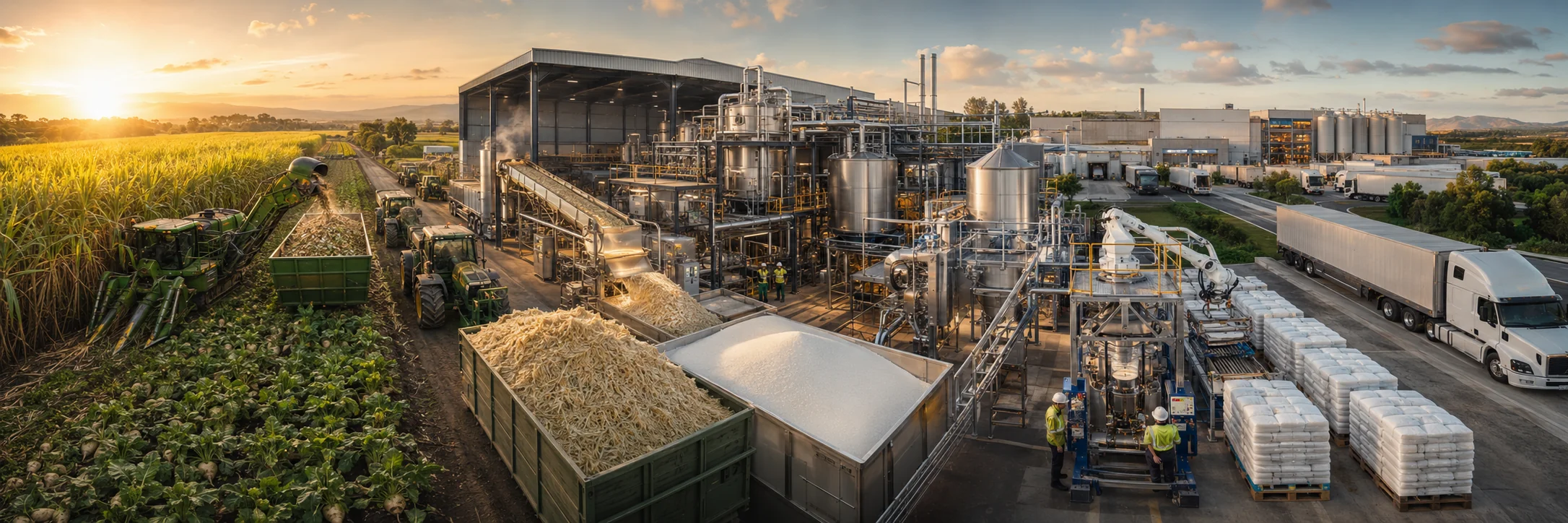
Follow sucrose from a living cane stalk or beet root into a uniform crystal, and see what concentration makes possible—and what it disconnects.
From leaf to crystal and back into solution
Sugarcane and sugar beet begin with sunlight, carbon dioxide, water, and nutrients. Their leaves make carbohydrates through photosynthesis, and the plants store part of that chemical energy as sucrose dissolved in water-filled cells. Cane holds much of it in tall fibrous stalks. Sugar beet stores it in a swollen root. Neither crop leaves the field as the dry, uniform product found in a kitchen or food factory.
Harvested cane moves quickly to a nearby mill, where rollers or a diffuser release its juice. Beets can sometimes wait in cool storage piles before a factory washes, slices, and diffuses them in hot water. Both juices are cleaned, concentrated by evaporation, brought to supersaturation, seeded with crystals, and spun in centrifuges that separate crystals from the remaining syrup. Cane raw sugar may then travel to a separate refinery to be washed, melted, clarified, decolorized, crystallized again, dried, and graded.
The finished sucrose moves in bulk vessels, railcars, trucks, bags, or liquid tankers to ingredient distributors, food and drink manufacturers, fermentation plants, retailers, and kitchens. There it is dissolved, baked, boiled, frozen, browned, fermented, eaten, spilled, or washed away. The plant created the molecule; the supply chain progressively separates it from its biological setting, moves it, and gives it new functions.
The crystal is useful; the body does not require it
Human bodies need energy and material for growth, repair, temperature regulation, movement, and organ function. They can obtain that energy from several dietary sources. Digestive enzymes break down carbohydrates, and the small intestine absorbs simple sugars that the liver and other tissues store, transform, or use. The U.S. National Institute of Diabetes and Digestive and Kidney Diseases describes sugars alongside amino acids, fatty acids, and glycerol as usable inputs for energy, growth, and cell repair.
Sucrose supplies glucose and fructose after digestion, but refined sucrose is not a distinct dietary requirement. Starches, naturally occurring sugars in foods, and other energy sources can contribute to the same larger need. The European Food Safety Authority concluded that added and free sugars should be as low as possible within a nutritionally adequate diet, while also stating that available evidence did not support a precise tolerable upper intake level.
This does not make every molecule of dietary sugar equivalent in use or context. “Free sugars” include sugars added during preparation and those naturally present in honey, syrups, fruit juices, and fruit-juice concentrates; total sugars also include those naturally present within intact fruit, vegetables, and milk. The World Health Organization’s free-sugars guideline uses these categories when recommending lower intake. Its separate carbohydrate guidance addresses food source, fibre, and digestibility rather than treating all carbohydrate as free sugar.
The distinction matters to the supply chain. Biological energy need does not create a tonne-for-tonne floor under refined sugar demand. Present demand is enlarged by beverage and food recipes, portion and concentration, shelf-life arrangements, industrial fermentation, and the ability to move a cheap, stable ingredient through long distribution systems. Some of that sugar performs real technical work in the product as presently designed. Some can be reduced when recipes, preservation methods, distribution, and patterns of consumption change.
Cane starts a clock; beet starts a storage problem
Cane and beet contain the same target molecule but do not offer the factory the same time. A cut cane stalk is wounded living tissue. Its own enzymes continue acting, microorganisms enter damaged surfaces, and sucrose is consumed or converted into compounds that can interfere with processing. Billet harvesting creates more cut surfaces than whole-stalk handling. Heat, injury, infection, and delay all affect the rate, so there is no single universal number of safe hours.
The consequence is nevertheless firm: cane cannot be held like dry grain. USDA Agricultural Research Service work identifies cut-to-crush delay, injury, environment, and infection as interacting causes of postharvest deterioration. A refinery can remove color from later sugar; it cannot recreate sucrose already consumed between harvest and crushing.
Sugar beets give processors more storage time, especially in cold climates, but the root does not become inert. It respires, using sucrose to maintain living tissue. Wounding, dehydration, heat, and rot accelerate loss and can create compounds that make extraction harder. USDA research on postharvest sugar-beet degradation describes exposed storage piles lasting far longer than cane storage while still losing recoverable sucrose through respiration, disease, and physical deterioration.
Cold air, ventilation, careful piling, disease control, and processing order can slow beet losses. They also require suitable weather, fans or buildings, monitoring, pile space, electricity, and a factory able to slice the roots before conditions deteriorate. Cane’s constraint is rapid delivery; beet’s apparent flexibility becomes a problem of storage condition and campaign length.
The mill and the field share one queue
A cane mill draws from a limited surrounding area because long transport consumes time and moving water-heavy stalks consumes vehicles and fuel. Harvest crews, loaders, trucks, weighbridges, sampling stations, cane yards, crushers, boilers, and downstream equipment must keep approximately the same physical rhythm. If trucks arrive faster than the mill can receive them, cut cane waits. If the mill lacks cane, expensive continuous equipment and workers wait. If a breakdown lasts, growers may have to leave mature cane standing or watch harvested cane deteriorate.
No grower independently controls that rhythm. Harvesting requires labor or machinery, fuel, field access, and transport; the mill assigns or negotiates delivery windows and has finite unloading and crushing throughput. Rain can close a field while the factory remains ready. A factory stoppage can close the delivery route after a grower has committed the harvest expense. Money must be available before the crop becomes saleable sugar, so scheduling and working money determine which physically sensible response is actually available.
Payment systems often try to recognize that a tonne of cane is not a tonne of sucrose. The South African Sugar Association’s recoverable-value system, for example, samples deliveries for sucrose, non-sucrose material, and fibre, then estimates the sugar and molasses that can be recovered. That is more informative than gross weight alone. It still estimates a consignment from a sample and a formula; it does not identify exactly when every loss occurred or whether a queue controlled by several parties caused it.
Beet processors coordinate a different queue. Harvest may be concentrated into weeks while slicing continues for months. Which roots enter long storage, which are processed first, and when piling stops during warm weather can matter more than road distance alone. Field and factory remain one physical process even when contracts, crop ownership, transport, and storage accounts divide them.
The factory does not make sucrose
At a cane mill, knives and shredders open the stalk and rollers squeeze out juice. Water or recycled juice can be sent against the moving fibre to wash out more dissolved sugar, a practice called imbibition. The fibrous material leaving extraction is bagasse. Heat and lime help the juice form particles that can be settled or filtered; evaporators then remove much of its water. Vacuum allows the concentrated syrup to boil at lower temperatures, limiting damage while the solution is brought to the point where seeded sucrose can grow as crystals.
Beet processing reaches a similar liquor by a different path. Factories wash the roots, slice them into thin strips called cossettes, and pass water through them in a diffuser. Sucrose moves from the cells into the water, leaving wet beet pulp. Lime and carbon dioxide help remove non-sugars, after which evaporation, vacuum boiling, seeding, crystallization, centrifuging, drying, and cooling produce white crystals. The EPA’s separate descriptions of cane processing and beet processing show the shared concentration sequence and the different solid residues.
Every stage has a physical boundary. More wash water can recover more sucrose from fibre but creates more dilute juice to heat. Higher evaporation temperatures or longer residence can damage sugar and color. Better clarification removes material that would obstruct crystallization, yet the filter cake can carry some sucrose away. Centrifuges separate crystals from syrup but need crystals of a suitable size and a massecuite—a mixture of crystals and mother liquor—that can still flow.
“Yield” therefore needs a named object. Crop tonnes per hectare, sucrose concentration in the crop, recoverable sugar at delivery, extraction from cane or beet, crystals packed by the factory, and saleable food made from those crystals are different ratios. A heavier crop can contain a lower sugar concentration; a high-sucrose delivery can still lose material in extraction; more crystals can be recovered while using more water, steam, chemicals, or time. The useful measure depends on the transformation being controlled.
Each crystal changes the liquid left behind
Crystallization does not pull every sucrose molecule from syrup in one step. The first crop of crystals leaves a mother liquor containing remaining sucrose plus glucose, fructose, salts, color compounds, and other non-sugars. Reboiling and seeding can produce another crop, but the remaining liquid becomes more concentrated in substances that hinder further crystallization. Eventually the material and energy required to recover another crystal exceed what the installed process and intended product can accept. The final syrup is molasses, not a liquid with no useful carbon left.
That remainder can become animal-feed ingredient, fermentation substrate, yeast, rum, citric acid, or ethanol. Bagasse can fuel boilers that provide mill steam and electricity or enter fibre products. Beet pulp can be pressed, dried, and sold as feed. Filter cake may return organic matter and minerals to land where its composition and transport permit. The EPA process map treats these as real co-products and residues rather than pretending the crystal is the whole crop.
A possible use is not a completed use. Wet pulp spoils and is expensive to move unless pressed or dried. A mill can burn bagasse only with suitable boilers and emission controls. Molasses needs storage, a buyer, or fermentation equipment. Filter cake must be handled and applied without moving contaminants or nutrients to the wrong place. A co-product’s money price can make recovery feasible, but the label “co-product” does not establish that its material function was actually preserved.
Cane juice and molasses also connect sugar to fuel. A mill with fermentation and distillation equipment may direct part of its fermentable material toward ethanol, and policy and relative prices can alter that split. The Brazilian government’s cane harvest reporting tracks sugar and ethanol together for this reason. The flexibility is real but bounded: plant configuration, fermentation capacity, crystal commitments, storage, and energy needs prevent every tonne from switching products without limit.
Uniform crystals travel farther than living crops
Raw cane sugar is already crystalline and transportable, but a thin film of molasses remains around the crystals. A separate refinery can wash that film away in affination, melt the crystals into syrup, clarify and decolorize the liquor, then crystallize, centrifuge, dry, cool, and screen the sugar again. Some cane facilities integrate these steps or make direct-consumption sugar at the mill. Beet factories commonly produce white sugar without shipping a raw crystal to a distant refinery.
The resulting product is deliberately uniform. Sucrose from a cane stalk and sucrose from a beet root perform the same chemistry. Dry crystals can be stored far longer than either harvested crop and can be blended into large lots. Refining and aggregation therefore expand substitution across origins: a buyer can specify a grade, crystal size, package, and delivery date without designing a recipe around a particular field.
The crystal itself carries little evidence of that field. Lot records may preserve factory, date, supplier program, or certified production claim, and segregation can retain identity where buyers fund it. Bulk storage, remelting, and blending can combine many farms and processing runs. Improving the record can keep selected history reachable; it cannot make the molecule reveal water use, soil condition, harvest delay, or working conditions that the chain did not observe.
The same uniformity shapes price. A quoted sugar price refers to a defined grade, location, contract, currency, and delivery period. Tariffs, quotas, support programs, freight, finance, and fuel policy affect which crystals reach that point and which actions remain viable upstream. The price is consequential, but it is not a measurement of sunlight, water, soil loss, storage respiration, factory steam, nutrition, or the complete material result.
Food manufacturers buy behavior, not sweetness alone
Sucrose tastes sweet, but sweetness is only one reason a manufacturer buys it. Dissolved sugar adds solids and viscosity. It controls crystal structure in confectionery, affects freezing point in frozen foods, feeds yeast in fermentation, contributes color and aroma during heating, supplies bulk, and changes how water is available to microorganisms. Which functions matter depends on the recipe and process.
Preservation illustrates the boundary. A concentrated sugar solution binds part of the water in a food and can reduce water activity—the water available for microbial growth. The U.S. Food and Drug Administration explains that sugar is commonly used to control water activity, while also requiring the finished formulation and temperature to be related to a measured result. A sugar percentage alone does not establish that a jam, filling, or sauce is shelf-stable.
A high-intensity sweetener may replace sweetness with very little mass but cannot automatically replace fermentation substrate, browning, bulk, or water binding. Starches, fibres, polyols, other sugars, refrigeration, heat treatment, packaging, or a shorter shelf life can supply some of those functions, each with different equipment and material consequences. Reformulation is therefore a physical redesign, not simply a purchasing decision. This is why some present sugar demand can be reduced while some remains tied to what the product and distribution system are expected to do.
Ingredient buyers specify the properties relevant to their process: granulation, polarization (an optical estimate of sucrose content), moisture, color, ash (an estimate of inorganic mineral content), flow, package condition, and sometimes microbiological limits. The Codex standard for sugars distinguishes white, powdered, soft, brown, raw, and liquid sugar products rather than treating all saleable sugar as one object. A conforming certificate establishes the sampled product against those requirements. It does not establish the behavior of the complete recipe, the amount a person will consume, or the history excluded from the specification.
Once dissolved, recovery changes character
A clean dry spill can sometimes be swept, screened, or reprocessed. A segregated stream of sweet water inside a refinery may be returned to a melter or vacuum pan. Once sugar is diluted into floor washings, mixed with soil and cleaning chemicals, baked into discarded food, fermented, or consumed by microorganisms, recovering it as food-grade crystals requires a different separation problem and may no longer be safe or materially sensible.
Dissolved sugar is not harmless merely because it is biodegradable. Microorganisms consuming organic material in water also consume oxygen. The EPA regulates biochemical oxygen demand, suspended solids, pH, and other conditions in sugar-processing effluent because a lost product can become a downstream treatment load. Preventing a concentrated leak, returning clean sweet water, and biologically treating mixed wastewater are three different actions with different results.
Food waste creates a similar boundary. Anaerobic digestion may recover some chemical energy as biogas; composting may return part of the remaining organic matter; animal feed may preserve more of the food function where safe and permitted. None recreates the refined ingredient after it has been mixed, cooked, contaminated, or decomposed. Avoiding an unnecessary formulation loss and recovering energy from unavoidable waste should not be counted as the same outcome.
Responsibility is divided at exactly these transitions. The grower influences crop condition, while mill scheduling remains partly outside the farm. Extraction is under the mill’s control; demand for every residue is not. A refinery’s responsibility reaches the sugar specification, whereas the final recipe belongs downstream. A food manufacturer can alter concentration and portion only with suitable equipment, shelf-life evidence, retailer acceptance, and working money. The wastewater operator receives the consequence after the easiest recovery point may have passed.
Keeping concentration connected to purpose
The sugar chain succeeds at a remarkable physical task: it takes sucrose dispersed through perishable plant tissue and makes a stable, compact ingredient that can travel across seasons and continents. That achievement should not be confused with proof that every present tonne is biologically required, that maximum extraction is the best complete use of the crop, or that a uniform crystal represents uniform conditions upstream.
Preserving those distinctions changes the available questions without blaming a single participant. It makes harvest scheduling part of product condition, recognizes storage and working money as physical constraints on action, treats reformulation as engineering work, and follows dissolved losses into water rather than ending the chain at the sale. It also shows where demand can change: in crop and factory losses, recipes, preservation systems, portion and concentration, food waste, fermentation routes, and the infrastructure that lets co-products perform another function.
Inside CompanyGraph
Explore the growers, harvest crews, cane mills, beet factories, refineries, terminals, ingredient distributors, food and fermentation producers, and residue and effluent relationships that connect stored plant sucrose to its eventual functions inside CompanyGraph.