 CompanyGraph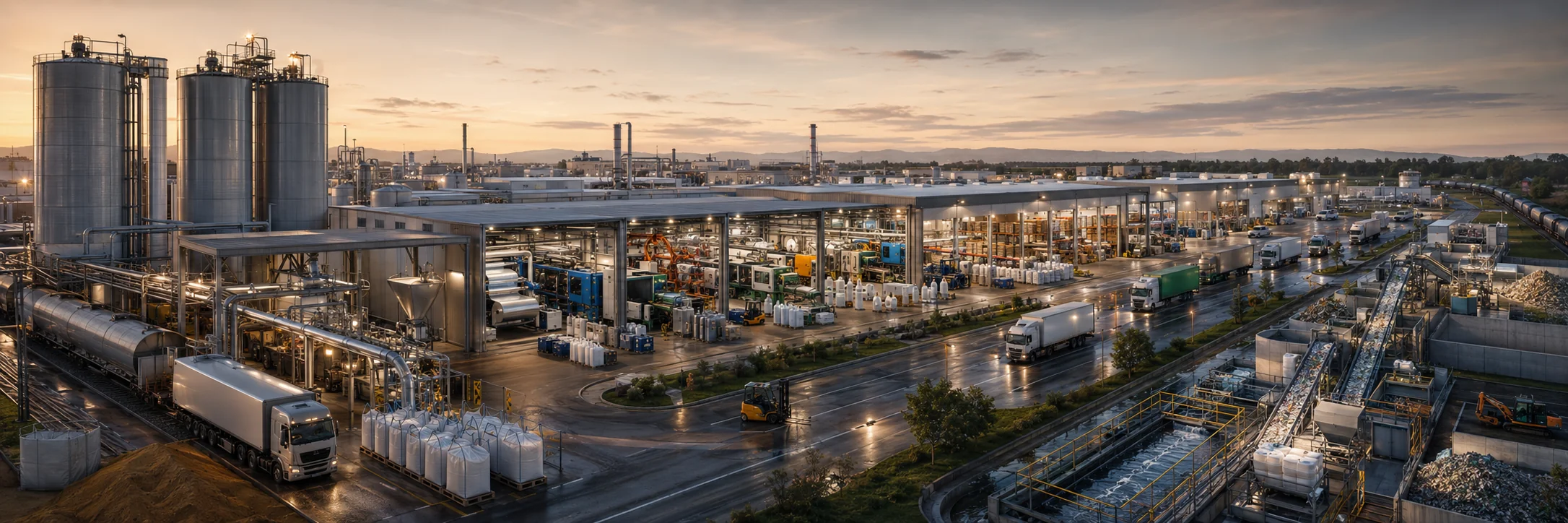
Plastic is a family of material functions. Hydrocarbon feedstock becomes a specified polymer, compound, and shape, then disperses through use until collection and sorting decide how much of that manufactured work can be preserved.
Plastic is a family of functions
People need a sterile barrier, a lightweight container, insulation, a flexible seal, a low-friction part, or a durable structural component. “Plastic” names neither one chemistry nor one life. Polyethylene, polypropylene, PVC, PET, polystyrene, polyamide, and engineering polymers differ in monomer, additives, processing window, use, and recovery route.
The chain runs from oil, gas, or recycled feedstock through monomers and polymerization, pelletizing, compounding, conversion into film, fibre, foam, bottle, pipe, or part, use, collection, sorting, reprocessing, combustion, or disposal. Each stage changes the material and the information attached to it.
Feedstock becomes a polymer history
Refineries and crackers separate naphtha, ethane, propane, and other streams; chemical plants convert them into ethylene, propylene, styrene, vinyl chloride, and other monomers; polymer plants link those molecules into chains with a chosen molecular-weight distribution and branching. Catalysts, temperature, pressure, residence time, and purification determine the result.
Recycled feedstock can replace some virgin material, but it arrives with a prior history. Moisture, food residue, pigments, additives, previous heat exposure, and mixed polymers can limit the next use. A bale of bottles is not PET resin, and a certificate of polymer identity does not prove the material is free of every contaminant relevant to a sensitive application.
Additives and compounding set behavior
Pellets are often mixed with plasticizers, stabilizers, flame retardants, pigments, fillers, glass fibre, impact modifiers, or antimicrobial agents. The compound determines stiffness, colour, weathering, melt flow, food contact suitability, and fire behaviour. A converter may need a narrow moisture and temperature window to produce consistent film or a safe pressure pipe.
Substituting a resin grade or additive can change a part's service life and recycling route. The recipe is therefore tied to the machine, mould, die, customer specification, and regulatory claim. “Same polymer” is not the same as “same function.”
Converters turn pellets into geometry
Extrusion, injection moulding, blow moulding, thermoforming, fibre spinning, foaming, and film casting turn a compound into a shape. Cooling rate, orientation, wall thickness, weld lines, residual stress, and joining determine the finished part. A resin inventory can exist while the required machine, mould, skilled operator, or electricity is unavailable.
Production records and test coupons observe selected properties. They do not establish the condition of every thin film, hidden weld, or installed component. A bottle that passed a line test may later be punctured in distribution or contaminated during filling.
Packaging buys protection and creates dispersion
Packaging can prevent moisture, oxygen, microbes, breakage, and contamination. It can also make a product light, portioned, and inexpensive to move. Those functions are real. Short-lived packaging then disperses into millions of homes, shops, streets, drains, and landfills, where recovery becomes more difficult than production.
Present demand is partly created by convenience, hygiene, and food-safety requirements and partly amplified by single-use formats and global distribution. Whether collection and sorting are funded depends on the local contract and payment system. California's Beverage Container Recycling Program, for example, collects a redemption fee from distributors and refunds California Redemption Value to people who return covered containers; CalRecycle describes the payment route. A reusable container may require washing, reverse logistics, storage, and a different business arrangement; it is a physical alternative, not a slogan.
Money helps determine which collection and sorting arrangements are accessible
Collection needs bins, trucks, labour, transfer stations, land, safety, and a buyer for the recovered material. Sorting needs identification systems, optical equipment, balers, washing, wastewater treatment, and markets for each output. The owner of a package may not receive money for performing any of that work.
When a recycler is paid by weight while moisture, contamination, or mixed polymer lowers the usable yield, rejecting a load or sending it to a lower route can be the commercially available action. A deposit, extended producer-responsibility payment, or long-term offtake can finance a different route, but only if it covers the actual equipment and timing required.
A recycling rate is not a closed loop
A recycling rate may count collected material, sorted bales, reprocessed tonnes, or material used in a product. Those are different boundaries. EPA's U.S. municipal-solid-waste plastic data reports generation, recycling, combustion with energy recovery, and land disposal using defined categories through its published data period; it does not describe plastics globally or mean every collected item returned to the same function.
Mechanical recycling can preserve polymer function when the stream is clean and compatible, but repeated heat and contamination can narrow the next specification. Chemical recycling can break polymers into feedstocks, while requiring energy, separation, and a route for residues; EPA’s overview of advanced recycling notes that mechanical recycling is limited by variability and contamination, while chemical and thermal routes can handle some complex streams. Combustion recovers heat and destroys the shaped material. Reuse generally preserves more completed work than grinding or melting, but only when identity, cleanliness, safety, and a suitable next user remain reachable.
Records name resin, not complete condition
A resin code communicates a family of polymer. A bale ticket records weight and grade. An optical sorter records a classification. A mass-balance certificate allocates an accounting claim. A product label states intended composition or use. None alone establishes the complete molecular history, additive content, contamination, service exposure, or final route.
Aggregation is useful for throughput and transport but reduces causal resolution. Once films, bottles, fibres, and mixed household plastics are blended, a database cannot reconstruct which item was contaminated or which producer paid for collection unless physical identity and transaction records were preserved.
Use, sorting, and rejected fractions change the route
Sunlight, oxygen, heat, abrasion, food contact, detergents, and mechanical stress alter a plastic during service. A pipe carries pressure for decades; a food tray may be discarded after minutes. At end of use, residues and attachments can matter more than the polymer label. A recovered pellet is not automatically suitable for food contact, medical use, or a high-load part.
Responsibility therefore includes additives, wastewater, emissions, litter, worker exposure, collection, rejected fractions, and disposal. The material can remain chemically persistent while its original function and identity disappear.
A resin code is useful at purchase and often weak at end of life. A food bottle can carry a polymer family, pigment, label adhesive, oxygen barrier, cap, and residue; a medical part can carry sterilization exposure and a specification that makes a mixed household bale unsuitable. The longer the material is used, filled, dyed, bonded, or blended, the more tests and separation work the next route requires.
Sorting and washing create moisture, labels, caps, food residues, fines, mixed polymers, and wastewater. A recycler may sell a clean flake while sending the difficult fraction to another handler, combustion, or disposal. The saleable pellet is therefore not the complete material result. A circularity claim has to specify which fraction, process, and next function it measures.
Inside CompanyGraph
Inside CompanyGraph, map feedstock suppliers, crackers, polymer plants, compounders, converters, brand owners, retailers, collectors, sorters, recyclers, and waste handlers. The graph can show where material and payment boundaries separate; it cannot by itself establish contamination, molecular condition, or whether a claimed circular route actually occurred.