 CompanyGraph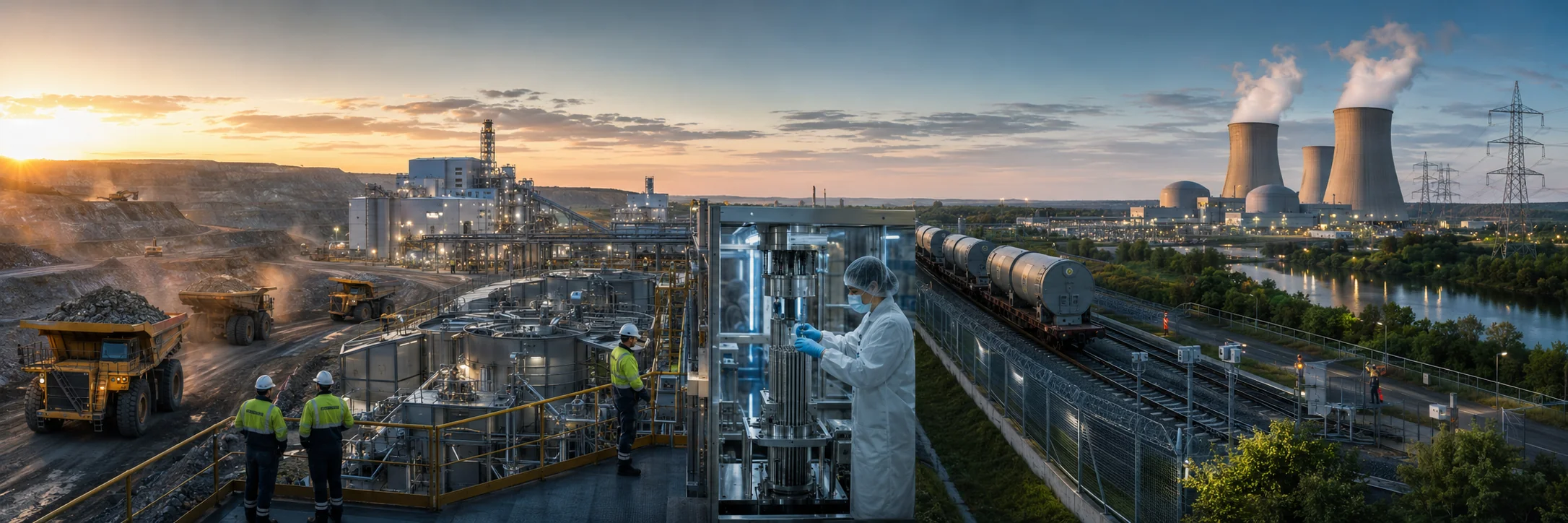
Follow uranium from rock to reactor-specific fuel, then through the reactor into a material that still requires cooling, shielding, accountancy, and custody after power production ends.
The fuel arrives as an exact arrangement
A fresh fuel delivery at a nuclear power station does not resemble a shipment of coal or gas. For a typical light-water reactor, ceramic uranium dioxide pellets sit inside sealed metal tubes. The tubes form fuel rods; grids and structural parts hold many rods in an assembly whose dimensions, materials, enrichment, and manufacturing history correspond to a particular reactor design. The assembly travels in a package that must preserve that geometry through normal transport and specified accident conditions.
During refuelling, operators place selected assemblies in planned core positions. Water removes heat and, in a light-water reactor, also slows neutrons. Some neutrons split uranium-235 nuclei. The fissions release heat and more neutrons; control systems and the core's physical arrangement keep the chain reaction within its intended range. Heat moves through coolant and steam systems to a turbine and generator. The fuel therefore supplies nuclear heat, not electricity by itself.
After its planned irradiation, an assembly no longer fits the core's required reactivity, power distribution, exposure, and safety limits. It is removed under water and transferred to a pool. The sustained chain reaction has stopped, but radioactive decay continues to release heat. Years later the assembly may move into a dry storage system, be sent for reprocessing where that route exists, or remain in storage pending disposal.
The commercial sale may have ended before loading, yet the physical chain continues for far longer than the electricity production.
A reactor needs a neutron arrangement, not uranium mass
Natural uranium contains mostly uranium-238 and about 0.7 percent uranium-235. Uranium-235 is fissile: after absorbing a suitable neutron, a nucleus can split and release additional neutrons that sustain a chain reaction. Whether that reaction can continue depends not only on isotope concentration but also on the quantity and geometry of the material, neutron leakage, absorbers, temperature, and the substances that slow or reflect neutrons. Criticality control outside a reactor relies on those relationships just as deliberately as a reactor core uses them to produce heat.
Reactor designs achieve the required neutron economy in different ways. Most commercial light-water reactors use low-enriched uranium, in which the proportion of uranium-235 has been increased. Some heavy-water and graphite-moderated reactors can use natural uranium; the Canadian Nuclear Safety Commission's terminology, for example, describes CANDU reactors as using heavy water and natural uranium. Research and advanced reactors may use plate fuel, metallic fuel, coated particles, or fuel dissolved in salt. A universal five-stage route from mine through enrichment to pellet would therefore describe one important family of fuel cycles as though it were the physical rule.
The underlying human need is further away still. People require heat, light, cooling, motion, communication, and other services. Nuclear fission is one way to provide energy for those services, and an energy system can sometimes reorganize generation, storage, networks, and demand around other sources. The boundary changes at an operating reactor. Once a reactor, licence, outage plan, and core design exist, an arbitrary tonne of uranium—or an unqualified assembly from another design—cannot replace the exact fuel that refuelling requires.
Ore becomes portable before it becomes reactor fuel
Uranium first has to be separated from a much larger mass of rock or from mineral-bearing groundwater. At a conventional mine, ore is excavated, crushed, ground, and leached so that uranium can be recovered from the surrounding minerals. The mill precipitates and dries a concentrated uranium oxide product often called yellowcake. The familiar name does not guarantee one colour or one exact compound, and the concentrate is still far from a finished fuel.
Conventional recovery also leaves most of the mined rock behind as tailings. Those tailings can retain radium, release radon, and contain other metals and process chemicals. Their stability, water management, covers, monitoring, and long-term control belong to the same material separation that produced the concentrate. The US Nuclear Regulatory Commission's description of conventional mills and the US Environmental Protection Agency's mill-tailings standards make clear that producing a transportable concentrate also creates a site-specific residual-material duty.
In situ recovery uses a different boundary. Wells inject a solution into a suitable ore-bearing formation, dissolve uranium underground, and pump the uranium-bearing water to the surface for processing. This can avoid an open pit and conventional tailings pile, but it makes well-field control, groundwater chemistry, restoration, and monitoring central. The NRC distinguishes conventional and in situ uranium recovery because their wastes and failure paths are not interchangeable.
For an enrichment route, a conversion plant next turns uranium concentrate into uranium hexafluoride, or UF6. UF6 is useful because it can become a gas at process temperature, allowing isotope-separation equipment to act on molecules containing uranium-235 and uranium-238. It is transported as a solid in cylinders, but it is chemically reactive and can form corrosive and toxic products on contact with moisture. Conversion has made uranium suitable for enrichment while introducing a chemical condition, cylinder history, and handling problem that a mine assay does not describe.
Enrichment sells separation, not uranium
An enrichment plant does not create uranium-235. It divides a feed stream into an enriched product containing a higher proportion of uranium-235 and a depleted stream containing less. Modern centrifuges repeatedly separate slightly lighter UF6 molecules from slightly heavier ones through linked stages called cascades. The physical output is therefore two uranium streams, not enriched material plus nothing.
Enrichment service is measured in separative work units, or SWU. The unit represents the work of changing isotope concentrations, not a mass of uranium or an amount of electricity. Operators choose a tails assay: the uranium-235 concentration left in the depleted stream. A lower tails assay extracts more uranium-235 from each unit of natural feed and can reduce the amount of uranium that must be mined and converted, but it requires more separative work. A higher tails assay uses less enrichment work and leaves more uranium-235 behind, so more natural feed is needed for the same enriched product. The International Atomic Energy Agency's account of uranium-feed and SWU requirements shows these alternative input combinations explicitly.
This tradeoff separates plant need from organized demand. A reactor's required batch and enrichment do not by themselves fix the quantity of natural uranium demanded upstream. Available centrifuge capacity, conversion capacity, prices, contracts, inventory policy, and the selected tails assay help determine it. When separation work is scarce or expensive, buyers may use more natural uranium feed. When separation work is accessible, they can spend more SWU and leave less useful uranium-235 in the tails. Neither choice changes what the loaded fuel must do inside the core.
The depleted UF6 stream remains material under management. It occupies cylinders, contains uranium, and retains the chemical hazards of UF6. Deconversion can turn it into a more stable uranium oxide while producing fluorine-bearing co-products that need a demonstrated use or waste route. The NRC describes depleted-uranium deconversion as a distinct fuel-cycle activity. Calling the stream tails identifies its position in a separation process; it does not resolve its next physical condition.
Fabrication freezes fuel into one reactor's geometry
For conventional light-water-reactor fuel, a fabricator receives enriched UF6, converts it to uranium dioxide powder, presses the powder into pellets, and heats the pellets so their particles bond into dense ceramic. The pellets are ground to controlled dimensions, loaded into cladding tubes, sealed as rods, and built into assemblies. The NRC's fuel-fabrication overview describes this route while noting that fuel design varies with reactor type and manufacturer.
Fabrication is not merely packaging enriched uranium. Pellet density and chemistry affect heat transfer and irradiation behaviour. Cladding contains fission products and separates fuel from coolant. Rod spacing changes cooling and neutron behaviour. Structural grids have to hold geometry through handling and years in a flowing, irradiating coolant. Some assemblies contain fuel with different enrichments or burnable absorbers in selected positions so that power changes across the core in a controlled way.
Newer designs widen the differences. The NRC's review of new-fuel fabrication includes coated TRISO particles, pebbles or compacts, metallic fuels, and fuels dissolved in molten salts as well as higher-enrichment ceramic fuel. These forms require different chemical processes, equipment, safety analysis, transport, and qualification evidence. Enrichment percentage alone cannot make one form interchangeable with another.
Before irradiation, uranium emits far less penetrating radiation than spent fuel, but fabrication still combines chemical, radiological, and criticality hazards. Criticality safety depends on controlling mass, spacing, vessel dimensions, moderators such as water, and neutron absorbers. A batch can meet chemical assay and still have the wrong pellet, rod, assembly, or record. Transport adds another boundary: package design must keep fresh assemblies intact and subcritical, including under evaluated accident conditions. The NRC's account of fresh-fuel package certification explains why maintaining fuel geometry is itself a transport safety function.
Refuelling begins years before the outage
A power reactor replaces only part of its core at a refuelling outage. Engineers choose which irradiated assemblies to remove, where to move retained assemblies, and where to place fresh ones. The plan has to meet limits on power distribution, reactivity, cooling, shutdown margin, and fuel exposure. Fabrication slots, enriched-material availability, approved transport packages, regulatory changes, and quality records must converge before the outage begins.
This gives money and time a physical role. Long-term contracts and inventory can bridge mine, conversion, enrichment, and fabrication lead times. Working capital determines how early a utility or supplier can secure material and services. A low-priced tonne that arrives in the wrong form or after the refuelling window is not equivalent to a qualified assembly already at the site. Conversely, holding several years of concentrate or enriched material can protect one boundary while leaving another exposed if fabrication or transport is unavailable.
A warehouse count therefore cannot answer whether the next core can be loaded. Natural uranium inventory, UF6 feed, enrichment capacity, fabricated assemblies, approved designs, and outage-ready fuel are different stocks. A commercial chain can be abundant in aggregate and short at the exact transformation where a reactor's schedule and licence meet.
Inside the core, fuel becomes another material
When a uranium-235 nucleus fissions, the original atom becomes two smaller fission-product nuclei, additional neutrons, radiation, and heat. Some uranium-238 absorbs neutrons and contributes to the formation of plutonium and other heavier elements; some of those nuclei later fission. Gases form within the fuel. Pellets crack, swell, and restructure under changing temperatures and radiation. Cladding changes through corrosion, stress, hydrogen uptake, and irradiation. Fuel performance is the behaviour of this coupled material system, not simply the disappearance of uranium-235.
Burnup expresses the energy produced per initial mass of fuel. Greater burnup can extract more energy before discharge and may change the number and timing of assemblies required, but it also changes isotopic composition, decay heat, radiation, cladding condition, and the analyses used for transport and storage. The NRC's in-reactor fuel review separates material, mechanical, chemical, thermal, nuclear, and fission-product-release behaviour because no single test establishes them all.
Reactor instruments observe neutron flux, temperature, pressure, coolant chemistry, radiation, and other operating conditions. Inspections and later examination can reveal fuel or cladding behaviour that models did not predict. But measured electrical output cannot identify every condition inside each rod, and a fuel batch that operated without a detected leak has not thereby proved every design claim. Corrective information must travel from operation and post-irradiation examination back to core design, fabrication, transport, and future licensing while the supplier can still change the next batch.
Spent fuel is neither spent nor finished
Spent means that an assembly has left its intended reactor service. It does not mean that the material has no remaining energy, uranium, plutonium, radioactivity, or heat. Immediately after removal, water in a spent-fuel pool provides cooling and radiation shielding. Pool structures, racks, water chemistry, level, temperature, makeup systems, monitoring, and procedures together maintain that function. A full pool is not merely storage capacity occupied; it is an operating system with heat to remove.
After sufficient cooling, some fuel can move into a dry cask system. Assemblies are loaded into a sealed canister or metal cask, typically surrounded by additional steel or concrete. Inert gas and passive heat transfer help move decay heat to the surrounding air; confinement and shielding limit releases and radiation exposure. The NRC's spent-fuel storage questions distinguish decay heat and radiation after discharge, while its dry-cask description identifies confinement, shielding, and heat removal as continuing functions.
A cask is not proof that the material has reached a final destination. Storage presumes monitoring, ageing management, security, records, and the ability to retrieve or repackage fuel if required. Future transport depends on the condition of the assemblies and canister, the availability and approval of a package, compatible handling equipment at both ends, and a receiving facility. Deferring a route does not remove these dependencies; it transfers them to a later owner and time.
Once-through and recycled cycles preserve different things
In a once-through cycle, used fuel is stored and intended for disposal without separating its uranium and plutonium. This preserves the assembly as a single accountable item for much of its journey, but it also places unused fissile material, fission products, cladding, and structural parts on the storage and disposal route together.
Reprocessing dissolves used fuel and chemically separates uranium and plutonium from most fission products and other waste constituents. Recovered material can be made into new fuel, such as mixed uranium-plutonium oxide, where reactors and licences permit. Recycling can reduce some requirements for newly mined and enriched uranium and change the composition and volume of waste streams. It also adds remote chemical processing, separated material streams, losses, new fabrication steps, transport, safeguards, and wastes that still need conditioning, storage, and disposal. The IAEA's description of reprocessing defines the separation, while its spent-fuel management guidance treats storage, reprocessing, and disposal as connected back-end choices rather than synonyms.
The two routes preserve different things. Direct disposal avoids deliberate separation of plutonium but does not recover its potential fuel value. Reprocessing recovers selected materials but dismantles the original assembly and creates several new streams requiring distinct evidence and custody. Neither label alone establishes environmental performance, proliferation resistance, cost, or final isolation. Those results depend on the facilities, inventories, controls, time horizons, and receiving routes that actually exist.
Mass, assay, integrity, and accountancy answer different questions
Uranium moves through a chain in which measurement is essential, yet different measurements describe different objects:
- Mass and process balance estimate how much uranium entered, left, accumulated, or was lost within a defined boundary.
- Isotopic assay estimates the proportions of uranium isotopes. It does not establish pellet density, assembly identity, or cladding integrity.
- Fabrication inspection and qualification establish specified dimensions, materials, welds, and performance evidence for a design and batch. They do not predict every condition after irradiation.
- Reactor operating records connect an assembly to power, position, coolant conditions, and exposure. They do not directly observe every change inside every rod.
- Radiation and contamination monitoring observe fields or material at a place and time. A normal reading does not account for all nuclear material.
- Nuclear material accountancy records declared inventories and transfers. Seals and surveillance help maintain continuity of knowledge and reveal access or movement; they do not replace engineering safety analysis.
The IAEA Safeguards Glossary describes material accountancy as fundamental and containment and surveillance as complementary. A seal can support confidence that a container was not opened without detection. It does not show that the container removes heat, that its contents remain undamaged, or that an upstream waste stream was well managed. Conversely, a technically sound storage system does not by itself verify that all declared nuclear material remains present.
These records become more valuable when their identifiers survive transformations and handoffs. A concentrate lot may be blended during conversion; an enriched cylinder may feed several fabrication batches; assemblies may move within a core; rods and solutions may be separated during examination or reprocessing. Traceability need not pretend that every atom retains an individual identity. It must preserve enough relationship among quantities, batches, processes, locations, conditions, and decisions to investigate a discrepancy and change the next action.
Custody begins at extraction and outlives generation
Responsibility does not begin when enriched fuel becomes strategically important. A recovery operator changes rock, water, and residual material before uranium reaches fuel-grade purity. Remediation funding and records have to remain available while tailings, wells, covers, drainage, and groundwater can still require action. If the operating company disappears before those duties are funded and transferable, the material remains while the organization capable of correcting it does not.
Nor does responsibility end when a utility pays for fresh assemblies. Conversion residues, depleted uranium, fabrication wastes, used fuel, contaminated equipment, and decommissioning materials occupy different owners and regulatory categories. Some retain potential value; all require a physically reachable next step. A named recycler, future repository, or possible reprocessor is not a route until it has compatible specifications, capacity, transport, permissions, money, and an agreed transfer of custody.
Time makes the uranium chain unusual but not exempt from ordinary organizational limits. Mines and mills can close before long-term monitoring is complete. A supplier can leave a market while its fuel remains in cores and pools. Records can outlive software, contractors, and corporate names. Interim storage can continue across generations of staff. Complete responsibility therefore requires durable institutions, but it also requires practical feedback: inspection findings, water measurements, fuel performance, cask condition, inventory differences, and worker observations must reach someone who still has the authority and resources to alter the physical system.
The chain is complete only when every output has a route
A narrow uranium supply chain ends when a fabricated assembly reaches the reactor. The physical chain cannot. The mine separated concentrate from tailings and water; enrichment separated product from depleted uranium; the reactor separated useful heat from a changed radioactive material. Each useful output is accompanied by another material whose condition and destination remain part of the same transformation.
This does not make all uranium use unnecessary, nor does it make one fuel-cycle choice correct everywhere. It clarifies the decision. At an existing reactor, qualified fuel can be necessary for the next safe operating cycle. Upstream demand for natural uranium can still vary with reactor design, enrichment work, tails assay, fuel management, recycling, inventories, and losses. Downstream responsibility can still vary with burnup, cooling time, storage design, reprocessing, transport, and disposal infrastructure. Present organization converts some physical requirements into additional material demand while postponing some outputs beyond the transaction that created them.
A complete view follows four linked states: what nuclear function is required; what material and geometry can provide it; what every transformation leaves behind; and who can still act on the evidence after ownership changes. Only then can a shortage be located at its real boundary, an efficiency claim be tied to the resources it displaced, and a fuel delivery be connected to the full material history it begins.
Inside CompanyGraph
Explore the mines and well fields, mills, conversion plants, enrichers, deconverters, fuel fabricators, transport-package owners, reactor operators, laboratories, regulators, safeguards authorities, pool and cask operators, reprocessors, waste facilities, remediation teams, and long-term custodians that connect uranium-bearing ground to nuclear heat and every material state that follows inside CompanyGraph.