 CompanyGraph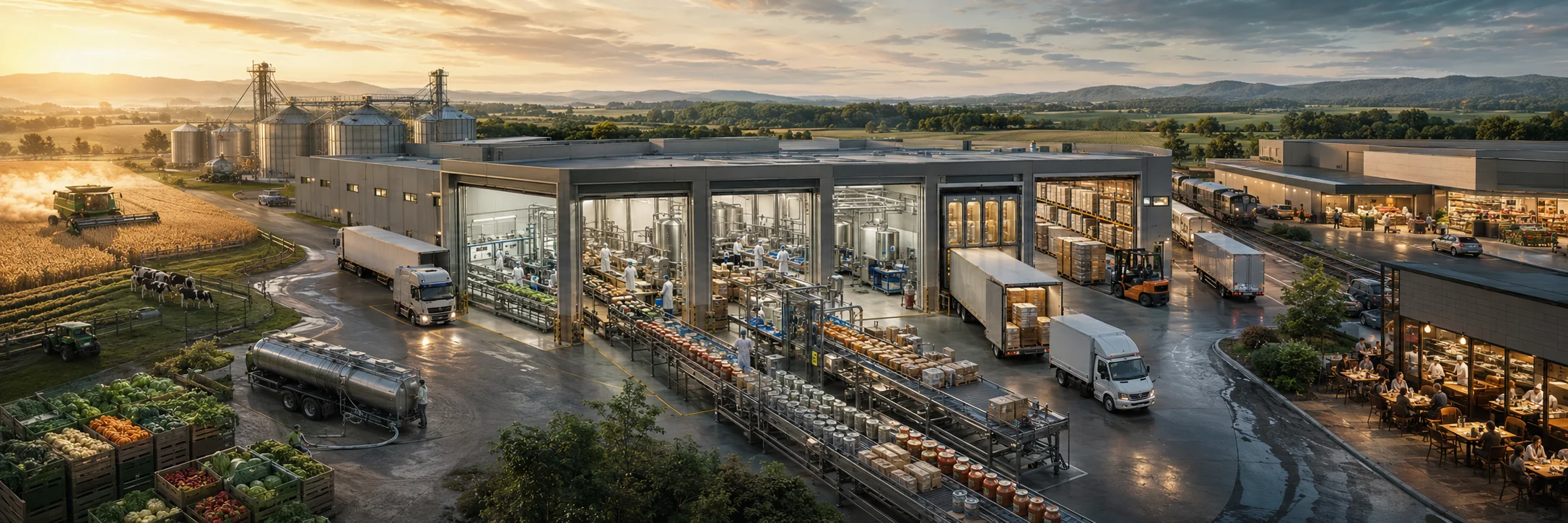
Processed food turns variable ingredients into a safe, stable function: nourishment, texture, taste, and convenience that can survive the time between factory and meal.
Food is a service before it is a product
A meal supplies energy, amino acids, water, minerals, and pleasure to a person at a particular time. A packaged soup, snack, frozen meal, or sauce is one way of making that service portable. It is not the underlying need. The product must also be safe, acceptable to eat, available where the person is, and usable with the time and equipment they have.
To make that possible, growers and processors produce ingredients; mills, dairies, slaughterhouses, and chemical plants convert them; a food manufacturer formulates, heats, dries, freezes, ferments, or mixes them; packaging protects the result; warehouses and retailers spend the remaining shelf life; and a household or food-service kitchen finally turns the product into a meal. Consumption completes the intended food service, but the material chain continues through packaging, wastewater, unused food, and discarded product.
Ingredients arrive with biological histories
Wheat, milk, tomatoes, oils, spices, starches, vitamins, cultures, and flavours do not arrive as interchangeable powders. Each carries a harvest season, moisture history, microbiological condition, processing route, allergen status, and specification. A flour mill can adjust a blend, but it cannot turn mould-damaged grain into sound grain. A processor can reject an unsafe lot, but the crop, labour, storage space, and time used to produce it are already gone.
Ingredient demand is partly biological and partly organized. People need food energy and nutrients; the present assortment of branded, year-round, portioned, and geographically distributed products creates additional needs for uniform grades, long storage, standardized packaging, and duplicate inventories. Centralized plants and global sourcing can lower the money cost of a unit while increasing the distance over which temperature, identity, and safety must be maintained; whether that trade-off occurs depends on the product and distribution design.
FDA preventive-controls rules require covered facilities to identify hazards and implement controls, but a hazard analysis does not replace the physical work of drying, chilling, cleaning, segregating allergens, or preventing recontamination. FDA preventive controls describe the required system; the ingredients still have to arrive in a condition the process can safely handle.
Formulation couples many materials
A recipe is a set of physical relationships. Water, starch, fat, salt, acid, proteins, leavening agents, cultures, and minor ingredients determine viscosity, gel formation, emulsification, browning, freezing behaviour, nutrition, allergens, and taste. Changing one ingredient can change several properties at once. A replacement may be chemically safe yet fail to deliver the texture, shelf life, label declaration, or equipment behaviour that made the original product workable.
This is why qualification is more than finding a similar price. A new supplier may need identity testing, allergen controls, process trials, shelf-life studies, and a new label. A co-manufacturer may need a different mixer, filler, clean-out sequence, or thermal schedule. The formula therefore ties the upstream chain to the plant and to the downstream claim.
Packaging is part of the formulation in a wider sense. A can, pouch, carton, bottle, or multilayer film provides a particular barrier against oxygen, water vapour, light, puncture, and microbes. It also determines fill speed, pallet geometry, transport damage, and the information printed for the person who will use the food.
The process creates safety and shelf life
Heating can kill pathogens; drying lowers available water; acidification changes pH; fermentation produces inhibitory compounds; freezing slows biological reactions. Each method works only within a defined range of time, temperature, acidity, moisture, and equipment performance. A retort process that reaches the required lethality protects a sealed can; it does not make a damaged seam safe after the fact. A frozen product depends on the cold chain after it leaves the freezer.
Food safety controls are therefore partial. A critical limit, swab, metal detector, or finished-product test observes a defined hazard or sample. It cannot prove that every point of a long conveyor, every ingredient lot, or every later temperature exposure remained within the required condition. FDA traceability rules for selected foods create records that help locate events and recipients, but they do not themselves prevent contamination. The traceability rule is useful because it shortens the path from a credible signal to affected lots and handlers.
Packaging stores time and condition
Packaging spends material and energy to buy time. A hermetic can prevents new contamination; a high-barrier film slows oxygen and moisture transfer; a sterile pouch protects a device-like opening until use. Packaging also creates waste and can disperse small quantities across households, restaurants, and shops. The protection is real, but so is the later collection and disposal burden.
In the United States, date labels are not a single national measurement: a use-by date may concern safety, while a best-before or quality date concerns freshness, but legal meanings vary by jurisdiction and product. Neither is a live measurement of the product in every kitchen. A package that was correctly sealed can still be damaged, thawed, overheated, or opened before the meal.
Distribution keeps or spends that time
Ambient, chilled, and frozen foods use different clocks. A refrigerated salad has little tolerance for a warm dock. A canned bean can cross an ocean because its process and package preserve a much longer interval. Warehouses and retailers rotate inventory, reject damaged cases, and decide where to place limited shelf space. The chain may deliver the right product to the wrong place, or deliver it after the time that made it useful.
Money changes which protections are feasible. A processor needs cash for ingredients, packaging, sanitation, testing, and payroll before a retailer pays. A small supplier may know that a temperature-controlled shipment or a second approved ingredient would reduce loss, yet lack the working capital or contract authority to secure it. In U.S. fresh-produce trade, PACA normally requires prompt payment within ten days unless different terms are agreed in writing, and preserves a trust claim for unpaid sellers; USDA's PACA guidance shows how payment timing can determine whether a supplier can keep product, labour, and cold storage financed while waiting for the buyer. A retailer's chargeback can make a late but physically safe delivery expensive; a low purchase price can leave less money for supplier maintenance, testing, or redundant capacity. These are not merely incentives after a choice: they determine which equipment, inventory, and timing are reachable.
Records see lots, not every condition
The physical food, the recorded food, and the communicated claim are different layers. A lot code identifies a production interval. A certificate states that a defined inspection or test was passed. A temperature logger records exposure at its sensor. A nutrition panel describes the formulation under labeling rules. None of these alone establishes the complete condition of a meal at the moment it is eaten.
Aggregation can make a useful batch while reducing resolution. If several farms supply a sauce, a sample can represent the blended lot without preserving which field supplied each molecule. If a recall is issued after distribution, a traceability system can identify a route and a quantity, but withdrawal, consumer communication, and destruction still require people, money, transport, and time.
A recall follows ingredients and finished lots
A recall is not the same as correction. Detection may begin with a laboratory result, a consumer complaint, a foreign inspection, or a cluster of illness. The result must then reach the manufacturer, distributor, retailer, and person who can stop sale or remove product. The upstream cause may be a supplier, sanitation failure, process deviation, package seal, or temperature excursion. If lots were mixed or records were late, the cause can become difficult to reach even when the affected product is found.
Controls work when their result changes a feasible action. A supplier audit can lead to a sanitation investment; a swab can trigger a clean-out; a traceability record can narrow a recall. None supplies the missing cold room or repairs a broken seal by itself.
What remains after the meal
Processing creates residues: peel, whey, spent grain, wastewater, rejected batches, packaging, and food discarded after purchase. Some can become feed, ingredients, compost, biogas, or recovered materials; others are contaminated or too dispersed for that route. The fact that a residue has a market name does not prove it reached that use.
The chain is complete only when it accounts for the food function delivered and for the materials, water, energy, and wastes left behind. Present processed-food demand is necessary where people need safe, accessible nutrition or a specific culinary function. The exact assortment, packaging intensity, distance, and disposal pattern are organized choices that can enlarge the physical work required.
A finished product can be safe when released and still become part of a recall when a supplier later identifies a contaminated ingredient. FDA traceability rules treat receiving, shipping, and transformation as separate critical events because an ingredient may be commingled, repacked, or carried into several finished products. FDA explains that backward and forward tracing can narrow the route, but only if lot identity survives the transformation.
Inside CompanyGraph
Inside CompanyGraph, map ingredient origins, formulation owners, processors, packaging suppliers, cold stores, distributors, retailers, and recall routes. The graph can show where custody and authority meet; it cannot substitute for the samples, conditions, and decisions that remain unobserved.