 CompanyGraph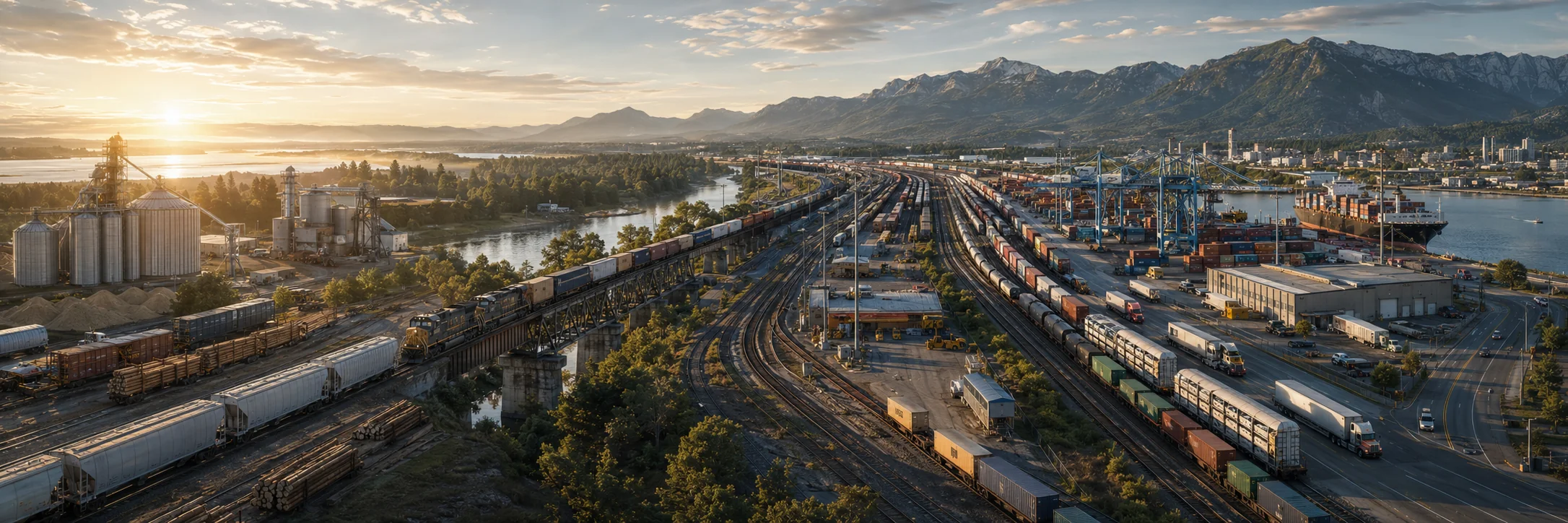
Rail freight preserves useful movement for heavy or bulk cargo across long distances, but a train is deliverable only when track, slots, cars, locomotives, terminals, and the last mile meet at the same time.
Rail supplies movement, not train miles
A mine needs ore at a concentrator, a farm needs grain at an elevator or port, and a factory needs inputs at its receiving gate. Rail is one way to move heavy loads over long distances with less road traffic and fuel per tonne-kilometre than many alternatives. The service is not a train counted on a timetable. It is cargo arriving in the required condition, at the required place, within the window in which the receiver can use it.
The physical journey runs from loading equipment through a yard, a consist, shared mainline track, dispatching, a terminal, and often a truck, barge, or ship. The route is fixed in geography but the available movement changes with maintenance, weather, crew, locomotive condition, car supply, signalling, and competing traffic.
Loading turns bulk into a train
Before a wagon moves, the cargo must be loaded, weighed, secured, and matched to a car type. Grain needs hoppers and moisture or quality records; coal needs rotary dumper or loading systems; automobiles need specialised racks; chemicals need compatible tank cars and handling procedures. The loading site has to fill cars fast enough for the railroad's train plan without damaging the material or exceeding axle and route limits.
A consist is a coupled physical arrangement, not a list of purchase orders. Car weights, braking, length, gradients, curves, hazardous-material rules, and destination blocks constrain what can travel together. A loaded car can be present but unavailable if it needs inspection, is in the wrong location, or cannot reach the required route.
Track capacity is a path and a schedule
Mainline railways serve many shippers. Dispatchers fit trains around signal blocks, passing sidings, junctions, maintenance windows, and priority rules. A new mine may have a loading loop but still lack a path to the market. A port may have cranes and storage but no available arrival slots. Capacity is therefore a relationship among infrastructure, operating rules, train characteristics, and time.
FRA describes the U.S. freight network as privately operated infrastructure with connections among railroads and other modes. The network overview supports that ownership and modal connections are distributed; the article infers the resulting handoff problem from the physical route.
Locomotives, cars, and seasonal slots are part of capacity
Locomotives convert fuel or electricity into tractive effort, but their rating depends on grade, train length, weather, braking, and maintenance. Freight cars are specialised assets with long repositioning cycles. A shortage of covered hoppers is not solved by an abundance of flatcars; a tank car that is physically present may be unavailable for a particular chemical because of cleaning, inspection, or regulatory restrictions.
Empty repositioning is part of the process. Cars must be returned to loading regions, sometimes against the dominant traffic flow. A railroad can have enough cars in aggregate while a shipper waits because the correct cars are elsewhere.
Rail equipment is a stock that has to be in the right place before a seasonal flow begins. Covered hoppers returned from an export region may be empty and technically serviceable yet unavailable to a grain elevator in the next harvest window. A lease, repair, inspection, crew, and loading loop all consume money before the car carries the next bushel.
Terminals and last mile finish the movement
Rail rarely reaches the final user without another mode. Grain is unloaded into an elevator and then moved by barge or ship; containers transfer through a port; steel coils go from a rail-served plant to a fabricator by truck. The terminal needs labour, cranes, storage, electricity, customs or inspection clearance, and a receiving appointment. If any is missing, a train can be technically on time while the cargo remains unavailable.
Demurrage and detention make time a money boundary. A car or container that waits beyond the allowed period can create charges while the underlying problem remains a missing truck, blocked silo, labour shortage, or paperwork hold. The charge records an interval of equipment use; it does not repair the terminal constraint.
Money buys slots, cars, and waiting time
Rail projects and operating decisions require money before revenue arrives. A shipper may need to finance a loading loop, storage, car leases, testing, and inventory while waiting for a sale. A railroad must maintain track, locomotives, crews, and signals even when demand is seasonal. A receiver may have to pay demurrage or hire temporary trucks before the contract allows recovery.
Payment terms can change a physical decision. If a buyer pays only after final delivery, an exporter may not have the working capital to hold grain for a vessel window or to pay for a second truck leg. If a railroad's tariff recognises movement but not the cost of a special siding, the shipper may keep using a slower transload route. The price is a contract amount; the physical cost includes steel, fuel, labour, time, wear, and the consequences of delay.
A wheat case shows transport scarcity
USDA ERS documented how U.S. wheat exports depend on rail access to ports and how disruptions can narrow the export route even when wheat exists in storage. The analysis describes the Mississippi River and rail connections as complementary routes. From that documented dependency, the article infers that a vessel booking or stored bushel alone cannot establish delivery during an export window; the source does not measure every individual shipment.
The case shows why an aggregate tonnage number is incomplete. The missing condition was a usable path, cars, and timing. A later truck or barge may provide a substitute, but only if the loading site, road, terminal, and money for the detour are available.
Records identify movement, not delivery condition
A waybill records an agreed movement. A GPS ping shows a location. A seal number connects a load to a container; a scale ticket records measured weight; a rail-car inspection records a defined condition at one time. These are valuable observations, but none proves that cargo arrived undamaged, uncontaminated, or usable for the receiver's process.
Identity can also change resolution. A train may carry separately identified cars, while a terminal combines bulk material in a silo. The ledger can preserve ownership shares even after physical mixing, but it cannot identify which particle came from which farm. A temperature or humidity record observes the sensor's path, not every point inside a long consist or warehouse.
Disruption feedback returns slowly
A derailment, flood, labour stoppage, bridge restriction, or locomotive failure becomes visible at a particular node. The cause may sit upstream in deferred maintenance, a missing crew, a congested junction, or a contract that assumed a route would remain open. By the time a receiver sees an empty bin, the train has already passed through several decision boundaries.
Correction requires more than reporting. A railroad may need track work or new crews; a shipper may need storage or another mode; a port may need a different appointment pattern. The person who sees the consequence is often not the person with authority or money to change the cause.
What remains after unloading
Rail moves material but also consumes diesel or electricity, steel, track life, braking components, ballast, and labour. Dust, spills, noise, and abandoned cars remain physical outputs. Reusing a car preserves a qualified asset; scrapping it recovers some metal but loses its geometry and inspection history.
A complete account therefore follows the cargo to its useful receiver and follows the infrastructure and residues that make the movement possible. Rail can be indispensable for a particular bulk route without making every current route, terminal, or inventory arrangement inevitable.
Inside CompanyGraph
Inside CompanyGraph, map shippers, railroads, car owners, yards, ports, terminals, and final receivers, then identify where a slot, car, inspection, payment, or last-mile connection can still change delivery. The graph can reveal handoffs; operating condition and authority still require direct evidence.