 CompanyGraph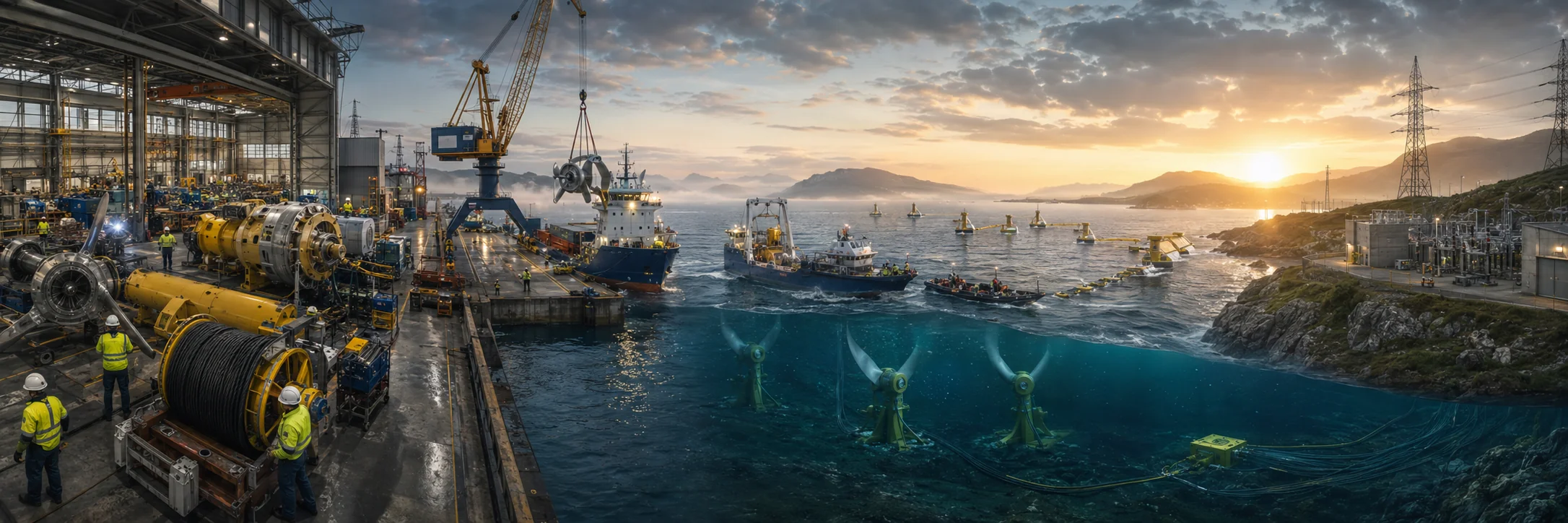
Follow machinery and cables from shore into moving seawater, where the resource that supplies energy also determines loads, access, evidence, and environmental change.
The machine travels to the resource
A marine-energy device begins on land. Steel plate becomes a frame, foundation, pressure vessel, or floating hull. Copper windings enter a generator; power electronics condition its output; composites or metal become blades, wings, flaps, or buoyant bodies. Bearings, seals, hydraulic equipment, air turbines, mooring lines, anchors, subsea connectors, and cables arrive from several established industries. A port or fabrication yard assembles and tests the system where cranes, quays, storage, and sheltered water permit.
The completed machine is lifted onto a vessel, carried on a barge, or towed afloat to a surveyed site. A tidal-stream device is fixed to the seabed, suspended from a floating platform, or flown through the current on a tether. A wave device is moored, seabed-mounted, or built into the shore. Installers connect it to an underwater cable that crosses the seabed and shore before reaching switchgear, a substation, and an electricity user or grid.
The project does not transport the moving water to the converter. It passes through or around the installed equipment, transferring part of its motion to a generator before continuing through the channel or wave field. Electricity and operating data leave the site; vessels, replacement parts, and technicians return when conditions allow. Eventually the device, moorings, foundations, and project-specific cables must be recovered, replaced, or deliberately left under an approved plan.
One title hides three physical systems
“Tidal and wave energy” is an industry grouping, not one conversion process. Tidal range, tidal stream, and wave devices all produce energy from moving seawater, but they encounter different resource patterns, structures, extreme loads, installation work, and environmental effects. The U.S. Department of Energy’s marine-energy glossary lists several converter families because there is no single generic ocean turbine.
The sections that follow concentrate mainly on tidal-stream and wave converters. Tidal-range projects share some electrical and environmental questions but organize construction, access, and maintenance more like major coastal civil infrastructure.
Tidal-range schemes use the difference in water level across a barrier. A barrage spans an estuary or channel; a lagoon encloses part of a tidal area. Gates admit or release water, and low-head turbines generate as a usable height difference develops. Their supply chains resemble major hydroelectric and coastal civil works: rock, concrete, gates, turbines, locks, grid infrastructure, sediment management, and construction lasting years. The barrier deliberately changes the timing and movement of water across a large area.
Tidal-stream devices use the kinetic energy of currents without impounding a basin. Horizontal-axis rotors resemble underwater wind turbines; other designs use cross-flow rotors, oscillating hydrofoils, ducts, or tethered wings. Flow reverses between flood and ebb at many sites and weakens around slack water—the interval when current speed is lowest. The astronomical cycle is regular, but device output still depends on local flow, turbulence, waves, blockage, control, fouling, and equipment availability.
Wave-energy converters use motion and pressure created mainly by wind-generated surface waves. A buoy can move relative to a mooring or submerged reference; a hinged flap can oscillate; an oscillating water column uses rising and falling water to push air through a turbine. Wave height, period, direction, grouping, and storm history matter together. A device suited to long ocean swell may respond poorly to short, confused seas even when two sites report similar average wave energy.
The need lies beyond the shoreline
People do not need ocean-energy capacity for its own sake. They need light, heat, cooling, communication, clean water, transport, manufacturing, ocean observation, and other services. Tidal and wave converters are possible ways to supply electricity or direct mechanical work for those purposes. They are not physically necessary at every energetic coast, and an undeveloped wave field is not an unmet human need.
The technologies can nevertheless serve specific conditions. A coastal or island system may use local marine electricity to reduce fuel shipments. Offshore sensors, aquaculture, desalination, or autonomous equipment may need modest power far from a grid. A larger electricity system may benefit from generation whose timing differs from wind and solar. DOE accordingly distinguishes grid-scale projects from smaller coastal and offshore uses that can justify devices at resources too small for utility generation.
Present demand for marine-energy equipment therefore comes from named service needs, fuel and emissions constraints, public research programs, electricity support mechanisms, coastal plans, and access to grid connections—not from theoretical ocean energy alone. A device can be useful under present island or offshore conditions without making the same design, site, or electricity volume inevitable elsewhere.
Predictability has a similarly bounded value. Astronomical tidal constituents allow the timing of tides and much tidal-current behavior to be forecast. NOAA separates those harmonic predictions from operational forecasts that add wind, atmospheric pressure, river flow, temperature, salinity, and storm surge. A tidal-current prediction can identify flood, ebb, and slack water; it cannot establish that a turbine, cable, and grid will be available when the current arrives. Wave conditions depend more directly on weather and are forecast on weather timescales.
The resource number shrinks at every boundary
Ocean-resource headlines often begin with energy moving through an entire coastline, channel, or basin. That is the theoretical resource. It is not a pile of electricity waiting to be collected. A converter intercepts only part of the flow, works over a limited range of sea states, loses energy in mechanical and electrical conversion, occupies space, and must leave passages among devices for wakes, moorings, cables, navigation, and ecological functions.
The National Renewable Energy Laboratory separates theoretical, technical, and practical marine resources. Technical resource applies a defined technology to estimate what it can capture. Practical resource then considers environmental, regulatory, competing-use, social, and money constraints at actual sites. Electricity delivered is narrower again: the installed project must be operating, electrically connected, and accepted by the user or grid at that moment.
Moving from one boundary to the next requires measurements. Developers map bathymetry—the depth and shape of the seabed—along with geology and cable routes. Tidal sites need current speed and direction through depth, turbulence, wave-current interaction, and extreme events. Wave sites need wave height, period, direction, seasonal distribution, and rare storms. A short measurement campaign must be related to longer records or models, which adds uncertainty even when the underlying tide is regular.
A device rating then connects those conditions to output. Nameplate power is the maximum electrical rating under specified conditions, not average production. Annual energy depends on the distribution of usable sea states, conversion performance, control limits, interaction among devices in an array, electrical losses, and availability—the fraction of time the system is capable of operating. A project can possess a large resource and installed capacity while delivering little because one narrower boundary failed.
The same water drives and loads the machine
The water that produces revenue also produces fatigue. A tidal rotor gains more energy as current speed rises, but blades, shaft, foundation, and cable also experience greater force. Reversing currents repeat the load in two directions. A wave device often captures energy by moving relative to the sea, while survival in a storm may require limiting that motion. Control systems may feather blades, change generator resistance, latch or lock a mechanism, submerge a body, or stop producing to keep loads within the design basis.
Normal operation and extreme survival are therefore different tests. A device can convert energy efficiently in moderate conditions yet fail its mooring in a rare storm. Another can survive by being heavy and restrained but capture too little annual energy to justify its material and installation. The useful design is not the one that maximizes a single tank-test efficiency; it is the one that delivers the required service through the full distribution of operating, idling, and extreme conditions.
Seawater adds gradual change. Corrosion consumes unprotected metal; coatings can be damaged; cathodic protection sacrifices another metal or supplies protective current; seals and connectors must exclude water; marine growth changes surface roughness, mass, drag, and sensor readings. Sediment can abrade surfaces or scour around foundations. None of these mechanisms affects every design equally, but all require an inspection, protection, or replacement strategy whose duration matches the intended service life.
The design response has material consequences. More steel, larger anchors, redundant mooring lines, stronger cable protection, and conservative operating limits can improve survival within a defined load case, while also increasing fabrication, vessel work, seabed disturbance, and embodied material. Calling one device “efficient” without naming energy delivered, extreme conditions survived, maintenance work, affected site, and years of operation conceals the central trade.
Slack water is an operating resource
For offshore tidal-stream and wave converters, installation and maintenance require more than a completed device. A suitable port needs enough quay strength, crane reach, water depth, storage, workshops, and sheltered assembly space. The chosen vessel needs deck area, lifting or towing ability, positioning equipment, crew, and permission to work. Divers and remotely operated vehicles have their own current, visibility, and sea-state limits. A component can be ready onshore while the physical route to the device remains closed.
Tidal work is often planned around slack water, when current is weak enough for a particular operation. Wave sites may have longer periods without slack but fewer calm sea states during energetic seasons. Forecasts identify possible windows; actual conditions and safety limits decide whether the vessel sails. The resource-rich period can therefore be the period in which access is least available.
Device architecture redistributes this difficulty. A bottom-mounted turbine may be stable in operation but require heavy lifting or subsea intervention. A floating tidal platform can be towed to shelter for some maintenance, while its moorings and dynamic cable remain exposed offshore. A wave device designed for quick disconnection may shorten vessel time but needs a reliable underwater connector and a safe place to tow and berth the machine. No access strategy removes work; it moves work among structures, vessels, connectors, and ports.
Money determines which of those options survives design review. A developer must reserve a vessel, crew, port, and replacement parts before the next electricity payment, and weather delay can extend the booking. A cheap component that requires an exceptional vessel to replace may create a costly operating path. Designing retrieval hardware, local spares, and common connection procedures uses money earlier but can preserve more generating time later. The feasible maintenance decision is shaped before a fault occurs.
A cable turns captured motion into supply
The converter’s moving part is only the beginning of the electrical chain. Mechanical motion may drive a generator directly or through gears, hydraulics, or compressed air. Power electronics regulate voltage and frequency as speed changes. Transformers raise voltage where useful. Cables carry electricity from the moving or fixed device through connectors, seabed routes, and a shore landing to protection equipment, metering, and a grid or local load.
Floating devices need an electrical umbilical able to move without exhausting its fatigue life. Submerged equipment may use a wet-mate connector—an electrical connection designed to be joined or separated underwater’ so a turbine can be recovered without lifting the whole export cable. Arrays add junctions or hubs that combine several devices. Each connection can simplify one operation while introducing sealing, mechanical, electrical, and inspection requirements of its own.
The cable also carries consequences in both directions. A grid-connected device may need auxiliary power for controls, pumps, brakes, communications, or restart. Fibre-optic or electrical communication brings sensor data ashore and sends commands back. If the export cable or onshore substation is unavailable, a mechanically healthy device may have to stop. Electricity measured inside a generator, at the subsea connection, and at the onshore meter represents three different loss and availability boundaries.
Shared test sites make the distinction visible. The European Marine Energy Centre provides pre-installed subsea cables, onshore grid connections, metering, data links, and environmental measurements. That infrastructure lets a developer test a converter without independently building every surrounding function. It does not become part of the device, and a later commercial project must recreate those connections at its own site.
A tank, a sea trial, and an array answer different questions
Numerical models and tanks allow rapid experiments with geometry, control, waves, and currents. Component rigs can cycle a bearing, seal, mooring line, connector, or power system under repeatable loads. Sheltered-water trials rehearse launch, connection, control, and recovery. Full-energy sea trials expose the integrated machine to real turbulence, wave direction, saltwater, fouling, weather, vessel operations, and electrical infrastructure. An array then adds wakes, shared cables, maintenance scheduling, and cumulative environmental effects.
These stages are not interchangeable evidence. A scaled model can show a hydrodynamic mechanism without reproducing full-scale material stress or years of corrosion. A component test can establish fatigue under its test history without proving the complete mooring. One successful sea trial can show operation at one site and period; it does not by itself establish lifetime availability or array performance. This is why DOE describes open-water testing as more complex and time-consuming than land-based testing and funds shared facilities and data access.
Standards make results more comparable. IEC technical specifications cover resource characterization, power performance, moorings, acoustic measurements, and other defined questions; they do not certify every consequence of a project. EMEC’s accredited power-performance assessment relates device output to measured wave or tidal conditions using a standardized method. Reliability still needs operating hours, fault records, maintenance history, and evidence that the physical device stayed connected to the reported data.
That evidence is expensive because learning requires deployment, retrieval, and time. Grants and public test infrastructure can fund questions that an early electricity sale cannot. Private investors, insurers, and lenders need evidence about availability and repair exposure before committing larger sums. Developers may keep detailed failure data confidential because it embodies their work and bargaining position. The result is not simply missing information: it is information divided among organizations that need different evidence before they can act.
The site changes when energy is taken from it
Marine-energy sites are already performing physical and living functions. Currents move sediment, nutrients, larvae, and animals; waves shape shorelines and mix water; channels support navigation and fishing; estuaries contain intertidal habitats. Installing foundations, moorings, cables, rotors, or barriers changes at least a small part of those conditions. At larger scales, energy extraction itself reduces or redirects motion that would otherwise continue through the site.
The mechanism determines the possible effect. A tidal-range barrier can alter water levels, current timing, sediment transport, water quality, fish passage, and the area exposed between tides. Tidal-stream projects raise questions about collision, avoidance, underwater sound, electromagnetic fields from cables, habitat change, and array wakes. Wave devices occupy surface and seabed space, introduce moorings and cables, and can create a wave shadow behind an array. “Renewable” describes the source; it does not answer these site-specific questions.
Evidence must be scaled carefully. The 2024 OES-Environmental state-of-the-science review found that several risks can be treated as low for small numbers of devices while collision understanding remains limited by few deployments and difficult observations. A seal not observed colliding with one monitored turbine is evidence about that deployment, not proof that a large array has no effect. Conversely, a plausible pathway is not evidence that harm occurred.
Baseline surveys, acoustic instruments, cameras, sonar, animal tags, seabed maps, cable measurements, and hydrodynamic models each observe limited conditions. Monitoring is useful when its result can change siting, operating limits, spacing, cable burial, installation timing, or array size. It becomes only a record when the cause lies outside the participant’s authority or when evidence arrives after foundations and contracts make correction unavailable.
Resource and environmental models therefore meet at the same boundary. Each additional device sees a flow already changed by upstream extraction and creates a wake for another device or habitat. The UK’s renewable-energy policy requires tidal-stream proposals to consider changes to waves, currents, scour, sediment transport, and monitored ecological evidence. Array yield, navigation, and ecological condition cannot be optimized as independent layers of the site.
Retrieval begins at the design table
For offshore converters, the ability to retrieve a device serves maintenance, learning, and end of life at once. Lifting points, tow stability, quick connections, flooded weight, marine growth, cable disconnection, cutting access, and the vessel’s safe working load all affect whether equipment can return to port. A drawing that shows installation but not recovery leaves a future physical operation unresolved.
Decommissioning extends beyond the visible converter. Mooring lines, anchors, piles, gravity bases, scour protection, array cables, and shore connections may require removal, cutting, burial, reuse, or an approved case for leaving them in place. Returning the seabed “as close as reasonably practicable” is not the same as restoring an untouched site; removal can create new disturbance and some foundations cannot be extracted without disproportionate work.
EMEC’s 2024 OpenHydro decommissioning project required divers, riggers, remotely operated vehicles, cable work, cutting, heavy lifting, and removal of grouted steel piles. It demonstrates that end of life is another marine construction project, not the reverse of pressing an installation button. Financial security and a credible method must exist while the responsible organization and suitable vessels can still be reached.
Back onshore, steel and copper may enter established recovery routes if contamination, coatings, disassembly, and lot size allow. Composite blades, elastomers, lubricated assemblies, electronics, and mixed cables need different treatment. Reusing a whole platform or connector preserves more completed work than melting its materials, but only if identity, condition, compatibility, storage, and a next project remain connected.
What dependable marine electricity connects
A strong tide, energetic wave climate, or installed generator is not yet marine-electricity supply. The complete result joins a resource that suits the chosen converter, a machine that captures energy and survives its load history, an access route that makes inspection and repair feasible, a cable that remains connected, a user or grid that can accept the output, and evidence that reaches the decisions able to correct failure.
Complete responsibility does not mean one company must own every stage. It means site conditions, design assumptions, operating data, environmental feedback, maintenance resources, and recovery obligations stay connected across the organizations able to act on them. The ocean continues across each contract boundary, carrying both the next unit of usable motion and the consequences of the last decision.
Inside CompanyGraph
Explore the fabricators, component suppliers, ports, vessel operators, test centres, marine contractors, project developers, grid connections, environmental monitors, maintenance providers, and recovery relationships that carry tidal and wave machinery from shore into service and back inside CompanyGraph.