 CompanyGraph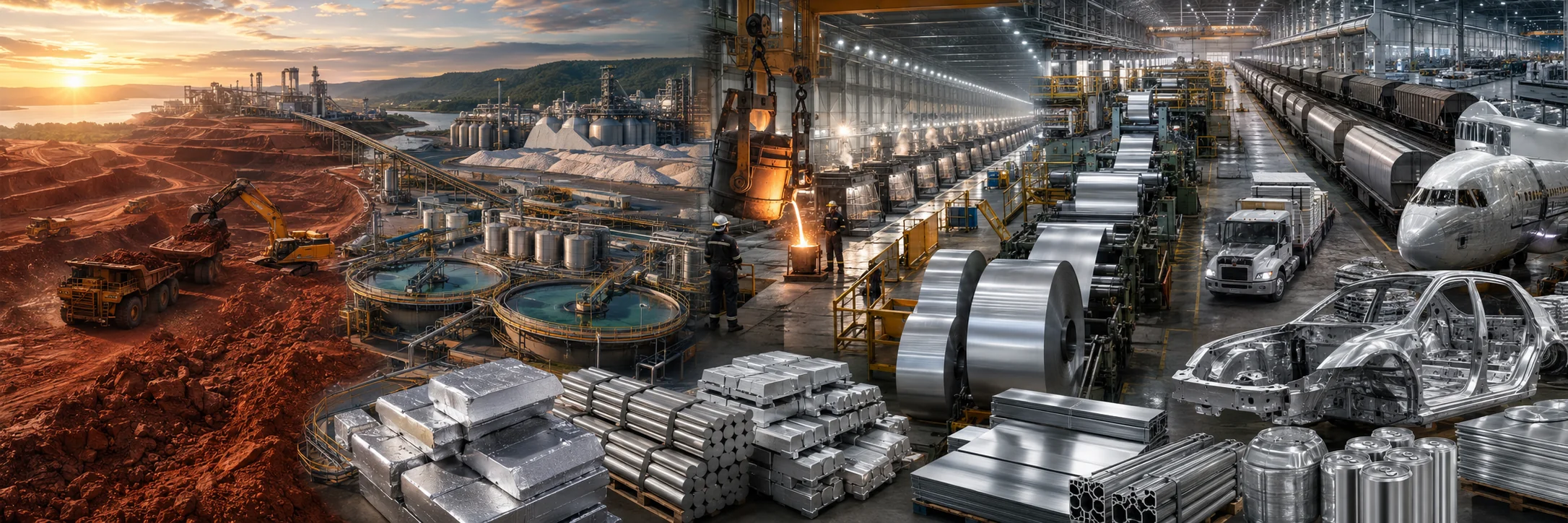
Follow aluminum from a weathered ore through caustic refining, continuous electrolysis, alloying, fabrication, service, sorting, and remelting—and see why metal mass does not establish usable supply.
An overhead line needs to carry current without placing unnecessary mass on towers. A beverage can needs a thin, formable barrier that survives filling, transport, and opening. A heat exchanger needs heat to cross a large area of thin wall. A vehicle or aircraft structure needs load paths, joints, damage tolerance, corrosion control, and low operating mass. None of these users needs an abstract tonne of aluminum. Each needs a property inside a complete design.
Aluminum is valuable because one element can support many such designs. It is low in density, conducts heat and electricity, forms a protective surface oxide in many environments, and can be rolled, extruded, cast, forged, machined, and joined. Pure aluminum, however, is too soft for many structural duties. Alloying elements, cold work, heat treatment, geometry, surface treatment, and joining create the final behavior. The same mass of aluminum can therefore be abundant in one form and unavailable in the form a user has qualified.
The production route has two very different beginnings. Primary production extracts aluminum from oxygen-rich minerals, creating controlled metal but requiring mined ore, chemical refining, continuous electrical reduction, and carbon. Secondary production begins with metal already separated from oxygen, but it inherits coatings, attachments, alloying elements, contamination, and the timing of old products returning. These routes meet in the cast house. What leaves the cast house should not be judged by origin alone. It is a specified material whose performance depends on how both inputs were combined and processed.
The material is a manufactured state
Elemental aluminum has a density of about 2.7 grams per cubic centimetre, a value included in the NIST material constants. Low density reduces mass for a given volume; it does not by itself establish stiffness, strength, fatigue life, crash behavior, electrical loss, or cost. Those outcomes belong to the chosen alloy and product geometry within its operating system.
Small additions of magnesium, silicon, manganese, copper, zinc, and other elements change strength, formability, corrosion behavior, conductivity, castability, and response to heat treatment. Cold rolling can strengthen some products while reducing ductility. Solution treatment and ageing can create fine precipitates that obstruct deformation. Annealing can restore workability. The Aluminum Association's alloy and temper systems distinguish composition from treatment because an alloy number alone does not define the state in which the material must be supplied.
The thin oxide film that forms on exposed aluminum can slow further corrosion, but it is not universal immunity. Chloride-rich environments, crevices, unsuitable contact with another conductive material, damaged coatings, trapped moisture, residual stress, and service temperature can change the result. A designer may add anodizing, cladding, paint, sealants, drainage, electrical isolation, sacrificial material, inspection, or greater thickness. Corrosion resistance is therefore a maintained relationship among alloy, surface, environment, geometry, and time—not a permanent adjective attached to the element.
A light part does not guarantee a light system
Substitution must be judged at the level of the service. Aluminum may require a larger cross-section than copper to carry the same current within a given loss, yet its lower density can make it attractive where conductor mass and supporting structure matter. An aluminum panel may need different thickness, ribs, fasteners, adhesives, repair methods, and corrosion isolation than a steel panel. A plastic package may be lighter in one measure but offer a different barrier, temperature range, recovery route, or shelf life. Magnesium, steel, copper, glass, wood, and composites each move constraints rather than simply replacing a kilogram.
This separates physical need from present material demand. Society may require electrical connection, protected food, buildings, transport, heat transfer, and machinery. Those services do not determine today's exact aluminum volume. Vehicle size, building geometry, transmission design, packaging format, repairability, product lifetime, reuse, collection, safety margin, and available substitutes all alter the amount and form required. Once a product has been designed, tooled, certified, and placed in service around a particular alloy, substitution may be slow or temporarily impossible even when another material could have served an earlier design.
Lightweighting can reduce energy or increase payload during use, but the result depends on duty cycle, energy source, replacement, production, and whether lower mass is used to reduce total consumption or to add range, size, speed, or features. A material property does not decide how its benefit is spent. That decision is made across designers, manufacturers, buyers, operators, infrastructure owners, and regulators.
Bauxite begins as a landscape
Aluminum is common in the Earth's crust but strongly bound in minerals. Commercial bauxite is not a pile of metal; it is a variable mixture of aluminum hydroxide minerals with iron oxides, silica, titania, water, and other constituents. Mineral form and reactive silica affect how a refinery must digest the ore, how much caustic soda it consumes, which impurities enter solution, and how much residue remains. The US Geological Survey description treats bauxite as a heterogeneous feed rather than a uniform grade.
Many deposits are mined from near-surface layers. Vegetation, topsoil, overburden, drainage, roads, pits, dust, noise, and water management therefore belong to material production before ore reaches a crusher. Selective mining can preserve ore quality while increasing the need to map and separate layers. Blending can make refinery feed more stable, but a blended assay does not show the condition of the disturbed land or the water leaving the site.
Rehabilitation must be organized before the first cut if topsoil, seed, drainage patterns, habitat material, and a feasible final landform are to remain available. The industry's bauxite-mining guidance emphasizes site-specific risk, progressive rehabilitation, communities, and post-closure conditions. A rehabilitation plan establishes an intended route. Placed topsoil, vegetation cover, water quality, species return, erosion resistance, and a land use accepted over time are separate observations. Ore shipped cannot serve as evidence that the landscape recovered.
The refinery separates aluminum and concentrates what remains
In the Bayer process, crushed bauxite is contacted with hot caustic soda (sodium hydroxide) under conditions selected for its mineralogy. Aluminum-bearing minerals dissolve into a sodium aluminate solution. Clarification separates undissolved solids. Aluminum hydroxide is then precipitated from the clarified liquor, and calcination drives off chemically bound water to make alumina, the oxide powder supplied to smelters. Caustic liquor and water are recovered and circulated where possible. The IAI process account shows that milling, digestion, clarification, precipitation, and calcination answer different physical tasks.
The refinery does not make the rest of the ore disappear. Iron-rich minerals, silica, titanium-bearing material, trace constituents, and residual alkaline liquor become bauxite residue, often called red mud. Its quantity and chemistry vary with ore and process. The residue must be dewatered, contained, drained, monitored, and ultimately placed into a stable closed landform or an actual qualified use. Alkalinity, fine particles, water inventory, foundation, rainfall, dust, seepage, and storage geometry remain relevant long after the saleable alumina leaves.
A proposed use in cement, construction material, metal recovery, or soil amendment is not a material route until specifications, contaminants, transport, processing, market demand, and regulatory acceptance align. Counting a research project or named application as recovered tonnage confuses technical possibility with physical delivery. The bauxite-residue management guidance accordingly follows storage from design through operation, closure, rehabilitation, and monitoring rather than treating the residue as a momentary by-product.
A potline turns continuous current into metal
Alumina is chemically stable. In the Hall–Héroult process, it is dissolved in a molten fluoride salt based on cryolite chemistry, and direct current passes between carbon anodes and the carbon-lined cell. Aluminum ions are reduced to liquid metal that collects below the bath. Oxygen from alumina reacts at the conventional carbon anode, consuming it and producing carbon dioxide. The EPA's primary-aluminum process description also distinguishes normal anode consumption from perfluorocarbon greenhouse-gas emissions during low-alumina operating disturbances called anode effects.
Electricity performs more than a purchasable energy input. Current drives the electrochemical separation, while the cell's electrical resistance helps maintain its thermal balance. Pots operate together in a series called a potline. A loss of current cools the molten bath; a prolonged interruption can freeze material, destabilize many connected cells, damage linings, and turn restart into a long physical reconstruction. Research on potline operation during blackouts explains why a smelter cannot be stopped and restarted like an ordinary warehouse machine.
This makes electricity price important, but reliability, duration, emissions, and operating flexibility matter too. A smelter also needs alumina, carbon anodes or their materials, fluoride chemistry, casting capacity, skilled crews, pollution control, maintenance, port or rail access, and customers for its output. Cheap power without those conditions does not create supply. Nor does a smelter necessarily locate at the cheapest momentary price: long-lived power arrangements, infrastructure, political risk, grid services, and the cost of an uncontrolled interruption shape what is financeable.
Changing the electricity source changes the indirect emissions associated with power. It does not remove the carbon consumed at a conventional anode, the fuel and heat used in refining and casting, or the upstream residue. The IEA's aluminum innovation assessment distinguishes lower-carbon electricity, cell efficiency, demand response, inert anodes, and more secondary production because each changes a different part of the system.
The cast house decides which forms can exist next
Liquid metal tapped from reduction cells is primary aluminum, but it is not yet a sheet coil, extrusion billet, foundry alloy, or finished component. In the cast house, metal enters holding or melting furnaces. Alloying additions and selected scrap adjust composition. Fluxing, settling, filtration, and degassing control inclusions, alkali metals, dissolved hydrogen, and oxide-related defects within defined capabilities. The melt is then cast into shapes such as rolling slab, extrusion billet, foundry ingot, rod feed, or remelt ingot.
That decision assigns future options. A rolling mill needs slab of the correct dimensions and composition. An extrusion press needs billet compatible with the alloy, diameter, die, press, and heat treatment. A foundry needs metal that will fill its geometry and solidify into an acceptable structure. Casting equipment, furnace schedules, alloy-change practice, metal treatment, and order sizes determine which output can be made without excessive transition scrap or delay. A region can have abundant liquid or exchange-grade metal and still lack the cast form required by its fabricators.
Primary metal contributes more than new mass. Its comparatively controlled, low-alloy composition can be blended with scrap to keep residual elements inside the target specification. Clean process scrap can do the same when its identity is known. This does not make primary production inherently necessary for every product; it explains why mixed scrap cannot always replace primary metal one-for-one even when both streams contain mostly aluminum.
Rolling, extrusion, and casting preserve different options
Rolling repeatedly reduces slab between rolls. Hot rolling establishes shape and breaks down the cast structure; cold rolling can control thickness, surface, and strength through work hardening; intermediate or final heat treatments change formability and temper. Sheet for an exposed vehicle panel, foil, can stock, heat-exchanger fin, and aerospace plate may pass through different mills, surfaces, widths, reductions, and inspection routes. Installed rolling capacity is not a single interchangeable number.
Extrusion pushes heated billet through a die to create a continuous profile. Alloy behavior, billet condition, press force, die geometry, exit temperature, cooling, stretching, ageing, straightness, and surface finish interact. The process can place material efficiently in a cross-section, but a profile tied to a die, press size, and qualified supplier cannot be replaced instantly by unused sheet capacity.
Casting fills a final or near-final geometry with molten alloy. Fluidity, solidification rate, gas, oxide films, feeding, shrinkage, die or mould condition, and heat treatment influence the resulting part. Wrought and casting alloys therefore organize composition differently. The Aluminum Association's production overview separates ingot, billet, rolling, extrusion, and final-shape casting because each preserves different material and geometric options.
Evidence connects chemistry to processing history
An aluminum designation is a composition boundary, not a complete material. Temper adds a controlled processing state. Product standards add form, dimensional tolerance, surface, and mechanical requirements. A customer drawing adds geometry, holes, joining surfaces, coatings, inspection, and use-specific evidence. A conductor, pressure part, aircraft plate, can end, and architectural extrusion can therefore share the element while remaining operationally non-substitutable.
A mill certificate usually links a lot to measured chemistry and specified tests. It does not directly observe every point in the lot, every later cut, or damage after shipment. A tensile coupon observes its own prepared specimen and direction. Conductivity can help infer heat-treatment condition in some alloys without proving fatigue life. A temper label describes a required processing route and property state, but welding, forming, overheating, or service exposure can alter the installed material. NIST's work on processing–microstructure–property relationships in aluminum plate captures why records of chemistry alone cannot represent performance.
Traceability should be proportionate to consequence. Commodity foil and a flight-critical forging do not need identical evidence. Yet loss of lot, temper, repair, or exposure history can make a physically sound item ineligible for a demanding reuse because its remaining condition cannot be established. The record is not part of the metal, but it determines which claims about the metal can responsibly be made.
One market price describes one narrow object
A quoted aluminum price can refer to high-grade primary metal, a regional delivery premium, an alloy adjustment, conversion into slab or billet, rolling or extrusion work, scrap of a named category, or a finished component. These are not additions to one universal commodity in the same way. They buy different chemistry, location, time, form, capacity, and risk.
The LME aluminum contract is physically underpinned by approved high-grade primary metal in specified shapes and warehouses. That standardization supports price discovery and delivery against the contract. It does not promise rolled sheet, a particular structural alloy, customer qualification, or immediate transport out of a warehouse. A warrant represents entitlement to a defined lot; it is not evidence that a fabricator's next coil exists.
Money changes feasible actions throughout the chain. A refinery needs working capital for caustic, fuel, residue management, and inventories. A smelter needs a power agreement that supports continuous operation and finance for restart or relining risk. A fabricator may need to reserve scarce width, press, die, or heat-treatment capacity. A recycler must hold and analyze scrap streams rather than mixing them for quick cash. A buyer without credit may accept an unsuitable delivery window even when better material exists elsewhere. Price can coordinate some scarcity while leaving physical conversion time and organizational authority unchanged.
Scrap returns on product clocks
New scrap is created during casting, rolling, extrusion, stamping, machining, and product manufacture. Its composition and source are often known, and it can return quickly. Old scrap becomes available only when a product is collected after use. A can may return in weeks; a vehicle in years; a window frame, cable, bridge element, or aircraft component after decades. Scrap supply therefore reflects earlier production, product lifetimes, demolition decisions, collection, and ownership—not today's metal demand alone.
When aluminum stocks in buildings, grids, vehicles, and equipment are growing, returning scrap cannot supply all new additions because much of the metal remains in service. Primary production or other material substitution may fill the gap. When stocks stabilize, more old metal can return, but only if collection and separation preserve it. The IEA notes in its aluminum assessment that scrap availability constrains secondary production; this is a timing boundary, not an argument that current losses are unavoidable.
Retirement can occur before physical exhaustion. A vehicle is written off, a façade replaced during renovation, a transmission line upgraded, or packaging discarded after one opening. Conversely, inspection, repair, component reuse, remanufacture, and adaptable design can preserve the product and the fabrication work already embodied in it. Extending service delays scrap supply but can preserve more function than immediate remelting. A high recycling rate is not automatically better than a long safe service life; they observe different parts of the lifecycle.
Remelting preserves metal, not automatically the alloy
Scrap begins with collection, identification, sorting, size reduction, removal of attachments, and often decoating or drying. Furnaces are selected for the feed. During melting, some aluminum oxidizes into dross; coatings and oils can create emissions; fluxes may protect the melt and collect impurities; salt slag, skimmings, dust, and separated materials require their own routes. Degassing and filtration can remove particular gases and inclusions. The IAI recycling-process account reports that transforming suitable scrap into recycled alloys uses about five percent of the energy input required for primary ingot from bauxite, while also describing the residues that remain.
That comparison applies to remelting and preparing suitable scrap, not to a mass-perfect return of every discarded product into its former function. Collection, transport, sorting, decoating, melt loss, treatment, casting, and refabrication still consume energy and material. Yield must be measured from discarded product to qualified output, not only from scrap charged to liquid metal.
Alloying elements do not reset when aluminum melts. Some can be adjusted or removed within limits; others are difficult or uneconomic to separate and accumulate when incompatible alloys, steel fasteners, copper wiring, coatings, and dirt enter one melt. Producers then select a tolerant target alloy, improve pre-melt separation, blend scrap streams, or dilute residual elements with cleaner metal. Open research on scrap-related elements in aluminum alloys shows that recycling quality is a problem of physical metallurgy and alloy design, not simply collection volume.
A beverage can is already a sorting problem
A can looks like one material, but body stock and lid stock are made for different forming and opening duties and have different composition requirements. Linings protect the product and metal; inks, labels, closures, and attached plastics can enter the collected stream. The Aluminum Association's can lifecycle inventory follows separate body and lid stock through remelting, casting, and rolling. A can-to-can route therefore depends on controlled blending and additions, not on every can returning as a chemically identical can.
Collection rate, sorting rate, remelt yield, recycled content, and closed-loop output are different measurements. Collection counts what entered a system. Sorting records what was separated into a category. Furnace yield follows saleable metal from charged scrap. Recycled content describes inputs to a new product. Closed-loop output asks whether the recovered composition and fabrication capacity actually served the same product system. A strong result in one measure cannot fill a missing observation in another.
Design affects all of them. A decorative sleeve can improve marketability while making optical sorting, decoating, emissions control, or final scrap value worse. The industry's container design guidance asks brands to minimize or make removable non-aluminum elements. That guidance is a control at the design table; its result becomes visible much later at a materials recovery facility and remelter.
Design decides the next melt
Cars, buildings, appliances, electronics, and energy systems combine castings, sheet, extrusions, cables, fasteners, coatings, glass, polymers, steel, copper, adhesives, and composites. Mixed-material design can improve use-phase performance while making dismantling and alloy separation harder. Joining can prevent vibration, leakage, or corrosion during use yet make a clean scrap stream unreachable at retirement. Neither effect should be ignored.
Alloy marking, accessible fasteners, separable joints, compatible alloy families, removable coatings, component records, and agreements to return production scrap can preserve future options. Clean offcuts can move directly back to the mill that knows their composition. End-of-life assemblies may need dismantling before shredding if valuable wrought alloys are otherwise mixed with casting alloys and foreign metals. The US Department of Energy's circularity framework identifies contamination and product design as limits on producing high-performance alloys from post-consumer scrap.
Direct reuse can preserve still more. An extrusion, plate, façade element, conductor, or component already contains alloying, casting, forming, heat treatment, machining, and surface work. Reuse keeps some of that geometry and history; remelting intentionally destroys it to recover compositional potential. Whether reuse is safe depends on condition, dimensions, former loading, corrosion, attachments, standards, and evidence. Recovered tonnes alone cannot distinguish preserved function from recovered liquid metal.
Failures must return to the material history
A crack, electrical hot spot, leak, distorted extrusion, stained façade, or corroded joint can begin in alloy selection, casting porosity, rolling direction, heat treatment, forming, machining, welding, coating, assembly, environment, overload, inspection, or maintenance. The final defect is an observation of the complete history, often made by a participant who controls only the last interval.
Investigation needs identity and comparison. Which heat, cast, slab, coil, billet, die, temper, machine settings, surface batch, joint design, and service conditions were involved? A chemical assay can find off-specification composition without locating a heat-treatment error. A tensile test can establish coupon behavior without reproducing a corroded joint. A recycled-content certificate can describe input accounting without explaining a fatigue crack. Corrective information must travel backward into the stage able to change the next outcome and sideways to other material sharing the relevant history.
Commercial boundaries can obstruct that route. A scrap seller may be paid for mass rather than composition. A fabricator may not receive service-failure data. A building owner may lack alloy records at demolition. A supplier can meet its delivered specification while the assembled design creates electrochemical corrosion between unlike conductive materials. Complete responsibility is not a promise by one company to prevent every failure. It is preservation of enough material identity, observation, and authority for the cause to remain reachable.
The residues keep their own clocks
Saleable metal is only one output. Mining changes land and drainage. Refining produces bauxite residue and process water. Carbon anodes are consumed and baked; pot gases require collection and treatment. Cell linings eventually fail and become spent pot lining containing carbon, fluorides, sodium compounds, and potentially cyanide. In the United States this material has been regulated as a listed hazardous waste, and the IAI's spent-pot-lining guidance notes that treatment and use routes remain a significant management challenge. Remelting creates dross, skimmings, dust, and sometimes salt slag.
Each output needs a route appropriate to its chemistry and lifetime. A residue storage facility must remain stable through closure and changing climate. Captured fluoride is useful only if it returns within specification. Dross recovery should count recovered metal and the remaining non-metallic fraction. A treatment certificate establishes that a defined process occurred; it does not by itself establish the condition of the final destination. Responsibility remains open wherever a material has been named but its containment, use, monitoring, or corrective authority is unresolved.
Primary aluminum can remain necessary when society is adding to the stock in use or when available scrap cannot meet the required composition. That physical conclusion does not make discarded clean scrap, lost alloy identity, avoidable early replacement, or poorly controlled residue necessary. The task is to preserve the properties and completed work that the next service can accept while supplying genuinely additional or cleaner metal where it cannot.
The return path must preserve capability
The aluminum chain is divided among mines, refineries, residue operators, anode producers, power systems, smelters, cast houses, rolling mills, extruders, foundries, component manufacturers, designers, owners, repairers, demolition contractors, collectors, sorters, remelters, and regulators. Their outputs meet only if mineralogy, chemistry, current, alloy, temper, geometry, condition, and timing remain compatible.
The most useful questions are therefore material questions. What function justified aluminum here? Which alloy state performs it? What did mining and separation leave elsewhere? Which process history created the delivered properties? When will the metal return, in what mixture, and with what evidence? Can the existing part remain in service or be reused before its geometry is destroyed? Which residual element or missing fabrication step prevents the collected metal from returning to the intended function?
Aluminum is sometimes described as stored electricity. Primary metal does embody an electricity-intensive separation, but the description is incomplete. The finished supply also stores ore selection, caustic refining, carbon consumption, alloy control, casting, deformation, heat treatment, surface preparation, qualification, and decisions about use and recovery. Preserving aluminum well means preserving as much of that completed work as the next purpose can physically accept.
Inside CompanyGraph
Map where bauxite mineralogy, refinery residue, power and carbon, alloy composition, temper, fabrication capacity, product condition, scrap identity, and corrective authority become separated—and which organizations can reconnect them before metal or function is lost—inside CompanyGraph.