 CompanyGraph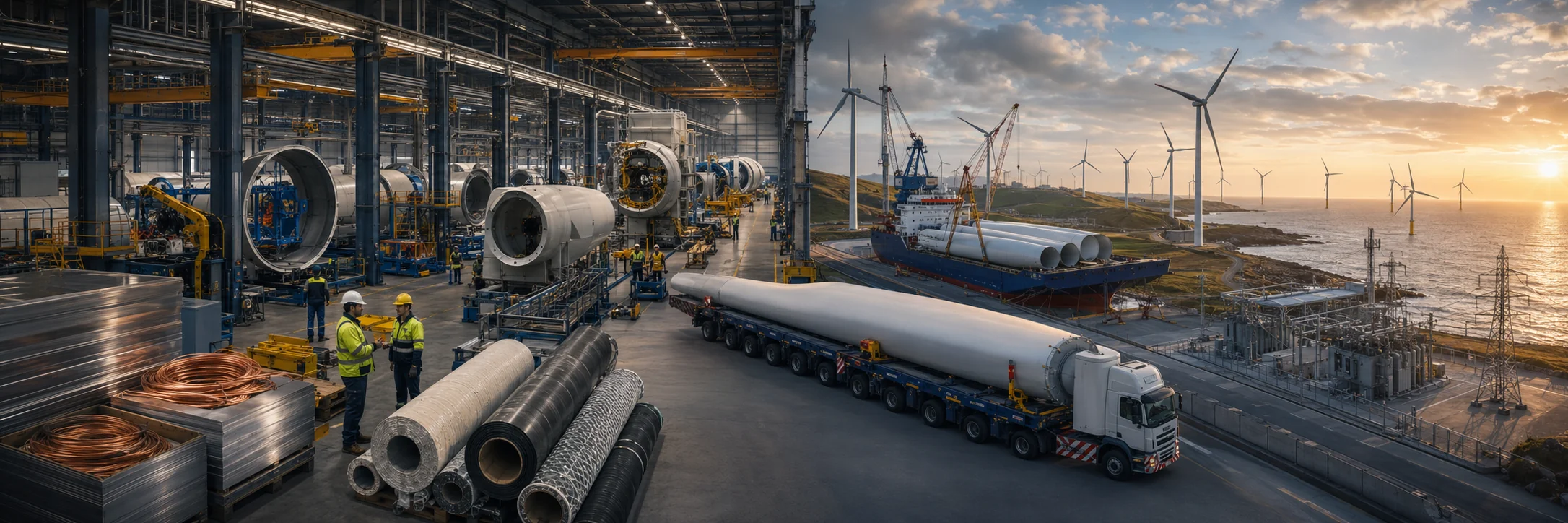
Follow moving air through a rotor, and follow the machine through molds, roads, foundations, decades of loading, maintenance, repowering, and material recovery.
The resource passes through the machine
A wind turbine never receives a batch of wind. Air approaches the rotor, flows around blades shaped to create lift, and turns the hub. The drivetrain carries that slow rotation and high twisting force to a generator, directly or through gears. Power electronics condition the resulting electricity; transformers and collection cables move it toward a substation and an accepting grid. The air continues downstream more slowly and with added turbulence. The turbine can take only part of the kinetic energy crossing the rotor because the flow must continue through and away from it. The US Department of Energy's turbine description follows this conversion from aerodynamic force to electricity.
People do not require rotating blades as an end in themselves. They require electricity for light, heat, cooling, motion, communication, and other services. A turbine is one way to convert an available resource into that electricity. Even a finished machine is not supply on its own: it needs suitable wind, an operable current path, an electrical connection, and a system able to accept its output. At the same time, the wind that turns the rotor bends the blades, loads bearings and foundations, erodes surfaces, and accumulates fatigue. The supply chain begins with that physical relationship, not with a catalogue of parts.
The rotor harvests an area, not a point
The useful resource is not the wind speed recorded at one instant or one mast. It is a distribution of speed, direction, change with height, turbulence, air density, and extreme conditions across the rotor and over time. The power available in wind rises with swept area and approximately with the cube of wind speed, so a modest difference in speed can create a large difference in available power. Larger rotors sweep more air and can capture useful energy at lower winds, while taller towers can reach a different wind regime. These gains also enlarge blade loads, tower clearance, tooling, transport, lifting, and foundation requirements. The Department of Energy's wind technology assessment explains how rotor area, hub height, wind speed, and power curves change accessible resource.
A turbine's power curve describes expected electrical output under specified conditions. Below cut-in speed it does not generate; above that point output rises; at rated power the controls limit further increase; and above a high-wind threshold the machine may shut down to protect itself. The exact thresholds belong to the turbine design. A nameplate rating identifies a maximum operating level, not the energy a machine will deliver in an hour or a year. A wind atlas estimates a resource, but not the precise future flow through a particular rotor. A power curve describes a tested relationship, but not every effect of terrain, wakes, condition, curtailment, or electrical loss at the site.
One turbine also changes the resource available to another. Its wake contains slower, more turbulent air; spacing and control can therefore trade land or sea area, cable length, and individual-machine exposure against plant energy and structural loading. The AWAKEN field research programme combines observations of atmospheric conditions, wakes, loads, and power because a rotor measurement alone cannot establish how an entire plant will perform.
The resource also bends the machine
A blade acts like a rotating beam fixed at its root: lift creates useful turning force while gravity, wind change with height, imperfect alignment, turbulence, gusts, and the blade's own mass repeatedly change the load along its length. The root transfers those forces through the hub and main bearing into the nacelle, yaw bearing, tower, foundation, and ground or seabed. Offshore, waves and currents add another moving load system. A high annual mean wind can coexist with damaging turbulence; a short extreme event and millions of ordinary cycles can threaten different parts of the machine.
Pitch systems rotate the blades to regulate power and loads. Yaw systems orient the rotor. Controllers start, limit, stop, and protect the machine; feathering a blade reduces aerodynamic force in high wind. Shutdown is therefore sometimes successful control, not lost mechanical function. But control cannot erase exposure. Rain, hail, salt, ultraviolet light, airborne particles, and repeated impact can roughen or remove the leading-edge coating. That surface change can reduce aerodynamic performance and progress into structural repair if it is not reached. The Department of Energy's leading-edge erosion research treats surface condition as both an energy and maintenance problem.
A blade is bonded together and trusted as one
Most large blades are composite structures rather than solid objects. A conventional clamshell process makes two aerodynamic skins in long molds, commonly from glass-fibre reinforcement and resin. Thick lengthwise reinforcement called spar caps carries much of the bending load; internal shear webs stabilize the shape and transfer force between the skins. Adhesive bonds join the shells and webs, while the root connection, lightning-protection path, coatings, and sometimes carbon-fibre reinforcement add other materials and interfaces. The national laboratory's blade manufacturing account shows how two skins and internal webs become one structural component.
Material identity is not enough to establish blade quality. Fibre orientation, resin mixing and infusion, temperature, vacuum integrity, cure history, bond-line thickness, voids, wrinkles, trimming, surface finish, balance, and handling all affect the result. Incoming certificates observe supplied material; process records observe selected manufacturing conditions; inspection and proof testing observe the accessible finished structure. None alone reproduces decades of combined fatigue, weather, repair, and lightning exposure.
Many utility-scale blades leave the factory and travel as single units because a continuous load path avoids a field joint. But indivisibility is not a law of wind power. Segmented blades, on-site assembly, and other logistics-oriented concepts exist. The Department of Energy's study of supersized blades explicitly assesses segmentation and on-site manufacturing. A joint can shorten the transported piece, but it adds mass, interfaces, assembly work, inspection needs, aerodynamic tolerances, and a new fatigue-critical history. Logistics difficulty is moved into design and field quality rather than abolished.
The drivetrain chooses where to put complexity
The rotor turns slowly with high twisting force, while electrical generation must be controlled over a variable speed range. A multi-stage gearbox can raise shaft speed and permit a smaller, faster generator. Medium-speed arrangements use fewer gear stages and a different generator. Direct-drive arrangements remove the gearbox but require a large generator able to work at rotor speed. Bearings, shafts, lubrication, cooling, converters, copper windings, magnetic fields, structural mass, service access, efficiency, and failure modes are redistributed across these designs.
Permanent-magnet generators can use neodymium-iron-boron magnets, sometimes with dysprosium or other additions selected for temperature and resistance to demagnetization. That creates a real connection to rare-earth mining, separation, alloying, and magnet production. It is not, however, a universal property of wind turbines or even of every direct-drive concept. Common geared induction-generator designs do not need rare-earth permanent magnets; electrically excited generators and other architectures provide alternatives, while some geared designs do use permanent magnets. The Department of Energy's neodymium-magnet supply-chain report makes this distinction explicitly, and its drivetrain assessment compares the broader system trade-offs.
A magnet specification establishes composition and magnetic properties under stated tests. It does not establish generator assembly quality, cooling, converter behaviour, bearing condition, or electricity delivered. Nor does choosing a magnet-free design make the drivetrain constraint-free. It selects a different combination of rotating components, copper, electrical excitation, gearbox stages, mass, maintenance, and manufacturing capability.
The road, quay, and crane set component boundaries
Blades, tower sections, nacelles, hubs, transformers, and offshore foundations leave different factories because their processes and transport envelopes differ. Steel plate is rolled and welded into tower sections; flanges, ladders, cables, coatings, and internal equipment are added before sections move to site. Foundries and forges supply hubs, frames, shafts, and bearing rings. Electrical factories make generators, converters, transformers, and switchgear. Composite plants need blade-length molds, controlled infusion and cure, finishing space, and a route out of the gate.
The largest part that can be made economically is not always the largest part that can reach the project. Road curves, bridge capacity, overhead clearance, escort rules, port channels, quay bearing strength, laydown space, crane reach, vessel deck area, and installation weather all become design inputs. A wider tower base may improve structural efficiency but exceed a road envelope; alternatives include more sections, hybrid concrete and steel, segmented designs, or on-site assembly. Blade factories often serve regional markets because abnormal loads are costly and route-limited, but ports, rail, specialist road routes, and segmented designs make the geography a choice among constraints rather than a universal rule.
Offshore construction adds marshalling ports, foundation and cable installation, offshore substations, heavy-lift or jack-up vessels, crew transfer, and weather-limited lifts. Floating projects can shift more integration toward port and tow assembled units to site, but then moorings, anchors, flexible cables that move with the platform, tow-out depth, and harbour depth become decisive. The Department of Energy's manufacturing and supply-chain overview maps these material and logistics capabilities; the national laboratory's port research shows why quay and harbour characteristics belong inside the production system.
The platform is industrial; its support belongs to the site
Wind projects do not begin from a unique turbine invented for every location. Manufacturers develop repeatable platforms, variants, interfaces, factories, software, tooling, and service systems. A project selects and configures that industrial product for a wind class, turbulence, temperature, corrosion exposure, grid code, acoustic limits, transport route, and other site conditions. The standardized machine and the particular site meet at a set of verified limits.
Below ground or water, the support is more specific. Onshore geotechnical conditions and loads shape concrete foundations, reinforcement, anchor cages, piles, or rock anchors. Offshore depth, seabed, waves, currents, scour, installation equipment, and removal plan help determine monopiles, jackets, gravity bases, or floating structures with anchors and moorings. The Department of Energy's offshore foundation research demonstrates why one support form does not fit every seabed and water depth.
Cables and the grid impose another site boundary. Array cables gather output; export or land cables, substations, protection, controls, transformers, and the interconnection point determine whether it can leave the plant. More installed rotor capacity cannot substitute for a delayed cable, damaged termination, constrained network, or unavailable transformer. Site engineering therefore adapts a repeatable platform to a place; it does not eliminate standardization, and the platform does not eliminate the place.
Commissioning proves a moment, not a lifetime
A type certificate evaluates a turbine design and manufacturing system against defined standards and design assumptions. Project certification or site assessment asks whether that design and its support, transport, installation, and conditions are suitable for a particular project. Factory acceptance tests observe components before shipment. Serial numbers, material certificates, weld and composite records, bolt-tightening records, software versions, and inspections that look for damage without cutting the component preserve different pieces of identity and history. The DNV certification framework distinguishes generic type approval from site-related evaluation, while the Department of Energy's testing overview describes blade, drivetrain, field, and grid-integration tests.
Commissioning checks the assembled turbine and plant: mechanical completion, protection, controls, communications, electrical behaviour, and performance under the conditions available at that time. It cannot expose every bond defect, future storm, controller interaction, bearing load, corrosion path, cable movement, or repair error. Passing commissioning establishes that specified checks passed at a recorded moment. It does not turn the future operating history into a known fact.
Wind availability and turbine availability are different
Once the plant operates, several numbers can look like supply while observing different boundaries. Nameplate capacity records rated power. A resource assessment estimates future wind. A power curve relates wind to expected machine output under defined conditions. Supervisory control and data acquisition, often shortened to SCADA, records selected operating signals and alarms. Condition-monitoring systems infer changes from vibration, oil, temperature, electrical, or other measurements. A revenue meter records electrical energy at a stated boundary. None of these observations alone identifies all lost energy or its cause.
A turbine may be mechanically available during calm air. It may be capable of generation but stopped for wildlife protection, excessive wind, icing, noise management, negative prices, network congestion, or an instruction from the system operator. Conversely, strong wind can coincide with a failed converter, a damaged cable, missing spare, crane delay, or inaccessible offshore turbine. Wakes, electrical losses, planned maintenance, forced outage, curtailment, and meter placement change different parts of the result. The OpenOA operational-assessment framework separates availability and electrical losses from the expected energy baseline for this reason.
Maintenance must reach the fault
Remote signals can narrow a diagnosis, but a repair still requires a reachable machine, the right people, tools, procedures, parts, authority, weather, and working money. A software reset, blade inspection, converter replacement, gearbox exchange, subsea cable repair, and foundation survey have radically different access needs. Onshore, a large component exchange may wait for a heavy crane and transport route. Offshore, vessel type, sea state, wind limit, daylight, technician transfer, and port distance can determine whether a known fault is actionable.
Spare strategy also changes what is possible. Holding every major component ties up money and storage; holding none makes a long manufacturing lead time part of the outage. An original-equipment service contract may provide diagnostics and parts while limiting the owner's direct access to software or repair options. A compatible component is not necessarily qualified for the existing interface, controller, warranty, or certification. Maintenance demand is therefore shaped both by physical wear and by modularity, documentation, commercial access, and the ability to keep alternatives available.
Delaying inspection can save an immediate vessel or crane mobilisation and permit a defect to grow. Replacing a whole assembly can restore generation faster while discarding serviceable subcomponents. Repairing in place can preserve material but demand scarce skill and a longer weather window. These are not simply choices between good and bad maintenance. They are actions made feasible or infeasible by access, cash, contracts, time, evidence, and the consequences of waiting.
Local observations have to travel back into operation
A wind plant also changes a place. Roads, foundations, cables, vessel activity, construction sound, operating rotors, aviation lighting, and land or sea occupation can affect people, habitat, birds, bats, marine life, and other users in different ways. A predicted mechanism is not an observed effect; absence in one monitoring method is not proof of absence everywhere. Baseline surveys describe selected conditions before construction. A complaint records an experience at a time and location. Sound measurements test defined acoustic conditions. Bird or bat searches observe only what the survey design, search area, detection, and carcass persistence allow. Offshore instruments observe selected species or stressors across limited space and time.
The important connection is corrective. Choosing the wider site and the exact position of each turbine can avoid some exposure before construction. Operating limits, seasonal or condition-based curtailment, lighting choices, restoration, and other measures may reduce particular effects after evidence emerges, but only if observations can reach those with authority to change design or operation. The US Fish and Wildlife Service guidelines use an iterative path from site evaluation through post-construction study and mitigation. For offshore wind, the Bureau of Ocean Energy Management's RODEO programme makes direct measurements during construction and initial operation to inform later analysis and decisions. A permit condition, a model, a field observation, and a corrected operating rule remain different events.
Repowering can retire a working machine
Physical failure is only one reason a turbine leaves its original role. A project may continue operating, replace selected components, partially repower with larger rotors or uprated equipment, or remove turbines and build a substantially new plant. Repowering can use an existing windy site, access roads, land relationships, permits, and grid connection more productively. It can also retire a machine that could still turn because the revenue, incentive, lease, service arrangement, parts outlook, or opportunity cost favours replacement.
A used turbine or component is not reusable merely because it remains intact. The next user needs identity, load and alarm history, inspection and repair evidence, remaining-life assessment, transportability, spare and software support, and compatibility with a new site and regulatory boundary. Without those connections, a market may price uncertainty as scrap even where substantial function survives.
A blade can leave service without becoming waste
Wind turbines contain large quantities of steel and iron, plus copper, aluminium, polymers, electronics, concrete, lubricants, and—in some generator designs—permanent magnets. Commercial recovery routes already exist for many metals. Thermoset composite blades are harder because fibres are embedded in a cross-linked resin and the structure is large, curved, bonded, coated, and sometimes contaminated by service and cutting. Harder to recover does not mean physically unrecyclable, and a recycling label does not say how much value survives.
An intact blade may be reused only where condition, geometry, certification, transport, and a next machine align. Repurposing can preserve some shape and embodied work in a different function. Mechanical processing can turn composite into smaller material for fillers or other uses. Cement co-processing can use portions as mineral input and fuel. Thermal or chemical routes can recover fibres, chemicals, or energy with different quality, cost, emissions, and residue. New resin systems are being designed for easier separation. The Department of Energy's wind turbine recycling overview distinguishes these routes, while its end-of-service guide separates continued operation, partial or full repowering, decommissioning, recycling, and disposal.
Foundations, buried or subsea cables, roads, and substations create other decisions. Full removal can recover material and free a site but cause new excavation, seabed disturbance, transport, and processing. Leaving part in place can avoid some immediate disturbance while preserving an obstruction, liability, or monitoring need for the future. The result depends on location and condition; it cannot be inferred from a universal hierarchy. Decommissioning plans, financial security, as-built records, material inventories, cable routes, contamination evidence, and assigned custody must remain reachable before the project company, warranty, or revenue disappears.
The wake eventually dissipates; obligations remain
A wake eventually dissipates as its slower, turbulent air mixes with the surrounding atmosphere, but the machine's material and operating histories persist. Dependable wind electricity requires more than turbine count. It requires a credible relationship between the wind distribution and the selected rotor, between loads and structural evidence, between a certified design and its actual site, between alarms and reachable maintenance, between local observations and corrective authority, and between removal and a next route for each remaining condition.
Inside CompanyGraph
Explore the material suppliers, blade and tower plants, foundries, drivetrain and electrical manufacturers, turbine platforms, ports, carriers, crane and vessel operators, foundation and cable contractors, project owners, grid connections, service networks, monitoring bodies, repowering projects, and recovery routes that connect moving air to delivered electricity and corrective action inside CompanyGraph.