 CompanyGraph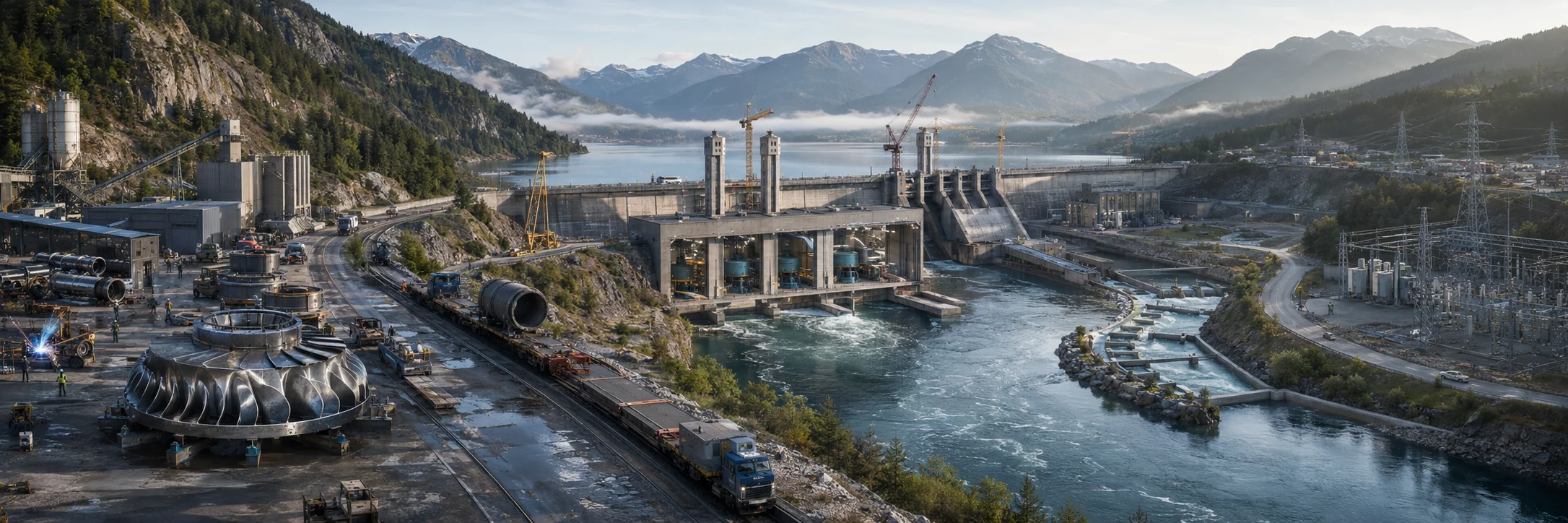
From watershed and riverbed to reservoir, turbine, grid, and downstream channel—and why water, sediment, safety, and competing users remain part of the electricity supply.
Hydropower is a service from moving water
Hydropower uses a change in elevation and a flow of water to turn a turbine, which turns a generator and sends electricity into a grid. In an impoundment plant, a dam stores water in a reservoir and releases it through a penstock. In a diversion or run-of-river plant, part of the flow is routed through a canal or penstock without a large storage lake. Pumped storage moves water between two reservoirs and uses electricity to pump it uphill before generating later. The U.S. Department of Energy describes these as different plant arrangements, not interchangeable versions of one machine.
The user does not need a dam or a reservoir as such. The user needs light, cooling, motion, communications, or another electricity service at a required moment. A hydro plant can supply energy, rapid changes in output, storage, grid stability, flood control, irrigation water, navigation, or recreation, depending on its design and operating rules. Those services can compete for the same water. A nameplate megawatt rating therefore does not establish how much electricity is deliverable during a drought, an environmental release, a fish-migration window, or a transmission outage.
The chain begins before concrete. A watershed supplies rainfall, snowmelt, and runoff; geology and topography determine head and foundation conditions; communities and other water users occupy the basin; regulators define licenses and safety duties; engineers select a dam, diversion, powerhouse, turbine, generator, and transmission connection. The physical principles described here are general, but the licensing, inspection, and project examples that follow are principally U.S.-specific. The water continues downstream after generation, carrying sediment, heat, dissolved materials, and the consequences of how it was released.
Head and flow set the first boundary
Available hydraulic power depends on the water flow and the elevation difference, or head, between intake and discharge. The site must also support a foundation, waterways, access roads, transmission, and safe operation under floods, earthquakes, landslides, ice, and changing inflows. These conditions are geographically fixed. A turbine can be manufactured elsewhere, but a project cannot move its watershed or recreate the same head at another location.
Geography does not by itself establish a viable project. A river may carry enough water in a wet year but too little during the season when electricity is needed. A high head may be inaccessible without a long tunnel or a reservoir that floods valuable land. A diversion may reduce inundation while leaving output dependent on natural flow. The physical site, the water year, and the required electricity service have to fit together.
Existing infrastructure can make a developed site useful for decades, but it does not make the water resource unlimited. Reservoir levels, inflow forecasts, snowpack, evaporation, competing releases, and turbine limits all affect the water that can reach the runner. EIA's hydropower analysis links seasonal precipitation and snowpack to U.S. generation forecasts; it does not treat installed capacity as guaranteed output.
Construction changes a whole river basin
Building a large project moves concrete, steel, rock, gates, tunnels, transmission equipment, and labor into a remote location. It may also move homes, roads, cultural sites, farms, and burial grounds before the reservoir fills. The project creates a new hydraulic geometry: water slows in the reservoir, the river channel is narrowed or bypassed, and release timing is governed by gates, turbines, spillways, water contracts, and safety rules.
A reservoir is not simply a larger natural lake. It changes residence time, temperature, dissolved oxygen, sediment transport, floodplain connection, and access for migratory fish. NOAA explains that many fish need both ocean and freshwater habitat to complete their life cycles and that hydropower barriers can block that movement. Fish ladders, bypasses, spill, turbine shutdowns, and habitat work are project-specific measures requiring design, maintenance, monitoring, and sometimes less water through the turbines. NOAA's project licensing summaries show how fish-passage standards and habitat obligations are negotiated for particular dams; they do not establish that every listed measure applies everywhere.
Flooded biomass can decompose without oxygen and release greenhouse gases in some reservoirs, especially where large areas of vegetation are inundated. The U.S. greenhouse-gas inventory accounts for methane from flooded lands and reservoir surfaces. Other release pathways, including degassing through turbines or downstream channels, require separate site-specific measurement rather than being attributed to that inventory statement. The amount depends on climate, vegetation, reservoir age, water chemistry, and the counterfactual land and river condition; it is not a single property of all hydropower.
The powerhouse converts water under constraints
At the powerhouse, an intake screen and gate admit water to a penstock or tunnel. The turbine converts hydraulic energy into rotation; the generator converts rotation into electricity; transformers raise voltage for transmission. Runner shape, head range, flow, vibration, cavitation, debris, and sediment determine how the unit can operate. A turbine overhaul can restore a physical capability, but it cannot create water that is not in the reservoir or a transmission path that is unavailable.
Run-of-river units usually have less stored water and therefore less ability to shift output across hours or seasons. An impoundment plant can reserve water for a later peak, flood-control requirement, irrigation release, or fish passage. That flexibility has a physical opportunity cost: water released for one purpose cannot be used for another at the same elevation and time. Pumped storage adds another route. DOE explains that water is pumped uphill when electricity is available and released through turbines when electricity is needed. DOE's pumped-storage technology assessment treats pumping energy and round-trip efficiency as part of the physical storage service, not as free capacity.
Electricity is not complete at the generator terminals. The plant needs protection, controls, communications, a substation, and a transmission connection that can carry the output to the load. A full reservoir and available turbine can coexist with a constrained line, a failed transformer, or a grid condition that limits dispatch. The electrical service emerges only when the water, machine, connection, and receiving system are coordinated.
Water allocation decides when power is available
Reservoir operation is a schedule of releases, not a simple decision to maximize generation. Operators may have to maintain minimum downstream flows, protect water quality, pass fish, supply irrigation or municipal users, manage flood risk, and keep enough storage for later conditions. The electricity price may indicate when generation is valuable, but it does not erase these physical and legal requirements.
Drought makes the distinction visible. In 2021, low levels at California's Oroville reservoir forced its hydropower plant offline for the first time since operation began, as documented in EIA's Oroville analysis. The plant and generator still existed; the water level had fallen below the facility's usable intake. A drought can therefore reduce hydroelectric output and cause other generators to run more, even when annual installed capacity remains unchanged.
Money changes which responses are reachable before the water shortage becomes an outage. One U.S. example is the Mid-Columbia relicensing settlement: the 1,993-MW Priest Rapids project carries a 91% fish-survival standard and about $3.2 million per year for tributary habitat, while the Rocky Reach project carries about $230,000 per year under its habitat plan. NOAA identifies the licensees and settlement parties responsible for those commitments in its project summaries. In a separate USGS study of five Penobscot River dams, modeled turbine shutdowns during peak migration preserved about 65% of hydropower generation while improving projected fish abundance; that result is a site-specific model, not a universal trade-off. An owner may also need funds for turbine refurbishment, forecasting, reservoir surveys, emergency spillway work, or transmission upgrades while revenue falls because less water is available for generation. A water agency may need to finance conservation or replacement supply before a reservoir can be held back for electricity. These are timing and authority constraints, not evidence that one participant simply chose the wrong release.
Sediment slowly changes the reservoir
Rivers carry clay, silt, sand, gravel, and cobble. A reservoir slows the water and traps part of that load, forming deltas and reducing the storage volume and intake conditions that the project was designed around. The Bureau of Reclamation says its sediment surveys measure changing reservoir capacity and sediment deposition because the relationship between water elevation and usable storage changes over time. Its monitoring guidance explains that sediment can also starve downstream reaches.
Sediment management can involve flushing, sluicing, bypasses, dredging, altered releases, or accepting a gradual loss of storage. Each route needs a suitable outlet, downstream capacity, equipment, permits, and money. A reservoir level gauge can show water surface elevation, but it cannot by itself show how much of the original storage is occupied by sediment or whether a turbine intake will remain clear for the next operating season.
Licenses and safety carry the project forward
Hydropower licenses divide time and authority. In the United States, FERC licenses many non-federal projects for 30 to 50 years, and relicensing can require new environmental measures, fish passage, operating rules, and public participation. A license is not a physical guarantee of water or safe operation; it authorizes a defined project under conditions that can change at renewal.
Dam safety is a continuing production requirement. FERC reports that roughly two-thirds of the dams in its safety program are more than 50 years old and requires regular inspections, including independent consultant evaluations for covered projects every five years. An inspection report observes defined conditions and risks. It does not itself perform the concrete repair, replace a gate, fund an emergency action plan, or ensure that downstream warnings reach the people who need them.
The financial pressure is concrete. A safety modification, turbine overhaul, fish passage project, or sediment survey consumes money and may require taking a unit offline, while the benefit is often a failure or loss that does not occur. If an owner, regulator, water agency, and grid operator hold different budgets and authority, a complete safety or environmental response can be delayed even while each party's local records remain current. FERC's dam-safety program makes the inspection and aging boundary explicit.
What the measurements actually establish
Reservoir elevation measures water surface at a location and time. An inflow gauge estimates water entering a basin. Turbine telemetry reports flow, vibration, temperature, and output at the unit. A power meter records electricity delivered at a connection. A fish-counting station observes passage under its method and period. A license or environmental report states obligations and declared conditions. These are different observations, even when they are later combined into a single operating dashboard.
A nameplate rating describes a unit under specified hydraulic and electrical conditions. Annual generation describes energy delivered over a period. Neither number establishes that the plant can provide power during a particular hour, that the reservoir retains its original capacity, or that downstream ecological conditions match the pre-project river. A certificate of renewable electricity describes an accounting claim; it does not inspect every release, turbine, sediment deposit, or fish passage event behind the certificate.
Controls still repair uncertainty. Forecasts can improve release planning; sensors can reveal seepage or vibration; fish passage monitoring can show whether a measure works for a species and season; independent inspections can identify a safety issue before failure. But a detected issue is not a corrected structure. Correction requires the person with the information, equipment, funding, outage window, and authority to change the dam, turbine, release, or downstream response.
After generation, water and infrastructure remain
Water leaves the turbine and continues downstream. It may be warmer or colder, carry a different sediment load, have a different dissolved-oxygen profile, and arrive at a different time than it would have without the project. Fish, wetlands, floodplains, farms, cities, and other hydropower units receive that altered flow. The electricity has been delivered, but the physical process has not ended.
When a unit is retired, the choices are not simply —“keep— or —“remove.—” An owner may modernize the turbine, change operating rules, add fish passage, retain the dam for water storage, draw down a reservoir, or remove a barrier. Removal can release accumulated sediment and change downstream hydraulics; continued operation requires safety, environmental, and financial commitments. USGS and NOAA describe dam removal and fish-passage work as site-specific interventions, not automatic reversals to an untouched river.
What must remain connected after generation
A complete account would connect watershed inflow, head, reservoir storage, sediment, turbine and generator condition, transmission, water allocations, fish and habitat observations, safety findings, payment, and authority over the next decision. It would distinguish a physical flow from a meter reading, a license condition from a completed repair, and a renewable-energy claim from the river and communities that continue to receive the altered water.
Inside CompanyGraph
Explore how watersheds, reservoirs, dams, turbine suppliers, grid connections, regulators, downstream users, and ecological obligations connect—and where water, electricity, money, evidence, and responsibility separate.