 CompanyGraph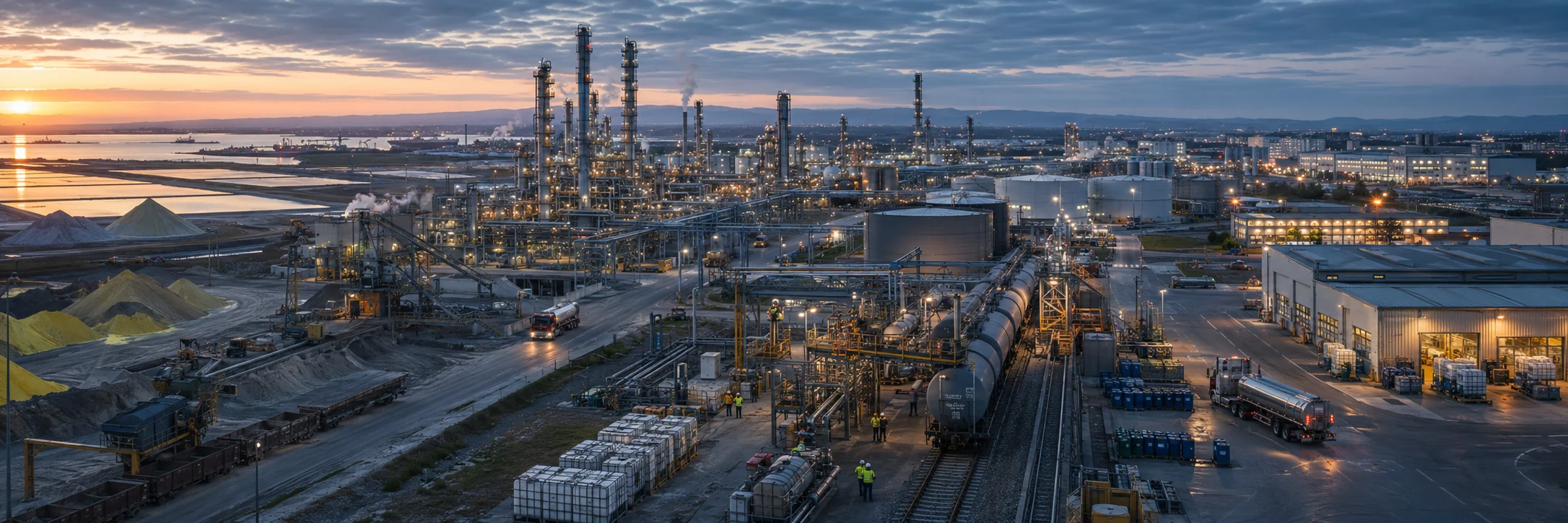
From salt, sulfur, air, hydrocarbons, and minerals to reactive intermediates—and why containment, process continuity, co-production, and downstream qualification decide what chemical supply can do.
A chemical is made useful by a controlled property
Industrial chemicals are not one product category. Chlorine chemistry can disinfect water or make PVC; sulfuric acid can leach metal ores, make phosphate fertilizer, or act as a battery electrolyte; caustic soda can break down wood fibers, adjust pH, or process alumina; solvents, oxidants, gases, and catalysts enable pharmaceutical, food, textile, semiconductor, and metals production. The user needs a reaction, separation, cleaning, sterilization, pH adjustment, surface treatment, or material property—not a drum or a tonne by itself.
Present demand is therefore partly physical and partly organized by the route currently used to provide a function. A water utility may use chlorine gas, sodium hypochlorite, or on-site generation. A paper mill may use caustic soda because its pulping equipment, permits, and wastewater system are built around that chemistry. An alternative can be physically possible while remaining unavailable to a particular site because it needs new tanks, dosing equipment, permits, trained operators, or working money before the next production run.
The chain begins with feedstocks such as salt, sulfur, air, water, natural-gas liquids, metals, biomass, or mineral ores. Processing separates, purifies, reacts, compresses, dries, or concentrates them. The resulting chemical may be sold as a bulk intermediate, moved through a dedicated pipeline or tank, or consumed immediately inside an integrated complex. It then becomes another material, is diluted into a working solution, or leaves as wastewater, salt, spent catalyst, off-specification product, or an emission that needs its own control.
The feedstock becomes a process-specific intermediate
The first transformation is not simply —“raw material to chemical.—” It is a sequence of unit operations whose order and conditions determine the product. Brine can be purified and electrolyzed; sulfur can be oxidized and absorbed; air can be separated into oxygen, nitrogen, or argon; hydrocarbons can be cracked, oxidized, hydrogenated, or distilled; minerals can be dissolved, precipitated, and crystallized. Temperature, pressure, residence time, water content, impurities, and catalyst condition determine what leaves each unit.
Chlor-alkali makes the coupling especially visible. Electrolysis of purified brine produces chlorine and caustic soda together, with hydrogen as another output. EPA's chlorine industry profile describes the process and its co-products. A plant cannot increase chlorine for one customer without also producing the associated caustic soda and hydrogen, unless it changes operation or finds another route for those products. The chemistry ties markets together before any contract is signed.
Purification also assigns future options. Water, salt, sulfur, trace metals, catalyst poisons, and corrosion products can enter with the feed. A product specification can reject an impurity, but removing it later may require another separation step, more energy, a different vessel, or disposal of a concentrated residue. A certificate of analysis reports sampled concentration or purity; it does not describe every exposure the chemical experienced before sampling or the condition of the customer's dosing system.
Containment follows the molecule
Storage is designed around physical behavior. A compressed gas needs pressure-rated vessels and relief systems. A corrosive liquid needs compatible tanks, linings, valves, pumps, and secondary containment. A cryogenic liquid needs insulation and boil-off management. A water-reactive or oxidizing chemical must be kept away from incompatible materials. Temperature, concentration, vapor pressure, permeability, and decomposition determine how long a product can remain in a container and what emergency response is possible.
Transport adds another layer. U.S. hazardous-material rules require classification-specific packaging, shipping papers, labels, placards, emergency information, and training. PHMSA describes how the rules apply across rail, road, vessel, and air transport. A new carrier cannot replace the old one merely because a truck or railcar is available; it must have compatible equipment, trained people, approved documentation, and a route that can handle the hazard.
The U.S. Chemical Safety and Hazard Investigation Board's review of chlorine-transfer incidents shows why this infrastructure is part of supply. In one 2002 incident, a ruptured transfer hose and a poorly maintained emergency-shutdown system allowed about 48,000 pounds of chlorine to escape; in a later comparison, a functioning shutdown system limited a similar release. The CSB case connects hose material, inspection, alarms, shutdown equipment, maintenance, and community impact.
This safety infrastructure is not separate from supply. It determines how much can be stored, which routes are permitted, how quickly a shipment can be rerouted, and which customers can receive the product. A chemical's useful property and its hazard are often the same physical fact: chlorine oxidizes and disinfects, sulfuric acid reacts and dissolves, and flammable solvents release vapors that can ignite.
A plant is a process, not a warehouse
Chemical plants join reaction, separation, heat exchange, pumping, compression, utilities, control systems, and waste treatment into a process that must remain within operating conditions. Some units can ramp output; others are designed around continuous flows and stable heat or pressure balances. The important constraint is not a universal requirement that every plant run at full rate, but that changes in rate, feed, or temperature can move the process outside the range where equipment, catalysts, product quality, and safety controls work as intended.
A planned turnaround isolates equipment, removes hazardous contents, cools and opens vessels, inspects pressure boundaries, replaces worn parts, tests controls, and restarts in stages. Maintenance contractors, spare parts, permits, product inventories, and customer notifications must be available at the same time. An unplanned trip can leave residues, blocked lines, damaged seals, or an uncertain process state that must be inspected before restart. The stop may take hours; proving that the plant is safe and qualified to resume can take much longer.
Redundant power, cooling water, steam, instrument air, flare systems, emergency shutdowns, and feedstock inventories protect the process from a single failure. These are real material capabilities that require money before an incident occurs. If maintenance or spare capacity is deferred because cash is needed elsewhere, the record may still show a compliant product from the last batch while the plant's ability to make the next batch has narrowed.
Co-production ties separate markets together
Co-production is not a commercial accident. It follows stoichiometry and the equipment's material balance. Chlor-alkali produces chlorine, caustic soda, and hydrogen together. Refining and cracking produce several hydrocarbon streams. Some mineral processes produce saleable metals alongside residues that require treatment. A customer may want only one output, but the plant must find a route for the others or reduce the process.
This coupling makes substitution harder. If chlorine supply falls, water treatment may need another disinfectant while PVC and hydrochloric-acid users lose their feed. If caustic soda demand falls, a chlor-alkali plant cannot simply stop making caustic soda while continuing to produce the same chlorine volume. Storage, contracts, and operating decisions therefore move burdens between products and downstream sectors rather than removing them.
Money determines which safe route can be arranged
A chemical producer must pay for feedstock, electricity, water, operators, maintenance, testing, containment, waste treatment, insurance, and emergency readiness before the customer receives the product. A water utility must pay for compatible storage, dosing, ventilation, monitoring, and trained staff before switching from one disinfectant form to another. A paper or mining plant must qualify an alternative chemical, adjust equipment, and test the resulting process before it can treat a new supplier as usable.
That timing creates pressure without requiring a bad actor. A low chemical price may not cover a producer's maintenance outage or backup inventory; a customer may postpone a safer storage upgrade because the existing tank still passes its current inspection; a distributor may keep a smaller local stock because financing a second compatible warehouse ties up cash. The physical consequences are different in each case, but the mechanism is the same: the money required to preserve a future option must arrive before the option is needed.
In the United States, OSHA's Process Safety Management standard requires covered facilities to analyze process hazards and address findings, while EPA's Risk Management Program requires facilities above specified thresholds of extremely hazardous substances to maintain plans for prevention and emergency response. OSHA's hazard-recognition guidance and EPA's RMP overview describe those controls. They are necessary because safety, redundancy, and corrective work consume money before the release, outage, or shortage they are intended to prevent.
The intermediate becomes someone else's process
A bulk chemical does not become useful when it crosses a plant gate. The receiving facility may dilute it, meter it, heat it, mix it, react it, or feed it into a biological or electrochemical process. The final outcome depends on concentration, temperature, impurities, dosing rate, residence time, and the condition of the receiving equipment. A drum marked —“98%—” is not evidence that the customer's process achieved the intended conversion.
Qualification is often specific to the supplier, grade, site, and use. A pharmaceutical manufacturer may need impurity profiles and change-control evidence. A semiconductor fab may require trace metals below a defined limit. A water utility may need a consistent active concentration and an emergency supply plan. A chemical substitution can therefore be physically possible but organizationally unavailable until the recipient has tested it and secured authorization.
What records and controls establish
A safety data sheet communicates hazards and handling advice. A shipping paper communicates classification, quantity, route, and emergency information. A certificate of analysis reports defined tests on a sample. A process-hazard analysis examines scenarios and safeguards. An EPA risk-management plan describes a facility's hazard assessment, prevention program, and emergency response. Each record answers a limited question.
None of these records alone establishes the complete condition of the chemical, vessel, pipeline, worker, receiving process, or surrounding community. A current certificate cannot prove that a tank was compatible throughout storage. A completed hazard analysis cannot prove that every safeguard remained available during a power loss. A shipping record can preserve entered identity while a mixed or contaminated delivery remains physically different from the claim.
Controls are partial repairs. They can make an incompatible valve visible, require a safer route, identify a missing emergency procedure, or stop a shipment that fails a defined test. They do not automatically supply a spare pump, fund a shutdown, reconnect a downstream user to its cause, or make an alternative chemical qualified.
When a disruption crosses the intermediates web
A disruption can begin as a power failure, feedstock interruption, transport restriction, corrosion finding, weather event, or safety shutdown. The first visible shortage may appear downstream weeks later, after inventories and work-in-process are exhausted. A water utility, paper mill, fertilizer plant, or medical manufacturer may know that a chemical is missing without knowing which upstream unit failed or which co-product balance made substitution difficult.
Co-location reduces some hazardous transport by connecting adjacent units with dedicated pipes, shared utilities, and common emergency systems. It also creates concentration risk: one fire, flood, power failure, or loss of cooling can interrupt several plants that share the same site, substation, pipeline corridor, or port. Geographic concentration is therefore not simply a market-share fact; it is a shared physical dependency.
Substitution is limited by more than price. The alternative must have the required chemistry, be available in the needed quantity, arrive in compatible packaging, pass the receiving site's tests, fit its permits and operating procedures, and leave a safe route for every co-product or waste stream. If any of those conditions is missing, a buyer can have money and still lack a physically usable replacement.
Outputs remain after the sale
Industrial chemical production produces more than a saleable molecule. It may produce brine, salts, spent acids, contaminated water, off-specification batches, catalyst waste, purge gases, heat, and packaging that has contacted the product. Some outputs return to the process; others are neutralized, concentrated, incinerated, sent to another user, or disposed of under defined controls. A product invoice does not establish that every output reached its intended route.
Plant retirement also has a physical sequence. Residual chemicals must be drained or neutralized, lines and tanks decontaminated, contaminated soil investigated, permits closed, equipment dismantled, and waste transported by qualified handlers. A facility can stop selling product while containment, monitoring, remediation, and emergency planning obligations continue. The money for those actions must remain available after revenue has ended.
What a complete chemical account would connect
A complete account would connect the feedstock and reaction route to containment, transport, process condition, co-products, customer qualification, worker and community protection, waste treatment, payment timing, and retirement. It would distinguish a molecule's measured purity from the condition of the vessel carrying it, a safety plan from a functioning safeguard, and a permitted process from a completed corrective action.
CompanyGraph can map producers, utilities, distributors, carriers, warehouses, customers, regulators, laboratories, contractors, co-products, and declared handoffs. It cannot itself measure corrosion, verify a process-hazard safeguard, establish the truth of a certificate, or guarantee that emergency or retirement work was funded and completed. Its useful boundary is to show where chemical identity, hazard information, payment, qualification, and corrective authority separate.
Inside CompanyGraph
Explore how feedstocks, chemical plants, co-products, distributors, carriers, customer processes, safety controls, and retirement obligations connect—and where chemical condition, money, information, and responsibility separate.