 CompanyGraph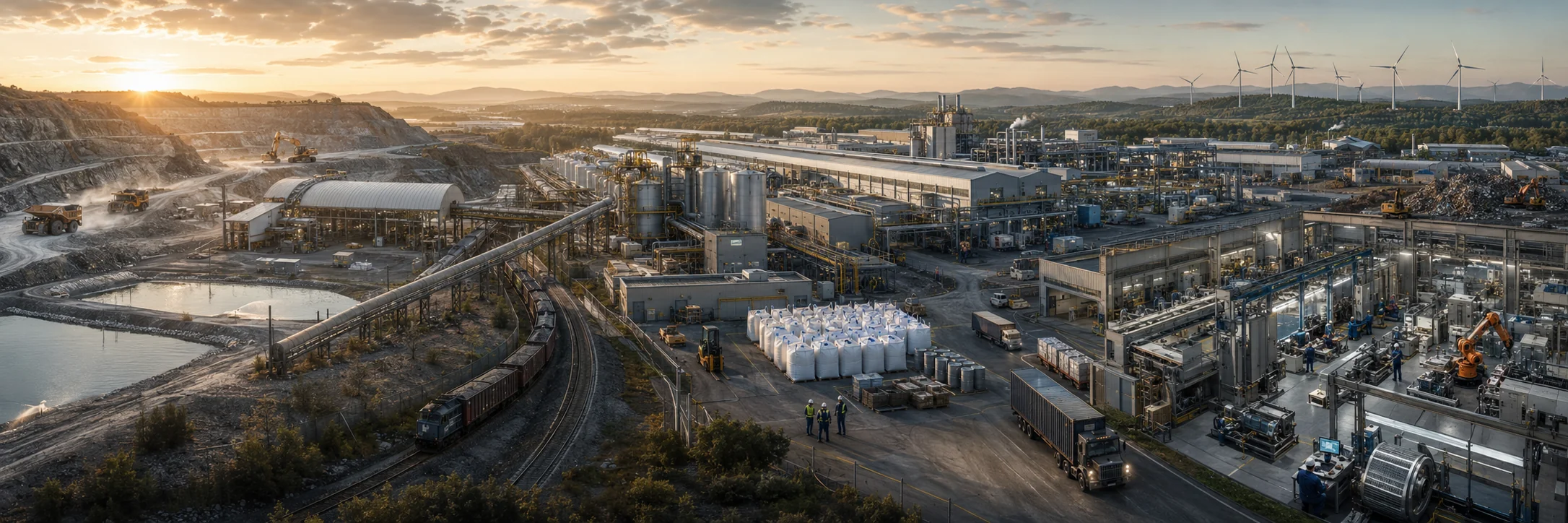
Rare-earth supply depends less on ore alone than on separating mixed elements and manufacturing them into qualified products.
Rare earth elements provide different physical functions. Neodymium, praseodymium, dysprosium, and terbium help make compact permanent magnets; cerium compounds polish glass and wafers; lanthanum compounds support catalysts, optics, and battery materials; other elements contribute to phosphors, lasers, ceramics, and specialized electronics. A manufacturer therefore needs a defined element or alloy in a defined form, not a generic tonne of “rare earths.”
The route begins with ore containing several rare earths together. Mining and milling concentrate minerals, but separation then uses leaching, solvent extraction, ion exchange, precipitation, calcination, and metal-making steps to create products with different purities. Some ores also contain uranium and thorium, so residues can require radiological controls. Downstream, an oxide becomes a metal or alloy, a magnet or catalyst is manufactured, and the product enters a service history that affects whether its material can be recovered.
Ore carries a mixture, not a chosen element
Rare earths are a group of chemically similar elements, including the lanthanides and usually scandium and yttrium. They are not all equally scarce, but economically useful concentrations are uneven and the elements commonly occur together in minerals such as bastnaesite, monazite, and ionic-adsorption clays.
Mining and milling produce a concentrate with a geological ratio of neodymium, praseodymium, cerium, lanthanum, and other elements. A mine can improve recovery or change the grade of concentrate, but it cannot freely decide to extract only the element whose price is highest. The deposit’s ratio becomes a production constraint and creates co-products that need buyers, storage, further treatment, or disposal.
The IEA identifies co-production of magnet rare earths with abundant, lower-value elements such as cerium and lanthanum as a structural challenge for investment. A project can therefore have a valuable neodymium resource and still lack a workable route for the whole mineral suite.
Separation creates the saleable chemistry
After crushing, grinding, and physical concentration, the mineral is cracked or leached so rare earths enter solution. Solvent extraction and ion exchange then divide elements whose chemical behaviour is very similar. Repeated stages gradually produce mixed rare earth carbonates or oxides, separated oxides, and sometimes metals or alloys.
The separation plant uses acids, bases, organic solvents, water, heat, pumps, tanks, and analytical controls. It also handles residues that were not present as a saleable product: acidic wastewater, solvent-bearing streams, process solids, and impurities concentrated from the ore. EPA notes that rare-earth minerals often contain uranium and thorium and that separating them produces technologically enhanced naturally occurring radioactive material wastes. The facility then needs site-specific plans for containment, groundwater protection, worker protection, monitoring, and site remediation.
A mixed oxide can be a useful product for some alloy or catalyst applications, while a magnet maker may require separated NdPr, dysprosium, or terbium at a specified purity. A mass balance, assay, or shipment record establishes a defined stream; it does not establish the condition of every tank, tailings cell, worker, or receiving ecosystem.
Magnets manufacture a particular performance
For a neodymium-iron-boron magnet, separated rare earth oxides must be converted to metals or alloys, combined with iron and boron, cast, milled, aligned in a magnetic field, pressed, sintered, machined, coated, and magnetized. Grain size, orientation, dysprosium distribution, coating integrity, dimensions, and magnetic properties determine whether the magnet fits a motor, generator, hard drive, or sensor.
DOE’s magnet supply-chain assessment explains that NdFeB magnets require combinations of neodymium, praseodymium, and sometimes dysprosium, with proportions influencing magnet properties. A separated oxide is therefore an input to a second qualified manufacturing chain, not the completed function.
Other elements enter other products
Magnet chemistry is only one branch. Cerium oxide can polish glass and semiconductor wafers; lanthanum compounds can support petroleum-refining catalysts, optical glass, and batteries; yttrium, europium, terbium, and other elements appear in lasers, phosphors, ceramics, medical equipment, and fiber optics. Some products use a mixed rare-earth material rather than fully separated elements.
These routes impose different specifications and end-of-life options. A polishing slurry may be captured from a manufacturing line, a catalyst may be regenerated or treated, a phosphor may be dispersed in a screen, and a magnet may remain recoverable inside a hard drive or motor. The element’s identity does not tell a recycler where it is, what else is attached, or whether the original function can be preserved.
Processing capacity forms a second geography
A mine and a separation plant solve different problems. Processing needs chemical equipment, trained operators, analytical laboratories, waste permits, water and energy, transport, and customers for both valuable products and co-products. Magnet manufacturing adds alloying, strip casting, alignment presses, sintering, coating, machining, and qualification.
The IEA reports that building diversified rare-earth supply chains requires mining, refining, magnet manufacturing, specialized equipment and skills, finance, infrastructure, and downstream demand; it also reports that 2025 export controls sharply disrupted shipments of heavy rare earths and permanent magnets. A country can have ore and still depend on another geography for separation, metal-making, magnets, or the machinery needed to make them.
Concentration also changes who bears disruption. A licensing delay or chemical-plant outage can strand miners, stop magnet lines, and interrupt vehicle and wind-turbine production. These are immediate availability and production risks for downstream users and owners of equipment that cannot run without the required magnets. Residues and water management create a different risk over a longer period: workers, nearby communities, and future site operators may remain responsible after production revenue has ended.
Prices and contracts shape which projects continue
Rare-earth projects need money before they have saleable separated products. Developers must finance drilling, pilot separation, demonstration runs, waste facilities, environmental monitoring, metal-making, magnet qualification, and years of operating work. Downstream customers often require demonstrated technical performance before signing long-term offtake agreements, while lenders want evidence of demand before committing capital.
The co-product problem makes the financing pressure concrete. A project may recover valuable NdPr while accumulating cerium and lanthanum that have lower prices or limited local buyers. If storage, treatment, or a customer for those streams is not funded, the route to the high-value element can stop even when the ore is available. A stockpile or long-term contract can buy time during a disruption, but it does not create separation or magnet capacity.
Financial pressure remains after a mine or separation plant closes. Revenue can stop while containment, groundwater monitoring, residue treatment, and equipment maintenance continue; if the remediation fund or responsible operator is unavailable, the burden can move to public agencies, workers, communities, or future site owners. Those obligations also affect whether a project can obtain financing before it has a qualified product.
Recovery begins with the product’s identity
Rare earth recovery is easiest when manufacturing scrap or an end-of-life component remains identifiable and concentrated. Magnet scrap can be demagnetized, dismantled, processed, and returned to a magnet or alloy route. A hard drive, motor, or wind-turbine generator may preserve more completed work if the magnet is removed before the product is shredded.
The IEA identifies growing end-of-life volumes from electric-vehicle motors, wind turbines, and electronic waste as an opportunity to strengthen rare-earth supply. Collection, disassembly, contamination, coatings, and transport economics determine whether those elements actually return. A dissolved or dispersed rare earth may require a new separation plant and may not preserve the original magnet function.
Substitution can reduce dependence in some designs: engineers may reduce heavy rare-earth content, substitute one element, redesign the motor, or use a different technology. That changes the required function and the manufacturing route; it does not prove that a generic rare-earth tonne can replace a qualified magnet.
Records track different parts of the route
A geological resource estimate, concentrate assay, separated-oxide certificate, metal purity test, magnet grade, export license, and recycled-content claim each describe a defined object or transaction. None alone describes the whole chain from mine waste and worker exposure to installed performance and final recovery.
Supply disruptions make these limits visible. The IEA reports that 2025 export controls caused sharp falls in heavy-rare-earth and magnet export volumes, leaving some automakers struggling to source permanent magnets and temporarily reducing production. An export license, a stockpile, or a price signal can change access, but it does not prove that a substitute magnet has been qualified in the vehicle or generator that will use it.
Inside CompanyGraph
Explore miners and concentrators, separation and refining plants, metal and alloy makers, magnet manufacturers, catalyst and polishing suppliers, vehicle and wind-turbine makers, electronics producers, recyclers, waste handlers, regulators, logistics firms, financiers, and communities near processing sites. CompanyGraph can map where the element, specification, custody, and responsibility change hands; it cannot by itself establish an ore body’s true composition, a residue’s containment, a magnet’s installed performance, or the final fate of a recovered stream.