 CompanyGraph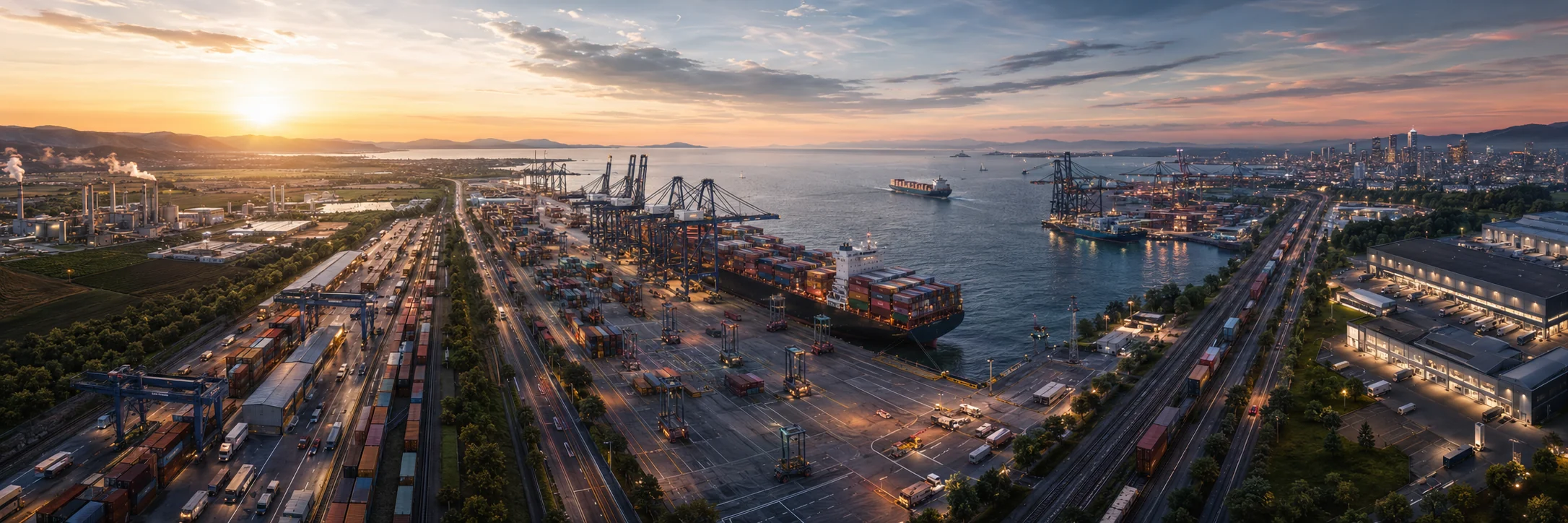
Follow one load from stuffing to delivery and empty-box return to see how a standardized container preserves cargo while ports, ships, inland links, timing, and records determine what can still reach the receiver.
A container is not the thing a household, hospital, factory, or shop ultimately needs. The useful result is a particular cargo arriving at the required place, time, and condition. A dry box may carry machine parts, garments, packaged food, or chemicals; a refrigerated container may carry cargo that must remain within a defined temperature range. The box is an intermodal load unit that makes one physical handoff possible: the same loaded unit can be lifted between truck, rail, terminal, and ship without opening the cargo at every boundary.
At a factory, goods are packed, braced, counted, and placed inside a container. The doors are closed and a seal is recorded. A truck carries the box to a terminal gate. The terminal checks the unit, weighs or receives its verified mass, places it in a yard, and later transfers it to a ship. At the destination the ship-to-shore crane lifts it out, a truck, rail wagon, or barge carries it inland, and a warehouse opens it. The container then becomes empty equipment that must be inspected, repaired when necessary, and returned or repositioned for another load.
That journey can preserve cargo and remove repeated unpacking, but it also joins the load to a sequence of compatible interfaces. A sealed box can be in the wrong yard, on the wrong vessel, without a chassis, waiting for customs release, or disconnected from the empty-equipment network. Container shipping is therefore a service of connected physical intervals, not a count of boxes or vessel capacity alone.
Why use a container at all?
Before containerization, much ocean cargo was handled as separate pieces, sacks, drums, crates, or pallets. Moving it between ship, quay, rail, and truck required repeated lifting and exposure. Standardized boxes transfer through corner fittings and lifting points, allowing the handling equipment at different modes to work on the unit rather than on every item inside it. The International Maritime Organization's Convention for Safe Containers links uniform safety requirements to inland and maritime transport and describes corner fittings as the devices that permit handling, securing, and stacking.
Standardization does not mean that every box or every cargo is interchangeable. International services use many dry, high-cube, refrigerated, tank, open-top, and other specialized units. A dry box needs a sound floor, doors, roof, and walls; a reefer needs power, a functioning refrigeration system, a set point, and a route that keeps electricity available at the required points. Dangerous goods require compatible packaging, declarations, segregation, and stowage. Heavy or concentrated cargo requires a loading plan that protects the floor, vehicle axle limits, and the ship's stability.
The underlying need can be met in other ways. Break-bulk handling, bulk transport, rail, road, air, coastal shipping, local production, inventory held near the user, or a different product may fit a particular movement better. For some trades, container demand can be enlarged by production separated from consumption, long replenishment loops, and the organization of factories and warehouses. Those conditions can make a container the reachable way to deliver a load without making a particular number of boxes inevitable.
Containerization also changes which losses are visible. A sealed unit can reduce handling damage while hiding wet cartons, poor bracing, an incorrect count, or a temperature excursion until the doors open. The box protects some physical conditions; it does not repair cargo that was badly packed or create a missing delivery window.
What must remain intact inside the box?
The first transformation is stuffing. People or machines place cargo in a defined arrangement, distribute weight, protect vulnerable surfaces, manage air flow, and keep the load from shifting. The shipper or packing contractor chooses cartons, pallets, dunnage, blocking, bracing, and labels. The result must satisfy both the cargo's needs and the container's structural and handling limits.
Closing the doors creates a useful boundary, not a complete observation. A seal can show that the doors were not opened through a defined interval. It does not establish that the right goods were loaded, that the goods stayed dry, or that the seal was attached to the correct box. A manifest or bill of lading records a declared shipment and its terms. It does not independently inspect every item. A container number preserves an identity for the unit; it does not make all contents traceable when lots were mixed before stuffing.
Weight and stowage have their own limits. The IMO's verified gross mass requirements require the packed container's gross mass to be verified before loading on a ship. That supports safe planning, but a correct mass does not prove that the load is evenly distributed or that the declared cargo is present. The IMO Code of Safe Practice for Cargo Stowage and Securing treats planning, execution, supervision, and securing as separate parts of safe transport.
Temperature records answer another question. A reefer logger can record air temperature around the sensor, while product temperature, exposure duration, humidity, gas composition, and the product's validated stability determine usability. A container can arrive with an apparently normal set point while a failed power connection, blocked airflow, or late intervention has damaged its contents. Inspection, scans, and data loggers are useful partial controls; each needs a defined condition and a decision that follows its result.
How does one load cross the interfaces?
After stuffing, a drayage truck takes the box to an origin terminal or inland depot. At the gate, the terminal may receive the booking, container number, seal, verified gross mass, dangerous-goods information, and appointment. The box is inspected for visible damage and placed in a yard position. A terminal plan later assigns it to a vessel bay and stack position that must fit the ship's stability, lashing, weight, destination sequence, and cargo restrictions.
A ship-to-shore crane lifts the box between quay and vessel. On an 11,000-TEU ship, containers on deck can be stacked seven or eight high and nineteen across, secured with fittings and lashings, according to the World Shipping Council. Larger vessels can carry more units, but their calls require compatible channel depth, berth length, turning space, crane outreach, yard capacity, power, tug assistance, and inland evacuation. The ship's nominal TEU capacity is not the number of boxes that can be loaded on every voyage: weight, stability, refrigerated plugs, dangerous-goods segregation, cargo mix, draft, and destination sequence all constrain the stow.
At sea, the container is exposed to vibration, acceleration, salt air, weather, and the vessel's motion. The ship follows a service schedule, but weather, port queues, equipment failures, labor availability, canal restrictions, and earlier delays can change that schedule. At a transshipment hub, the box may be lifted from one ship to another. Every lift can preserve the unit's identity while adding another opportunity for a wrong stack position, damage, lost connection, or delayed record.
At the destination terminal, discharge is not delivery. The box must be placed in a yard, matched to a customs or security decision, assigned a truck, rail wagon, or barge, and collected within the available storage and free-time conditions. A receiver may need the goods for a production line, a harvest, a clinical schedule, or a retail promotion. The vessel's arrival establishes one interval; usable delivery requires the remaining intervals to occur before the cargo's deadline or loss boundary.
Transport records therefore contain several events: booking, acceptance, gate-in, loading, departure, transshipment, discharge, customs release, gate-out, and empty return. A booking is not an uplift. A vessel arrival is not a released import. A terminal scan is not proof that the cargo inside is undamaged. The chain becomes legible only when these events remain connected to the correct container and the people able to act on them.
Why can a port call be possible but delivery still fail?
A port is not just deep water beside a crane. The UNCTAD maritime logistics guide describes port handling as a chain of quay, yard, gate, and inland interfaces. It is a coupled interface between channel, berth, quay, yard, gate, road, rail, barge, customs, labor, power, and storage. A vessel can fit the channel and still be unable to leave its cargo because the yard is full, trucks lack appointments, rail capacity is unavailable, or customs holds the unit. Conversely, a smaller vessel may call at a port that cannot receive an ultra-large ship, if the trade and connecting services make that call workable.
Changing a port takes planning, money, dredging, civil work, environmental review, equipment, trained labor, and connected roads or rail. The time and feasibility vary by site. A carrier can order a ship or move one to another service more quickly than a new terminal can be created, but neither vessel capacity nor berth capacity is a single number that guarantees an operable call.
Why do routes carry empty boxes as well as full ones?
Trade flows are rarely balanced. A port may export fewer loaded containers than it imports, or may have the wrong mix of 20-foot, 40-foot, high-cube, reefer, or specialized equipment. Carriers therefore reposition empty containers between depots, ports, and demand regions. An empty box is not a failed unit; it is equipment being moved to make another loaded movement possible. But the move consumes vessel, rail, truck, yard, labor, and money capacity.
Backhaul cargo improves the economics of a round trip, yet a route does not require both directions to be full. A carrier may accept empty repositioning, alter port calls, share slots, use a smaller vessel, or cancel a sailing when total revenue and operating conditions no longer support the service. Carriers design routes within cargo demand, port capability, vessel constraints, alliance or slot arrangements, and commercial commitments. Hub-and-spoke networks can combine large ships on dense trunk services with smaller vessels, rail, barge, or truck links to regional ports, but a physically capable port does not automatically receive a direct mainline call.
Equipment availability creates a shortage different from a shortage of ship space. A receiver may have cargo ready but no suitable empty box; an export region may have boxes but no booking or inland pickup; a depot may hold many units but too few reefers or the wrong dimensions. Container leasing, repair, customs status, and repositioning plans determine which equipment is reachable. A full ship, a full terminal, and a full depot can coexist with a shortage of the exact box and time a particular load requires.
A container ship is specialized: its hull, cell guides, lashing points, cranes where fitted, power systems, and cargo software are designed around containerized units. It cannot be switched quickly into an oil tanker or bulk carrier. It can, however, be redeployed among container services, chartered, laid up, slowed, or scrapped. The asset is committed to a class of work, not forever to one route.
Fleet capacity has a longer clock
New ships take years to order, finance, build, inspect, and deliver, while a ship may remain in service for decades if maintenance, classification, regulation, and market conditions permit. That timing mismatch matters when demand changes faster than yards and fleets can adjust. A carrier can also change effective capacity without building a hull: it can omit a port, blank a sailing, slow down, add or remove a vessel, change a rotation, or share slots. Nominal TEU capacity, deployed capacity, operable capacity, and capacity that reaches a particular port in a particular week are different observations.
Freight prices can rise when available capacity, equipment, or port access is tight and fall when more vessels, empty boxes, or alternative routes become available. A high price may reflect scarce capacity, congestion, fuel, risk, contract terms, or several conditions at once. Carriers' ordering and deployment decisions respond to expected demand, financing, regulation, competition, and rates; a long shipbuilding cycle can amplify a boom-and-bust pattern without making every outcome inevitable.
Money pays for the waiting
Capital also shapes feasible action before a voyage. A carrier needs money for fuel, crews, maintenance, insurance, port dues, and charter hire. A terminal needs money for cranes, yard equipment, power, dredging, labour, and maintenance. A shipper or importer may need working capital while goods are at sea and may face storage, demurrage, detention, truck, rail, and inspection charges before the cargo can be used. If an importer cannot pay demurrage before free time expires, a discharged box can remain in the terminal while charges accumulate; a second truck or warehouse does not restore access until cash and release authority are reachable. A technically preferable route can be unavailable if the relevant cash, equipment, appointment, or authority arrives too late.
What can the records tell us?
Container shipping creates a dense record trail. A booking records requested space and terms; a bill of lading or sea waybill records a transport relationship and declared cargo; a manifest communicates information to authorities and carriers; the container number and seal connect a unit to a movement; terminal events show gates, lifts, yard positions, loading, discharge, or release; vessel data shows a broadcast position; a reefer logger shows a sensor's temperature history; and a customs decision can release or hold a shipment.
A seal, manifest, scan, vessel position, or temperature trace can be accurate about the event it observed while leaving the condition that matters to the receiver unobserved. The records do not recreate a lost lot identity, inspect every carton, or prove that a released container is already usable at the destination.
Identity can also change resolution. Cargo from several suppliers may be mixed before stuffing, while one shipment may be split across boxes or transshipped through several terminals. A database can preserve the entered sequence of events; it cannot reconstruct an unobserved condition merely by adding more fields.
The CSC framework illustrates the boundary between a control and a complete condition. Safety approval, periodic examination, and maintenance support continued international handling of the container; they do not certify the cargo's quality, the shipper's packing, or the receiver's eventual use.
When does a delay become a physical loss?
A delay first appears as a missed appointment, a changed vessel estimate, a yard dwell event, a rolled booking, a customs hold, a reefer alarm, or a receiver's empty production window. The event is visible before its consequence is complete, but correction depends on remaining time and reachable options. A carrier may change a rotation; a terminal may open a gate or shift a stack; an importer may arrange another truck or warehouse; a shipper may reroute or replace the cargo. Each action requires authority, equipment, labor, information, and money.
Some cargo tolerates a week at sea; some has a harvest, clinical, construction, or production deadline. A box may remain structurally sound while its contents lose freshness, shelf life, contractual eligibility, or production usefulness. Conversely, a late box may still be physically usable if the receiver can change the schedule. “Delay” is therefore not one physical result. It becomes a loss at the boundary where the remaining time, condition, and alternative action no longer meet the receiver's need.
The March 2021 grounding of the Ever Given closed the Suez Canal for about six days before the vessel was refloated. The IMO account records the refloating and the resumption of vessel movements. The canal reopened, but vessels that had been held or rerouted did not instantly regain their original sequence. Arrival clusters then met berth, yard, truck, rail, and warehouse limits. Reopening a waterway removed one obstruction; it did not restore every schedule or empty-box position.
The 2021-2022 congestion at the San Pedro Bay ports showed a similar interface problem. The two-port complex handles about 40 percent of US containerized imports in the cited US government account, but the share and flows are time-dependent. When import volumes, vessel bunching, truck appointments, chassis, rail, and warehouse capacity were misaligned, ships waited offshore and containers remained in terminals. US congressional testimony documents the complex's scale; it does not by itself establish one cause for every delay. The physical lesson is narrower: concentration can make a local interface failure propagate through cargo, vessel, equipment, and inventory schedules.
What remains after delivery?
Delivery is not the end of the material chain. The consignee opens the box, removes pallets or loose cargo, and may reuse, repair, recycle, or discard packaging. The container itself becomes empty equipment. It may return to the carrier or leasing company, move to a depot, undergo inspection and repair, or be repositioned to another demand region. A box that is not returned can become unavailable equipment even when the ocean voyage was completed.
The CSC makes the owner responsible for continued maintenance and periodic examination of approved containers. That requirement connects the physical box to records and a future use, but it does not make every damaged unit worth repairing. A decision to repair, repurpose, sell, or retire depends on structural condition, location, labor, parts, inspection, demand, and money. A container can be available in the inventory system while not being safe or economically reachable for the next load.
Empty repositioning also has an environmental and material boundary. Moving an empty box consumes fuel, port and terminal work, road or rail capacity, and time. Leaving it where no export cargo exists can strand equipment; moving it long distances can preserve future loading ability while using additional resources. The relevant question is not whether the box is empty, but whether the next load, route, condition, and return decision keep the intermodal system physically available.
Who can correct the complete movement?
No single participant controls every condition affecting a container's movement. The shipper controls packing and much of the cargo information; the trucker controls one inland interval; the terminal controls gates, yards, cranes, and some records; the carrier controls vessels, rotations, equipment, and bookings; customs and other authorities control release decisions; railways, depots, warehouses, and consignees control later interfaces. Their contracts divide payment and liability, while cargo, time, equipment, and consequences continue across the boundaries.
Complete responsibility connects cargo condition, container identity, schedule, equipment, records, money, and corrective authority so that a problem can still reach an action before the receiver's usable window closes. Controls matter when they trigger work: an unsafe container is withdrawn, a reefer alarm reaches a technician, a wrong stack position is corrected, a customs hold is resolved, or an empty box is repositioned before the next load is stranded.
Three questions bring the movement together:
- Did the container preserve the cargo's required condition, or did the records only show that the box moved?
- When a delay or damage appeared, could the chain reach the interface and participant able to change it?
- After delivery, did the cargo and empty equipment have a physically reachable next route?
Container shipping works when a load unit, a vessel, a terminal, inland transport, information, and time remain connected to the receiver's need. The box reduces repeated handling, but the complete service depends on the interfaces around it.
Inside CompanyGraph
Explore the cargo owners, packers, depots, terminals, carriers, ports, customs authorities, rail and road operators, warehouses, and equipment lessors that connect a sealed load to its delivery, delay, and empty-box return inside CompanyGraph.