 CompanyGraph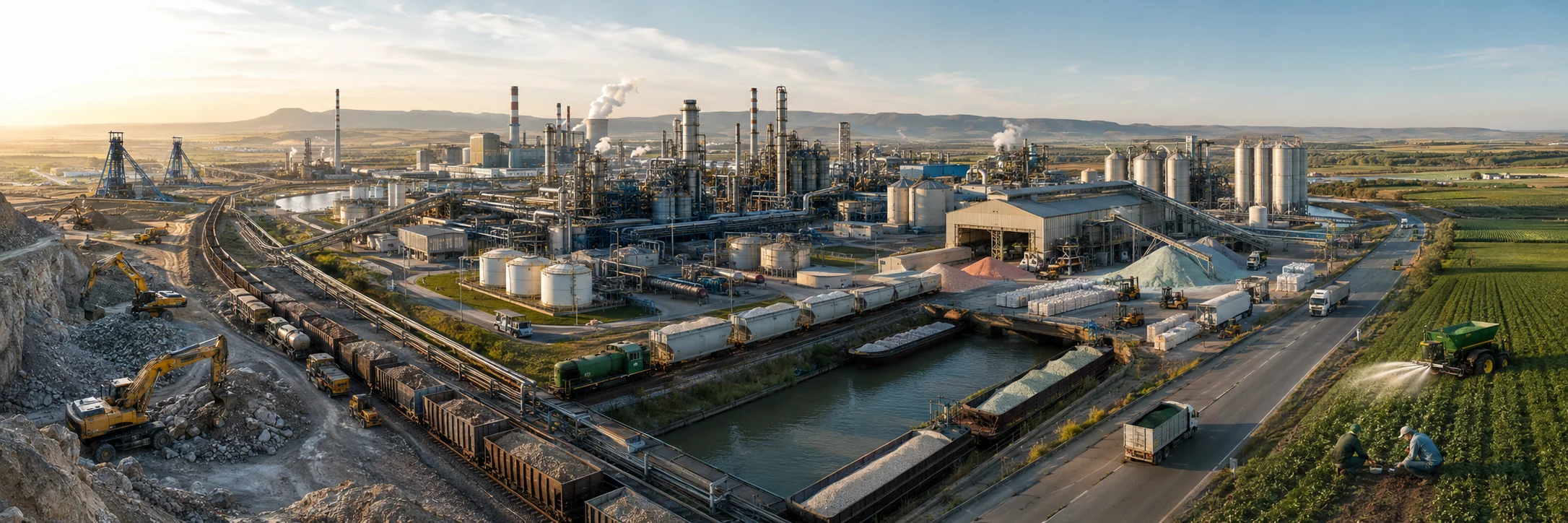
Plants need accessible nutrients. Fertilizer concentrates and moves them, but how much is needed depends on what harvest removes, what soil and biology supply, what agriculture returns, and what it lets escape.
How fertilizer reaches a field
Fertilizer does not begin as one material. Its nitrogen may begin in the air, with hydrogen supplied today mainly from natural gas or coal. An industrial plant combines the gases to make ammonia, then may convert that ammonia into urea, ammonium nitrate, a liquid solution, or an ammonium phosphate. Its phosphorus usually begins as phosphate ore that is mined, processed to concentrate its phosphate minerals, and reacted with acid. Its potassium usually begins as potash ore or brine from which water-soluble potassium salts are separated.
Manufacturers dry, granulate, coat, or combine these materials into products that can survive handling and be applied at a known concentration. Some move as liquids or pressurized ammonia; much moves as dry bulk. Ocean vessels, railways, barges, pipelines, trucks, port terminals, inland warehouses, distributors, and farm retailers carry and store it. A dealer may blend several products to make a specified nutrient grade before a truck delivers the blend to a farm. The route from gas field or mine to field can cross thousands of kilometres and several organizations.
Delivery is not the final transformation. Granules must dissolve; organic materials must decompose; soil water, temperature, acidity, microbes, and chemical reactions affect which nutrient forms remain accessible. Roots must encounter and absorb them while the crop can use them. Some nutrients enter the harvested grain, fruit, fibre, or forage and leave the field. Others remain in residues and soil, accumulate, or escape in water, eroded soil, or gases.
The supply chain therefore continues beyond the farm gate. Food and feed move nutrients to livestock operations, processors, settlements, wastewater systems, and waste facilities. Whether those nutrients return to suitable land helps determine how much new fertilizer the next crop requires.
What do plants require?
Plants require elements, not commercial products. Nitrogen is part of proteins and chlorophyll; phosphorus is involved in energy transfer and genetic material; potassium regulates processes including water relations and enzyme activity. Crops also require sulfur, calcium, magnesium, and smaller amounts of other elements. A nutrient can be present in a field yet unavailable to roots because of its chemical form, soil conditions, location, or timing.
The atmosphere contains abundant nitrogen gas, but most crops cannot use that gas directly. Microorganisms can convert atmospheric nitrogen into reactive forms, including through associations with legumes. Soil organic matter, crop residues, manure, compost, irrigation water, and atmospheric deposition can also supply nutrients. Weathering and soil reserves supply part of the phosphorus, potassium, and other elements. The FAO guide to integrated plant nutrition treats mineral fertilizer, organic materials, biological nitrogen fixation, and soil reserves as parts of one nutrient-management problem.
An external input becomes necessary when plant-available supply at the relevant place and time is insufficient for the intended crop and for maintaining the productive condition of the soil. That input may be a mined or synthesized fertilizer, manure, compost, a recovered nutrient product, or a combination. Conversely, a familiar fertilizer product is not biologically required on a field already supplied from other sources.
This distinction does not make fertilizer optional by declaration. A deficient field cannot be restored by pointing to a nutrient source that is physically distant, unsafe, too dilute to transport, unavailable at the required time, or locked in a form the crop cannot use. Necessity is established by the nutrient balance and the feasible means of correcting it, not by the product name.
Why does present agriculture create additional demand?
Harvest creates a real nutrient removal. Grain shipped from a field contains nitrogen, phosphorus, potassium, and other elements that are no longer there for the next crop. Higher yields and repeated harvests can increase that outflow. When removals exceed accessible inputs over time, soil reserves are depleted and crop growth becomes constrained.
But crop biology does not determine the entire volume or geography of fertilizer demand. Nutrients can also leave through erosion, runoff, leaching, volatilization, or denitrification. Crop residues may be removed rather than returned. Feed may travel to concentrated livestock operations, leaving manure nutrients far from the cropland that produced the feed. Food moves into settlements, where nutrients enter wastewater or discarded organic material rather than returning automatically to farms.
A 2024 FAOSTAT cropland nutrient-budget study makes the accounting visible. It counts synthetic fertilizer, manure, biological nitrogen fixation, and atmospheric deposition as inputs, and harvested crops as outputs. The results show both surpluses and deficits across nutrients and regions. A global total can therefore conceal two different failures at once: too little accessible nutrient where crops remove it, and an accumulation or loss elsewhere.
The separation of crops and livestock provides concrete evidence. USDA researchers mapped US counties with manure nutrients in excess of local crop removal and counties able to use more. In four modelled "manuresheds," the average distances needed to redistribute surplus manure phosphorus ranged from about 147 to 368 kilometres, depending on the livestock system. The study did not show that the nutrient was absent; it showed that water content, bulk, transport, timing, equipment, and organization stood between a surplus and a field need.
Wastewater offers a similar distinction. Treated biosolids and recovered products can return nutrients, and the US Environmental Protection Agency describes regulated agricultural uses for some of them. Safe recovery requires treatment, testing, separation, transport, and control of pathogens and contaminants. Without that infrastructure, nutrients removed from farms may be treated as a disposal problem while farms purchase newly mined or synthesized inputs.
How does industry make nutrients portable?
The industrial chain concentrates diffuse or immobile sources into materials that can be stored, traded, blended, and metered. That portability is a real function. It also gives the three main nutrient streams different physical dependencies.
Nitrogen: fixing nitrogen from the air
For nitrogen, ammonia is the bridge from atmospheric nitrogen to most mineral nitrogen fertilizers. Conventional plants obtain hydrogen by reforming natural gas or gasifying coal, then combine it with nitrogen under pressure. Natural gas is therefore a feedstock and energy source for much current production, but it is not a molecular requirement of ammonia itself: hydrogen can also come from water electrolysis or other routes. The International Energy Agency reported that just over 70% of ammonia production used natural-gas-based steam reforming in 2021 and most of the remainder used coal. Existing plants, energy access, and production methods determine how strongly a region's supply responds to gas or coal conditions.
Phosphorus: making mined rock plant-available
For phosphorus, mined rock is concentrated and most fertilizer production converts it to phosphoric acid, commonly by reaction with sulfuric acid. The acid may be reacted with ammonia to make monoammonium phosphate or diammonium phosphate, or used in other phosphate products. This chain consumes sulfur, water, energy, and processing capacity and produces material residues, including phosphogypsum. The EPA's fertilizer-manufacturing description shows why a phosphate product depends on more than a mine.
Potassium: separating water-soluble salts
For potassium, mines and solution operations extract potash-bearing salts, then flotation, dissolution, crystallization, or evaporation separates usable products. The common product is potassium chloride, although crop and soil conditions sometimes call for other salts. The US Geological Survey defines potash as a group of mined and manufactured salts containing potassium in water-soluble form.
From concentrated production to regional inventory
Geology locates phosphate and potash extraction, while factories and transport determine which deposits become practical sources. The USGS 2026 Mineral Commodity Summaries, reporting 2025 data, shows phosphate-rock production led by China, Morocco, the United States, and Russia, and potash production concentrated particularly in Canada, Russia, China, and Belarus. A reserve estimate is not fertilizer at a farm: ore still needs permission, equipment, processing, energy, transport, time, and working money.
These concentrated products then enter a multimodal distribution system. In the United States, for example, imported dry fertilizer commonly arrives by bulk vessel or rail and continues inland by barge, rail, pipeline, and truck, as shown in the USDA's fertilizer transportation data. Production can run for much of the year while regional applications cluster into shorter agronomic windows, so terminals and dealers hold inventory between the two. Storage space and working money are therefore physical preconditions for timely availability, not merely accounting details.
When can a delivered product still fail?
A product can meet its chemical specification, arrive on time, and still fail to provide the intended plant nutrition. The result depends on source, rate, timing, and placement in relation to the crop, soil, water, weather, and all other nutrient sources.
Nitrogen illustrates the timing problem. Applying all of it at planting is not a universal biological rule. Depending on crop and conditions, nitrogen may be applied before planting, at planting, in split applications, beside a growing crop, or through irrigation. A soluble form applied long before uptake may leach below roots, run off, volatilize, or be transformed by microbes. An application delayed beyond a period of rapid crop demand may arrive too late to restore the lost growth.
Phosphorus usually moves less freely through soil water, but it can become chemically less available or leave attached to eroded soil and runoff. Repeated surplus applications can accumulate in soil and raise the potential for loss long after the transaction that delivered them. Potassium behaviour depends on soil minerals, water movement, crop removal, and the accompanying salt. The right correction is consequently site-specific rather than a fixed dose of N, P, and K.
The USDA Natural Resources Conservation Service national nutrient-management standard requires plans to account for measurable sources and removals, including fertilizer, manure, legumes, residues, biosolids, wastewater, soil supply, and irrigation water. It then connects the source, rate, timing, and placement to soil tests, crop sequence, realistic yield goals, weather, and loss risk. That list is important because no participant receives all of it automatically with a fertilizer shipment.
Materially available actions differ among farms. Testing needs representative samples and interpretation. Split application needs another pass, suitable equipment, labour, fuel, and a field that can be entered. Manure substitution needs storage, analysis, hauling, and spreading equipment. A farmer may need to pay for product and work months before receiving crop income. A rain forecast can close the safe application window even when fertilizer and machinery are present. Advice alone does not supply any of these conditions.
Some failures can be corrected in a later application or crop cycle. Others cannot be repaired for the affected crop. Nitrogen already lost below the root zone cannot be pulled back by changing the invoice. Soil carried into a river cannot be reattached to the same field by a better product label. Later management may prevent repetition or restore conditions over time, but detection is not retroactive correction.
What does the chain measure?
Commercial fertilizer needs grades and specifications because participants exchange material without observing its entire history. A grade such as 12-32-16 states guaranteed percentages by weight of nitrogen, phosphate expressed as P2O5, and potash expressed as K2O. The FAO fertilizer specifications also define properties such as moisture, particle size, and nutrient solubility for particular products.
Those measurements can establish that a sampled product meets a defined composition. They do not establish that a field needs that grade, that the spreader delivered the planned rate evenly, that rain did not move it, or that roots absorbed it. These are different observations made at different times.
A bill of lading records a shipment. A dealer's batch record connects ingredients to a blend. A soil test estimates selected properties in the submitted sample. An application log records what an operator says was applied to a location. A tissue test observes the plant later. Yield and water measurements reveal still other consequences. Each record can be accurate within its boundary while leaving the complete nutrient path unknown.
Traceability to a factory or mine can help investigate contamination, off-specification material, or a delivery error. It cannot determine agronomic need by itself. Conversely, a precise field map cannot reveal an unrecorded manufacturing defect. Useful control therefore follows the suspected cause: product sampling for composition, calibrated equipment for application, field sampling for spatial condition, and water or air monitoring for loss.
The communicated claim must stay within that evidence. "Delivered 100 tonnes of urea" is a logistics fact. "Applied 46 tonnes of nitrogen" additionally assumes the specified concentration and application record. "The crop used that nitrogen" requires observation or a defensible nutrient balance; it does not follow from the purchase.
Can the cause of a mismatch still be reached?
The chain divides the nutrient problem among participants. A mine or ammonia plant controls extraction and manufacturing conditions but usually does not see a field. An importer and terminal can preserve inventory and product condition but cannot decide a crop's requirement. A dealer can blend and schedule deliveries. An agronomist can interpret samples and recommend a plan. An applicator can calibrate equipment and respond to field conditions. A farm controls parts of the crop sequence, residues, and application, but not the location of mineral deposits, the design of wastewater systems, or the arrival of every upstream shipment.
Payment and contracts recognize only parts of this work. Manufacturers sell specified material; carriers move tonnes; warehouses provide throughput and storage; laboratories report test results; farms sell crops. The nutrient that accumulates outside a measured boundary remains physically present even when no transaction records it. The same is true of nutrient depletion that becomes visible only after several harvests.
When a crop shows deficiency, several causes are possible: insufficient total supply, an unsuitable form, uneven placement, root damage, adverse pH, lack of water, saturated soil, or a loss before uptake. When water monitoring finds excess nitrogen or phosphorus, the material may have come from several fields, manure stores, eroding banks, or wastewater discharges. Aggregation in a river or in a regional fertilizer sales total can make the original decision difficult to identify.
Feedback works only if the observation returns to a cause that is still identifiable and to someone able to change it. Rejecting an off-specification batch can correct a manufacturing control. A soil test can change a future rate. Neither provides manure-processing equipment, wastewater recovery, field drainage, storage, or working money. Controls are useful when their limited result changes a feasible decision.
What would complete responsibility connect?
No single company needs to own every mine, factory, terminal, farm, livestock operation, and treatment plant. The physical process does, however, need connected responsibility from nutrient source to crop, harvest, consumption, recovery, and loss.
That means planning from a field and rotation nutrient budget rather than from product sales alone; counting soil supply, fixation, residues, manure, and recovered materials before adding an external input; preserving product identity where it matters; and returning field and environmental observations to the participant able to act. It also means providing the equipment, infrastructure, time, and working money required for the correction.
Three questions test whether the chain is supplying plant nutrition or only moving fertilizer:
- Which nutrient removal or deficit makes this input necessary, and which part of demand is compensating for a preventable loss or broken return path?
- Can a deficiency, surplus, contamination, or loss be traced to a condition that someone can still change?
- Does that participant have the material means and timely feedback required to change it?
Fertilizer can be indispensable under the conditions a field actually faces without making the current product, volume, or organization inevitable. The useful measure of the chain is whether it maintains plant nutrition and the productive living system with the least avoidable extraction, displacement, accumulation, and loss.
Inside CompanyGraph
Explore the companies, facilities, and relationships connecting nutrient sources, fertilizer production, distribution, and agricultural use inside CompanyGraph.