 CompanyGraph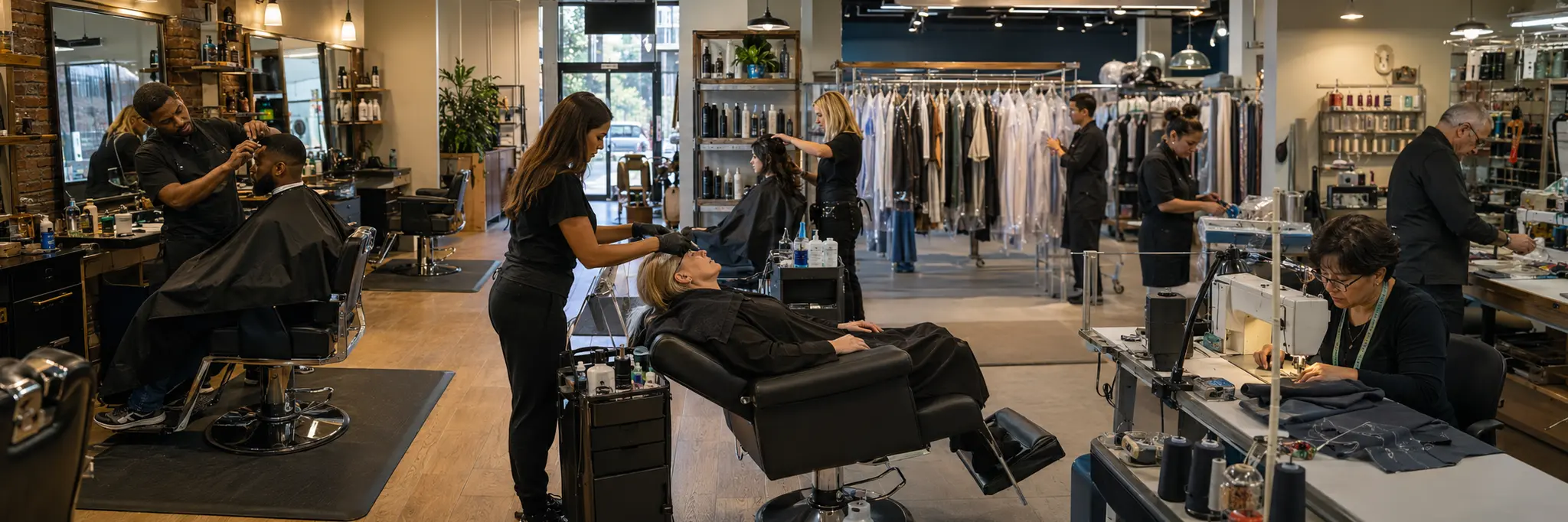
Physical proximity requirements limit geographic reach without distributed location networks, while labor as the primary cost component resists capital substitution given the personal nature of service delivery.
The personal services industry delivers labor-intensive, proximity-dependent services directly to individual consumers. The transformation converts specialized labor, dedicated facilities, and service-specific equipment into funeral and memorial care, laundry and garment care, pet grooming and boarding, and other personal maintenance functions. The irreducibly local and physical nature of these services means the unit of delivery is a human interaction occurring at a specific place and time, distinguishing the industry structurally from product-based or digitally deliverable businesses.
The economics are dominated by labor costs, which constitute the majority of operating expenses. Many personal services require skilled human performance that resists mechanization: a funeral director's guidance, a tailor's fitting expertise, or a pet groomer's handling skill represent labor forms that current technology cannot replicate at acceptable quality. This labor intensity creates a structural margin ceiling that tightens when wage pressures increase, with pass-through capacity constrained by local competitive dynamics and consumer price sensitivity. Regulatory requirements vary by service type and jurisdiction, adding compliance fragmentation across multi-location operations.
As a downstream consumer-facing industry, personal services companies compete primarily on proximity, local reputation, and service quality. Scale is achieved through multi-location networks or franchise models that distribute brand and administrative costs, often preserving local identities to maintain community trust. Demand patterns range from demographically driven and non-discretionary services such as funeral care to more income-elastic categories like appearance and lifestyle services, creating varying degrees of cyclical sensitivity across the service mix.
Structural Role
Performs tasks that individuals cannot, prefer not to, or are structurally unable to do for themselves, converting specialized labor and dedicated facilities into convenience, care, or ritual fulfillment at the point of consumer need.
Scale Differentiation
Large personal services companies achieve scale through multi-location networks that spread brand development, technology systems, and procurement costs across many operating units, often retaining local brand identities to preserve community relationships. Mid-size operators use franchise models to expand geographic reach with limited corporate capital investment. Smaller operators compete on local reputation, personalized service, and lower overhead structures but face difficulty investing in technology or marketing beyond word-of-mouth referral networks.
Connected Industries
Advertising Agencies
Creates demand for
Local marketing for customer acquisition
Insurance Property & Casualty
Creates demand for
Real Estate Services
Creates demand for
Requires retail locations in customer-proximate areas
Staffing & Employment Services
Creates demand for
Labor-intensive model drives staffing demand
Stocks
Andersen Group Inc. Class A Common Stock
ANDG
Bright Horizons Family Solutions Inc.
BFAM
Carriage Services Inc.
CSV
Convano Inc.
6574
CVS Group plc
CVSG
Fameglow Holdings Ltd.
8603
Frontdoor, Inc.
FTDR
Fu Shou Yuan International Group Ltd.
1448
H&R Block Inc.
HRB
Hubei Huarong Holding Co., Ltd.
600421
Lungyen Life Service Corporation
5530
Mears Group plc
MER
Rollins, Inc.
ROL
Service Corporation International
SCI
União Pet Participações S.A.
AUAU3
XPS Pensions Group plc
XPS