 CompanyGraph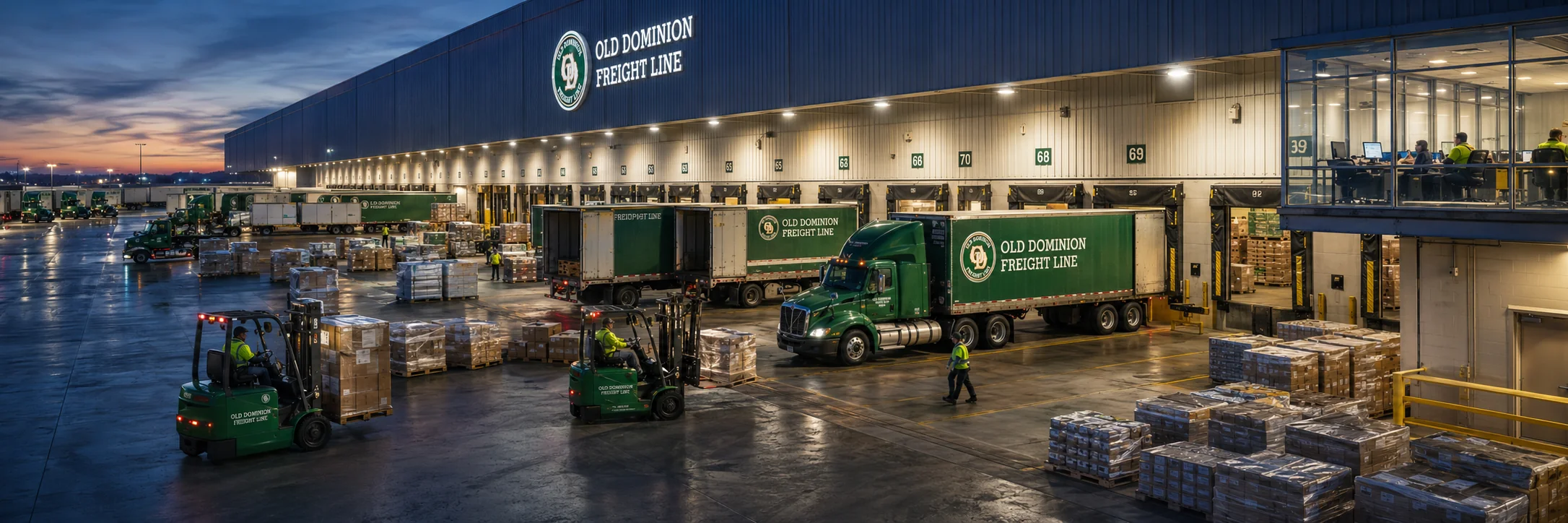
Old Dominion's long story is about making partial shipments dependable: freight must be collected, sorted, moved through a network of terminals, and delivered without losing the service promise at a boundary.
The customer buys a delivery result
A shipper using less-than-truckload service does not need a truck to be full. It needs a pallet or crate to reach a particular receiver within an acceptable window and condition. The carrier must combine many customers' freight without losing identity, route it through breakbulk terminals, and provide enough linehaul and delivery capacity for the promised service.
Old Dominion's 2025 Form 10-K describes one integrated, union-free organization with service centers across the continental United States, regional, inter-regional, and national LTL services, plus alliances for broader North American coverage. The network is the operating object. A truck, dock, or scan is only one part of it.
Density pays for the network
LTL economics differ from full-truckload movement because shipments are consolidated. A pickup route feeds a service center; freight is sorted and reloaded; linehaul connects terminals; destination operations separate freight again for local delivery. The more compatible freight moves through a network, the more of each route's fixed labor, dock, building, and equipment cost can be spread across shipments.
That relationship works in both directions. Old Dominion reported that productive labor costs rose to 24.4% of revenue in 2025 from 24.1% in 2024 as network density decreased. The filing also reports 99% on-time service and a cargo-claims ratio of 0.1%. These numbers do not prove that every shipment was perfect, but they show the operating tension: lower volume can make the network more expensive per shipment even while the company tries to preserve service.
Money changes what can be maintained before a failure is visible. A terminal can retain labor and equipment through a soft period, or reduce capacity and make later consolidation less reliable. A carrier can buy tractors and trailers, but the service still depends on drivers, dock workers, maintenance, linehaul timing, and enough freight to keep the pattern viable.
Handling creates the risk the invoice hides
Every transfer is an opportunity to damage, misroute, or detach a shipment from its identity. A barcode scan records that a label was read at a place and time. It does not describe how the pallet was handled between scans, whether packaging absorbed a shock, or whether the receiver can use the contents. A claims ratio measures reported claims under a defined process; it does not observe every latent defect.
The useful feedback path therefore needs shipment identity, terminal history, equipment information, and receiver evidence. A recurring damage pattern may belong to a packaging design, a loading practice, a particular transfer, or a mismatch between the freight and the service selected. If the claim is reduced to a carrier-wide percentage, the person able to correct the physical cause may never see it.
Quality is an accumulated decision
Old Dominion's service reputation reflects many choices that compound: terminal design, route density, equipment maintenance, training, pricing, and the willingness to absorb cost to protect a delivery promise. A premium can help fund those choices, but it does not make density inevitable. Customers can consolidate freight, alter shipping windows, or choose a lower-price carrier; each action changes the network that remains.
The family-management history and integrated organization may support consistency, but they do not remove exposure to wages, fuel, regulation, recession, weather, or a decline in shipment volume. The 2025 density example makes the mechanism visible: the same physical network can deliver high service while its financial burden rises.
Inside CompanyGraph
The screen below shows the statement shape of infrastructure-carried service: a high machinery share, a well-depreciated asset base, and sales measured against the non-current assets that produce them.
High Machinery Share, High Accumulated Depreciation Share, And Elevated Sales-To-Non-Current-Assets
Machinery and equipment is a large share of non-current assets while accumulated depreciation is a large share of total assets and sales-to-non-current-assets is high
A match records what the balance sheet carries, not the permits, density, or contracts that make such infrastructure hard to reproduce.