 CompanyGraph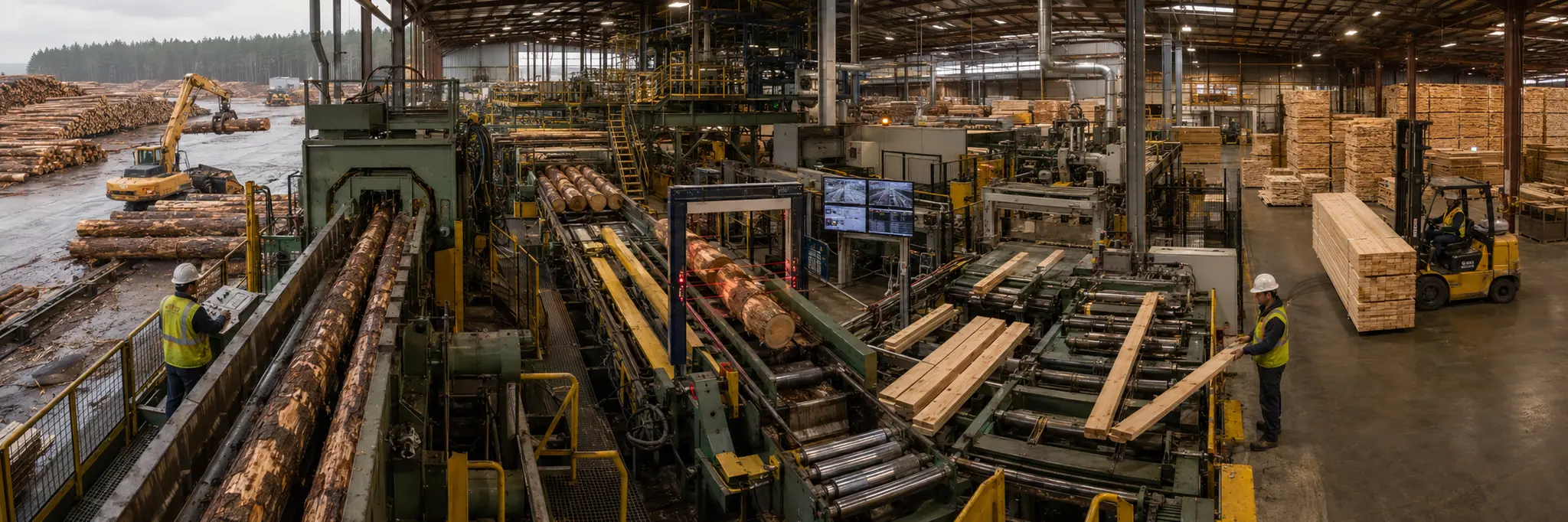
Timber growth cycles of 20 to 80 years create supply inelasticity that cannot respond to short-term demand, while transportation costs relative to product value limit the economic radius of operations.
The lumber and wood production industry sits at the intersection of biological systems and industrial demand. A tree planted today will not be harvestable for decades, yet the construction demand it will eventually serve fluctuates on cycles measured in months and years. This fundamental mismatch between supply formation and demand realization means the lumber market oscillates between shortage and surplus, driven by the collision of biological time and economic time, as producers cannot accelerate growth when prices rise or halt biological maturation when prices fall.
The conversion process from standing timber to finished lumber involves logging, sawmilling, drying, and grading, each with its own cost structure and efficiency constraints. The final product remains a commodity whose price is determined by aggregate supply and demand rather than individual producer costs, meaning producers compete primarily on cost efficiency and log procurement advantages. The geographic structure is shaped by the weight-to-value ratio of wood products, where transportation costs are significant relative to product value, creating regional markets where proximity to both timber supply and construction demand determines competitive position.
Timberland ownership introduces a distinct asset dynamic. Standing timber increases in biological volume each year through growth, functioning as a self-replenishing inventory that appreciates in physical quantity independent of market prices. This growth optionality allows timberland owners to accelerate or defer harvesting based on market conditions, providing a natural buffer against price cycles. Companies owning significant timberlands operate with a different cost structure than those dependent on open-market log purchases, creating a persistent divergence in input cost exposure and financial characteristics within the industry.
Structural Role
Converts standing timber from biological growth into standardized building materials, mediating between multi-decade biological growth cycles and short-cycle construction demand, and supplying a foundational structural material to the construction value chain.
Scale Differentiation
Large lumber producers integrate timberland ownership with milling and distribution operations, capturing value across the chain from standing timber to finished product and investing in efficient mill technology and geographic diversification across timber baskets with different species and growth rates. Mid-size operators run multi-mill systems focused on specific species or product types within a regional timber supply area. Smaller operators run single-mill operations dependent on purchased log supply, making them vulnerable to local timber availability and transportation cost fluctuations without the inventory buffer that timberland ownership provides.
Connected Industries
Building Materials
Supplies inputs to
Building Products & Equipment
Supplies inputs to
Farm & Heavy Construction Machinery
Provides tooling for
Logging equipment for timber harvesting
Packaging & Containers
Supplies inputs to
Wood-based packaging materials
Paper & Paper Products
Supplies inputs to
Wood pulp feeds paper manufacturing
Residential Construction
Supplies inputs to
Lumber is a primary structural material for homebuilding
Stocks
Boise Cascade Company
BCC
Dehua Tb New Decoration Co. Ltd.
002043
Dexco S.A.
DXCO3
Dongwha Enterprise Co. Ltd.
025900
Fujian Jinsen Forestry Co.
002679
Fujian Yongan Forestry Group Co., Ltd.
000663
Greenpanel Industries Ltd.
GREENPANEL
Greenply Industries Ltd.
GREENPLY
Guangxi Fenglin Wood Industry Group Co., Ltd.
601996
Interfor Corporation
IFP
Kangxin New Materials Co., Ltd.
600076
Simpson Manufacturing Co., Inc.
SSD
Singaraja Putra Tbk.
SINI
UFP Industries, Inc.
UFPI
West Fraser Timber Co. Ltd.
WFG
Yunnan Jinggu Forestry Co., Ltd.
600265
Zhongfu Straits Pingtan Development Co., Ltd.
000592