 CompanyGraph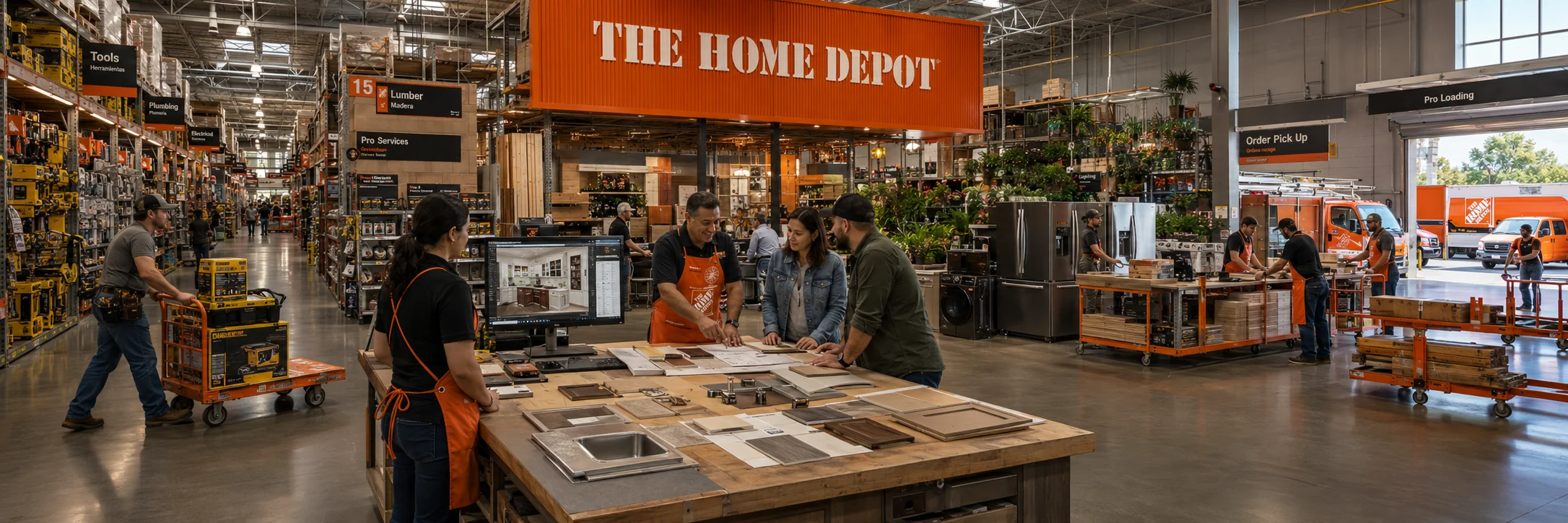
A repair is completed at a house or jobsite, but the conditions that make it possible are assembled across suppliers, stores, warehouses, delivery routes, employees, and customer cash flow.
A repair starts before a product is sold
A homeowner does not ultimately need a faucet, a sheet of drywall, or a box of screws as isolated retail objects. The need is a working bathroom, a weatherproof roof, a repaired pipe, or a building that can continue serving its occupants. A contractor needs the specified material in the required quantity, at the jobsite, before labor and equipment are waiting. That changes what availability means. A product listed online is not yet a completed repair, and a pallet in a distant distribution center may be useless if it misses the work window.
The company sits between manufacturers, distributors, tradespeople, homeowners, installers, and the existing housing stock. Roofs leak, pumps fail, paint peels, and electrical components wear out at different times and in different places. The demand is therefore geographically scattered and often urgent. It cannot be served by a single factory or by an inventory total that ignores distance, quantity, advice, and delivery.
One warehouse replaced several trips
When the first two Home Depot stores opened in Atlanta on June 22, 1979, the official company history describes warehouses of roughly 60,000 square feet carrying about 25,000 products, far more than the typical hardware store at the time. The company's history presents the format as one-stop shopping, but its physical consequence was more specific: lumber, plumbing, electrical, tools, and advice could be reached in one trip instead of through a circuit of small specialists.
That combination changed both sides of the transaction. A store could hold deeper stock because volume supported larger buildings, supplier relationships, and replenishment systems. A customer could compare alternatives and ask for help without already knowing which specialist to call. The trained associate mattered because many projects are not simple substitutions; the customer must match a part to an existing system, understand installation, or decide what can safely wait.
Scale did not make every item universally available. It made a particular local promise more plausible: a broad assortment, at a known place, with enough quantity and assistance to let the next step happen. The same promise also creates exposure. A store with the wrong mix, an inaccurate inventory record, or an absent knowledgeable employee can still leave a customer with a full building and no usable solution.
Stores are also pieces of a delivery network
Home Depot's current footprint is not just a collection of sales floors. Its company description reports more than 2,300 stores in the United States, Canada, and Mexico, an interconnected online assortment of more than one million products, and a typical store of about 105,000 square feet. Those numbers describe physical reach and catalog breadth, not the condition of every item or the time required to move it.
The 2025 annual report describes nearly 200 last-mile distribution assets and a ship-from-best-location algorithm that looks across distribution assets, including stores. More than half of deliveries of products Home Depot stocks were reported as same-day or next-day in fiscal 2025. That performance depends on inventory accuracy, labor, routing, vehicle capacity, and the local stock position. A delivery promise is therefore an operating result, not a property of the catalog.
Bulky and fragile goods make this boundary visible. Lumber, insulation, roofing shingles, appliances, and concrete-related products take space, require handling, and may need a truck that can reach a jobsite. The route from supplier to store to customer is not interchangeable with the route from supplier to a Pro distribution center to a scheduled delivery.
Professional jobs need a different handoff
A DIY customer may need one replacement part and advice. A professional customer may need thousands of units across several categories, delivered in sequence while crews, permits, equipment, and subcontractors are scheduled. The same product assortment cannot by itself solve that coordination problem.
Home Depot's 2025 annual report names six capabilities larger Pros expect: a professional sales force, enhanced delivery, trade credit, preferred pricing, order management, and a digital experience. These are not decorative services around a shelf. They determine whether a contractor can quote a job, reserve material, finance the purchase, receive it in the right order, and keep labor productive. The company says these capabilities are at different stages of maturity in its priority markets; the existence of a program therefore does not prove equal service everywhere.
In March 2024, Home Depot described four new Pro distribution centers for Detroit, southern Los Angeles, San Antonio, and Toronto. The announcement specified job-lot quantities, direct-to-jobsite delivery, localized assortments, dedicated sales forces, order-management tools, a trade-credit pilot, and tiered pricing. The example shows a retailer adding the physical and financial interfaces of a distributor, not simply enlarging a store.
Credit changes what can reach the jobsite
Money enters the chain before the sale is recognized. A contractor may need to buy materials, pay crews, rent equipment, and wait for an owner or general contractor to pay an invoice. If the contractor cannot finance that interval, the technically available material may not be an available option. A supplier can face the same problem when it must carry inventory or adapt packaging before a purchase order is certain.
Home Depot's Pro announcement identifies trade credit as a capability being built and its SRS acquisition as bringing a robust trade-credit offering. SRS also brought more than 760 branches, over 2,500 professional salespeople, a fleet of more than 4,000 trucks, and jobsite delivery across 47 states. Those assets matter because they change who can finance, sell, stage, and move material before a project pays out. The mechanism is concrete: a contractor who can obtain terms and a scheduled delivery may accept a project that would otherwise require too much upfront cash or coordination.
This does not establish that every trade-credit arrangement is affordable or that the acquisition will create the promised returns. It shows why working capital is part of the physical service. Payment timing determines whether inventory, labor, trucks, and customer commitments can be held together long enough for the project to reach completion.
SRS extends the network beyond orange aisles
Home Depot completed its acquisition of SRS in June 2024. SRS was built around specialty trade distribution rather than a general merchandise warehouse. In fiscal 2025, the annual report says SRS completed the acquisition of GMS, adding interior building products to SRS's exterior offerings. The strategic logic is to combine catalogs, customer relationships, logistics, and sales teams across a project.
The move exposes a limit of the old warehouse thesis. A national store may carry many categories, but a roofer, landscaper, pool contractor, or remodeler may need deep trade-specific assortment, branch-level knowledge, specialized delivery, and credit. Integrating those capabilities can increase reach, but it can also create new failure points: incompatible systems, lost local knowledge, misaligned incentives, or a promised delivery that no longer matches the jobsite's sequence.
Digital ordering still depends on physical stock
An online cart can reduce search and allow a customer to compare products, build a quote, or request delivery. It cannot make a substitute compatible, manufacture a missing item, repair a damaged pallet, or place a truck at a site that cannot receive it. Home Depot's annual report describes investment in catalog data, compatibility, sourcing logic, delivery-route intelligence, and post-purchase support because the screen is only one observation of the chain.
Order, inventory, scan, and delivery records answer different questions. An order confirms what was requested. A stock record reports what the system believes is present. A scan can establish that a unit passed a location. A delivery record can establish a handoff. None alone proves that the material arrived undamaged, matched the specification, was installed correctly, or solved the building problem. The last of those may be known first by a contractor or homeowner who has no authority to alter the supplier's catalog or the carrier's route.
The project reveals what the transaction hid
A retail sale can look complete while the job is still open. A missing fitting may be discovered only when a wall is open. A wrong quantity can leave a crew idle. A delivery can be on time but unusable because it was damaged, incompatible, or staged where a crane cannot reach it. The relevant feedback therefore travels backward: from the building or jobsite to the installer, store, distributor, supplier, and the people who set inventory and product information.
Home Depot's original advantage came partly from keeping advice close to merchandise. Its current Pro system tries to keep delivery, credit, sales support, and specialty knowledge close to larger jobs. The stronger the promise becomes, the more the company must preserve the information that explains a failure and the authority to correct it. A catalog change cannot fix a route problem, and a store associate cannot redesign a supplier's packaging without a path for that observation to travel.
Scale creates reach and a continuing burden
Scale can lower purchasing cost and spread technology, stores, training, distribution, and inventory investment across more transactions. It can also make failures larger. A bad product record can affect many stores; a supplier disruption can leave a whole region short; a centralized policy can remove the local judgment that once solved an unusual problem. A broad network is therefore not self-proving resilience. It is a maintained capability.
Home Depot's story is not that the warehouse format made specialists or e-commerce irrelevant. It is that a fragmented project can be made more reachable when one organization connects assortment, place, advice, payment, and delivery. The company remains exposed wherever those connections stop: when a product is present but not accessible, when credit arrives after the work window, when a delivery record substitutes for a jobsite result, or when the person who discovers the problem cannot change the next handoff.
Inside CompanyGraph
The screen below shows companies whose returns on capital sit in the industry-benchmarked upper range - ROE, asset turnover, and ROA together, the statement shadow of the operating discipline this story describes.
Industry-Benchmarked Return on Capital Elevated
Three industry-benchmarked capital-efficiency observations co-occur: ROE elevated, asset turnover elevated, and ROA elevated
A match records current returns against peers, not the process that produces them.