 CompanyGraph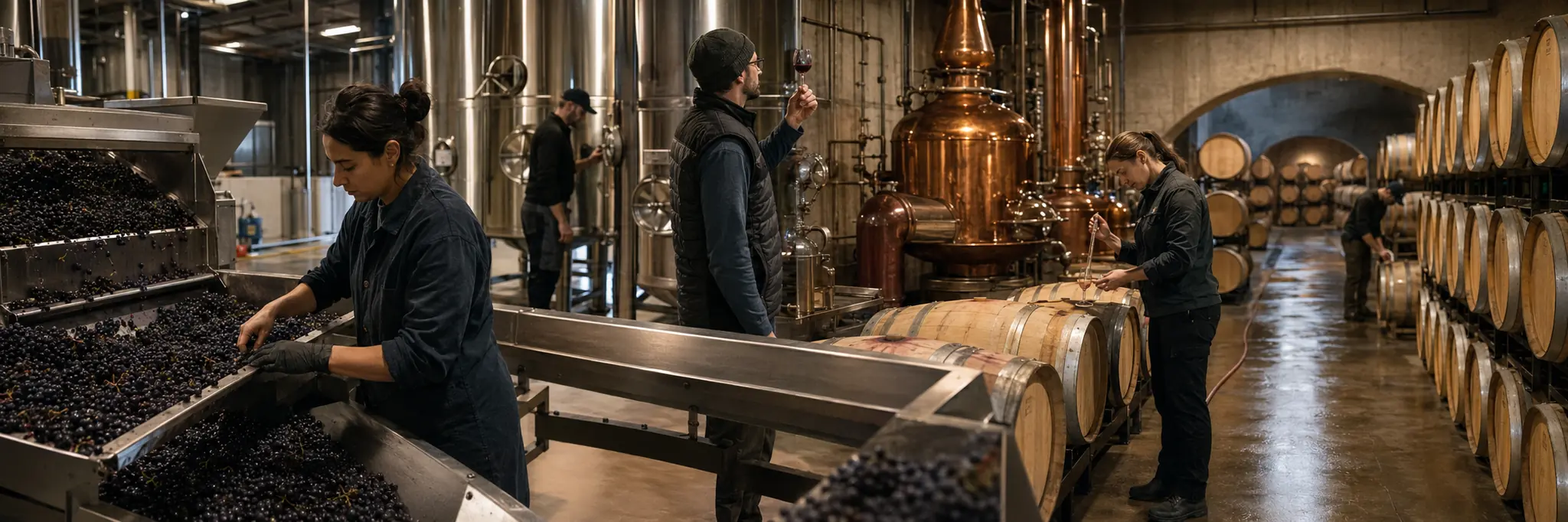
Aging requirements immobilize capital in inventory for years before revenue, while agricultural input variability introduces quality fluctuations that constrain production consistency.
The wineries and distilleries industry transforms agricultural raw materials into branded alcoholic beverages through fermentation, distillation, aging, and blending. The defining structural feature is the role of time in production: spirits and many wines require years of aging before sale, immobilizing capital in inventory that generates no revenue during maturation. This time constraint shapes the financial architecture of the industry, requiring producers to fund extended production cycles before realizing returns.
Value capture is concentrated in brand development and distribution access rather than manufacturing efficiency alone. Brand equity, built through heritage, perceived craftsmanship, and category positioning, is the primary mechanism for commanding pricing above commodity levels. Distribution regulation, particularly three-tier systems requiring mandatory intermediaries, further shapes competitive dynamics by favoring producers with portfolio breadth and distributor relationships over smaller operators seeking direct market access.
Agricultural input variability, excise taxation, and jurisdiction-specific licensing requirements impose persistent structural costs that all participants must absorb. The interaction between seasonal harvest conditions, multi-year aging timelines, and shifting consumer category preferences creates a production planning environment where decisions made years in advance determine available supply, and adjustments to volume cannot be accelerated to meet unexpected demand shifts.
Structural Role
Coordinates the conversion of perishable agricultural inputs into shelf-stable, branded alcoholic beverages, managing time-intensive aging processes and navigating regulated distribution systems to deliver differentiated products across price tiers and consumption occasions.
Scale Differentiation
Large producers operate global brand portfolios spanning multiple price tiers and categories, leveraging distribution scale, marketing reach, and the financial capacity to hold large aging inventories. Mid-sized operators hold positions in specific categories or regions, managing the transition from production-focused operations to brand-building organizations. Small producers focus on artisanal or regional products, competing on provenance, craftsmanship, and direct relationships with consumers or specialty retailers.
Connected Industries
Advertising Agencies
Creates demand for
Farm Products
Creates demand for
Grapes, grains, agave sourcing
Food Distribution
Creates demand for
Three-tier distribution system
Grocery Stores
Supplies inputs to
Packaging & Containers
Creates demand for
Glass bottles and closures
Restaurants
Supplies inputs to
On-premise wine and spirits
Stocks
Agencia Comercial Spirits Ltd.
AGCC
Anhui Golden Seed Winery Co., Ltd.
600199
Anhui Gujing Distillery Co., Ltd.
000596
Anhui Gujing Distillery Co., Ltd.
200596
Anhui Kouzi Distillery Co., Ltd.
603589
Anhui Yingjia Distillery Co., Ltd.
603198
Anora Group Oyj
ANORA
Becle, S.A.B. de C.V.
CUERVO
Brown-Forman Corporation
BF.B
Brown-Forman Corporation
BF.A
Chapel Down Group Plc
CDGP
Citic Niya Wine Co., Ltd.
600084
Davide Campari-Milano N.V.
CPR
Diageo plc
DGE
Gansu Mogao Industrial Development Co., Ltd.
600543
Globus Spirits Ltd.
GLOBUSSPR
GM Breweries Ltd.
GMBREW
Hebei Hengshui Laobaigan Liquor Co., Ltd.
600559
Hite Jinro Co., Ltd.
000080
Jiangsu King's Luck Brewery Co., Ltd.
603369
Jiangsu Yanghe Brewery JSC Ltd.
002304
Jinhui Liquor Co. Ltd.
603919
Jiugui Liquor Co., Ltd.
000799
Kuaijishan Shaoxing Wine Co., Ltd.
601579
Kweichow Moutai Co., Ltd.
600519
Luzhou Laojiao Co., Ltd.
000568
MGP Ingredients Inc.
MGPI
Naked Wines plc
WINE
Oeneo SA
SBT
Pernod Ricard SA
RI
Qinghai Huzhu Tianyoude High-Tech Co., Ltd.
002646
Radico Khaitan Ltd.
RADICO
Richmond Hill Resources PLC
RHR
Shanghai Bairun Investment Holding Group Co., Ltd.
002568
Shanghai Jinfeng Wine Co., Ltd.
600616
Shanxi Xinghuacun Fen Wine Co. Ltd.
600809
Shede Spirits Co. Ltd.
600702
Sundial Growers Inc.
SNDL
Tilaknagar Industries Ltd.
TI
Tonghua Grape Wine Co. Ltd.
600365
Treasury Wine Estates Limited
TWE
United Spirits Limited
MCDOWELL.N
United Spirits Ltd.
UNITDSPR
Vats Liquor Chain Store Co., Ltd.
300755
Viña Concha y Toro S.A.
CONCHATORO
Wei Long Grape Wine Co., Ltd.
603779
Wuliangye Yibin Co., Ltd.
000858
Xinjiang Yilite Industry Co., Ltd.
600197
Yantai Changyu Pioneer Wine Co Ltd
000869
Yantai Changyu Pioneer Wine Co., Ltd.
200869
Zhejiang Guyuelongshan Shaoxing Wine Co., Ltd.
600059