 CompanyGraph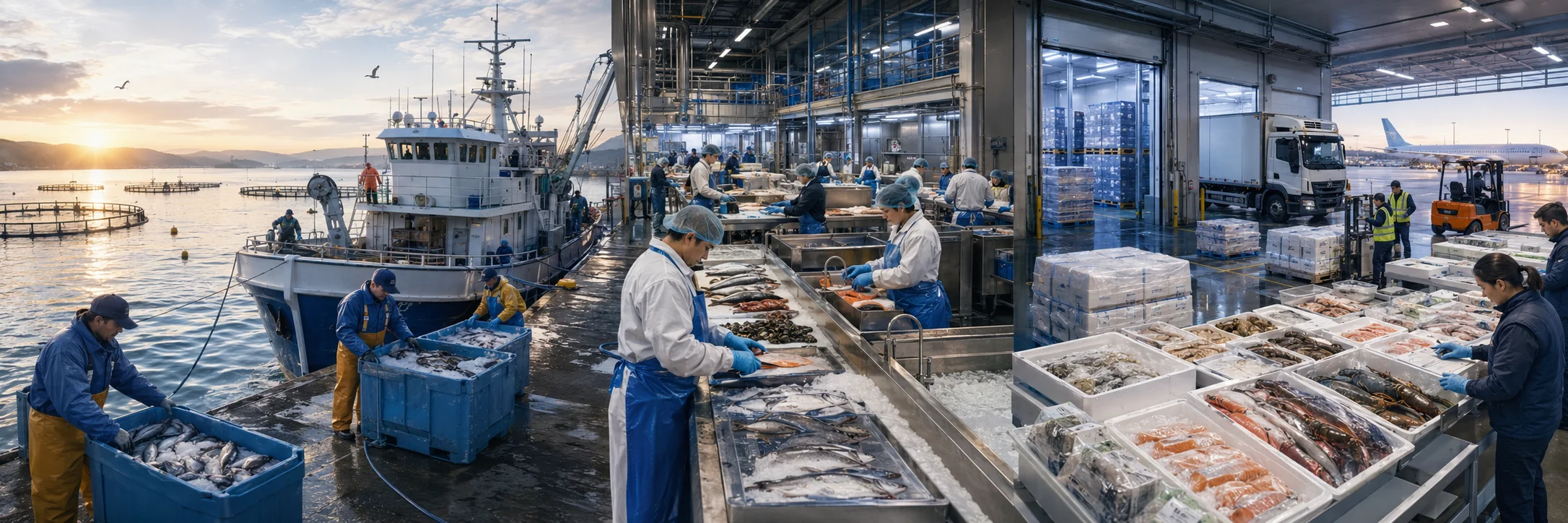
Seafood supply is the work of producing or harvesting an aquatic animal, preserving a safe edible function, and keeping species, handling history, and responsibility attached until consumption.
From living water to edible function
A fish becomes food through a sequence that begins with a living population and ends with a meal, an ingredient, or feed. Protein, energy, and nutrients such as iodine, vitamin B12, vitamin D, and long-chain omega-3 fatty acids may be part of what a person or animal needs, but species and products differ. A sardine, a salmon fillet, a live oyster, a can of tuna, and a fishmeal ingredient are not interchangeable.
The physical journey starts before a sale. A wild fish grows in a stock that reproduces, migrates, and responds to its ecosystem; a farmed fish grows from eggs or juveniles in a pond, tank, cage, or recirculating system. Harvest then changes a living animal into a perishable food. It must be handled, chilled or processed, sorted, packed, transported, and prepared before its edible function reaches a person. At each stage, some options remain open and others become impossible to recover.
FAO reported that aquatic animal production reached 185.4 million tonnes in 2022, with aquaculture providing 51 percent of that total for the first time. That statistic describes production, not the amount that became safe, nutritious food in a particular place. It also does not show how much was used for feed, lost during handling, or made available to people who could afford and prepare it.
Wild capture and aquaculture renew differently
The first clock is biological renewal. Wild capture and aquaculture meet in processing and distribution, but they begin with different constraints. A fishing vessel searches for a population it cannot manufacture. Weather, gear, migration, recruitment, water temperature, and stock condition affect what it can catch on a particular trip. A quota is a permitted upper bound, not a guarantee that the fish will be present or that a vessel can find the permitted amount.
Stock assessments turn surveys, catch records, biological observations, and models into management advice. NOAA explains that annual catch limits are reduced from estimated overfishing limits to account for scientific uncertainty, and that targets can be set lower again for management uncertainty. The assessment, the legal limit, and the fish in the water are related but different observations. A management rule can constrain extraction; it cannot make an uncertain stock behave like a factory inventory.
Aquaculture changes the starting point rather than removing biology. A farmer can control stocking, feed delivery, water exchange or recirculation, oxygen, harvest timing, and biosecurity more directly than a fishing fleet can control an ocean stock. Growth, mortality, disease, water quality, and weather still determine what survives. Feed availability and farm infrastructure add dependencies of their own, and an outbreak can remove harvestable biomass before a buyer ever sees it.
The first minutes after harvest set the later choices
Once a fish dies, time and temperature begin changing the product. The vessel may use ice, chilled seawater, refrigerated seawater, or a freezer; a farm may need to harvest, wash, grade, and chill fish quickly after crowding and removal from a pond or cage. Handling can bruise tissue, rupture the gut, or expose the product to contaminated surfaces before a processor receives it.
The hazard is not only a lower selling grade. For fish capable of forming scombrotoxin, bacterial activity can produce histamine when chilling is delayed. FDA states that histamine, once formed, cannot be removed by washing, freezing, or heating; rapid chilling and time-temperature control prevent its formation. A later test can detect a hazard, but it cannot restore the condition that would have prevented it.
Cold infrastructure is therefore part of the harvest system, not a service added at the supermarket. FAO reports that limited electricity and refrigeration in small-scale fisheries contribute to food loss, lower post-harvest quality, and reduced market access. An ice delivery, insulated box, landing-site power supply, and trained handler can preserve more usable food than a later discount or relabelling decision can recover.
Freezing and processing preserve different things
Freezing extends the time available for transport and sale by slowing microbial growth and biochemical change. It does not erase the history before freezing, and storage can still cause oxidation, dehydration, freezer burn, or texture changes. FAO identifies temperature fluctuation, biochemical change, and dehydration as causes of quality deterioration in frozen fish. “Frozen” is a preservation route, not a universal quality grade.
Other processes move the product into different physical forms. Canning applies a validated heat process and a sealed container; drying, salting, smoking, fermentation, cooking, surimi production, and meal or oil rendering each preserve some functions while ending others. A can can remain shelf-stable while no longer carrying the appearance or texture of the whole fish. A mince can supply protein while making species, size, and origin harder to inspect visually.
Processing also divides the animal into outputs. Fillets, frames, skin, roe, liver, heads, bones, shells, and trimmings may go to separate buyers or uses. The edible share, the by-product route, and the discarded fraction depend on species, equipment, market specifications, and local facilities. A processor cannot make only the portions that have the highest price without deciding what happens to the rest.
A fillet does not carry a whole fish’s identity
A whole fish can provide visual clues about species, size, and sometimes handling. A fillet removes many of those clues; a minced, breaded, cooked, or blended product removes more. Lots are also split, combined, frozen, thawed, repacked, and sold across borders. The commercial record may preserve a declared origin while the physical product has been commingled with material from other vessels, farms, or harvest areas.
That is why traceability is a chain of specific entries rather than a property automatically carried by the food. A vessel or farm log can record harvest time and location. A landing document can identify a lot. A processor can record receiving temperatures and production codes. An importer can retain catch documentation. NOAA’s Seafood Import Monitoring Program requires importers of covered products to report key chain-of-custody data from harvest to entry into U.S. commerce. Those records support targeted checks and recalls, but they do not independently prove that every entry was accurate or that every piece in a commingled lot came from the stated source.
Species testing answers another limited question. FDA identifies species substitution as economic fraud and gives examples such as pollock sold as cod and less expensive snappers sold as red snapper. A DNA result can help identify the species in a sample; it does not by itself establish catch area, gear, welfare, temperature history, or legal status. The product claim is only as strong as the observation behind each part of it.
Aquaculture moves dependencies upstream
Farmed seafood is often described as a controlled alternative to wild catch, but control is distributed across a longer production system. Feed may contain fishmeal and fish oil, soy, cereals, plant proteins, oils, minerals, and additives. Requirements differ by species and life stage: carp, tilapia, salmon, shrimp, and marine finfish do not impose the same feed or water conditions.
FAO’s 2022 fisheries and aquaculture assessment summarizes fishmeal and fish oil use in aquafeeds and the pressure that supply and price place on feed formulation. The farm can therefore reduce exposure to the variability of a target fish stock while remaining connected to capture fisheries, crop production, feed mills, energy, and transport. A lower feed-conversion ratio may reduce feed required per unit of harvested biomass, but it does not describe the full water, disease, labor, and infrastructure system.
Disease creates another feedback path. Stocking density, water exchange, animal movement, biosecurity, diagnostics, and treatment decisions affect whether a local infection becomes a farm loss or spreads to other sites. FAO’s Progressive Management Pathway for Aquaculture Biosecurity treats surveillance, diagnostics, management, and evaluation as shared responsibilities across farms and public systems. A health certificate records a defined inspection or test; it does not make every animal healthy indefinitely after the inspection.
Money buys time, equipment, and compliance
Finance changes which physical actions are available before the fish deteriorates or a stock-management window closes. A vessel needs fuel, ice, gear, safety equipment, labor, and a landing route before it can sell a catch. A farm needs feed, electricity, water treatment, labor, veterinary support, and working capital between stocking and harvest. A processor needs cold rooms, packaging, testing, sanitation, certification, and enough time to wait for payment.
FAO identifies finance for equipment, working capital, and certification as a critical need across fisheries value chains. The trip-loan example is a mechanism, not a claim about every fishery: if a processor or trader cannot finance ice, insulated containers, or a short holding period while repayment is due, an immediate sale at a lower grade may be the only accessible way to repay. Payment timing therefore determines whether preservation work can happen before the fish deteriorates.
Regulation and safety controls resist the same pressure. Catch limits, observer coverage, landing reports, HACCP plans, sanitation, testing, and disease surveillance cost money and can slow throughput. Their benefits are often a stock that is not depleted, a person who is not poisoned, or a recall that is smaller because the lot can be found. The expense appears now; the avoided failure may never appear as revenue. A permit or certificate therefore establishes a required condition or recorded process, not proof that financial pressure has disappeared or that the full physical result is safe.
Controls see defined parts of the chain
A stock assessment estimates abundance and sustainable removals from selected data. A catch limit controls a legal quantity. A harvest-vessel record documents stated chilling and storage. A HACCP plan identifies hazards and critical controls for a defined process. A temperature logger records exposure at its location. A species test identifies what was sampled. A catch certificate or import record links declared identity and movement. These controls are useful precisely because each answers a limited question.
FDA’s seafood HACCP guidance covers hazards and controls including time-temperature management, histamine, pathogens, parasites, contaminants, and process validation. The guidance also relies on illness reporting to investigate and remove unsafe products. A control can make a failure easier to detect or limit its spread; it cannot repair fish damaged before the critical limit or establish the condition of an entire lot from one sample.
Failure becomes useful only when information reaches its cause
A complaint about odor, texture, or illness may begin at the meal but point to different causes: delayed chilling, contaminated water, a failed cooking step, a temperature excursion, or a species whose hazards were not declared. To correct the cause, the signal must reach the lot, processor, farm, landing, or vessel that can still be investigated. If lots were merged without preserving identity, the response may become a broad withdrawal rather than a precise correction.
The same timing problem appears before harvest. A stock assessment can reveal declining abundance, but management action must reach vessels, quota holders, processors, workers, and communities whose money depends on the season. NOAA’s management rules distinguish scientific uncertainty from uncertainty about whether managers can constrain actual catch. A closure or lower limit is physically protective only when people have the authority, information, and material means to comply; its economic effect also depends on access to alternative income, credit, or lawful work during the restriction.
NOAA documents that Northwest Atlantic groundfish stocks became severely depleted in the 1990s, spawning biomass fell, areas closed, and fishing communities carried economic burdens. A later closure can reduce new removals, but it cannot instantly restore stock condition or the livelihoods and market relationships that depended on the earlier fishery.
Responsibility follows the food and the living system
A complete seafood account connects the condition of the stock or farm, the safety and welfare of workers and animals, the first handling decision, the cold chain, processing, labeling, sale, consumption, and the treatment of residuals. Heads, frames, shells, skin, viscera, and spoiled product may become meal, oil, collagen, bait, pet food, compost, wastewater, or waste. Each route has its own handling, contamination, and market requirements.
Responsibility is not established by naming the last seller. It requires a path by which a stock signal, a temperature failure, an illness report, a species discrepancy, or a farm disease observation can reach the people able to change the next trip, harvest, process, contract, rule, or investment. The chain is dependable when those people also have the money, equipment, authority, and time to act before the next biological or quality boundary is passed.
Inside CompanyGraph
Explore fishing vessels, quota holders, fishing communities, farms, hatcheries, feed mills, ice and cold-storage providers, landing sites, processors, auctions, exporters, importers, retailers, restaurants, laboratories, regulators, insurers, lenders, workers, and waste or by-product handlers. CompanyGraph can map where species, lot identity, temperature evidence, payment, and authority change hands; it cannot by itself establish the stock’s true abundance, a fish’s complete handling history, a farm’s unseen disease condition, or whether a recorded claim matches every item sold.