 CompanyGraph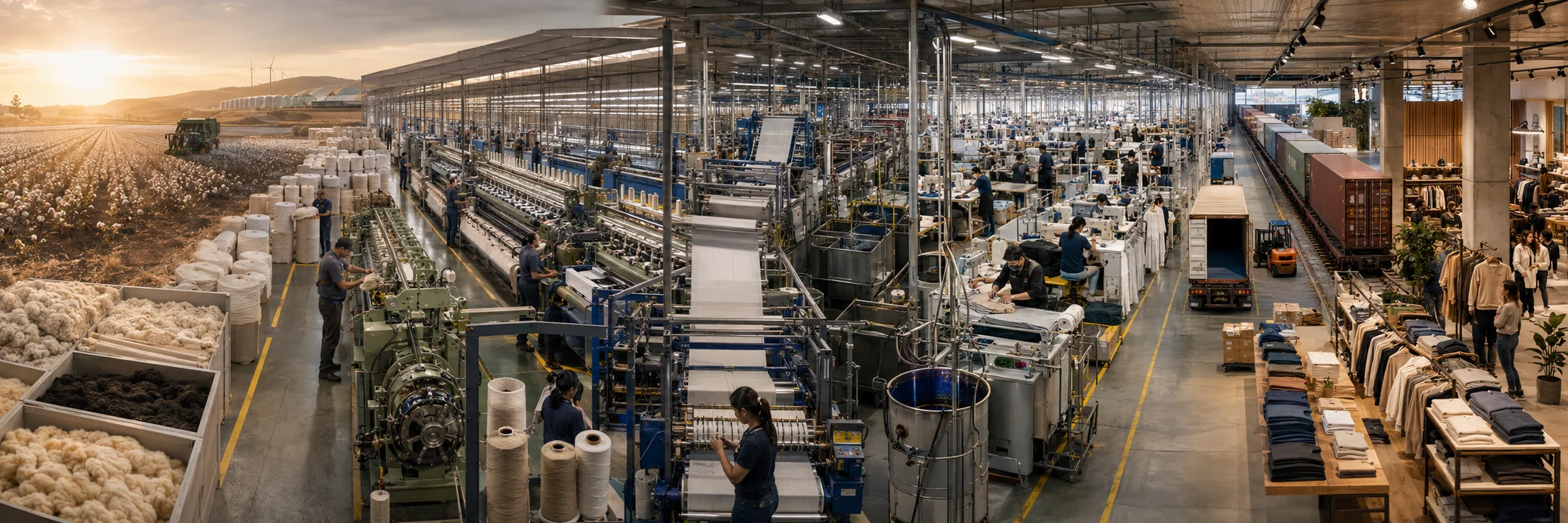
Follow a garment from the functions required at the body through fibre, yarn, fabric, dyeing, pattern, cutting, assembly, use, care, sorting, reuse, and recycling—and see why fibre content and unit count cannot establish usable clothing.
A winter coat must limit heat loss without unacceptably restricting movement. A running shirt must manage sweat while it stretches. A school uniform has to fit a body, survive repeated care, and satisfy an institutional rule. Protective coveralls may need a barrier that remains effective at seams, closures, and interfaces with gloves or a respirator. People do not need garment units in the abstract. They need clothing functions in particular environments and social settings.
Those functions are created cumulatively. Fibre chemistry affects moisture, strength, heat response, and dyeing. Yarn and fabric structure affect stretch, drape, air movement, abrasion, and cutting. Finishes can add colour, softness, water resistance, flame performance, or dimensional control. A pattern allocates fabric around an assumed body. Seams and closures complete the moving structure. Laundering, drying, repair, sunlight, sweat, and wear keep changing it after sale. A correct fibre label can coexist with a garment that shrinks, leaks at a seam, restricts movement, or simply does not fit.
This also separates necessary clothing from the volume organized by the present apparel system. Bodies need protection, thermal regulation, movement, modesty, and participation in workplaces, schools, ceremonies, and communities. Population, climate, occupation, wear, loss, and changing body size create real replacement and access needs. Today's exact volume is not physically determined by those needs. Collection frequency, assortment size, trend turnover, dress rules, low durability, poor fit, returns, prices, marketing, and the early retirement of wearable clothes can all enlarge material demand.
Clothing works at the moving boundary of the body
The body produces heat and moisture while posture, speed, weather, and work change. Clothing alters the exchange of heat, air, liquid water, water vapour, radiation, and friction across the skin. Adding insulation may help in cold conditions and increase heat burden during strenuous work. A tightly sealed barrier may exclude a contaminant while also limiting evaporation. Loose clothing can permit movement in one task and create an entanglement hazard in another. There is no universally best fabric outside a use.
Protection belongs to the complete worn system. The NIOSH account of protective-clothing selection distinguishes material properties from garment design, seams, closures, size, fit, and the stresses of use. A barrier test on flat fabric cannot observe leakage at a zipper, separation at a seam, exposure created when a sleeve rides up, or loss of dexterity that causes the wearer to change how the garment is used. The test remains useful; its boundary must remain visible.
Many clothing functions are not biological in the narrow sense. A uniform can establish role or access. Dress conventions can enable social participation. Colour, shape, and decoration can carry identity and cultural meaning. These are real human and institutional demands, but they do not make every commercial assortment or rate of replacement inevitable. The useful question is which function is being served, for whom, under what condition, and how much material and completed work that function actually requires.
A fibre name does not describe a garment
Natural staple fibres such as cotton and wool begin as variable biological structures. Regenerated cellulose fibres dissolve or chemically transform plant-derived cellulose before extruding new filaments or staple. Polyester and nylon begin with manufactured polymers; elastane contributes high stretch and recovery in small proportions. Each route has different land, water, energy, chemical, feedstock, pollution, labour, and recovery conditions. “Natural” and “synthetic” are origin categories, not complete environmental results.
Fibre properties also depend on fineness, length, crimp, cross-section, molecular structure, damage, and processing. Cotton can absorb moisture but cotton garments do not all dry, stretch, abrade, or insulate alike. Polyester can be made into fine filament, textured yarn, fleece, woven shell, filling, or reinforcement. Wool's crimp and scale structure influence insulation and felting, while treatment and fabric construction change both. A blend can combine useful properties and make later separation harder.
A percentage printed on a label identifies declared generic fibre composition within the applicable rules. The US Federal Trade Commission's textile-label guidance separately addresses fibre content, country of origin, and the identity of the responsible business. Those observations do not reconstruct the farm, polymer feedstock, spinner, dye house, finish chemistry, or conditions at every production site. Nor do they establish yarn quality, fabric structure, seam strength, shrinkage, colour fastness, fit, or remaining life.
Yarn and fabric structure create movement
Staple fibres are opened, cleaned, aligned, drawn, and spun so many short lengths hold together through twist and contact. Continuous filaments can be grouped, twisted, or textured. Fibre length, yarn count, twist, hairiness, evenness, and blend distribution influence strength, softness, pilling, appearance, and behaviour in the next machine. A spinner can meet average yarn count while local thick places or contamination still affect fabric and dyeing.
Weaving interlaces relatively straight warp and weft yarns. Knitting forms intermeshing loops that can extend and recover. Nonwovens bond a web mechanically, thermally, or chemically without first making a conventional woven or knitted structure. Within each family, density, yarn path, loop or weave design, direction, and finishing change air permeability, drape, stretch, tear, snagging, and dimensional stability. Equal fibre composition does not make a jersey, denim, fleece, lining, and coated shell interchangeable.
Fabric formation is highly mechanized, but it still produces a variable sheet. Tension, broken yarns, needle or loom settings, width, bow, skew, shade, and local defects travel forward. Rolls may need inspection, classification, and relaxation before cutting. A defect map can help a marker avoid a visible fault; it does not turn that area into first-quality cloth or show how the finished garment will move on a body.
Textiles may be desized, washed, scoured, bleached, mercerised, dyed, printed, rinsed, heat-set, softened, brushed, coated, or treated for water, soil, crease, microbial, ultraviolet, or flame performance. These steps remove substances, add others, change dimensions, set synthetic structures, and alter surface friction and handle. The European textile reference document treats preparation, dyeing, printing, and finishing as distinct operations because their material inputs, emissions, controls, and effects differ.
Colour is a chemical and process history, not merely a visual selection. Fibre type, pretreatment, dye class, salt, pH, temperature, time, liquor movement, washing, and drying influence shade and fastness. A laboratory dip observes a small prepared sample under defined conditions. Bulk fabric may differ because the substrate, machine, water, recipe control, loading, or later finish differs. Shade approval is therefore a control before production, not proof of every metre after it.
Water leaving a wet process can carry heat, salts, organic load, colour, suspended solids, process chemicals, and substances released from the textile. The US EPA textile-mill effluent rules divide the sector by operations and pollutants rather than treating wastewater as one generic output. A treatment plant can remove or transform defined constituents within its design. It does not make water use, sludge, air emissions, chemical exposure, or unmeasured substances disappear. A named wastewater system is not an observed river condition.
The pattern turns body assumptions into geometry
Before fabric is cut, designers and technical teams specify the garment's intended function, silhouette, materials, components, construction, measurements, and tolerances. A pattern converts those intentions into two-dimensional pieces. It allocates ease for breathing and movement, positions grain and stretch, shapes curves through seams or darts, and reserves material for hems, seam allowances, pockets, closures, and reinforcement.
A size label is a category, not a body measurement or a fit result. Grading scales a base pattern into a size range according to chosen rules, but shoulders, torsos, waists, hips, limbs, posture, and movement do not all change in the same proportion. Fabric stretch, recovery, drape, thickness, and shrinkage alter the result again. The same labelled size can therefore fit differently across styles, brands, production runs, and wearers without any label being a direct measurement of the body.
A bill of materials and technical package can define fabric, thread, interlining, elastic, buttons, zippers, labels, stitches, dimensions, and inspection points. They describe intended production. If an unavailable zipper is substituted, a pattern is changed, bulk cloth shrinks differently, or a tolerance stack accumulates across several seams, the resulting garment can depart from the approved sample while each local operation appears close to instruction.
Cutting commits shape and creates offcuts
Fabric rolls may be inspected for shade and faults, grouped into compatible lots, and allowed to relax before spreading. A marker nests pattern pieces inside the usable width while respecting grain, nap, print direction, stripes, checks, size ratios, and defect positions. Cutting turns a continuous sheet into garment-specific panels. Once a sleeve, collar, or pocket is cut, its geometry and orientation narrow what that material can become.
Marker efficiency is not controlled by the cutter alone. Style geometry, number of sizes combined, fabric width, one-way prints, matched patterns, order quantities, and quality rules determine how tightly pieces can nest. Offcuts are generated even when cutting follows the marker perfectly. Standardising components, changing geometry, combining orders, or designing around available widths may reduce loss, but those choices belong earlier in design and planning.
Clean, known offcuts can be easier to recycle than post-consumer garments because composition and contamination are more controlled. Yet recycling them as fibre still discards spinning, weaving or knitting, dyeing, finishing, and the usable areas between cuts. A remanufactured product that can accept irregular pieces may preserve more completed fabric work. The physically available route depends on size, colour, composition, finish, separation, demand, and the equipment nearby—not on the word “scrap.”
A sewing operator does more than activate a needle. Loose panels must be picked up, oriented, layered, eased around curves, held against shifting, fed at compatible rates, and checked while the seam changes the shape of the assembly. Thin cloth can curl; slippery layers migrate; stretch fabric distorts under tension; pile and coated surfaces respond differently to gripping. The flexibility that lets clothing conform to bodies makes general manipulation difficult.
That difficulty does not mean sewing has never been automated. Fabric spreading, vision inspection, marker planning, cutting, pocket setting, buttonholes, programmable seams, welding, bonding, knitting to shape, and other defined operations can be mechanized or automated. Research on vision-guided robotic fabric gripping focuses on reliable grasping and placement because deformable material handling remains a bottleneck. Progress occurs operation by operation and product by product; a stable seam on a prepared part is a narrower problem than changing styles, sizes, fabrics, trims, and three-dimensional assemblies across a factory.
The seam is itself a material system. Stitch type, thread, needle, tension, seam geometry, allowance, feed, reinforcement, and fabric determine strength, extensibility, puckering, leakage, abrasion, and repairability. Too much needle heat can damage synthetic material; a damaged needle can cut yarns; a strong thread can concentrate load into a weak fabric; a waterproof cloth can leak through an untreated seam. Inspection at the end may find the symptom after the relevant machine, setting, bundle, or operator context has moved on.
An approved sample is one observed garment
Development may include prototypes, fit samples, size sets, colour submissions, pre-production samples, testing, and a pilot or first output review. Each answers a different question. A fit sample can reveal how one material and size sit on one fit model. A wash test can observe specified care cycles on submitted specimens. A seam test loads a prepared construction. A pre-production sample can confirm an agreed assembly before volume begins.
None observes every garment in the production run. Bulk fabric may come from another dye lot; cutting may combine sizes differently; operators and machines vary; a trim supplier can change; later washing or pressing can alter dimensions. Statistical inspection samples a defined share under an acceptance rule. It helps manage a known defect risk, but accepted lots can contain defects and rejected lots can contain many good garments. “Inspected” is not a physical property of every unit.
This is why quality cannot be placed at a final checkpoint. Pattern tolerance, material compatibility, machine maintenance, operator training, line balance, lighting, needle control, shade separation, humidity, pressing, packing, and time all create or preserve condition. A final inspector can sort visible outcomes; they cannot restore cloth already cut to the wrong geometry or identify every latent weakness without destructive testing.
The order clock begins before demand is known
Long before a finished garment reaches a customer, mills reserve fibre, yarn, machine, dye, and finishing capacity. Factories source fabric and trims, make samples, plan lines, cut orders, and finance work in progress. Minimum yarn, dye-lot, fabric, printing, and trim quantities can exceed the demand for one style-colour-size combination. A brand that offers many colours, sizes, and short-lived styles divides aggregate demand into many smaller forecasts while some upstream processes require larger lots to maintain throughput, shade consistency, and acceptable setup loss.
Some commitments can be postponed. Undyed and unfinished “greige” fabric can preserve colour options until later. Common materials or components can serve several styles. Replenishment can use observed sales. Nearer production can shorten some transport intervals. Made-to-order can delay final commitment. Each option moves rather than abolishes risk: holding greige cloth still ties up money and may not preserve every finish; small dye lots can cost more and vary more; late customisation needs reserved capacity; made-to-order asks customers to wait.
Excess inventory is therefore not a law of fabric or a proof of individual carelessness. It can arise when long physical lead times meet many speculative variants, minimum quantities, early commitments, generous availability targets, easy returns, rapid collection turnover, and contracts that reward shipped units more than long use. Forecast error remains real, but the way demand is divided and risk is assigned amplifies or reduces it. Fewer variants, better fit information, durable carry-over products, controlled replenishment, repair, resale, and accepted stockouts can change the volume without changing the human need for clothing.
Production geography is a capability map
Labour cost matters because cutting, handling, sewing, finishing, and inspection still require substantial human time. It does not determine geography alone. A garment region also needs yarn and fabric or reliable imports, dyeing and washing capacity, pattern and sample skills, trained production teams, machine repair, electricity, water treatment, ports or roads, customs capability, trade access, finance, and a network of button, zipper, label, packaging, and testing suppliers. These capabilities accumulate and are not recreated by a low wage.
Different products require different clusters. A basic jersey shirt, tailored wool jacket, seamless knit, taped outdoor shell, washed denim, bra, medical gown, and embroidered occasion garment do not use the same machines, skills, suppliers, tolerances, or certifications. An idle sewing floor is not automatically capacity for the missing product. Qualification, material access, tooling, learning, and line balance must be rebuilt before acceptable output exists.
Production does move as wages, trade rules, exchange rates, politics, capacity, market access, and business strategies change. But “migration to the cheapest labour” hides persistence as well as movement. Regions with higher wages may retain complex, fast, automated, specialist, or tightly integrated work. A lower-cost location may lose an order because fabric must travel too far, quality is unstable, credit is unavailable, lead time is too long, or the required process is absent. Delivered price is an outcome of a capability network, not a wage converted into kilometres.
Money determines which corrections are possible
Factories commonly must buy materials and pay workers before the buyer pays for completed goods. Credit limits and payment timing decide whether a supplier can reserve fabric, maintain equipment, add a shift, refuse unsafe overtime, retain skilled workers, treat wastewater, or survive a late change. A technically possible correction may be commercially unreachable if the participant responsible lacks cash, time, contractual authority, or a paid order.
Purchasing practices travel into physical production. The OECD's garment and footwear due-diligence guidance connects inadequate specifications, short lead times, price pressure, late changes, and subcontracting risk rather than treating factory conditions as isolated supplier choices. An urgent purchase order does not manufacture safe space, trained labour, dye capacity, or working capital. It can instead make hidden overtime or unauthorized subcontracting one of the few commercially accessible routes for a supplier that fears losing the customer.
Payment for a garment also does not show how value and risk were distributed. Retail price includes product development, rejected work, freight, duty, warehousing, marketing, stores or digital systems, markdown risk, returns, and finance as well as manufacturing. A high retail price does not prove a high factory margin or wage. A low factory quote does not prove efficiency. Money is evidence of a transaction under particular terms; those terms decide which material and labour actions are feasible.
Records observe different boundaries
The apparel chain produces many records because no participant can directly observe the whole material history. A fibre-content label declares composition. A purchase order names a product, quantity, price, and timing. A technical package defines intended construction. A lab report describes submitted specimens and methods. A factory audit observes a defined site, time, scope, people, and records. A shipping scan places an identified package at a checkpoint. A receipt records arrival. A return code assigns a reason. These are not weaker versions of one universal truth; they answer different questions.
A certificate for a mill cannot establish every shift after the visit, a subcontractor outside scope, or the condition of a worker's home. A transaction certificate can support a chain-of-custody claim without proving that the garment will be recyclable after its trims, dyes, finishes, and wear. A barcode can preserve style and size identity while the physical garment is stained or damaged. A return marked “too small” may reflect pattern, grading, shopper expectation, body variation, shrinkage, or a mistaken selection. Records become useful when their limits remain attached and when several can be connected to a physical lot, operation, and decision.
Care labels illustrate the distinction well. The FTC care-labelling guide requires reasonable evidence for instructions that apply to the complete garment, including its components. The label tells the user a supported care route. It cannot observe detergent dose, machine action, drying temperature, mixed loads, stain treatment, sunlight, repeated cycles, or the garment's present damage. An instruction is a control available before care, not a guarantee after it.
Use continues the material history
Wearing bends yarns, rubs surfaces, loads seams, stretches elastic, exposes dyes and polymers to sweat, oils, ultraviolet light, heat, contaminants, and weather. Washing swells or softens fibres, releases soil and some material, moves dye, abrades surfaces, and changes dimensions. Drying supplies heat and mechanical action. Ironing, bleaching, dry cleaning, waterproofing, patching, and alterations change the garment again. The item that returns after two years is not the finished product that left the factory.
Care can consume water, energy, chemicals, money, equipment, and time, but less care is not automatically better. Inadequate cleaning can make protective, medical, food-service, or ordinary clothing unsafe or unacceptable. Excess heat or aggressive cycles can shorten life. A durable garment that demands a specialised care route unavailable to its owner may be retired early even if the fabric remains strong. Service life is jointly created by design, use conditions, fit, care instructions, household access, repair cost, fashion acceptance, and the owner's changing needs.
Repair can preserve the highest-value object already made: the garment. A replaced zipper, reinforced seam, darned hole, new elastic, altered waist, or refreshed coating may keep fibre, yarn, fabric, dye, pattern, cutting, and most assembly in service. Repairability depends on seam access, spare components, material allowance, construction method, skill, equipment, information, and whether repair costs less—in money and inconvenience—than replacement. A physically repairable garment can still lack an organizational repair route.
The first sort assigns the next route
When an owner releases a garment, its next path begins with collection and sorting. The sorter considers cleanliness, damage, style, local demand, size, season, brand, fibre, colour, hardware, and resale price. One item may be suitable for direct local resale, another for export, repair, remanufacture, wiping cloth, insulation feedstock, fibre recovery, energy recovery, or disposal. The first decision assigns how much of the completed product will be preserved.
Direct reuse can preserve fibre, yarn, fabric, colour, finish, pattern, seams, and most of the garment's remaining service. Repair or alteration preserves slightly less while restoring access to use. Cutting into a wiping cloth preserves fabric but abandons fit and garment construction. Shredding intentionally destroys yarn and fabric structure to recover a fibre mixture. Chemical separation may recover a polymer or cellulose feedstock while losing colour, structure, and geometry. These routes should not be reported as one undifferentiated “diversion” result.
Export also names a movement, not a final use. The European Environment Agency's analysis of used-textile exports finds that destination outcomes can include reuse, sorting, downcycling, re-export, landfill, and informal disposal, with limited evidence about actual fate. A bale classified or sold as reusable may contain garments of different quality. Shipment transfers custody; it does not observe whether a person wore the item or where the unusable fraction went.
Fibre recovery inherits every blend and finish
Mechanical recycling opens or shreds textiles. Cutting, tearing, and carding can shorten fibres and mix colours, finishes, and contaminants, so the output may need longer virgin fibre, another binder, or a product tolerant of lower strength and variable appearance. Chemical routes target particular material chemistries: one process may dissolve cellulose, another depolymerise a selected polyester, while incompatible fibres, elastane, coatings, pigments, flame retardants, soil, and trims interfere differently. “Chemical recycling” is therefore a family of processes, not a universal machine for mixed clothes.
Buttons, zippers, labels, sewing thread, elastic, interlinings, prints, coatings, and adhesives are small in mass but can be large processing constraints. A cotton-rich garment with a little elastane may behave differently from pure cotton in separation. A multilayer waterproof jacket preserves useful protection by combining membranes, face fabric, backing, tape, zippers, and finishes; the same integration makes clean fibre streams hard to reach. Designing only for fibre percentage can miss both service performance and recovery.
Sorting needs evidence. Visible inspection can find condition and colour, but not reliably identify every fibre, additive, coating, or blend ratio. The NIST fibre-identification benchmark is intended to improve comparison of technologies that measure textile composition for sorting. The Joint Research Centre's assessment of textile-waste routes shows why reuse, preparation, mechanical recycling, chemical recycling, recovery, and disposal require different feed conditions and yield different outputs. Collection volume alone cannot supply a recycler with qualified feedstock.
Feedback must return to pattern and process
A wearer may be the first person to discover that a shoulder restricts movement, a seam twists, dye transfers, elastic fails, a zipper catches, a finish washes out, or the care route is impractical. The visible failure may have begun in fibre damage, yarn twist, fabric tension, finishing, pattern geometry, grading, component choice, machine setting, pressing, or the instructions provided at sale. The retailer who receives the return usually controls none of those operations.
Refunding the customer settles a transaction. Recording a defect creates information. Investigating comparable garments identifies a possible pattern. Correcting the next outcome requires the information to reach the team that can change the specification, pattern, mill process, trim, machine, supplier, purchasing term, or care instruction. These events occur at different times and across different organizations.
Traceability should follow consequence and the correction sought. A style-level return code may be enough to find a sizing problem. A colour-fastness failure may need dye lot, fabric roll, treatment, wash, and test history. A worker-safety concern may require the actual production site, shift, subcontracting route, and purchasing timeline rather than the factory named on an approved list. More data is not automatically more control; the necessary identity must remain connected to someone with authority and resources to act.
The return path begins at design
A garment designed for longer use aligns material, construction, fit, care, repair, and aesthetic life with its duty. A replaceable closure is useful only if it can be reached and a replacement exists. A mono-material design may simplify one recycling route while failing the stretch, barrier, durability, or repair needs of the service. A blend may extend useful life and complicate separation. The right decision depends on which function must be preserved, which failure is likely, and which return infrastructure can actually accept the product.
The chain is divided among fibre producers, spinners, mills, dye houses, chemical suppliers, pattern teams, trim makers, cutters, sewing factories, testing laboratories, brands, logistics providers, retailers, users, repairers, collectors, sorters, resellers, exporters, recyclers, waste operators, regulators, and workers whose observations may never enter a product record. Complete responsibility does not mean one company physically performs every stage. It means the function, material identity, working conditions, observations, money, and authority needed for correction remain reachable across those divisions.
Apparel demand includes genuine access and replacement needs. It is also shaped by decisions about collection turnover, fit, variety, durability, price, contracts, care, repair, resale, and what is counted as recovery. A garment system preserves the most usable function and completed work when it first keeps a suitable garment in safe use, then preserves fabric or fibre only when the higher function can no longer be reached. Fibre supply closes one material boundary. Clothing succeeds at the body.
Inside CompanyGraph
Map where garment function, fibre and fabric identity, dye and finish history, pattern revision, production site, purchasing terms, fit feedback, repair access, and end-of-use outcomes become separated—and which organizations can reconnect them before clothing function or material is lost—inside CompanyGraph.