 CompanyGraph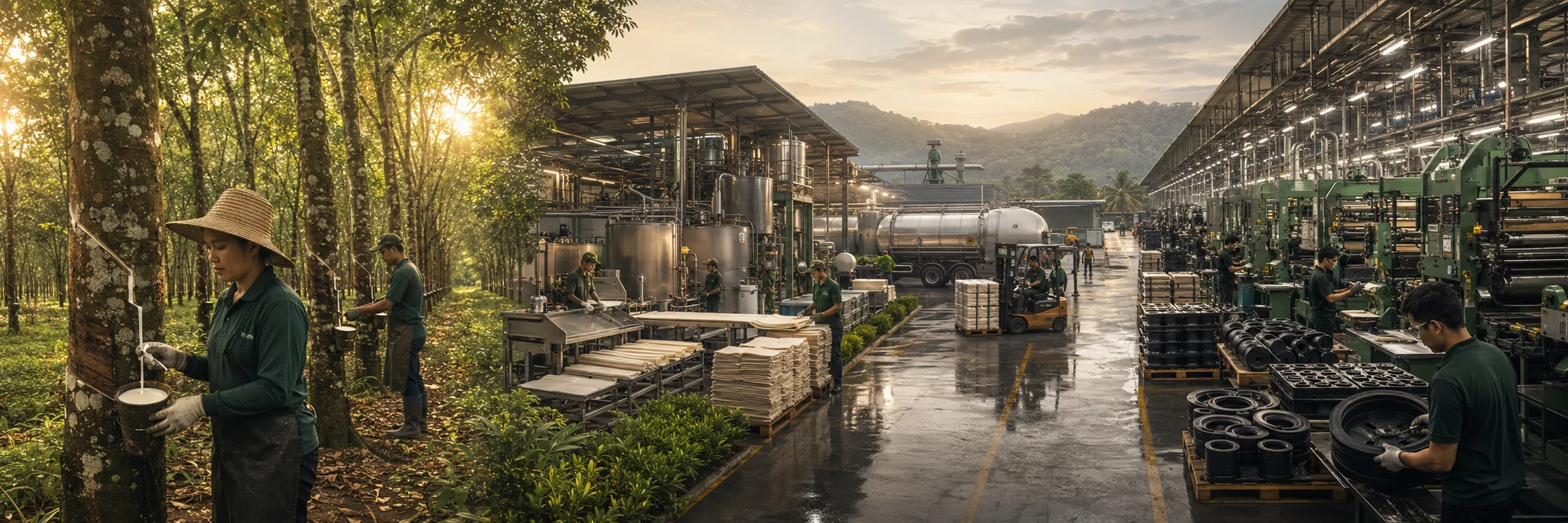
Natural rubber begins as latex made by a living tree and becomes elastic tyres, seals, gloves, and belts only after tapping, coagulation, drying, compounding, and vulcanization preserve the properties a use requires.
The required function is elastic recovery
People do not need a plantation or a bale of rubber for its own sake. They need a tyre to deform and recover while carrying a vehicle, a seal to maintain a pressure boundary, a belt to transmit force, or a glove to flex without tearing. Natural rubber is valuable because its polymer structure can provide high elasticity, fatigue resistance, tear strength, and low-temperature performance in particular formulations. The International Rubber Study Group describes latex tapping, coagulation, sheet and block processing, and the distinction between Hevea rubber and alternative crops.
Those properties are not present as a finished commodity in a tree. A rubber tree makes latex; a processor turns latex into sheets, blocks, or concentrates; a compounder adds fillers, oils, antioxidants, pigments, and curatives; a manufacturer shapes and vulcanizes the mixture. Each stage creates a different material history and can narrow what the next stage can do.
A tree makes latex on a biological clock
Hevea trees need years of growth before tapping and then remain productive only while bark, water, nutrients, weather, disease pressure, and management permit. Tapping removes latex from living tissue. The cut has to be made at a frequency and depth that release sap without exhausting the tree or damaging the future tapping surface.
Weather changes the biological queue. Rain can interrupt tapping and dilute or contaminate collection. Drought can reduce latex flow. Leaf disease can reduce photosynthesis and yield. Replanting creates a long interval with no harvest, so a shortage of mature trees cannot be repaired by ordering more seedlings this season. Natural rubber demand is partly a physical response to the performance required in tyres and medical or industrial goods, and partly enlarged by the present use of disposable products, long-distance trade, and plantations separated from processors and buyers.
Tapping converts labor and bark into supply
Latex is collected in cups, stabilized or coagulated, and moved from smallholdings to collection points, cooperatives, or factories. The work is repetitive and time-sensitive. A farmer may need tools, labour, access roads, chemicals, clean containers, and cash before the sale of rubber. Payment arrangements vary by place and buyer. Where payment is based mainly on wet weight, the measure recognizes volume while potentially obscuring dilution, dirt, or the future damage caused by an overly aggressive cut; this is a mechanism to verify locally, not a universal rule.
The choice is therefore bounded by money and timing. A documented Sri Lankan study found that rubber prices affected replanting decisions with lags of several years, because cutting mature trees removes current income before replacement trees produce; the study supports the long financial clock, not a universal payment practice. A premium for dry rubber or clean latex helps only if the farmer can finance the extra sorting, containers, labour, and storage required to earn it.
Latex becomes a graded material
Factories add acid or other coagulants, press out water, wash the rubber, smoke or air-dry sheets, or produce technically specified block rubber. These processes improve throughput and standardization, but they also blend deliveries and reduce the resolution at which a defect can be assigned. Concentrate may be centrifuged and preserved for latex products. Drying reduces water and stabilizes the material, but smoke, heat, contamination, and uneven moisture alter colour, odour, plasticity, and cleanliness.
Grades and tests can report dirt, ash, volatile matter, nitrogen, plasticity retention, or viscosity in a sample. They do not recreate the tree, weather, tapping history, or every part of a bale. Aggregating deliveries makes a plant efficient and a shipment uniform enough to trade, but it also reduces the resolution at which a defect can be traced. ASTM’s technical-grade specification defines natural-rubber grades through measured properties rather than origin alone.
Compounding and vulcanization make the product
Natural rubber becomes useful in a tyre or seal through compounding and vulcanization. Heat and sulfur or other curing systems create cross-links; carbon black, silica, oils, resins, and protective additives set stiffness, abrasion, hysteresis, ageing, and grip. The recipe and cure schedule are tied to mixing equipment, mould geometry, reinforcement, and the performance tests required by the finished part. ISO guidance on vulcanized-rubber specifications likewise treats the finished properties as material-specific, not as a generic rubber quantity.
A tyre and a surgical glove do not consume the same rubber history. A tyre compound must carry cyclic load and heat; a glove must meet barrier, elongation, and biocompatibility requirements. A grade that passes one application may be unsuitable for another. “Natural rubber supply” is therefore not one interchangeable volume.
Tires and seals consume different histories
During service, the product experiences ozone, oxygen, heat, water, abrasion, cyclic strain, and contact with oils or chemicals. A tyre can lose tread, a seal can swell, and a belt can crack even when the original compound met its specification. Maintenance, inflation, alignment, temperature, and the surrounding machine change the material's life.
When a failure appears, the cause may be the tree, contamination, mixing, cure, design, installation, or service environment. A production certificate can establish that a batch met a defined test; it cannot by itself establish why a field part failed after years of loading.
Money arrives before the next crop
The chain needs money before latex becomes saleable and again before new trees replace old ones. Small growers finance tapping, fertilizer, labour, tools, and transport; processors finance chemicals, energy, storage, and inventory; tyre makers finance moulds, testing, and approved compound changes. Prices move faster than a tree's biological clock. A low farm-gate price can postpone replanting, while an abrupt high price can make new planting attractive without creating mature supply for several years.
Synthetic rubber can substitute for some functions and is made from petrochemical monomers, but substitution is not automatic. It may require a different formulation, equipment, approval, or service trade-off. The present volume of natural rubber is therefore shaped both by physical performance requirements and by product designs, labour arrangements, land use, and replacement decisions.
At the tree, the same payment can therefore support different physical actions depending on whether the buyer measures dry-rubber content, wet weight, delivery time, or a later factory grade. The correct comparison is not a universal claim about all buyers; it is the locally documented payment measure and the work it makes possible.
What grades and certificates establish
Keep three layers separate. Physical condition includes trees, latex, polymer, compound, product, worker exposure, soil, water, and emissions. Recorded condition includes a moisture test, bale grade, factory batch record, cure curve, and tyre inspection. Communicated condition includes “technically specified rubber,” “sustainable plantation,” or “approved compound.”
Certification can establish compliance with a defined standard and audit scope. A laboratory result can establish a measured property in a sample. Neither proves that every farmer received the premium, every tree was protected, or the installed seal experienced the claimed service conditions. Traceability is useful only where identity and the relevant observation survive the handoff.
Failure appears after service
Latex defects may be visible at the collection point; a cure deviation may appear at the factory; a tyre failure may appear months later on a road. Detection and correction are separate. A recall or customer complaint can identify a lot, but if bales were mixed, the source of contamination may no longer be reachable. Even when the source is known, correction requires a farmer, processor, compounder, or manufacturer with the authority, equipment, and money to change the next action.
Return routes preserve different work
Tyres and rubber goods can be retreaded, repaired, reused in another application, devulcanized, ground, burned for energy, or discarded. These routes preserve different amounts of completed work. Retreading keeps a casing and much of its embodied manufacturing; grinding recovers material but destroys the original geometry and compound history; combustion recovers heat while losing the polymer function.
A return route must also handle steel cords, textiles, additives, and contamination. A named recycling route is not evidence that the material reached it, nor that the next product can accept the recovered rubber.
Rubber products also return steel cords, textile, carbon black, oils, and additives. A recycler's accepted-tonnage record establishes an input to its process, not the function of the next product or the fate of rejected fractions. EPA’s scrap-tire materials guidance distinguishes recycling and beneficial-use routes from a completed return to the original function.
Inside CompanyGraph
Inside CompanyGraph, follow tree owners, tapping crews, collectors, processors, compounders, tyre and seal manufacturers, users, repairers, and recovery facilities. The graph can show where identity, payment, test evidence, and authority separate; it cannot replace direct evidence of the tree, batch, or service condition.