 CompanyGraph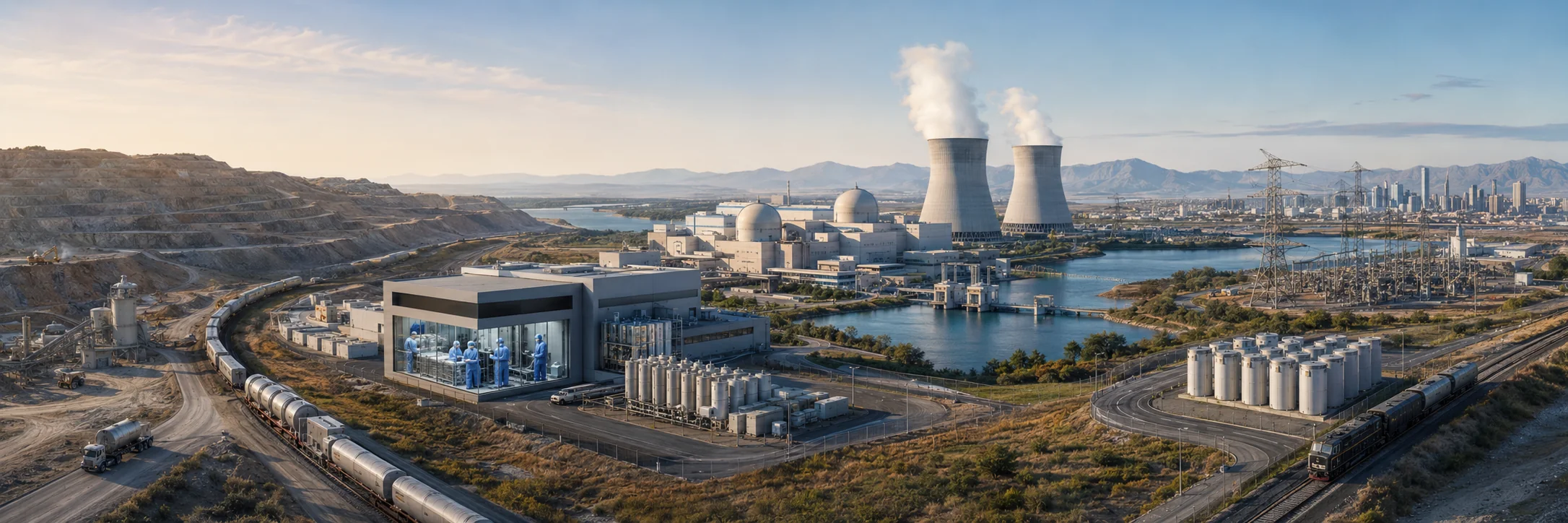
Follow uranium from ore through milling, conversion, enrichment, fuel fabrication, fission heat, steam, electricity, spent-fuel storage, and decommissioning. A reactor’s service is controlled heat and electric output; its fuel, coolant, records, and back-end routes determine whether that service can continue.
Electricity users need dependable power, while some industries and district-heating systems can also use reactor heat. Nuclear power is one way to provide those services. In a reactor, a controlled fission chain reaction produces heat; a steam system and turbine convert that heat into electricity, while cooling systems carry unused heat away. The need for the service does not by itself specify how many reactors, how much uranium, or which reactor design must exist.
The detailed route here is the common civil power chain for water-cooled reactors using enriched uranium-oxide fuel. Heavy-water reactors, fast reactors, molten-salt concepts, and advanced fuels change parts of the route. The shared problem is still physical: radioactive material must remain in a controlled configuration, heat must be removed, and every output must have a managed destination.
Fuel begins as uranium ore
Uranium enters the chain as ore or as a solution recovered from an in-situ operation. Mining and milling separate a small amount of uranium from much larger quantities of rock, water, residue, and disturbed ground. Uranium mill tailings contain long-lived radioactive materials and can require containment, groundwater protection, monitoring, and eventual site remediation. The mill produces uranium oxide concentrate, commonly called yellowcake; it does not produce reactor fuel.
The U.S. Department of Energy describes the front end as mining, milling, conversion, enrichment, and fuel fabrication. Each stage changes chemical form and creates its own waste, equipment, records, and transport requirements. Ore grade and recovery affect how much material must be moved, but neither an ore tonnage nor a yellowcake shipment establishes how much qualified fuel a reactor can load.
Enrichment separates an isotope, not a finished energy product
For most light-water power reactors, uranium oxide concentrate is converted to uranium hexafluoride, or UF6, because UF6 can become a gas for isotope separation. Natural uranium contains about 0.7% uranium-235; commercial reactor fuel is commonly enriched to roughly 3–5% uranium-235. Centrifuges separate the slightly different masses of uranium isotopes into enriched material and depleted tails.
Enrichment capacity is technically specialized and subject to safeguards. The same enrichment technology can produce material at much higher uranium-235 concentrations, creating proliferation concerns and requiring safeguards and nuclear-material accounting. A separative-work contract, a quantity of UF6, and an enrichment assay answer different questions. The reactor still needs fuel in a particular chemical form, enrichment range, geometry, and approved manufacturing route.
Fuel fabrication fixes the assembly’s geometry
At a fabrication plant, enriched UF6 is converted to uranium dioxide powder, pressed into ceramic pellets, and sintered at high temperature. Pellets are loaded into metal cladding tubes, and the rods are arranged into fuel assemblies with spacers, guide structures, and other components. Dimensions, materials, welds, pellet density, and inspection results are controlled because the assembly must survive heat, pressure, neutron exposure, vibration, and handling.
Fuel is not interchangeable merely because two assemblies contain the same isotope. Its shape and materials affect neutron behaviour, coolant flow, heat transfer, and the calculations used to operate the core. DOE notes that fuel assemblies are designed for particular reactor types and made to quality-assurance specifications. For advanced-reactor fuels, the NRC’s fuel-qualification guidance links fuel performance to the reactor design, operating environment, manufacturing parameters, and evidence at the intended burnup.
Fission turns the assembly into controlled heat
When uranium-235 fissions, it releases heat and neutrons. Control rods, soluble absorbers in some reactor designs, coolant conditions, and core loading patterns keep the chain reaction within the operating envelope. In a pressurized-water reactor, primary coolant transfers heat through steam generators; in a boiling-water reactor, reactor water boils in the vessel. Steam turns a turbine connected to a generator, and a condenser returns water to the cycle.
The NRC describes the sequence from fission heat to steam, turbine rotation, generator output, and condensed feedwater. The electricity meter records a grid delivery, but the useful service also depends on cooling water or air, pumps, valves, transformers, switchyards, operators, maintenance, and the receiving grid.
Reactors must remain within licensed operating limits
The core, coolant boundary, steam systems, electrical systems, containment, and emergency systems are operated as one licensed plant. Defence in depth uses several layers: fuel pellets and cladding, the reactor coolant boundary, containment, redundant cooling and power systems, testing, maintenance, and trained operators. Those layers remain protective only when the equipment is inspected, the systems are maintained, and deviations are acted on before they become more consequential.
Fuel temperature, cladding condition, coolant chemistry, pressure, vibration, radiation monitors, and power distribution are observed because a local change can alter heat transfer or the confinement of radioactive material. A control-room indication reports a sensor and its calibration chain; an inspection examines a defined component; a safety analysis models events that cannot be reproduced at full scale. These observations support operation and correction, but none proves the condition of the entire plant.
Refuelling is planned before the outage
Fuel assemblies spend years in the core and are removed when their exposure, reactivity, power distribution, or condition no longer fits the next operating cycle. The NRC notes that about one-third of a reactor’s fuel is replaced at each refuelling. The outage also coordinates inspections, maintenance, testing, crane work, cooling-system work, and grid scheduling.
Fresh fuel must arrive in time, match the approved design, and be loaded in a configuration that the core calculations support. A delay in fabrication, a transport problem, a failed inspection, or an outage that runs long can reduce available generation even when uranium is sitting somewhere in the wider market. The physical queue is set by the reactor’s reload plan, not by a tonne count alone.
Shutdown stops fission but not heat
When the chain reaction is stopped, radioactive fission products continue to decay and release heat. The reactor and recently discharged fuel therefore need cooling after shutdown. Freshly removed assemblies go into a deep pool that provides water cooling and radiation shielding; after sufficient cooling, some fuel is transferred to dry casks.
The NRC recognizes spent-fuel pools and dry casks as storage methods and continues to regulate their safety, security, inspections, and performance. A plant can stop generating electricity while its cooling, monitoring, security, and spent-fuel obligations continue.
Storage, recycling, and disposal are different back ends
Spent fuel may remain in storage, be reprocessed where that route is licensed, or be prepared for final disposal. Reprocessing separates usable uranium and plutonium from fission products and other residues; it creates new fuel streams and new radioactive waste streams. Direct disposal treats the used assembly as the waste form and requires a repository and transport route suited to its long-lived condition.
The choices are not interchangeable. Pools provide cooling and radiation shielding for recently discharged fuel. After sufficient decay, dry-cask systems can provide containment, shielding, and passive heat removal. Geological disposal is intended to isolate material for the long term, but storage, reprocessing, and disposal routes differ by jurisdiction; a planned repository is not the same as an operating one. The NRC lists interim storage, possible reprocessing, and final disposition as separate stages of the fuel cycle.
Decommissioning removes a plant in stages
Decommissioning begins when an operator permanently ceases operation, but it is not the instant disappearance of the site. Fuel must be removed from the reactor, radioactive systems characterized, buildings and equipment dismantled or decontaminated, waste packaged and transferred, and the site surveyed against a release standard. Spent fuel can remain in an independent storage installation after the generating equipment is gone.
In the United States, the NRC process includes certification of shutdown and fuel removal, a post-shutdown plan, a license-termination plan, implementation, inspections, and final radiological surveys; completion is generally required within 60 years unless otherwise approved. The timescale and legal details differ by jurisdiction, but the physical sequence remains: dismantling, characterization, material routing, radioactive-waste management, and proof that the site meets its release conditions.
Money and timing determine which route can be maintained
Money must be available before many nuclear actions become possible. A new plant needs design work, qualified manufacturing, construction, commissioning, regulatory evidence, and grid connection before it can sell electricity. An operating plant needs fuel orders, outage labour, inspections, spare parts, security, emergency preparedness, and waste management. A decommissioning fund must support work after revenue ends.
Revenue and expenditure arrive on different clocks. During a planned outage, a unit earns no electricity while crews, inspections, replacement power, and long-lead parts still cost money. A delayed component can extend the outage; deferring maintenance can move work into a later outage without proving the deferral safe. Construction financing accrues before revenue, and decommissioning funds must remain available after generation ends. The NRC’s safety-culture policy says nuclear safety must be prioritized when it conflicts with production, schedule, or cost goals.
Corner-cutting does not require an explicit decision to violate a safety rule. It can occur through competitive bids, shortened schedules, reduced inspection scopes, deferred maintenance, staffing reductions, cheaper procurement routes, fragmented subcontracting, or optimistic decommissioning provisions. Each decision may remain individually acceptable while reducing the plant’s overall safety margin. Workers need a credible way to report concerns, and regulators need independence and resources to investigate them. Because nuclear materials and equipment remain consequential for decades, this pressure is part of the supply chain itself.
Contracts can divide these obligations among utilities, fuel vendors, engineering firms, regulators, grid operators, waste handlers, and governments. They do not remove the physical work. A low quoted construction price can exclude financing during delay, replacement power during an outage, or the future handling of activated equipment. Conversely, a regulated payment mechanism can keep inspections and long-lead procurement reachable before the plant earns its next megawatt-hour.
Inside CompanyGraph
Explore uranium miners and mills, conversion and enrichment operators, fuel fabricators, reactor vendors, utilities, grid operators, regulators, safeguards bodies, maintenance firms, transporters, spent-fuel storage operators, waste repositories, decommissioning contractors, insurers, financiers, and host communities. CompanyGraph can map their handoffs and stated responsibilities; it cannot by itself prove a fuel assembly’s condition, a cask’s integrity, a reactor’s present safety margin, or a site’s final radiological status.