 CompanyGraph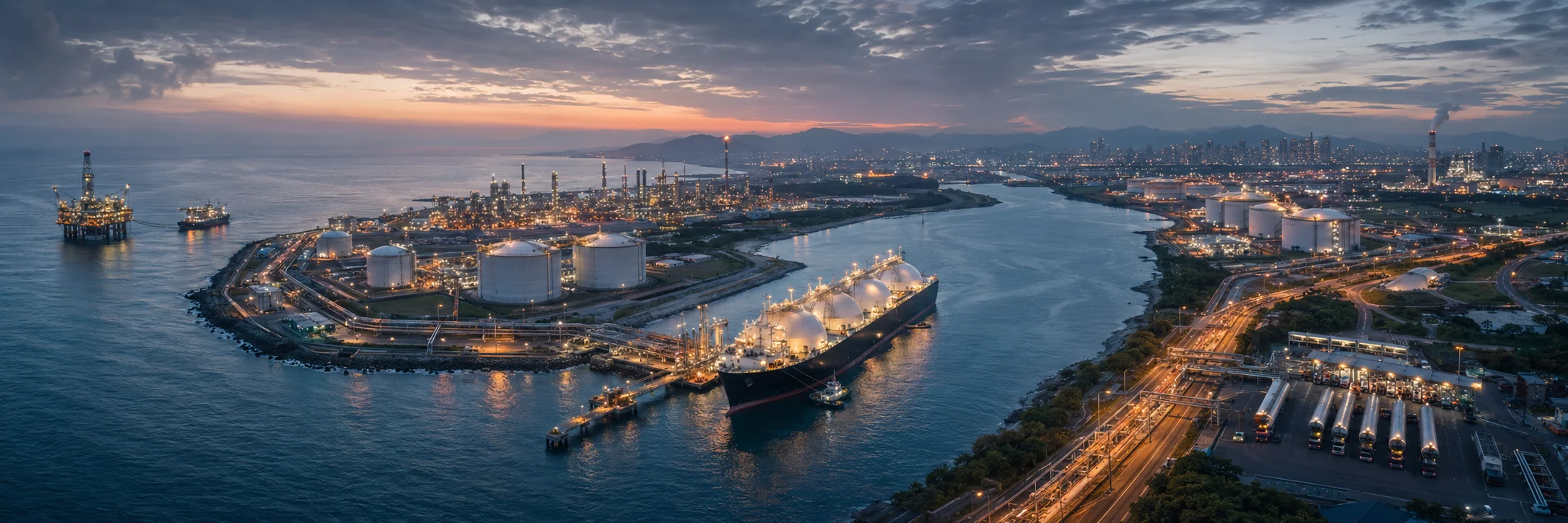
Liquefied natural gas buys distance by removing heat from cleaned gas. Its useful supply is the gas that can be safely loaded, carried, regasified, and delivered when a receiving network can use it.
LNG is a transport condition
Users need heat, electricity, industrial hydrogen, or chemical feedstock. Natural gas is one way to supply those functions. LNG is not a different fuel molecule; it is mostly methane cooled to about -162°C so that its volume becomes small enough for insulated tanks and ships to move it across water.
The chain runs from a producing reservoir through gathering and processing, liquefaction, storage, loading, a cryogenic ship, unloading, regasification, and a high-pressure pipeline. The U.S. Energy Information Administration describes LNG as natural gas cooled for shipping and storage and notes that regasified gas returns to pipelines. At each boundary the material must remain within a narrow temperature, pressure, composition, and custody condition. A cargo counted at the export terminal is not yet gas at a power plant; the export, voyage, and receiving boundaries observe different conditions.
Gas must be cleaned before cooling
Raw natural gas contains methane with water, carbon dioxide, nitrogen, heavier hydrocarbons, sulfur compounds, mercury, and sometimes other contaminants. Processing removes or separates components that would freeze, corrode equipment, violate a sales specification, or create unsafe combustion. The saleable stream and the removed streams leave by different paths.
A processing certificate can report a sample composition. It cannot establish that every part of a gathering system was leak-free, that the gas remained within specification between samples, or that the separated carbon dioxide, sulfur, water, and produced water were harmlessly managed. Processing therefore creates both a product and continuing waste and emissions obligations.
Liquefaction spends energy to buy distance
Liquefaction compresses and cools gas through a sequence of heat exchangers, refrigerant circuits, compressors, valves, and controls. The plant consumes part of the incoming gas or electricity to run that machinery. Large capital works, reliable power, trained operators, and maintenance are required before a single cargo can be sold.
Cooling makes ocean transport practical, but it also makes the plant and ship dependent on materials that remain tough and leak-tight at cryogenic temperature. Boil-off gas can be used as fuel, reliquefied, or managed through other approved systems. A tank that is full by volume may still have less deliverable energy if pressure, composition, or terminal operating limits prevent unloading.
A cargo is a moving inventory
After loading, the LNG is a moving inventory with a route, a ship, a destination terminal, and a delivery window. Weather, port congestion, boil-off, vessel availability, draft restrictions, and a receiving tank's remaining capacity can all change the usable route. A ship at sea is a different inventory condition from gas already in a local pipeline.
Long-term contracts can support the capital needed for a liquefaction train, ship fleet, or terminal. Spot cargoes can respond to short-term scarcity, but only where a compatible ship, terminal slot, financing, and pipeline connection exist. A high cargo price may pay for scarce shipping or storage; it does not create a berth or repair a compressor.
Regasification returns gas to a network
At the receiving terminal, LNG is warmed, measured, odorized or otherwise conditioned as required, and sent into a pipeline. The terminal needs unloading arms, storage tanks, vaporizers, water or air heat exchange, boil-off handling, safety zones, and a connection with enough pressure and capacity. Gas can leave a terminal while a city still faces a downstream pressure or interconnection constraint.
Power stations and factories also require compatible pressure, composition, and scheduling. A plant with a gas purchase agreement can still be curtailed when the local pipeline lacks capacity or prioritizes residential demand. Conversely, a full storage tank at a terminal does not prove that each downstream user can receive the required flow.
Contracts and terminals shape feasible routes
Money changes which route can be built and used. A developer must fund wells, processing, liquefaction, ships, tanks, insurance, and connection before revenue from delivered gas arrives. A buyer may promise future offtake but lack authority to reserve a berth or build a pipeline. A terminal may have a slot but no working capital to keep inventory through a delayed cargo.
These pressures organize geography. LNG can connect gas markets separated by oceans, but it does not erase the fixed locations of liquefaction plants, ports, storage tanks, regasification terminals, and pipelines. A route is physically available only when the equipment, permits, crew, money, and timing line up.
A disruption can be local despite global cargo
A liquefaction outage, ship collision, canal closure, cold snap, pipeline failure, or terminal shutdown can reduce local supply even while LNG is abundant elsewhere. The 2022 European gas crisis showed a narrower mechanism. LNG helped offset reduced Russian pipeline supply, while regasification capacity, interconnections, storage, and demand reduction constrained how much could be delivered to particular markets. The IEA records that European regasification capacity expanded during winter 2022/23 and that new floating units increased options without guaranteeing cargo volumes. A global cargo count did not establish a local heating service.
Feedback also travels unevenly. A power plant may see fuel pressure falling before a producer knows which terminal or compressor caused it. A terminal operator may identify a vaporizer problem while the buyer experiences an electricity shortfall. Correction requires a reachable cause and the equipment, authority, and money to change it.
Records measure custody, not complete climate result
A bill of lading records a cargo. A custody-transfer meter measures a defined flow. A gas analysis reports selected compounds. A greenhouse-gas certificate may allocate emissions under a method and boundary. Each can be accurate within its scope without establishing the entire methane and carbon sequence from well to combustion.
Leak detection, flare records, ship fuel use, boil-off, venting, and combustion occur at different locations and times. A claim that a cargo was delivered does not prove that upstream methane losses were small or that displaced coal generation actually occurred. The physical result, recorded result, and communicated claim must remain separate.
Use changes the molecule
Combustion converts methane into carbon dioxide, water, heat, and pollutants; chemical processing converts it into hydrogen, methanol, ammonia, plastics, or other products. Once burned, the methane cannot be recovered as the same gas. The product may perform a necessary service while creating emissions and ash-free but still material obligations in air, climate, and equipment.
A gas stream that is rejected, flared, leaked, or vented is also part of the chain. A saleable cargo is not the only output that needs a route.
Retirement leaves cryogenic and gas burdens
When a liquefaction train or terminal closes, tanks, insulation, compressors, refrigerants, contaminated piping, wastewater systems, and hazardous areas remain. Decommissioning may recover steel and equipment, but it also requires purging, gas freeing, monitoring, and decisions about reuse. Revenue can stop before those obligations do.
Terminal geography sets a regional option
An LNG cargo becomes a regional option only when the receiving terminal, storage tanks, vaporizers, pipeline interconnections, and downstream buyers can use it. The IEA's account of the 2022 European crisis describes Lithuania's Klaipėda floating terminal and the interconnectors that allowed gas to move beyond the berth; it also shows why terminal and interconnection capacity are distinct from global cargo availability. The documented terminal profile identifies a berth, storage, regasification capacity, and an 18-kilometre pipeline to the transmission system.
A terminal may unload a ship while a downstream network remains constrained. Conversely, a pipeline can be available while no compatible cargo is scheduled. The source, ship, terminal, and user each observe a different boundary of the same gas route.
Maintenance spends the route before revenue returns
Cryogenic tanks, loading arms, compressors, vaporizers, insulation, valves, and emergency systems require inspection and planned outages. A terminal operator may need to reserve a berth, buy replacement parts, and keep trained staff while a cargo is delayed or a tariff payment is uncertain. A maintenance record proves that a defined inspection occurred; it does not prove that every cryogenic surface or downstream pipe is ready for the next cold spell.
Inside CompanyGraph
Inside CompanyGraph, map producers, processors, liquefaction trains, shipowners, ports, terminals, pipeline operators, power plants, and industrial users. The graph can show where custody and contracts meet; direct operating data is still needed to establish temperature, pressure, emissions, and available corrective action.