 CompanyGraph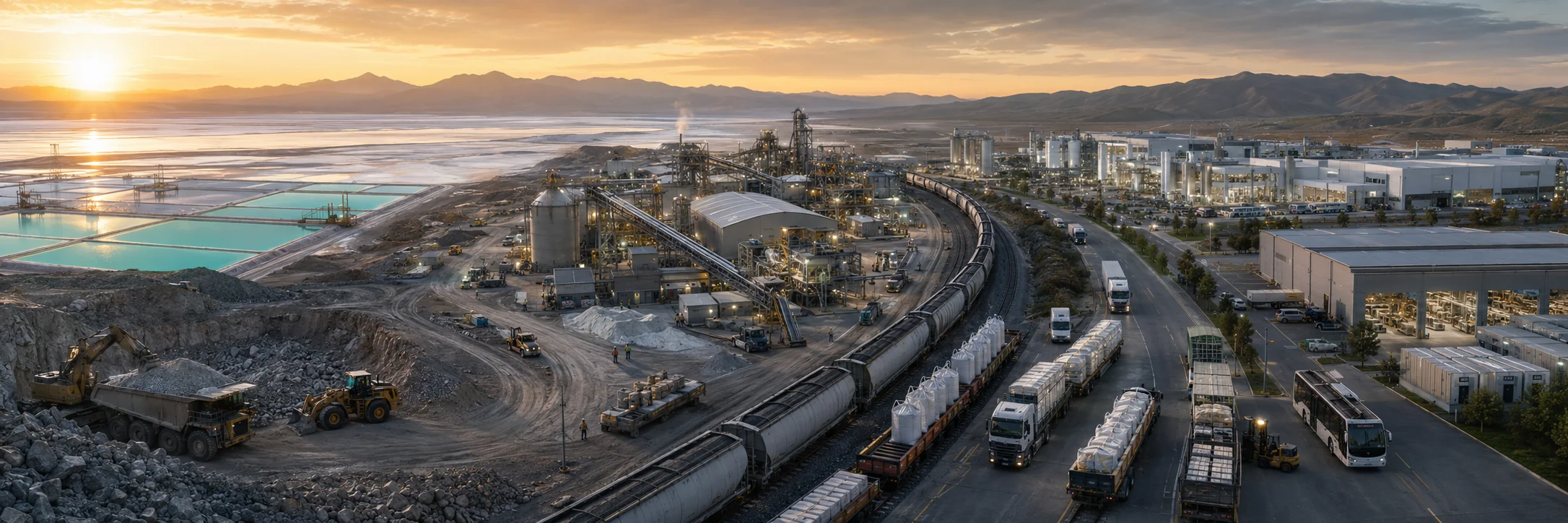
Lithium becomes usable traction storage only after extraction, impurity control, conversion to battery-grade compounds, cathode and cell manufacture, formation, pack integration, and service. A mine or chemical plant alone is not a battery.
The service is controlled electrochemical storage
Lithium has several material destinations, including glass, ceramics, lubricants, electronics, stationary storage, and vehicle batteries. This article follows the lithium-to-EV-battery route because it combines the longest qualification chain; the USGS summary documents the wider end-use boundary. A vehicle needs electrical energy delivered at a controlled voltage and power while accepting charge, surviving vibration and temperature, and remaining safe over many cycles. Lithium compounds are inputs to that system, not the service itself. A battery pack has cells, current collectors, separators, electrolyte, sensors, cooling, software, enclosure, and a qualified operating window.
The chain runs from brine or hard-rock ore through concentration, chemical conversion, cathode or anode materials, cell assembly, formation, module and pack integration, vehicle use, repair, second life, and recycling. Each stage introduces impurities, interfaces, data, and failure modes.
Brine and rock start different clocks
Brine operations pump lithium-bearing water, concentrate it through evaporation or direct-extraction processes, and convert the recovered material into carbonate, hydroxide, or another compound. Hard-rock operations mine and crush ore, concentrate spodumene or another mineral, and use heat and chemicals to produce a lithium intermediate. Water, energy, reagents, land, tailings, and local hydrology differ between routes.
Both routes require years of exploration, permitting, construction, commissioning, and ramp-up. A resource estimate or announced capacity does not establish qualified battery-grade product. Brine chemistry can change with aquifer and season; ore bodies and processing circuits can produce variable impurities.
Concentration is not battery grade
Battery applications require controlled impurities, particle chemistry, moisture, and consistency. Conversion plants purify lithium compounds and crystallize or precipitate them to a specification. A lot can meet a headline lithium percentage while containing an impurity that affects cathode synthesis, cycle life, safety, or yield.
The USGS Mineral Commodity Summary reports lithium production, reserves, and processing in defined categories, while the IEA battery analysis follows the later concentration of cell manufacturing and materials. These are different measurements. A mine's tonnes are not a factory's qualified cathode output.
Cathode chemistry fixes the next route
Lithium carbonate and hydroxide enter different cathode routes and customer specifications. NMC cathodes contain nickel, manganese, and cobalt; LFP uses lithium iron phosphate. Particle coating, precursor purity, calcination, and electrode formulation determine how the cathode behaves. Changing chemistry can change energy density, cost, safety, mineral demand, equipment, and vehicle design.
Supply cannot be substituted by label alone. A customer may need an approved chemistry, particle morphology, and supplier history. An alternative compound or cathode requires testing, process qualification, and evidence before it can enter a vehicle program.
Cells acquire a formation history
Electrodes are coated, dried, calendared, cut, assembled with separator and electrolyte, sealed, and electrically tested. Formation and ageing cycles create the interphase layers and reveal defective cells. The process uses dry rooms, precise equipment, electricity, solvents, trained operators, and a large amount of time before a cell is saleable. A DOE environmental assessment of a lithium-ion cell plant describes slurry mixing, coating and drying, assembly, electrolyte filling, sealing, formation, ageing, degassing, and final storage; the assessment supports this as a concrete manufacturing route, not a universal factory template.
A factory building with coating machines does not by itself provide qualified production. Yield, traceability, test limits, software, maintenance, and the ability to quarantine suspect lots determine usable output. A nameplate gigawatt figure can coexist with low output during ramp-up or a shortage of the exact qualified format.
A pack is a qualified system
Cells become modules and packs through busbars, welds, cooling plates, sensors, battery-management software, crash structures, and connectors. The pack must fit the vehicle, communicate with its controls, and remain safe under charge, discharge, vibration, impact, and temperature. A cell that works in one pack architecture may not be approved for another.
Service history changes remaining options. A pack that has seen heat, fast charging, water ingress, or a collision needs different tests before repair or second-life use. Records affect whether its condition can be established and whether repair is authorized; records do not change the physical condition itself.
Money arrives before a mine or factory
Projects need exploration capital, permits, wells or pits, chemical plants, qualification runs, inventory, safety systems, and trained workers before battery or vehicle revenue arrives. An automaker may want a qualified low-carbon supply before committing to an offtake; a miner may need that commitment to finance the plant. The same timing mismatch appears in cell factories: customers want yield and reliability, while the factory needs money and time to reach them.
Prices can encourage extraction, but they do not create water infrastructure, a dry room, a recycling plant, or a qualified alternative. A low purchase price can leave maintenance, redundancy, and environmental monitoring outside the contract. Those burdens return when a mine loses water access, a cell line fails, or a pack cannot be safely repaired.
Recycling follows product lifetime
Recycling feedstock arrives after vehicles and batteries have been used, not when a new factory opens. Packs must be identified, transported safely, discharged, dismantled, and separated. Mechanical processing produces black mass; hydrometallurgy or pyrometallurgy can recover selected elements, but the route consumes energy, reagents, equipment, and produces residues.
Direct reuse of a module or pack preserves more completed work than recovering metals, but requires reliable identity, remaining-performance testing, safety controls, and a suitable application. A recycling statistic may describe input to a plant or recovered metal; it does not establish a new vehicle cell of equivalent function.
Records establish assay, not cell performance
An assay establishes selected chemistry. A cathode certificate establishes a specification in a lot. A formation record documents a cell's tested history. A battery-management log records selected operating conditions. A battery passport or serial record can connect information to a unit. None alone proves current capacity, internal damage, crash safety, or the next user's suitability.
When a field failure appears, correction may belong to the cell maker, pack integrator, vehicle manufacturer, service center, or recycler. A notification is not a repair. The signal becomes useful only if identity, cause, authority, money, and a feasible technical action meet before the next cell or pack is released.
Battery feedstock arrives after the vehicle
Recycling cannot supply a new EV battery at the moment a mine or cell plant starts. Feedstock arrives when vehicles and packs reach repair, second-life, or end-of-life routes. The IEA identifies recycling as an important later source of lithium, nickel, cobalt, and other materials, but the timing depends on product lifetimes, collection, transport safety, dismantling, and process capacity. The IEA battery analysis separates current manufacturing capacity from future recycling availability.
A pack can be physically present and still unavailable for recovery if its state of charge, crash history, ownership, serial identity, or transport classification is unknown. Discharge and dismantling require trained people, fire protection, tooling, and a buyer for the recovered stream. Those requirements determine whether direct reuse, hydrometallurgy, pyrometallurgy, or disposal is materially reachable.
Inside CompanyGraph
Inside CompanyGraph, map brine fields and mines, chemical converters, cathode and cell plants, pack integrators, vehicle makers, service networks, second-life users, and recyclers. The graph can show qualification and custody relationships; direct tests are still needed to establish present electrochemical condition and safe reuse.