 CompanyGraph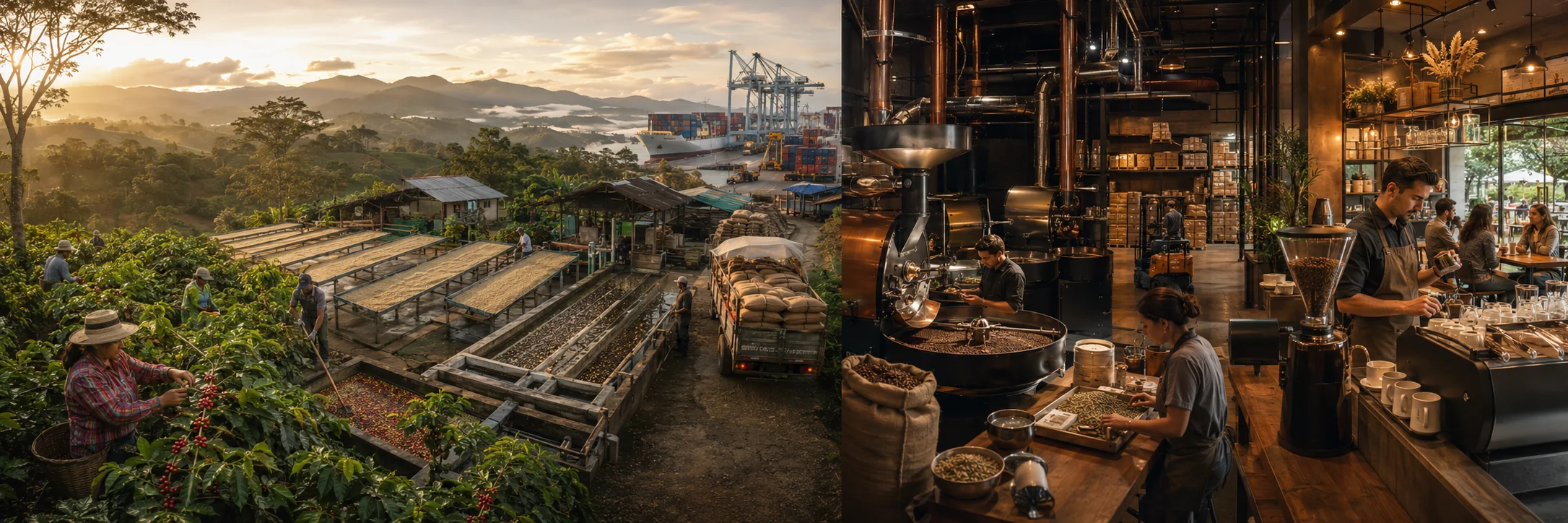
Coffee crosses farms, mills, traders, ships, and roasters before it reaches a cup. At every handoff, something can be preserved, damaged, measured—or forgotten.
How coffee reaches the cup
Coffee begins as fruit on a tree. The condition of that fruit is already connected to the plant variety, soil, water, temperature, sunlight, shade, surrounding life, plant health, and the work performed on the farm.
Ripe coffee cherries are harvested and processed soon afterward. Depending on the method, the fruit may be dried around the seeds or removed through pulping, fermentation, washing, or mechanical separation. The seeds are then dried to a condition suitable for storage. A dry mill removes the remaining parchment or husk, then cleans, grades, and sorts the resulting green coffee.
Exporters, cooperatives, or traders assemble green coffee into lots. The lots are sampled, contracted, stored, moved to a port, shipped, received, and stored again. Roasters select green coffees, sometimes combine them into blends, and apply heat to transform them into roasted coffee. The roasted beans are packaged and distributed. A household, workplace, shop, or café stores, grinds, and brews them.
By the time someone drinks the coffee, months may have passed. The coffee may have crossed several organizations, contracts, records, measurements, and money payments.
What must go right along the way?
“Coffee quality” is not one physical property. It may refer to the absence of defects, a particular flavor or aroma, a repeatable cup profile, food safety, freshness, or documented production conditions. The intended property has to be named before the chain can preserve it.
Many of those properties depend on several stages. Harvesting a mixture of ripe, unripe, and overripe cherries changes the raw material entering processing. Delaying processing can allow unwanted fermentation or deterioration. Uneven drying, rewetting, contamination, excessive heat, or humid storage can damage the beans. Roasting can develop desirable aromas from suitable green coffee, but it cannot reconstruct beans damaged by mould, severe over-fermentation, contamination, or poor storage.
The FAO coffee-processing manual describes this directly: each processing step influences the final cup, and some losses cannot be regained later.
Each stage therefore receives a range of physical possibilities. Careful work may preserve that range. A damaging step narrows it. Later participants can sort, blend, or adapt their process to what remains, but they cannot recreate every possibility that was lost upstream.
The cup retains the history of the chain, including conditions the person drinking it cannot see.
What happens when coffee changes hands?
At a farm, coffee can be connected to a particular plot, plant variety, harvest day, group of workers, weather pattern, and processing decision. At a collection point or cooperative, deliveries from several farms may be combined. A mill may separate coffee by processing method or measured grade. An exporter may assemble enough coffee to meet a contract. A roaster may combine several origins or lots to produce a repeatable blend.
Aggregation performs real functions. It joins small deliveries, fills processing equipment, creates quantities suitable for shipment, and helps buyers obtain a defined product. It can also reduce the resolution of information. A coffee previously identified by plot and harvest day may later be identified only by region, grade, container, or product name.
A 2024 International Coffee Organization working document shows this contrast within the current trade. It describes standard coffee as commonly moved in large volumes, treated as interchangeable within broad categories, used in blends, and accompanied by little origin traceability. It describes specialized coffee through named farms or plots, varieties, processing methods, cup profiles, and fuller traceability.
Preserving detail requires the physical coffee to remain separate and its identity to survive every handoff. That requires containers, storage space, sampling, records, and coordination. If the coffee is combined first, a more detailed database cannot reconstruct which bean came from which source afterward.
What is each participant actually able and paid to do?
Money does not merely reward a decision after it has been made. Access to money helps determine which decisions are materially available.
A farm needs tools, plant care, and people before it receives money from the harvest. Selective picking requires workers to recognize and revisit ripening fruit. Processing needs equipment, water management, drying space, protection from weather, storage, and time. Exporters need working money to purchase, mill, store, and ship coffee before receiving final payment. Importers finance coffee during transport and storage. Roasters need money to hold inventory or commit to future deliveries.
Knowing the physically preferable action does not provide the equipment, time, or working money required to perform it.
A study of coffee chains in eastern Uganda provides a concrete example. Hired pickers in the studied chains were paid for each basket they filled. That measurement directly recognized quantity but not the ripeness of every cherry. The researchers found that it encouraged faster, less selective harvesting and made careful picking harder to arrange. A more precise requirement would also need a workable way to observe ripeness and provide for the additional picking work.
The same distinction applies beyond harvesting. A contract can recognize moisture, defect count, cup score, certification, delivery date, or origin. Conditions outside the contract may still affect the coffee and its production environment without changing the payment.
Wet processing provides a concrete example. It produces wastewater containing fruit material and other organic matter. Researchers sampling effluent and 11 connected rivers and streams in Ethiopia found high organic loads, depleted oxygen downstream, and pollution measurements far outside the cited environmental guidelines. They identified the absence of suitable treatment facilities as one of the main factors. Their study also describes the physical burden continuing into downstream water and ecosystems.
Treating that water requires infrastructure, space, maintenance, and work. If those are not provided, a coffee transaction can still be completed using measurements such as weight, moisture, defects, and cup result. The untreated water is then absent from the transaction's money calculation but remains part of the physical production process. The coffee appears cheaper because the downstream water system carries work that the transaction did not pay to perform.
When is damage discovered—and can its cause still be reached?
Some problems are visible where they occur. A processing team can see unripe cherries, a dirty drying surface, rain reaching uncovered parchment, or a poorly adjusted huller. Other problems are discovered only later.
The FAO manual gives a useful example: some off-flavours leave green beans looking normal. Sorting equipment cannot identify them. They are discovered when the coffee is tasted, after the opportunity to remove the affected beans during sorting has passed.
Detection and correction are therefore different events. A roaster may identify a defect months after harvest. If the lot combines many farms or processing batches, the sample may not reveal where the defect entered. Even if the source remains known, the observation has to return to the person able to change the next harvest or processing run. That person also needs the equipment, time, information, and material ability to act on it.
A complaint sent upstream is not yet a corrected process. Feedback works only when it reaches a cause that is still identifiable and changeable.
What do grades, records, certificates, and claims establish?
Three different things can travel through a supply chain:
- The physical condition: what happened to the plants, land, people, coffee, water, and materials.
- The recorded condition: what a sample, grade, audit, certificate, or database captured.
- The communicated condition: what another participant or the person drinking the coffee was told.
A grade can accurately report bean size, moisture, defects, or a sample's cup result. It does not report every condition that produced the lot. A certificate can establish compliance with defined requirements over a defined scope and period. It cannot establish conditions its rules and evidence did not examine.
Traceability can preserve the movement and identity of a lot through named stages. That is useful for locating failures, supporting claims, and returning information. It does not make the entered information true by itself. The record can be internally consistent while the original observation was incomplete or inaccurate.
Blockchain does not change this boundary. It can make a submitted record difficult to alter later; it cannot observe a farm, verify a worker's entry, or reconnect coffee that was physically mixed without preserving its identity. A 2025 review of blockchain coffee projects found that many remained proofs of concept and that the central obstacles involved data governance, agreements, finance, training, standards, and integration with existing systems.
The strength of a claim can therefore never exceed the observation and evidence supporting it.
Why does the chain require so much control?
The chain creates uncertainty by dividing observation and responsibility among farms, collectors, mills, exporters, traders, warehouses, roasters, certifiers, and retailers. It then adds controls to make transactions workable across that separation. The International Trade Centre's Coffee Guide, for example, describes separate records maintained by farmers, cooperatives, washing stations, shippers, and roasters—and the discrepancies and disputes that can result.
Contracts, samples, inspections, audits, certifications, and traceability systems each answer a limited question: Does this sample meet the contract? Did this lot pass through the recorded locations? Were specified practices observed during an audit? Can this shipment be connected to a named supplier?
Those answers can solve particular problems. They do not provide drying infrastructure, make working money available, restore a lost lot identity, or reveal a condition nobody observed. More control can stabilize a fragmented arrangement without changing the conditions that keep producing fragmentation and mistrust.
The practical question is therefore not how much control exists. It is which physical condition the control observes, what remains outside its boundary, and whether its result reaches a decision capable of correcting the process.
Who is responsible for the complete coffee?
No single participant needs to own every farm, mill, warehouse, ship, roaster, and café. But producing coffee as one coherent process requires more than a sequence of purchases.
The desired physical result must guide upstream work. Harvest timing must connect with available processing and drying ability. Important lot identities must survive. Downstream observations must return to causes upstream. The people receiving that feedback need the material means to act on it. Ecological and human effects remain part of production even when a contract does not record them. Responsibility for a final claim cannot disappear at a supplier boundary.
A company name can mark that connected responsibility, but the name alone proves nothing. The substance lies in whether the organization can support its claims, trace a failure, reach its cause, and provide what is needed to correct the process.
Three questions bring the chain together:
- Can a physical problem be traced to the place and decision that produced it?
- Does the person able to correct it have the information and material means to do so?
- Who remains responsible when the process and the claim diverge?
Those questions show whether the supply chain transports only coffee, or also preserves the knowledge, ability, and responsibility needed to produce it properly.