 CompanyGraph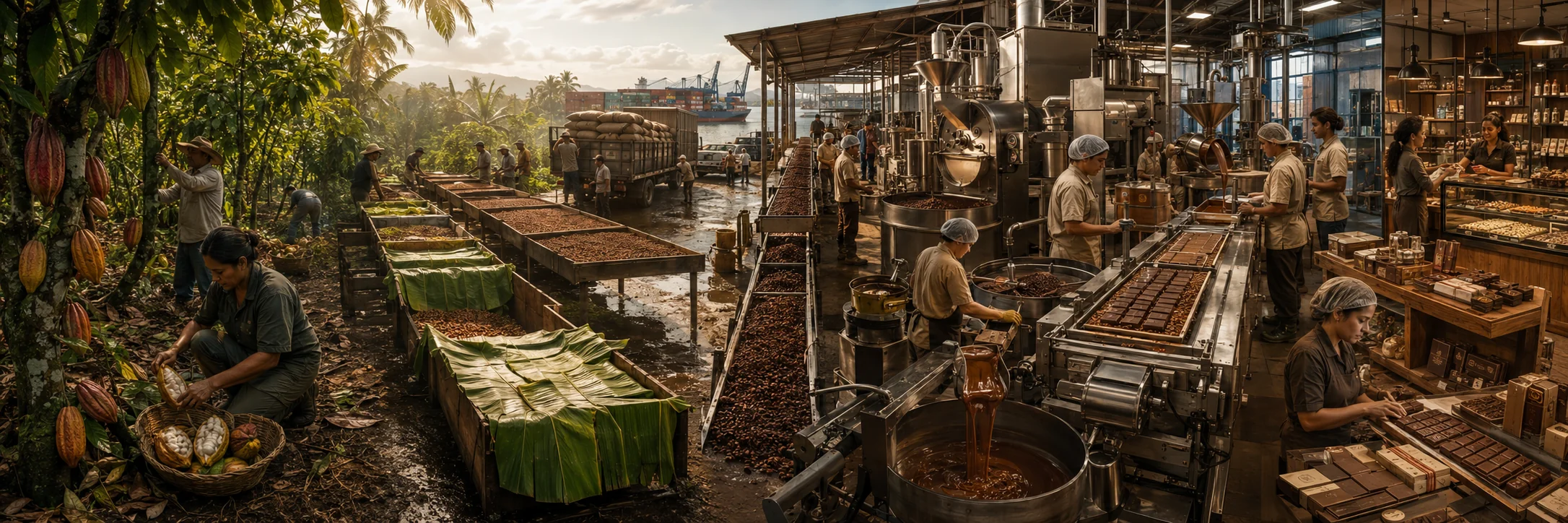
Follow cacao from flower and pod through fermentation, drying, processing, chocolate, and return routes—and see why bean volume alone cannot describe supply.
A cocoa bean reaches a factory only after a living tree has flowered, formed and ripened a pod; someone has selected and opened that pod; microbes have consumed the fruit pulp around its seeds; and heat, water movement and time have changed the seeds into stable raw material. The factory then continues the transformation. It roasts, separates shell from nib, ruptures cells, divides cocoa mass into butter and cake, and may recombine cocoa ingredients with sugar, milk and other materials before controlling particle size, flow and crystal structure.
Calling this a cocoa supply chain can make the bean appear to be the constant object. It is not. The living seed harvested from a pod is chemically and physically unlike a fermented dry bean, cocoa mass, pressed butter, powder or tempered chocolate. Each operation creates a new condition while closing some options that existed before.
The journey is also divided among people who observe different parts of it. A farmer sees pod ripeness, disease and fermentation weather. A warehouse sees bags, moisture, insects and documents. A grinder sees roast response, shell separation and press balance. A chocolate maker sees particle behavior and fat crystallization. A retailer sees finished units and sales. A person eating the product encounters flavor, texture, safety and portion—not the number of beans originally purchased.
The useful question is therefore not how to move more cocoa through the same sequence. It is what physical and human functions cocoa is meant to provide, what conditions each transformation requires, and whether evidence, money and authority can travel far enough to correct a problem before the next transformation hides or fixes it.
The purpose is food and experience, not bean count
People need safe nourishment and may seek sensory or cultural experience. They do not have a biological requirement for cocoa. Cocoa products can supply food energy and other nutrients, but their distinctive role is primarily as ingredients with particular sensory and physical behavior. Cocoa solids contribute color, bitterness, acidity, aroma precursors and roasted flavors. Cocoa butter supplies fat and a melting and crystallization pattern that helps chocolate become firm and glossy at ordinary room conditions, break with a snap and melt in the mouth.
Those functions are real. They support foods, drinks, cultural practices, pleasure and livelihoods. But they do not make today's exact volume or product mix physically inevitable. Demand is also shaped by recipes, portion sizes, advertising, packaging, retail placement, losses, prices and the availability of other fats, flavors and foods. A requirement for nutrition should not be confused with demand for a confectionery formulation, just as the industrial usefulness of cocoa butter should not be confused with a biological need for the bean.
This distinction changes what counts as successful supply. More harvested mass is not automatically more nourishment, better sensory experience, safer work or better land condition. A smaller amount retained in a suitable food may fulfill more purpose than a larger amount spoiled, rejected, over-processed or sold in a form that does not reach people who need food.
A cacao tree makes pods on several clocks
Cacao is a perennial tree. It builds roots, trunk, branches and leaf area before it can allocate material to flowers and fruit. The International Cocoa Organization says trees commonly take three to five years to yield a crop, with some hybrids bearing earlier. Replacing an old or diseased stand therefore removes production before a replacement has completed its juvenile years. Nursery stock, land tenure, shade management, soil condition, water, labor and income during the unproductive interval are part of replacement capacity.
Flowers and pods grow from cushions on the trunk and older branches. One tree can carry flowers, young pods and maturing pods at the same time. Weather, soil water, nutrient access, disease, pruning and canopy condition affect different stages differently. A count of trees does not establish the number of healthy bearing trees, and a count of flowers does not establish a harvest.
The tree also cannot be paused when the market price is low and restarted when it rises. It continues respiring, growing, flowering, experiencing drought and interacting with pests and pathogens. A commercial decision made during one season may alter pruning, sanitation, renewal and harvest several seasons later. Cocoa capacity is therefore living condition maintained through time, not planted area alone.
Cacao flowers are small and structurally difficult to pollinate. They depend on insect pollination, but the specific pollinators and farm habitats vary among locations and remain active research questions. USDA Agricultural Research Service work treats limited pollination as a production bottleneck and investigates the insects, flower traits and farm habitats involved. That is more precise than claiming that one named insect is the sole pollinator or that one canopy design guarantees fruit set.
Even a successfully pollinated flower does not promise a mature pod. The tree sheds flowers and young fruit as it balances available carbohydrates, water and nutrients. Research on cacao cherelle wilt describes a physiological loss of young pods during development. Later, insects, fungi, viruses, wind damage, drought and harvest injury can remove more of the potential crop.
A forecast based on flower abundance therefore observes an early possibility. A pod count observes a later one. Neither establishes a deliverable lot or dry-bean supply. The chain has already passed through biological filters before a trader or processor can receive a lot.
Pods on one farm do not ripen together. Harvesters return through the field, distinguish mature pods from immature or diseased ones and cut them from trunks and branches. The FAO harvesting guide advises cutting rather than pulling so that flower cushions are not damaged. The act that removes today's pod can otherwise reduce the sites available for later flowers.
Ripeness affects the pulp and seed condition entering fermentation. Harvesting too early, leaving diseased pods among sound material, cutting the beans while opening a pod, or delaying the next operation can alter the batch before fermentation management begins. Yet waiting for perfect uniformity is not feasible because pods and weather continue changing while labor and tools are finite.
Harvest capacity is consequently not just the number of hands or tonnes collected per day. It includes the ability to revisit dispersed trees, recognize condition, use sharp tools safely, separate unsuitable material and move ripe pods into post-harvest work without injuring the tree or the worker.
Opening the pod starts coupled transformations
When a pod is opened, the thick husk, placenta and wet beans separate. Each bean is still a seed surrounded by sugary, acidic mucilage. The husk remains near the farm unless someone organizes another route. Pulp begins draining or becoming microbial food. Beans that were protected within the fruit become a batch exposed to tools, surfaces, animals, rain and the surrounding microbial community.
The first transformation consumes the pulp; the second changes the seed. Yeasts, lactic-acid bacteria, acetic-acid bacteria and other organisms act in succession as sugar, acidity, oxygen and temperature change. Their activity removes mucilage, generates heat and metabolites, kills the seed and drives internal reactions that reduce astringency and create precursors for later cocoa flavor. Fermentation is not decay tolerated on the way to the factory. It is a manufacturing stage performed with a living community.
Batch size, variety, pod maturity, drainage, container or heap design, insulation, turning, ambient weather and desired flavor affect the necessary management and duration. A fixed number of days is not a universal recipe. The relevant question is whether heat, aeration, drainage and internal bean change reached a suitable state without putrefaction, excessive acidity, contamination or an unfinished center.
The statement that flavor is decided entirely on the farm is too absolute. Genetics, pod maturity and fermentation establish possibilities and defects. Drying and storage can preserve or damage them. Roasting then generates much of the familiar chocolate aroma through reactions among precursors. Formulation, refining, conching and storage alter the final experience again.
What is irreversible is narrower. A factory cannot return a dried bean to its living seed state and repeat the original microbial succession inside fresh pulp. It can blend, roast around some variation or choose a product whose flavor tolerates it, but these actions do not recreate a precursor that failed to form. Likewise, intense roasting can mask some sensory differences while creating others; it does not prove that the incoming fermentation was equivalent.
Fermentation time also ties up material before sale. Turning, covers, boxes, drainage, batch separation and daily attention require labor and working money. If a household needs cash immediately, if rain threatens drying, or if a buyer pays only for weight, an abbreviated process can become financially accessible even when a longer or differently managed process would improve the intended bean. The physical result cannot be separated from the time and money available to produce it.
Drying must finish without creating a new problem
Fermented beans remain wet and biologically unstable. According to the ICCO description of cocoa processing, drying commonly reduces moisture from roughly 55 percent to about 7.5 percent. Water must move from the bean interior to its surface and then into air. That takes exposed area, airflow, heat and time.
Drying too slowly can allow mold and off-odors to develop. Rain or condensation can rewet a batch. Direct contact with smoke can create smoke taint, while excessive heat or a sealed surface can leave an unfavorable internal condition. The FAO processing guidance therefore treats turning, protection from rain, suitable surfaces and clean storage as parts of bean preparation rather than optional logistics.
A moisture reading at one location or one time cannot establish uniform moisture throughout every bag and bean. Nor does reaching a target number establish good fermentation, absence of mold, suitable flavor or freedom from contamination. It answers an important but bounded question: how much water the sampled material contained by the chosen method.
Farm conditions, labour, and cash precede the bean
Cocoa operations consume resources before sale. A farm pays or supplies labor for pruning, sanitation, harvest, pod opening, fermentation and drying. Trees under renewal use land and care before they yield. Bags, fermentation boxes, drying surfaces, covers, moisture meters, protective equipment, transport and storage require money while cocoa remains unsold.
The ICCO reports that more than 90 percent of cocoa farmers are smallholders, commonly on two to five hectares. That farm structure is not a biological property of cacao. Its practical importance is that a household's cash needs, crop diversity, land rights, labor access and bargaining position can determine which agronomic action remains reachable.
A premium promised after delivery cannot finance a drying cover needed before delivery unless credit or advance payment bridges the interval. A higher annual average price may not help a farmer who sold before it rose, lost yield to disease or faced higher labor and input prices. The relevant money flow has amount, timing, conditions, risk and a recipient—not just a price.
The ICCO daily price is constructed from the nearest three active cocoa futures contract months in London and New York, with currency conversion described in its statistical method. That makes it a useful market observation. It is not the amount a particular farmer receives.
Farm-gate money depends on the local marketing system, exchange rates, taxes or levies, quality rules, cooperative or trader deductions, transport, timing, contractual arrangements and the weight and grade actually accepted. Household income also depends on harvested yield, farm area, other crops, paid and unpaid labor, debt and production expenses. A rising futures quote can coexist with delayed or incomplete improvement at the farm.
Prices coordinate offers and reveal willingness to transact under market rules. They do not establish the physical cause of scarcity, the condition of trees, whether fermentation was adequate, or whether enough money arrived early enough to change the next crop. Those questions require separate observations.
Cocoa depends on skilled physical work. Pruning, harvesting, carrying pods, opening fruit, turning fermentation, spreading beans, covering them against rain and moving bags all place bodies in contact with blades, loads, heat, smoke, dust and chemicals. Mechanization can alter some tasks, but tree spacing, uneven ground, dispersed ripeness and the need for selective cutting keep substantial work close to the plant.
Not every task performed by a child is legally or practically the same. The International Labour Organization distinguishes permissible light work from work that is too early, excessive, hazardous or interferes with schooling. In cocoa, the US Department of Labor documents hazardous exposure to sharp tools, agrochemicals, heavy loads and other dangerous tasks. Precision matters because calling every contribution identical can obscure the specific work that must stop.
A monitoring visit or case record can establish that selected farms and people were assessed under a method. It does not establish absence outside the sample or correction after detection. Remediation may require school access, adult labor, income support, protective equipment, health services, enforcement and follow-up. If a buyer's requirement ends at recording a case, the informational chain has not yet changed the physical condition.
Ageing, unproductive or diseased trees may need rehabilitation or replacement, but removal is not an instantaneous capacity upgrade. The new planting must be chosen, propagated, established and protected through vulnerable years. Shade may be needed especially during establishment, while later canopy and pruning are adjusted to local water, disease and production conditions.
A farmer deciding whether to replant compares more than biological yield. The decision includes tenure security, expected prices, food crops and income during the immature interval, access to suitable planting material, labor, disease pressure and the risk that promised support will disappear before harvest. Keeping an old tree can be a rational way to preserve near-term cash even when replacement would improve long-term production.
A seedling distribution record can establish a recorded handover. It does not prove survival, genetic identity, eventual yield or replacement of infected material. Those outcomes become visible on different clocks and require different follow-up.
Cacao can be grown under diverse canopy arrangements. Young trees often benefit from shade, and agroforestry can combine cacao with other trees and crops, but neither one universal shade percentage nor a full-sun system is inherently correct everywhere. Light, humidity, wind, water, disease, tree species, farm income and management interact. FAO describes agroforestry as an integrated land-use approach, not a single cocoa recipe.
Forest clearing is therefore not an intrinsic property of every bean, but land conversion can make new cocoa area commercially available. The ecological result depends on the previous ecosystem, retained or planted species, soil cover, water regulation, habitat connections, chemical use, tenure and the duration of management. A map polygon establishes a declared location. Satellite data can observe canopy change over a defined area and time; it does not prove that every bean in a warehouse came from that polygon, nor does it establish soil condition, labor conditions, or fermentation quality.
Once beans are physically mixed, mass can later be divided but the original individual beans cannot be reassigned reliably to farms by paperwork alone. A lot code can preserve a declared relationship if separation, measurement, sealing, transfer records and reconciliation all maintain it. A purchase receipt shows a transaction. It does not, by itself, establish that the delivered beans remained separate or that the farm condition described by a claim was observed.
This creates a real design choice. Fine-flavor or defect-sensitive lots may justify smaller segregated flows, more samples and slower accumulation. Large standardized flows can increase throughput or lower unit handling cost in transport and grinding but reduce the resolution at which quality or harm can be traced. Neither resolution is free: it uses bags, space, labor, tests, data and working money.
A warehouse holds condition, not just inventory
Dried cocoa beans are hygroscopic: they exchange moisture with surrounding air. A sound lot can absorb water in a humid warehouse or container, while a damp pocket can support mold. Insects can enter or emerge, bags can tear, and beans can absorb odors from smoke, fuel, chemicals or other cargo. Time in storage is therefore another processing interval.
Warehouse controls include clean dry structures, ventilation, pallets or other separation from damp surfaces, pest management, inspection and stock rotation. The Codex code for preventing ochratoxin A in cocoa connects harvest, drying, transport and storage because fungal contamination is not confined to one company boundary.
A warehouse receipt can establish declared quantity, location and sometimes grade. A humidity logger observes air at its sensor. An inspection sees the places opened and sampled. None establishes every bean's condition, but together they can make deterioration visible soon enough to dry, segregate, investigate or reject material before grinding disperses it.
The factory separates and recombines the bean
At the factory, beans are cleaned to remove stones, metal, fiber and other foreign material. Roasting applies a controlled time-temperature history to whole beans, nibs or cocoa material. Heat reduces moisture, changes acidity, loosens the relationship between shell and nib and develops aromas from precursors formed earlier.
Roasting may also serve as a pathogen-reduction step, but the two purposes are not interchangeable. Flavor development does not automatically validate microbial lethality. A process must account for equipment, product load, initial condition, cold spots and the organism being controlled. The FDA inspection guide for cocoa products explicitly directs attention to roasting time and temperature, sanitation, insects and Salmonella.
The distinction matters because chocolate and cocoa products are low-moisture foods. Low water activity prevents ordinary microbial growth, but it does not reliably kill Salmonella already present. FDA guidance for foods containing peanut-derived products notes that low water activity can increase Salmonella heat resistance. A dry finished product can therefore carry a persistent hazard even though it does not support multiplication in the way a wet food does.
Roasted beans are cracked and winnowed. Airflow, screens and mechanical separation direct the dense nib fragments toward food processing and the lighter shell away from them. The operation must recover nib without leaving excessive shell in food or throwing excessive nib into the shell stream.
This is the first major factory separation of one bean into materials with different specifications and destinations. Nib contains most of the desired cocoa solids and fat. Shell may carry adhering nib, fiber and minerals, so its food or feed uses depend on composition, contamination control and regulation. It can become an ingredient or material only where safety, composition, regulation and a receiving process make that use suitable. A named possible use is not evidence that a particular shell lot reached it.
Separation performance depends on bean size, roast, breakage pattern, equipment settings and flow stability. A high total recovery can conceal poor purity, and a shell specification can conceal lost edible nib. Both output quantity and composition are required to understand the step.
Nibs appear dry, but their cells contain substantial cocoa butter. Grinding ruptures the cellular structure and generates enough heat to melt the fat. The result is cocoa mass, also called cocoa liquor: a suspension of fine non-fat cocoa particles within cocoa butter. No alcohol is implied by the word liquor.
Flow now depends on temperature, particle size and shape, fat content, moisture and the way particle surfaces interact. A tonne of nib and a tonne of liquor are not operationally interchangeable. The grinding history has created a pumpable state when kept warm, exposed more surface area and made later separation or formulation possible.
Cocoa mass may be used directly in chocolate, pressed into butter and cake, or treated to change color and flavor. Alkalization can modify acidity, color, flavor and dispersibility, but it also defines another processing history. The product name alone does not establish whether or where that treatment occurred; specifications and records have to make the route explicit.
Hydraulic pressing applies pressure and heat to cocoa mass. Liquid cocoa butter leaves through filters while a compressed cake remains. The cake is broken and milled into cocoa powder. Pressure, temperature and residence time affect residual fat in the cake and the yield and condition of both streams.
This creates a coupled output problem. The same input produces butter and cake together, yet demand for them can move differently. Chocolate, compound coatings, cosmetics, beverages, bakery products and other users require different combinations and specifications. A shortage of suitable butter can coexist with available powder, or the reverse. More bean grinding creates both; it does not selectively produce only the constrained output.
Processors can adjust recipes, residual cake fat, inventories, purchases and sales, but each option has limits. A chocolate formulation may require a particular fat behavior. A powder user may require a particular color, flavor, pH or fat content. Co-products are physically linked at the press and commercially separated afterward.
Chocolate is a suspension, not a melted bean
Chocolate manufacture combines cocoa mass, cocoa butter and often sugar, milk ingredients, emulsifiers or flavorings according to the intended product and applicable standard. In the United States, FDA standards of identity define composition and naming boundaries for particular cacao and chocolate products. A label such as dark, milk or white chocolate therefore refers to a formulation category, not a complete account of ingredient origin, sensory quality or manufacturing condition.
The solid sugar, cocoa and milk particles do not dissolve in the fat. They remain dispersed. Their size distribution, shape, surface area and coating by fat strongly affect viscosity, grittiness and the amount of fat needed for flow. Research on chocolate particle-size distribution and rheology shows why nominal ingredient percentages do not fully describe manufacturing behavior.
The factory is therefore building a structured multiphase material. It must move through mixers, refiners, conches, pumps, tempering equipment and moulds while retaining the intended sensory result. More cocoa content may change flavor and composition, but it does not by itself prove better texture, nutrition, labor conditions or land outcomes.
Refining reduces and redistributes solid particles. It can make a product feel smoother, but smaller particles also create more surface area that must be coated by fat. If particle distribution, moisture and formulation are poorly matched, reducing average particle size can increase resistance to flow instead of simply improving the chocolate.
Conching mixes and shears chocolate while controlling temperature and aeration. Moisture and some volatile acids are reduced, fat spreads across particle surfaces, agglomerates are broken down and flavor develops. Time cannot be treated as the only variable: equipment geometry, batch load, energy input, formulation and the incoming refined material all affect the result.
A viscosity measurement observes flow under a defined method, temperature and shear condition. It is useful for pumping, enrobing or moulding decisions. It does not alone establish mouthfeel, flavor release or behavior in every machine. The maker must connect the measurement to the use that the chocolate must perform.
Tempering selects a crystal history
Cocoa butter can solidify in several crystal arrangements. They have different melting behavior and stability. Conventional tempering melts unwanted structure, cools under controlled motion to create suitable crystal nuclei and then adjusts temperature so the desired population can guide solidification. Research on cocoa-butter crystallization during tempering describes the relatively stable Form V crystal arrangement as the principal target for well-tempered conventional chocolate because it supports gloss, contraction, snap and melting behavior.
The ingredients can all be correct while the crystal history is wrong. Under-tempered chocolate may set slowly or develop unstable structure. Over-tempered chocolate may become too viscous or form poorly. Mould temperature, cooling rate, product thickness, inclusions and later storage continue changing the material after the tempering machine reports an acceptable condition.
A finished bar is thus not merely a recipe that became cold. Its performance includes a manufactured arrangement of fat crystals around dispersed solids. This is why a product specification, an ingredient record and an observation of finished appearance answer different questions.
Bloom and contamination are different failures
Fat bloom appears as a pale or grey surface when fat migrates or cocoa-butter crystals reorganize. Temperature cycling, incompatible fats, poor tempering and filling migration can contribute. A review of chocolate chemistry links cocoa-butter crystallization and polymorphism to fat bloom and other quality changes.
Bloom can make chocolate look old, alter texture and cause rejection even when the product is microbiologically safe. It is not itself proof of pathogen contamination. Conversely, a glossy surface is not evidence that Salmonella is absent. Appearance and microbiological condition are separate observations.
Distribution must protect both. Warehouses, vehicles, shop displays and homes expose chocolate to heat and repeated cooling. Packaging can protect against moisture, oxygen, odors and physical damage only within its design and seal integrity. A temperature excursion may create no visible change immediately, while a later bloom reveals a history whose cause could lie in tempering, transport, storage or recipe.
Contaminants enter through different boundaries
No single cocoa test represents all food-safety conditions. Salmonella may enter through raw beans, equipment, dust, people or post-roast contact. Ochratoxin A is associated with fungal growth and moisture history. Cadmium can be taken up by the tree from soil, with bioavailability affected by soil chemistry. Foreign material and residues from pest-control chemicals arise through still other mechanisms.
The Codex code for reducing cadmium in cocoa beans begins before planting and continues through harvest and post-harvest handling because a finished-product rejection may reflect soil condition that no factory control can reverse. Management must be based on relevant soil and bean evidence rather than assuming that total soil concentration alone predicts uptake.
Sampling plans, laboratory methods and lot identity determine what a test result can support. A passing sample does not prove that every unit is identical. A failure does not identify the cause without traceable material and process history. Tests detect selected conditions; correction requires access to the farm, warehouse, line or procedure that created them.
Every cocoa product leaves another stream
Only part of the pod becomes cocoa ingredient. Pod husks, placenta and some pulp remain near opening. Fermentation releases liquid and volatile products. Sorting removes defective beans and foreign material. Winnowing creates nib-rich and shell-rich fractions; some germ follows the shell. Cleaning, alkalization and sanitation can create dust and wastewater. Chocolate manufacture produces start-up material, off-specification batches and packaging waste.
Possible destinations include return to soil, feed, fuel, extraction, food ingredients, wastewater treatment, material recovery or disposal. Each requires compatible composition, contamination control, equipment, transport, rules and a receiver. The FAO's agricultural vocabulary identifies pod husk, pulp and cocoa shell as distinct by-products. Naming a route does not mean it is safe, accessible or actually used.
Preserving edible cocoa in suitable food generally retains more completed work than rejecting it after roasting and refinement. Preventing unnecessary wrapper and product loss preserves more than recovering material after the chocolate is mixed and consumed. Once eaten, cocoa enters digestion and metabolism; the pod husk, shell, wastewater, rejected batches and packaging remain separate responsibilities.
Different failures must travel to different causes
A smoky flavor may point toward drying, but a scorched note may originate in roasting. Excessive acidity can involve fermentation and conching. Grittiness can involve refining or particle agglomeration. Fat bloom can involve formulation, tempering, cooling, storage or transport. Salmonella can point to the kill step or recontamination afterward. Cadmium can require action at soil and planting boundaries.
Finished-product observation is therefore the start of diagnosis, not its end. Lot identity must reach the relevant incoming beans, process parameters, equipment and supplier. People with expertise must interpret the evidence. Material resources and authority must then reach whoever can alter the farm practice, warehouse, sanitation barrier, recipe, tempering curve, package or transport condition.
Detection, reporting, diagnosis and correction are distinct events. A complaint database can count reports while the same process continues. A supplier audit can request action without funding it. A recall can remove identified product without repairing the source. Feedback is complete only when it changes a reachable next outcome and the effect of that change can be observed.
Cocoa supply closes at food and responsibility
A dependable cocoa system begins with a modest statement: cocoa is useful because of the food, sensory and cultural functions it can perform, not because bean volume is itself the purpose. The tree must then remain capable of producing suitable pods. Harvest, fermentation and drying must create a bean whose condition the factory can use. Aggregation and storage must preserve condition and enough identity. Roasting and sanitation must control hazards. Grinding, pressing, refining, conching and tempering must manufacture the required ingredient and chocolate behavior.
No single measure establishes that sequence. Tree count is not yield. Wet-bean weight is not dry supply. A cut test is not flavor. A grade is not food safety. A futures quote is not farm income. A traceability record is not remediation. A recipe is not crystal condition. A wrapper recovery claim is not a route for cocoa husk or shell.
Complete responsibility means keeping food purpose, tree and land condition, worker safety, post-harvest batch, lot identity, contaminant evidence, processor outputs, fat and particle state, money, residual routes and corrective authority connected for as long as someone can still change the result. The bean need not carry every fact physically. The organizations around it must keep the relevant causes reachable.
Explore the cocoa chain inside CompanyGraph
Use CompanyGraph to map where pod condition, fermentation time, drying weather, lot identity, working money, worker protection, land evidence, food-safety controls, butter-and-powder balance, temperature history and residual routes become separated. The useful graph is not merely a list of cocoa companies. It shows who can observe each condition, who can change it, and whether feedback and resources can cross the boundary before the next transformation removes the relevant corrective option.