 CompanyGraph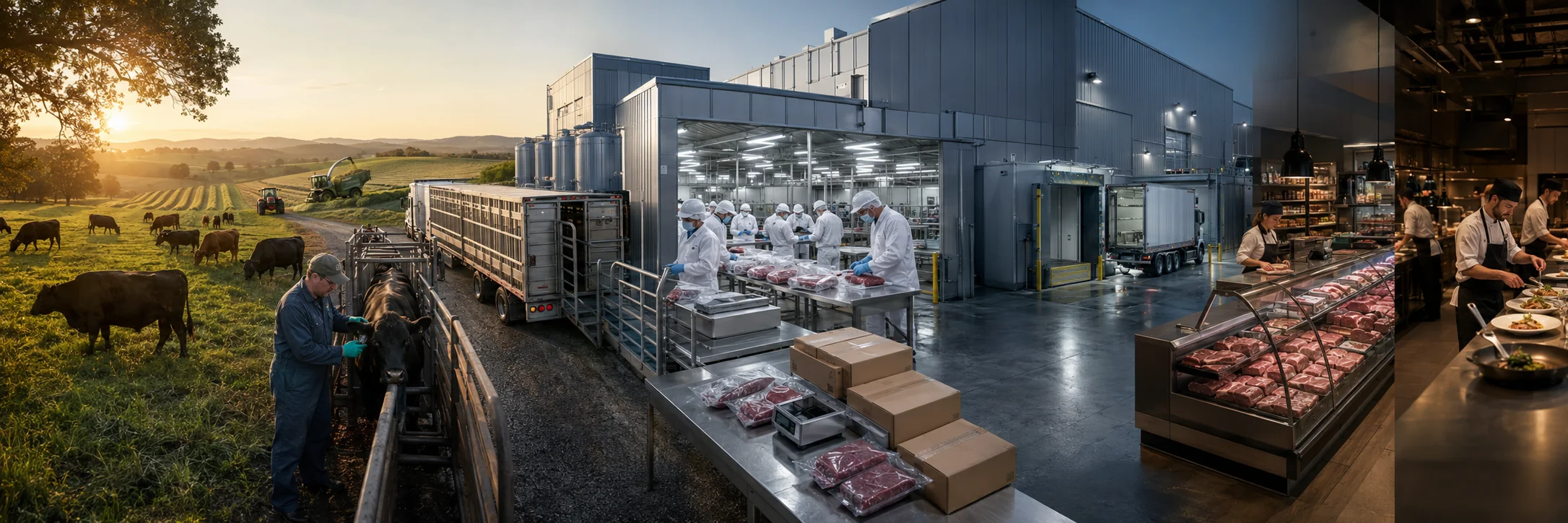
Follow nourishment through a living ruminant, then follow one animal as it becomes many foods, materials, records, and responsibilities.
Nourishment is the need, not beef tonnage
People do not biologically require cattle numbers, carcass weight, or beef sales. They require safe food and an adequate nutritional pattern, including energy, protein and essential amino acids, vitamins, and minerals. Beef can supply protein, iron, zinc, vitamin B12, energy, and sensory and culinary functions. Those are real functions. They do not make beef the only physical means of providing them. The USDA lists seafood, eggs, beans, peas, lentils, nuts, seeds, and soy products alongside meat in the protein foods group; the National Institutes of Health notes that vitamin B12 is also available from other animal foods, fortified foods, and supplements, while dietary iron occurs in both animal and plant foods.
That distinction does not make every food interchangeable. Foods differ in nutrient concentration, digestibility, preparation, availability, price, taste, culture, and the people for whom they are suitable. Beef may be an accessible or valued part of a diet without its present volume being a biological requirement. The underlying need establishes a nutritional boundary. It does not determine how often beef is served, the size of a portion, which cuts are preferred, how much marbling a buyer rewards, how much prepared food is discarded, or whether another food could perform part of the same role.
Present demand therefore contains several things at once: nourishment; preference and tradition; restaurant and retail formats; grading and appearance conventions; prices and income; institutional menus; and loss between purchase and eating. Some cattle and beef production serves a distinct food use. Some volume is enlarged by serving design, rejected appearance, poor carcass balance, over-ordering, and waste. A credible supply-chain account must keep biological need separate from the particular product volume organized around it.
The rumen turns plant structure into animal tissue
Cattle enter the industrial chain as living ruminants. They do not themselves produce the enzymes needed to break down cellulose. Microorganisms in the rumen ferment plant material into short-chain fatty acids that the animal absorbs, microbial cells that are later digested, and gases that are released. USDA Agricultural Research Service descriptions of cellulose digestion and the rumen microbial community make the physical function clear: the conversion depends on an animal-microbe system, not on the animal alone.
This system can turn grass and other fibrous feeds that people do not eat directly into animal tissue. That capacity is important, but it is not a universal description of every beef route. Some cattle spend most of their lives on forage; finishing diets can also include substantial grain and protein concentrate. Land that supports grazing varies in its other possible uses, while feed crops, silage, supplements, and agricultural co-products carry their own land, nutrient, water, processing, and transport histories. The statement that cattle can use cellulose does not establish that every feed input was otherwise unusable or that every grazing system maintains soil, water, and habitat.
Fermentation also produces methane. The US Environmental Protection Agency describes enteric fermentation as a normal digestive process and distinguishes it from emissions arising through manure management. Manure returns carbon and nutrients where animals deposit it, but location and concentration matter. Distributed pasture manure can return nutrients to the grazed land; accumulated manure requires storage, transport, application, or treatment. Nutrients can be useful in one field and excessive near another facility. The animal does not eliminate a nutrient cycle. It moves and transforms it.
The breeding herd carries several clocks
There is no single eighteen-to-twenty-four-month beef clock. Gestation, lactation, weaning, grazing, backgrounding, finishing, and the decision to retain or cull a breeding animal are different intervals. USDA's cattle sector overview says calves are commonly weaned at three to seven months and may then graze, enter a preconditioning or backgrounding program, or move toward a feedlot. Time in a feedlot can range from about ninety to three hundred days depending on placement weight and age, genetics, weather, ration, and the intended carcass.
Expanding the breeding herd creates an even longer delay. A retained heifer is removed from current slaughter supply, must grow and reproduce, and only later produces a calf that itself must grow before slaughter. USDA's analysis of livestock production cycles describes roughly two years before the retained heifer produces her first calf and about another eighteen months before that calf reaches slaughter. The additional beef does not arrive merely one gestation after a price signal.
The national cattle cycle is therefore biological and organizational. Gestation and growth impose delay, but prices, feed cost, credit, drought, pasture condition, breeding choices, disease, culling, imports, dairy cattle, and processor capacity influence its direction and duration. USDA describes historical cycles of eight to twelve years, not a metronome guaranteed to repeat. Biology limits the response; it does not choose the herd size or the commercial signal to which producers respond.
A living animal cannot wait for market
Steel can be stored without hunger. A cattle operation must provide feed, water, health care, shelter or protection appropriate to conditions, handling, and daily observation while the animal grows. When forage fails, a feed delivery is delayed, or a slaughter booking disappears, the animal's requirements continue. The feasible responses may include buying feed, moving cattle, changing gain targets, selling earlier, retaining animals longer, or reducing the herd. Each response changes later weight, cost, welfare, land pressure, and product flow.
Growth is not only an elapsed time. It is accumulated condition. Breed, nutrition, disease, heat, cold, stress, pregnancy, and management affect body composition and the time or feed needed to reach a target. A liveweight reading observes mass at that moment; it does not by itself reveal health, welfare, gut fill, future carcass composition, or the resources used to produce the gain.
Cow-calf, stocker, backgrounding, and feedlot are useful names, but they do not describe one mandatory sequence. A calf can remain with a producer after weaning, graze elsewhere, be prepared through a health and feeding program, enter a feedlot at different weights, or follow a pasture-finishing route. Cull cows, bulls, and animals originating in dairy herds enter different beef streams. The beef supply chain is not one conveyor beginning with a purpose-bred steer.
Each route places resources and decisions in a different location. Grazing depends on forage growth, land access, water, fencing, and seasonal management. Confinement can make ration control and aggregation easier while concentrating feed deliveries, manure, water demand, animal health management, and capital. Finishing targets also reflect commercial organization: a grading system and buyer specification can reward weight, age, fatness, or marbling that is not identical to the minimum physical requirement for nourishment.
A cattle inventory counts living animals with different ages, weights, reproductive roles, and destinations. Live weight includes hide, head, feet, blood, digestive contents, organs, bone, fat, and muscle. After slaughter, hot carcass weight excludes several of those streams. Chilling changes weight again. Fabrication separates bone, fat, trim, and saleable cuts. Cooking removes water and fat and may leave inedible material. A serving is another quantity again.
There is no universal conversion from one of these measurements to the next. Dressing percentage varies with animal type, condition, gut fill, and how the carcass is defined. Fabrication yield varies with fatness, bone, defects, cutting specification, and whether trim becomes ground beef or another product. Cooking yield varies with cut, method, endpoint, and holding. A report of live animals, carcass tonnes, boxed beef, retail weight, or cooked servings answers a different question. Converting them with one fixed percentage can turn a real biological and processing variation into false precision.
The animal crosses a welfare boundary before a food boundary
Transport and handling begin changing animal welfare and eventual carcass condition before slaughter. Gathering, loading, travel, unloading, lairage, weather, footing, water access, mixing, and handling can change animal condition and welfare before the carcass exists. The effects can include fatigue, injury, bruising, stress, and changes in measured live weight. Some effects later appear as trim loss or product quality; others matter even when the carcass remains commercially usable. Welfare is not merely an input to meat quality.
At a federally inspected establishment, ante-mortem inspection observes animals at rest and in motion to help determine fitness for slaughter, while humane-handling verification addresses how animals are handled and slaughtered. FSIS treats these as related but distinct duties in its ante-mortem inspection and humane handling directives. Passing ante-mortem inspection does not certify the animal's complete lifetime welfare. A welfare audit, transport record, injury observation, and food disposition each cover different boundaries.
Slaughter turns one body into many material streams
The plant first receives an animal, not a carcass. Stunning or an applicable ritual method, bleeding, hide removal, evisceration, splitting, trimming, interventions, inspection, and chilling must keep food material separate from contamination while workers and equipment coordinate with the moving body. Post-mortem inspection presents the head, viscera, and carcass for examination; it can lead to passage, retention, trimming, or condemnation under defined rules. The FSIS post-mortem directive describes those observations and dispositions.
This is also the point where identity fans out. One animal becomes two carcass sides, organs, blood, hide, fat, bones, digestive material, condemned material, wastewater, and other residues. Some streams can become food; some may enter leather, feed, rendering, energy, pharmaceutical, or industrial routes subject to their own conditions; some require treatment or disposal. The sale of the carcass does not close the animal's material account.
Every separation also creates an identity problem. If an individual animal identifier is retained only until a carcass passes inspection, later boxes may carry a lot or production identity instead. That may be adequate for a defined control, but it is a change in resolution. A buyer may know the establishment, shift, grade, or lot without knowing the animal, farm, feed history, or welfare event. Identity is not simply lost or preserved; it is repeatedly reassigned.
Inspection, testing, and grading answer different questions
Inspection supports a regulatory disposition about whether an animal, carcass, or product may enter food under the applicable system. It includes establishment controls and government verification, but the mark of inspection is not a claim that every surface is sterile or that no later contamination, temperature abuse, mislabelling, or cooking error can occur. Food safety depends on controls across slaughter, fabrication, storage, transport, retail, and preparation.
A microbiological test observes the defined sample using a method with a detection limit at a particular time. A negative result does not establish the absence of a hazard on every surface or in every unit. A positive result can trigger control, investigation, diversion, or recall, but detection is not the same event as correction. Sampling design, lot definition, product movement, and the authority to hold or recover product determine what the result can still change.
Grading is different again. USDA grading is voluntary. Quality grades describe traits associated with tenderness, juiciness, and flavour; yield grades estimate the yield of specified closely trimmed, boneless retail cuts. The agency's explanation of beef grades distinguishes that service from inspection. A quality grade is not a food-safety result, a nutrient requirement, an actual eating experience, or a complete environmental or welfare assessment. Likewise, a production claim or certification can verify compliance with a defined protocol without observing every result associated with the farm or product.
Chilling transforms meat as it preserves it
After slaughter, muscle does not become an inert commodity. Oxygen supply stops, post-mortem metabolism changes acidity, rigor develops, proteins change, moisture moves, and enzymes continue acting. Temperature affects both microbial growth and these quality processes. Chilling must remove heat rapidly enough to control growth without treating the carcass as though faster were always physically better.
Cooling muscle too rapidly before rigor can contribute to cold shortening and toughness. Controlled refrigerated ageing can later improve tenderness. A peer-reviewed study following beef from carcass chilling through primal storage describes this balance and shows that temperature, pH, water activity, packaging, and storage time interact. Refrigeration is therefore both preservation and processing. Storage can deliberately create a desired eating property while consuming time and carrying microbial risk.
Cold does not remove contamination. It slows some biological and chemical changes at rates that depend on temperature and product condition. Vacuum packaging changes oxygen exposure; freezing changes the available time and may change quality; cutting increases exposed surface; grinding distributes surface material through the batch; cooking creates another state. There is no single shelf-life clock called beef.
A carcass cannot produce only steaks
Fabrication converts a chilled carcass into primals, subprimals, steaks, roasts, trim, fat, and bone according to cutting specifications. The first cut commits geometry and future options. A muscle kept intact may become a roast or several steaks; once cut or ground, the intact option is gone. Skilled labour, knives, saws, automation, temperature, line balance, and customer orders all influence what the carcass becomes.
Demand is usually uneven across the animal. A restaurant may want rib or loin cuts, a manufacturer may want lean trim, and a retailer may want ground beef with a particular fat content. Producing more of one cut necessarily produces the rest of the carcass. Imports, exports, freezing, further processing, and price differences help balance these simultaneous outputs, but none makes the anatomy disappear. A premium steak market can support cattle production only if lower-valued cuts, trim, fat, bone, organs, and hide also have feasible routes.
This is why a tonne of beef is too broad to describe supply. A cold store can hold abundant forequarter material while a buyer lacks the specified loin. Lean cow trim can be scarce while fattier fed-cattle trim is plentiful. A carcass may meet a quality grade while a particular muscle fails a customer's size or fabrication specification. Aggregate mass does not establish the right cut, composition, condition, place, or time.
Ground beef reverses the identity flow
Slaughter and fabrication split one animal into many products. Grinding can reverse the direction by combining trim from several carcasses, lots, establishments, or countries into one production lot. This makes texture and fat content controllable and creates a route for material that would not become an intact cut. It also changes the failure geometry. Surface contamination that might remain on the outside of an intact cut can be mixed through ground product.
The USDA's ground beef guidance explains why grinding changes exposure and cooking control. The merger of material also changes traceability. To reach an upstream source from a finished lot, the processor must know which source materials entered it, which material carried over, when grinding occurred, and when equipment was cleaned.
US regulations consequently require defined raw beef grinding records, including supplier establishments, lot numbers, production dates, source material, grinding time, carryover, and sanitation time. Those records make candidate sources reachable. They do not themselves prove that a pathogen was present, that a cleaning step was effective, that every upstream identity is correct, or that all affected product was recovered. Traceability is a capability to investigate and act, not a guarantee that failure never occurred.
Processing capacity must balance the whole animal
A slaughter and fabrication plant coordinates live-animal receiving, humane handling, inspection access, skilled labour, line speed, carcass cooling, food-safety interventions, box assembly, refrigeration, water, wastewater, sanitation, maintenance, rendering or co-product collection, and outbound logistics. These systems are coupled. More cattle cannot pass through simply because one cutting station has spare time; the complete line and every required downstream route must accept the added flow.
Large plants can lower the money cost of processing each animal when high throughput spreads capital and specialized operations across more units. They also require a large and steady cattle flow to use that capacity. USDA Economic Research Service analysis of meatpacking concentration and capacity describes both scale economies and the cost of operating at or above designed capacity. A nominal slaughter capacity is not automatically staffed, maintained, scheduled, supplied with cattle, or connected to enough chilling and fabrication capacity.
Concentration is consequently important without being a biological inevitability or the unavoidable price of inspection. Plant scale, capacity utilization, acquisitions, procurement arrangements, labour markets, wastewater and refrigeration systems, cattle geography, distribution access, finance, and competition policy all help organize the present industry. Smaller plants can preserve animal identity or shorten some journeys, but may face different constraints in staffing, inspection scheduling, equipment use, market access, and full-carcass sales. The question is not whether one scale is universally correct. It is which physical and commercial functions each network can maintain.
Geography follows cattle, feed, water, labour, and cold routes
Cow-calf operations follow forage, land, water, climate, and ownership. Stocker routes follow seasonal grass and weight-gain opportunities. Feedlots require cattle, ration ingredients, water, animal care, manure management, finance, and access to slaughter. Packing plants require enough animals, workers, inspection, utilities, wastewater capacity, refrigeration, co-product routes, and transport. Retail demand follows people. No single input explains the map.
Feed matters, but saying that feedlots simply locate near corn erases silage, hay, protein supplements, grazing history, water, climate, cattle movement, and processing capacity. The physical trade-off is among moving live animals, moving bulky feed and water-dependent production, moving refrigerated products, and maintaining every stage at adequate utilization. Geography is a negotiated network of several masses and constraints, not a line drawn from cornfield to city.
Money determines which biological options remain open
A rancher may know that retaining cows would preserve future calf supply but lack affordable feed or credit through a drought. A feedlot may be able to slow or accelerate gain within biological and welfare limits but still need working money for cattle and feed. A processor may know that another shift, repair, pathogen hold, slower line, or additional chilling space would protect future output but be unable to staff or finance it at the required time. The technical option and the financially accessible option are not always the same.
Payment timing also assigns risk. The participant who owns the animal during feed-price change, illness, weather, or delayed slaughter carries costs that may not be visible in the final beef price. A plant paid for saleable boxes may still bear disposal cost for condemned material and wastewater. A retailer rewarded for case availability may order a buffer that later becomes markdown or waste. A restaurant may substitute cut, portion, or menu item if its information and authority arrive before service; after preparation, fewer options remain.
Money does not merely provide an incentive after the physics. It determines which feed, transport, health, labour, storage, testing, maintenance, recovery, and correction actions can occur before an irreversible boundary. A low cattle price can coexist with unaffordable feed. A high wholesale price can coexist with a plant unable to add a safe shift. A profitable cut can coexist with an uneconomic route for the remainder of the carcass.
The difference between a cattle price and a boxed-beef or retail price is not a margin on the same object at the same moment. The animal and the products differ in time, weight basis, grade, cut mix, processing work, yield, co-product value, inventory, contracts, and delivery. Capacity utilization and bargaining conditions can matter, but a widening spread alone does not isolate market power, labour shortage, plant outage, changing cut demand, cattle quality, export demand, or co-product prices.
Concentration can reduce the number of feasible buyers and affect bargaining. Scale can also reduce unit processing cost. Both propositions require evidence rather than inference from one price series. The useful question is which cattle, plants, products, dates, capacities, contracts, and alternatives produced the observed spread—and which participant could alter each condition. Price is evidence of a transaction boundary, not a complete explanation of the physical chain.
Hides, edible and inedible offal, blood, fat, and rendered materials can support food, leather, feed, oleochemical, pharmaceutical, fuel, and other uses. USDA ERS describes how beef and pork co-products can add revenue and avoid disposal cost. Those possible uses matter because the value and handling cost of non-carcass material affect processing economics.
Possibility is not destination. A hide is not leather until preservation, transport, tanning, grading, and a buyer actually connect. Fat is not fuel merely because a fuel route exists. Organs may be edible under one inspection and market system and unwanted under another. Condemned or specified-risk material has narrower routes. For each output, a complete account needs quantity, condition, eligibility, destination, transformation, and residual—not only a list of markets that sometimes accept it.
After fabrication, time-temperature control continues through packaging, cold rooms, vehicles, distribution centres, retail cases, restaurants, and homes. The cold chain is not a brittle baton that becomes worthless after every deviation. Risk and remaining life depend on product form, initial contamination, temperature and duration, packaging atmosphere, subsequent handling, and intended use. A deviation can be serious without every deviation producing the same result.
A temperature logger observes exposure at its sensor. It does not directly measure contamination, microbial growth in every package, package integrity, tenderness, odour, remaining shelf life, or safe preparation. A receipt scan observes arrival; a use-by label expresses a shelf-life decision under stated conditions; a visual check observes appearance. None can replace the others. Cold preserves options only while the product's actual condition remains acceptable and someone can still act on the evidence.
Cooking completes the food path
Retail delivery is not the final physical function. Beef becomes nourishment only when a suitable product reaches a person in an edible, acceptably prepared form. Thawing, cutting, cooking, holding, serving, and leftovers change temperature, water, fat, texture, microbial condition, and final yield. Cooking also distinguishes product geometries: the control appropriate to an intact cut is not automatically sufficient for ground beef whose former surfaces have been mixed through the interior.
Colour, smell, a grill setting, and elapsed cooking time observe limited conditions. USDA advises a food thermometer for ground beef because colour does not establish doneness. That control occurs far downstream from cattle breeding and plant inspection, but it can determine whether all preceding work produces safe food.
Preparation also decides material loss. Trimming, overcooking, plate waste, and discarded leftovers can enlarge the upstream product volume required for the same eaten nourishment. Redistribution of suitable food, preparation of different cuts, portion changes, freezing, and menu flexibility can preserve more food function than disposal followed by energy or nutrient recovery. Demand measured at the packer, retailer, restaurant, and mouth is not the same quantity.
Drought reveals a delayed reversal
Drought reduces forage and harvested feed. Producers may buy feed, move animals, wean earlier, sell calves, cull cows, or retain fewer heifers. Increased cattle movement and cow slaughter can raise near-term beef output even as the smaller breeding herd reduces later calf supply. When rain returns, forage can recover faster than herd structure because breeding and growth still take time. USDA's cattle overview documents how drought has accelerated herd contraction and then reduced later feeder-calf availability.
This is not a paradox once animal function and time are connected. Today's additional slaughter can be evidence of tomorrow's reduced production capacity. A slaughter count observes current flow; breeding inventory and animal condition observe different parts of the future. Feed availability, working money, and land condition decide which biological options remain reachable between them.
Feedback must cross both split and merge
A bruise observed on one carcass may need to reach a transporter or handling practice. A residue or disease finding may need animal and farm identity. A pathogen result in trim may affect boxes, ground lots, customers, and later products. A complaint at a restaurant may begin in cooking, retail handling, distribution, grinding, fabrication, slaughter, or an upstream animal source. Each investigation needs a different path through the network.
Fan-out and fan-in make that path difficult. One animal's products may reach many buyers; one ground lot may contain many sources. A recall notice, test result, supplier record, shipping scan, and customer complaint identify overlapping but non-identical populations. The correction reaches only as far as the maintained connections among them. Detection without a lot definition creates ambiguity; a lot definition without customer reach leaves product in use; recovery without root-cause feedback allows recurrence.
Responsibility therefore cannot stop at custody. A participant may not control the whole journey, but it can maintain identity, condition evidence, handoff information, escalation routes, and authority appropriate to the boundary it controls. Complete responsibility is not one company owning every stage. It is the ability of information, material resources, and authority to reach the people who can still change the animal, process, product, instruction, or next production cycle.
Beef supply begins with nourishment, passes through land, forage and feed, rumen microbes, animal growth and reproduction, welfare, transport, slaughter, chilling, fabrication, packaging, distribution, preparation, and eating. At slaughter, one living identity becomes many food and non-food streams. At grinding, several identities can become one lot. A count at any single boundary can be correct while hiding deficiency, surplus, risk, or lost function elsewhere.
A complete account connects the required food function to the actual eaten result. It also keeps animal condition, land and water effects, methane and manure, inspection dispositions, grade, process controls, test results, cold exposure, product identity, cooking evidence, co-product destinations, loss, and corrective authority separate enough to be meaningful. High carcass utilization is not proof of good welfare. A low temperature is not proof of safety. A passed carcass is not proof of palatability. A named by-product use is not proof that material reached it.
Beef can be necessary or strongly valued under current dietary, geographic, cultural, and access conditions without making the present herd size, feeding route, cut mix, waste, or processing structure inevitable. The physical question is whether safe nourishment and other intended functions were delivered. The organizational question is whether the living system, food system, and every material output remained connected to evidence and decisions capable of improving the next outcome.
Inside CompanyGraph
Map where nutrient purpose, cattle identity, feed and land conditions, welfare observations, slaughter dispositions, carcass yields, cut demand, ground-beef lots, cold exposure, cooking controls, co-product routes, and corrective authority become separated—and who can reconnect them before animal options close, food is lost, or a failure spreads—inside CompanyGraph.