 CompanyGraph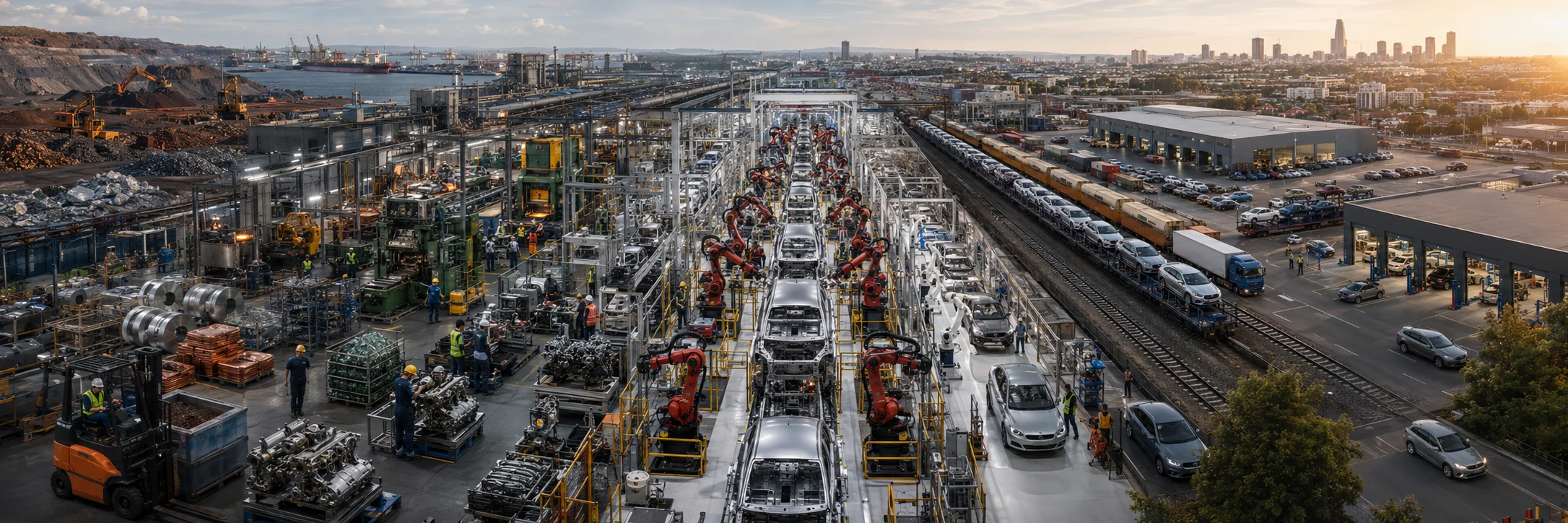
Follow a road vehicle from the mobility service it must provide through architecture, materials, tooling, qualified parts, body and paint, sequenced assembly, use, software, repair, dismantling, and recovery—and see why a finished vehicle is a maintained configuration rather than a count of parts.
An ambulance must bring people and equipment to a patient, then move that patient while preserving access for care. A delivery van must carry a changing payload through streets and loading spaces. A family car may connect a home to work, school, food, and other people where those destinations cannot be reached reliably by another mode. The need is mobility and access for particular people or goods. It is not vehicle production in the abstract.
A road vehicle performs that service by moving both its payload and itself. It must generate and control force at small contact patches between tyres and road, support static and dynamic loads, steer, brake, manage heat, preserve visibility, protect occupants, reduce danger to people outside, withstand weather and vibration, and remain usable as components wear. Fuel, a charged battery, or hydrogen is not mobility until a compatible vehicle, road, operator, energy network, and destination are connected.
That distinction leaves present automotive demand open to examination. Population, disability, emergency response, freight, remote settlement, existing roads, and unavailable alternatives can make particular vehicles necessary under current conditions. They do not determine the exact number, mass, power, occupancy, replacement rate, or ownership pattern of today's fleet. Distance between destinations, public transport, walking and cycling access, freight consolidation, vehicle size, shared use, repairability, service life, finance, parking, and road design all change how many vehicles and how much material are required to provide access.
Mobility begins outside the factory
A technically capable vehicle may still fail to provide access. The user must reach it, enter it, afford it, operate it or find an operator, travel on a suitable route, replenish its energy, stop at the destination, and continue the complete trip. A wheelchair user can encounter an inaccessible doorway after an otherwise successful journey. A truck can reach a city but lack a legal unloading place. An electric vehicle can hold sufficient energy yet be unable to use an incompatible or unavailable charger.
The transport system can change demand before vehicle design begins. A connected street network can shorten routes. Proximity can remove trips. Reliable public transport can combine many passengers in one vehicle. Walking, rolling, cycling, and micromobility can serve trips that do not require a car. The US Department of Transportation describes a complete trip as reaching the destination across all modes, transfers, and connections. A vehicle is one possible interval in that service.
This does not imply that every trip has an immediate substitute. Tradespeople carry tools; rural journeys cover sparse networks; emergency and accessible transport require specific vehicles; heavy or time-sensitive goods need controlled movement. It means the physical requirement should be named before present sales volume is treated as necessity. The same access may be created by another mode, a different land-use pattern, higher occupancy, a smaller vehicle, a longer-lived vehicle, or fewer empty movements.
At the tyre contact patches, longitudinal force accelerates or brakes the vehicle and lateral force changes direction. Available grip changes with tyre construction, tread, inflation, temperature, load, road surface, water, snow, and contamination. Suspension keeps the tyres in useful contact while allowing the body and occupants to survive road irregularities. Steering geometry, brakes, stability control, sensors, and software coordinate around that changing boundary.
Energy at the wheels overcomes rolling resistance, aerodynamic drag, gradients, driveline friction, and changes in speed. Mass matters most during acceleration, climbing, and load support; frontal area, shape, and speed influence aerodynamic demand; tyres deform and dissipate energy as they roll. Braking turns motion into heat, while regenerative braking can return part of it to an electrical store within the limits of traction, motor, power electronics, battery acceptance, and state of charge. The Department of Energy's work on vehicle energy losses separates drag, rolling resistance, friction, braking, thermal loads, and auxiliary demand because each responds to a different intervention.
Mass carries conflicting consequences. More structure can support payload, stiffness, comfort, energy storage, and protection in defined crashes. It also requires more material, increases tyre and road loading, and adds energy demand in many driving conditions. A lighter component may require a different geometry, alloy, joining process, coating, repair method, or cost. The relevant question is not whether mass is good or bad, but which complete design provides the required service and safety with the least avoidable material and energy demand.
Architecture turns components into one load path
A vehicle architecture locates occupants and cargo; defines wheelbase, track, ride height, suspension points, crash structures, steering, braking, energy storage, propulsion, thermal loops, electrical power, communications, and software control; and allocates space for assembly and repair. The body may be unitized, with body and main structure sharing loads; mounted on a separate frame; or specialized for a commercial duty. Whatever the form, loads must travel through joints and structures rather than through a list of materials.
Safety is similarly distributed. Tyres, brakes, lighting, visibility, controls, restraints, occupant compartment, crumple structures, fuel or high-voltage integrity, sensing, and software act before, during, and after a crash. NHTSA's vehicle research and testing separates crash avoidance, crashworthiness, biomechanics, defects analysis, structural integrity, and intelligent systems. A strong body cannot compensate for every loss of tyre grip, sensing, restraint timing, or road safety, and a driver-assistance feature does not remove the need for crash protection.
Interfaces create both specialization and dependency. A brake supplier can design a caliper, but its delivered behaviour depends on rotor, tyre, wheel, hydraulic or electronic command, axle load, cooling, stability control, and vehicle tuning. A seat is also a restraint anchor, packaging volume, electrical load, occupant-detection input, interior surface, and assembly variant. Companies divide the work because materials, electronics, casting, forging, tyres, glass, cells, software, and complete subsystems require different capabilities—not because it is physically impossible for one organization to own more of them.
Powertrain choice reorganizes the adjacent vehicle
An internal-combustion vehicle stores liquid fuel, meters air and fuel into an engine, converts pressure into shaft work, treats exhaust, rejects heat, and usually transmits torque through multiple ratios. A battery-electric vehicle stores electrochemical energy in cells assembled into modules or packs, manages high voltage and temperature, converts direct current through power electronics, and produces torque in one or more motors. A hybrid combines elements of both and coordinates their operating states.
These are not interchangeable propulsion boxes placed into an otherwise unchanged car. Fuel tank or battery location affects structure and crash protection. Powertrain mass changes suspension and tyre loads. Cooling loops, cabin heating, braking strategy, fire response, electrical architecture, software, manufacturing equipment, service tools, and supplier capabilities change. A vehicle platform may accommodate more than one powertrain, but each validated variant is still a particular arrangement.
The underlying need for motion does not prescribe one present architecture. Duty cycle, payload, route, climate, charging or fuelling access, energy source, noise, local emissions, range, downtime, maintenance, and infrastructure determine suitability. Once a factory, service network, and fleet are organized around an architecture, substitution becomes slower than the conceptual possibility. A different motor or energy store must cross packaging, performance, safety, manufacturing, certification, and service boundaries before it becomes available mobility.
Materials arrive with process histories
Vehicles combine steels, aluminium, cast irons, copper, glass, rubber, polymers, foams, textiles, coatings, adhesives, lubricants, electronic materials, and sometimes magnesium, composites, rare-earth magnets, or large traction batteries. Material names do not specify the delivered state. Sheet formability, alloy and temper, heat treatment, grain direction, cleanliness, coating, adhesive cure, moulding conditions, solder process, and software calibration all affect what the part can do.
Material changes move constraints across the system. High-strength steel can reduce gauge in some structures while increasing springback and tooling demands. Aluminium can reduce mass but changes joining, corrosion isolation, forming, and repair. A polymer can integrate shapes and reduce part count while adding ageing, attachment, coating, and recovery questions. Mixed materials can improve crash and use performance while making dismantling and alloy separation harder.
Composition information supports chemical compliance and recovery planning. The automotive International Material Data System records declared material and substance information for parts. That record does not observe porosity in a casting, incomplete adhesive cure, a substituted fastener, corrosion after service, or whether the material will be separated at retirement. Composition is one necessary identity, not the whole condition.
A platform can share hard points, structural concepts, powertrain families, electrical architecture, software foundations, manufacturing processes, and components across models. This spreads development and tooling over more volume and lets plants build related variants. It can also propagate a design decision, capacity constraint, software dependency, or defect across vehicles that look different in the showroom.
Common architecture does not make every part interchangeable. Wheelbase, body style, crash requirement, battery size, trim, market regulation, and supplier change create variant-specific parts and calibrations. Even geometrically similar parts may carry different material, software, tolerance, or approval. A part number is an organizational boundary around those distinctions; visual similarity is not a substitution rule.
Architecture narrows future options long before sale. Package space, voltage, network protocols, cooling capacity, structural hard points, assembly sequence, and service access constrain later upgrades. Modularity can preserve selected interfaces, but only where those interfaces were deliberately defined and maintained. “Flexible platform” is therefore a claim about a stated range of configurations, not unlimited adaptability.
Body panels need stamping dies or other forming tools. Castings and moulded parts need dies or moulds. Assemblies need locating fixtures, gauges, welding tools, grippers, test equipment, and software. Tool surfaces and locating points turn a drawing into repeatable geometry. Their cost, lead time, capacity, maintenance, and ownership affect which plant or supplier can make the part.
Tooling commitment is substantial but not universally permanent or single-model. A die is highly specific to a shape, while presses, robots, paint systems, conveyors, machining centres, and some fixtures can serve several parts or platforms. Inserts, end effectors, programs, and flexible locating systems can be changed. Tools may be modified, moved, stored for service production, repurposed, or scrapped. The physically relevant question is which geometry and process the existing equipment can produce within tolerance, at rate, with acceptable changeover and evidence.
Money determines whether that option is reachable. Suppliers may finance tools against forecast volume; contracts may assign tool ownership without making physical access simple; an engineering change can strand finished inventory and work in progress; a low-volume service part can become uneconomic long before every vehicle using it retires. Tooling invoices establish payment and ownership claims. They do not establish maintained condition, available operators, machine capacity, or the ability to reproduce a qualified part years later.
Qualification attaches a process to a part
A production part is approved against more than a drawing. Material records, dimensional results, process flow, risk analysis, control plan, measurement capability, sample parts, appearance, performance tests, and a production trial may be required. The automotive Production Part Approval Process, or PPAP, is intended to show that the supplier understands the requirements and that a defined production process can make conforming output at the intended rate.
Approval does not make capacity interchangeable. The evidence belongs to a part revision, material, tool, process, site, and agreed conditions. Moving a tool, changing resin, transferring production, replacing a chip, modifying software, or altering a sub-supplier can require assessment and renewed evidence. An idle machine somewhere else is not a qualified source until the relevant material, tooling, people, process controls, rate, and validation exist together.
Nor does approval prove every future unit. A dimensional report observes measured features on sampled parts. A capability study describes variation under defined conditions. An end-of-line test checks selected functions at one moment. Statistical process control can detect movement in measured variables without observing an unmeasured defect. The control matters precisely because production continues after approval and machines, tools, materials, settings, and people keep changing.
Body and paint create the durable shell
Coils or blanks are cut and formed into panels and structural pieces. Springback, thinning, wrinkling, cracks, lubricant, tool wear, blank position, and incoming material variation affect the stamped geometry. In the body shop, parts are located and joined by spot welds, laser welds, rivets, screws, brazing, adhesives, or combinations suited to the materials and loads. Each subassembly contributes variation to the body-in-white, the joined unpainted structure.
Measurement can find that a point lies within tolerance without establishing every joint's strength or the complete crash response. A weld monitor observes electrical or process variables, not necessarily the final nugget under every surface condition. A coordinate measurement observes selected geometry, not corrosion protection inside a closed section. Quality is built through design, material, locating, joining, maintenance, and feedback; final measurement samples the result.
The paint shop is both a surface factory and a chemical process plant. Cleaning and pretreatment prepare mixed surfaces; electrodeposition reaches cavities; sealers, primers, colour, and clear layers protect, cover, and create appearance; ovens cure material while body geometry must remain controlled. The EPA's automotive coating standards address volatile organic compound emissions because coating, mixing, cleaning, handling, and curing have outputs beyond the finished body. A paint-thickness reading does not establish adhesion, cavity coverage, wastewater condition, air emissions, or years of corrosion resistance.
Final assembly joins several clocks
A painted body receives wiring, glazing, insulation, cockpit, heating and cooling equipment, seats, closures, interior trim, suspension, brakes, wheels, powertrain, battery or fuel system, fluids, software, and calibrations. Some modules are installed early and become physically inaccessible later. Others are deliberately left serviceable. Assembly sequence is therefore a design constraint: the next operation must be possible without damaging what is already present.
Mixed-model lines can build several variants in a chosen order. A seat, cockpit, instrument panel, wiring harness, wheel, or powertrain may need to arrive in the same sequence as bodies. These “just-in-sequence” parts combine large physical volume with many variants and little useful interchangeability at the station. Smaller common fasteners or long-lead electronics can be managed very differently.
A production schedule tells suppliers what the plant intends to build. A shipment notice reports dispatched containers. A scan records an identifier at a checkpoint. A station record may associate a torque, software version, or test result with a vehicle. None creates the missing physical part or proves that the right item was installed without damage. The assembly system works when material identity and timing remain connected to the body's configuration.
Just-in-time is a control method, not a law of automobiles
The Toyota Production System developed just-in-time as an organized way for later processes to take what they need from earlier processes, using cards or digital replenishment signals often called kanban. Toyota's own history of just-in-time describes trial, suspension, and later realization. That history matters: just-in-time is a production-control choice shaped by conditions, not a physical property of a car.
Inventory has real costs. It consumes space and working capital, risks damage and obsolescence, and complicates variant selection. Large buffers can allow more units to be produced before a defect is detected and corrected. Buffers also preserve response time when transport, equipment, quality, or demand varies. The relevant choice is where to hold which material, in what quantity, with what replenishment time and failure consequence. “Lean” does not establish zero stock, and more stock does not correct a sole tool, long requalification, unknown lower-tier dependency, or unusable part.
Takt time is likewise a designed operating interval calculated as available production time divided by required output during that period. A line can change rate within equipment, labour, supplier, quality, and market constraints. It cannot pause without consequence once bodies and sequenced parts are moving, but that consequence was shaped by layout, buffers, staffing, repair capacity, and commercial decisions. The moving line makes coordination visible; it does not make one universal delivery window inevitable.
Production geography follows different kinds of proximity
Large, highly configured, sequence-sensitive modules often benefit from late assembly near the vehicle plant. The supplier can receive the body order, build the exact variant, and deliver it with limited transport uncertainty. Stamping and body operations may be integrated on the same site because panels are bulky, geometrically vulnerable, and consumed at high rate. A nearby supplier park is a physical response to some flows, not the geography of every part.
Other components travel globally because their process needs scale, rare capability, specialized tooling, clean manufacturing, mineral inputs, or a customer base larger than one assembly plant. Semiconductors, sensors, electronic modules, connectors, bearings, catalysts, cells, tyres, and material feedstocks can have upstream stages far from final assembly. Trade rules, energy, skills, infrastructure, tax, finance, intellectual property, and existing clusters influence that map alongside transport time.
Distance alone does not define resilience. A distant qualified source with stable transport, visible capacity, held inventory, and an alternate route may be less fragile than a nearby sole tool in a floodplain. Dual sourcing may require duplicate tooling, compatible design, continuing volume, and repeated approval; dividing low volume can make both sources less stable. The useful map connects each part's replenishment time, qualification, tool, capacity, inventory, geography, and consequence of absence.
A complete vehicle can wait for one incomplete interface
A missing decorative option and a missing brake controller do not have the same functional consequence, yet either can block the planned configuration. The plant may substitute an approved variant, re-sequence bodies, build incomplete vehicles for later finishing, slow the line, use inventory, or stop. Each response needs space, software, people, parts, safe procedures, and authority. Parking unfinished vehicles moves the constraint from the line to storage and later rework.
An alternative supplier must reproduce more than shape. Material, performance, embedded software, process variation, regulatory evidence, logistics containers, assembly behaviour, service information, and surrounding interfaces may need confirmation. Expedite money can purchase priority transport or overtime. It cannot instantly create semiconductor production capacity, a casting die, a trained line, a validation result, or production history. A shortage is therefore often a shortage of qualified configuration and conversion time, not raw component count alone.
Long upstream flows can remain invisible behind short local deliveries. NIST's analysis of manufacturing flow time traces automotive paths from raw material across many industries and shows why a plant receiving daily trucks can still depend on months of prior transformation. Local inventory measures the final interval; it does not reveal the time needed to rebuild the chain.
A vehicle identification number, or VIN, anchors make, model, model year, plant, sequence, and manufacturer-held build information. Connected records can associate the vehicle with installed part families, software, service campaigns, ownership registration, or recall status. That identity is valuable because many externally similar vehicles contain different components or revisions.
The VIN does not directly observe the vehicle now. Tyres, glass, airbags, control modules, battery, engine, software, body panels, and other parts may have been replaced. Collision repair may have changed geometry and coatings. Corrosion, overheating, flood exposure, loading, maintenance, and modification alter condition without changing the VIN. A build record is evidence of origin; an inspection, diagnostic, or measurement is needed for present claims.
Other records have similarly narrow boundaries. A part number identifies an approved definition, not the condition of the item in hand. A torque record reports a tool result under its calibration and association. An end-of-line test observes selected functions before shipment. An onboard diagnostic code records that defined conditions triggered a monitor; it is not automatically the failed component or root cause. A service invoice records work billed, not every operation performed or the remaining life of the vehicle.
Modern vehicles contain interacting control units for propulsion, braking, steering assistance, restraints, body functions, charging, thermal management, diagnostics, communications, and driver assistance. Software versions and calibrations must match hardware, market, vehicle options, and each other. A physical replacement can remain unusable until coded, paired, calibrated, or authorized within the vehicle.
An over-the-air update moves software without moving the vehicle to a workshop, but it still requires correct targeting, sufficient energy, communications, installation state, verification, rollback or recovery provisions, and a vehicle capable of receiving it. UN Regulation No. 156 addresses software-update management systems and the relation between update records and vehicle type. An update package establishes intended code. Successful download does not establish successful installation, compatibility, or safe behaviour in every operating condition.
Software can correct behaviour, add functions, change energy management, or support a recall without replacing material. It can also outlive a supplier contract, depend on unavailable servers or cryptographic keys, and make a physically repairable component inaccessible. Long vehicle life therefore requires more than durable hardware. Diagnostic information, tools, authorization, software support, cybersecurity, replacement parts, and skills must remain reachable.
Use creates the vehicle’s service history
Every trip adds load cycles, heat cycles, vibration, contamination, corrosion exposure, tyre wear, brake wear, seal movement, battery cycles, and software observations. Payload, towing, road roughness, speed, climate, charging pattern, fuel quality, salt, water, and driving change the rate and location of damage. Two vehicles with the same build date and odometer can have different remaining conditions.
Maintenance preserves interfaces: tyre pressure keeps the contact patch within an intended range; alignment controls tyre loading and stability; fluids lubricate, cool, transmit force, and carry contamination; filters protect systems; software and calibrations coordinate replacements. Fixed intervals are controls based on assumed use. Condition monitoring can add evidence, but a sensor observes its measurement point and failure modes. Neither schedule nor sensor removes the need for inspection and diagnosis.
Repair is another production system with more variable inputs than the original factory. The technician receives a used, partially observed configuration and must diagnose, disassemble without causing new damage, obtain a compatible part, restore geometry or function, calibrate affected systems, and verify the result. Access to lifting, high-voltage safety, structural repair data, scan tools, calibration targets, software, parts, and training determines which repair is physically and commercially possible.
A complaint, investigation, recall, and repair are separate events
A defect can first appear as a warning light, noise, leak, loss of function, crash, fire, warranty claim, technician report, supplier test, or pattern in field data. Each observation has selection and delay. Owners may not report; dealers may use different codes; the same symptom can have several causes. Aggregating complaints creates a signal without proving common cause.
NHTSA's recall process separates complaints, investigation, recall decision, owner notification, remedy, and completion tracking. A safety recall identifies a defined population and required action. It does not mean every included vehicle has already failed, nor does mailing a notice repair one. Parts, trained capacity, owner contact, vehicle access, and completion evidence must connect before the risk is changed.
Corrective scope depends on traceability. Investigators may need component serial, supplier site, material batch, process date, software version, tool cavity, vehicle build sequence, service history, environment, and comparable vehicles. Too broad a population consumes scarce remedy capacity; too narrow a population leaves relevant vehicles outside. Identity is useful when it reaches both the affected configuration and the organization able to change it.
Economic retirement can precede physical exhaustion
A collision can deform load paths, trigger restraints, damage sensors, crack castings, expose a high-voltage battery, or disturb coatings and joints. Repair must restore more than appearance. Measurement, sectioning, joining, corrosion protection, component replacement, software coding, wheel alignment, sensor calibration, and post-repair checks may all be required. A visually straight vehicle can contain an unsafe structure or calibration; a visibly damaged vehicle may still contain many sound components.
An insurer may declare a vehicle a total loss when expected repair, uncertainty, administration, and salvage economics exceed an agreed value. That is a commercial threshold, not a direct material diagnosis of irreparability. A vehicle can be physically repairable but lack affordable parts, information, skill, time, finance, or legal eligibility. Conversely, spending heavily does not make every repair technically sound.
Repair access changes service life and demand for new vehicles and parts. In the United States, EPA rules require manufacturers to provide emissions-related diagnostic and service information, tools, and reprogramming access; its current repair guidance makes that informational boundary explicit. Other safety, body, battery, proprietary, and market-specific information can follow different rules. Publishing information is necessary in some repairs and still insufficient without a compatible part, equipment, authorization, and competent technician.
Dismantling decides whether function becomes material
A safe used vehicle preserves the complete mobility system. A reused part can preserve geometry, material, manufacturing, and function when its identity and condition can be established. Remanufacturing disassembles, cleans, measures, replaces or restores elements, reassembles, and tests a component to a defined condition; NIST distinguishes remanufacturing from repair and recycling. Shredding intentionally destroys component geometry to expose material streams. These outcomes preserve different amounts of completed work.
End-of-life treatment begins by identifying the vehicle, removing fluids and hazardous or energetic components, and selecting parts for reuse or remanufacture. Batteries, fuel, refrigerant, airbags, tyres, catalytic converters, electronics, glass, and valuable components need routes suited to their state. A traction battery requires chemistry and state-of-health information; a deployed airbag is not equivalent to an unused one; a catalyst contains valuable metals but is also a functioning emissions component if still suitable for reuse.
After depollution and dismantling, shredding and separation can recover ferrous and non-ferrous metals while leaving mixed plastics, foams, glass, rubber, dirt, copper, electronics, coatings, and fine material. High recovered mass can coexist with lost alloy identity, downcycled polymers, destroyed electronics, or unrecovered critical materials. The European Commission's end-of-life vehicle assessment notes that high material-recycling rates can still yield low-quality scrap metal and limited plastics recycling.
Export is another movement, not proof of continued safe mobility. A used vehicle may provide valuable service elsewhere, require repair, transfer emissions and safety burdens, become a source of spare parts, or leave regulated treatment. An export record can establish declared movement or destination; roadworthiness, actual use, maintenance, and final treatment require additional observations.
The return path starts with service and design
Long life depends on durable structures, protected surfaces, replaceable wear parts, diagnostic access, software support, repairable joints, service parts, skills, and an owner able to finance maintenance. Recovery depends on identification, safe disassembly, known materials, accessible high-value components, compatible markets, and treatment capacity. A design optimized only for rapid assembly can make both service and dismantling expensive. A design optimized only for material purity can fail performance or safety.
Feedback must cross the same interfaces as failure. A cracked casting discovered in repair needs to reach design, material, process, and other vehicles sharing its history. A software fault needs hardware and version context. Repeated tyre wear may begin in alignment, suspension, load, maintenance, road, or driving. A recycled-material certificate cannot explain a brake failure, and a recall-completion code cannot establish the quality of an unrelated collision repair.
A complete account of the automotive system therefore connects mobility need, road and energy infrastructure, architecture, process history, qualified configuration, working money, use condition, repair access, field evidence, and the next route for every vehicle and component. It does not treat high-rate, low-inventory assembly as proof of resilient supply, a shipped vehicle as proof of access, or recycled mass as proof that useful function returned.
Vehicles can be necessary under current conditions without making the present fleet size, mass, turnover, or supply-chain organization inevitable. The physical test is whether people and goods receive safe, reliable access. The industrial test is whether the configuration can be built, maintained, corrected, and recovered without losing the information and authority needed at the next boundary.
Inside CompanyGraph
Map where mobility requirements, platform interfaces, tool ownership, part qualification, production sequence, software version, repair access, field failures, vehicle identity, and recovery routes become separated—and which organizations can reconnect them before a line stops, a defect spreads, or completed function is destroyed—inside CompanyGraph.