 CompanyGraph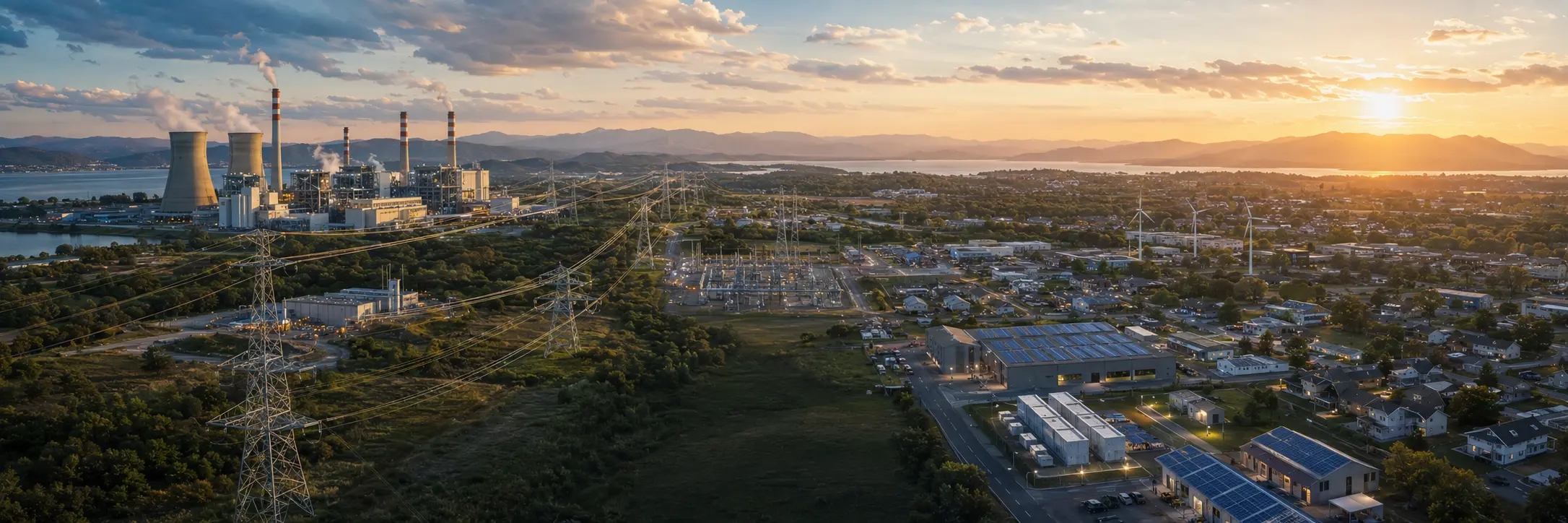
How energy is structured — centralized or distributed — determines who controls it, who depends on it, and how it fails.
The Structural Question
Where is energy produced relative to where it is consumed? This spatial relationship — the distance between generation and consumption — is one of the most consequential structural properties of an energy system. It determines the infrastructure required for delivery, the vulnerability to transmission failures, the distribution of control over energy supply, and the degree to which consumers depend on distant systems they cannot observe or influence.
The centralized model that dominates most industrialized countries' electricity systems was not selected because it is the optimal way to organize energy production. It was selected because the dominant generation technologies of the twentieth century — coal-fired steam plants, nuclear reactors, large hydroelectric dams — achieve their best economics at large scale. Building one large plant and transmitting its output was more financially efficient than building many small plants, given the technology available. The grid architecture, regulatory framework, market structure, and institutional knowledge that developed around centralized generation then reinforced the model, making alternatives not only technically different but institutionally unfamiliar.
The Centralized Model
In a centralized energy system, large generating stations produce electricity that is stepped up to high voltage, transmitted across long distances through transmission networks, stepped down through substations, and distributed to consumers through local distribution networks. Power flows in one direction: from large producers outward to many consumers.
This model has genuine structural advantages. Large plants can achieve thermal efficiencies that small plants cannot. Centralized management allows coordinated dispatch — matching generation to demand across a wide area, using the diversity of loads across geography to smooth demand peaks. High-voltage transmission loses less energy per kilometer than low-voltage distribution, making long-distance delivery feasible. These are physical properties, not merely economic preferences.
But the centralized model also has structural properties that are less often discussed. It concentrates control of energy supply in a small number of entities — whoever owns and operates the generating plants controls the energy that flows to consumers. It creates dependency — consumers cannot produce their own energy and rely entirely on the grid's continuous operation. It creates single points of failure — a large plant going offline removes a large block of generation, requiring reserves or load shedding. And it requires transmission infrastructure that is expensive to build, difficult to permit, and vulnerable to weather, physical attack, and aging.
The Decentralized Model
In a decentralized energy system, generation is distributed across many locations, typically closer to the point of consumption. Rooftop solar panels produce electricity where it is used. Community wind installations serve local loads. Microgrids combine local generation and storage to operate independently or in connection with the broader grid. Energy flows in multiple directions, and the boundary between producer and consumer blurs.
Decentralized generation reduces transmission requirements. Energy produced on a rooftop and consumed in the same building does not traverse the grid at all, avoiding transmission and distribution losses that typically consume 5-10% of generated electricity. Local generation also reduces dependency on distant infrastructure — a building with solar panels and battery storage can maintain some function during a grid outage, while a building dependent entirely on the grid cannot.
But decentralization introduces its own structural challenges. Many small producers require coordination that many large producers do not. The grid must manage bidirectional power flows — energy flowing from distributed sources back into the grid, sometimes at times when the grid does not need additional supply. Voltage management becomes more complex when generation is distributed across the distribution network rather than concentrated at a few injection points. Billing and metering systems designed for one-way power flow must be adapted for two-way transactions.
The coordination challenge is not trivial. A centralized system with twenty large power plants requires coordination among twenty entities. A decentralized system with two million rooftop solar installations requires coordination mechanisms that work at an entirely different scale — automated, distributed, and capable of managing millions of small, variable, and somewhat unpredictable generation sources.
Control and Dependency
The spatial structure of energy production determines the distribution of control over energy supply, and this distribution has consequences that extend beyond engineering.
In a centralized system, control over energy supply is concentrated. The entity that operates the generating plant decides when it runs, at what capacity, and under what conditions. The entity that operates the transmission network decides which generators are dispatched and how power flows. Consumers receive energy from a system they do not control and often cannot observe. The relationship is one of dependency: the consumer depends on the continuous functioning of distant infrastructure operated by entities whose decisions the consumer cannot influence.
In a decentralized system, control is distributed. A building owner with solar panels and battery storage controls a portion of their own energy supply. A community with a microgrid can continue to function when the broader grid fails. The relationship shifts from pure dependency to partial autonomy — not complete independence (the grid still provides backup and balancing), but a structural reduction in the degree to which energy supply depends on distant, centrally controlled infrastructure.
This distribution of control has implications for energy security, pricing power, and community autonomy. Centralized systems create pricing power for generators and grid operators — consumers cannot easily substitute their own supply and must accept the terms offered. Decentralized systems reduce this pricing power by providing alternatives to grid-supplied energy. The structural tension between centralized control and distributed alternatives shapes regulatory conflicts over net metering, grid access charges, and distributed generation policy worldwide.
Grid Architecture and Path Dependency
The physical grid — the network of transmission lines, substations, transformers, and distribution wires — was designed for one-way power flow from large centralized plants to distributed consumers. This architecture is a physical fact, not easily changed. Transformers, protection systems, and voltage regulation equipment are designed for power flowing in one direction. Accommodating distributed generation that pushes power back into the grid requires upgrading or replacing equipment that was designed for a different purpose.
This is path dependency in its most concrete form. Decades of infrastructure investment built a grid optimized for centralized generation. Transitioning to a grid that supports distributed generation requires not just new generation technology but new grid technology — smart inverters, bidirectional transformers, advanced metering, distribution-level automation, and communication systems that can coordinate millions of small generators. The cost of this transition is not the cost of solar panels or wind turbines — it is the cost of rebuilding the delivery infrastructure that connects them to consumers.
Path dependency also operates at the institutional level. Regulatory frameworks, market structures, and utility business models were built around centralized generation. Utilities earn returns on capital invested in large infrastructure — plants and transmission lines. Distributed generation, which reduces the need for both, threatens this business model. The institutional resistance to decentralization is not irrational — it reflects the real economic interests of entities whose infrastructure investments and revenue models depend on the centralized architecture continuing to function as designed.
Geothermal and the Decentralization Possibility
Most discussions of energy decentralization focus on solar and wind — technologies that are inherently distributed (sunlight and wind are available everywhere, though unevenly). But enhanced geothermal systems (EGS) present a different and potentially more consequential decentralization possibility.
Conventional geothermal is geographically constrained to areas with accessible geological heat — tectonic boundaries, volcanic regions, areas with thin crust. Enhanced geothermal systems attempt to create geothermal reservoirs in locations where natural conditions do not support conventional geothermal by drilling deep enough to reach hot rock anywhere, then creating fracture networks to circulate fluid through the hot rock and extract heat.
If EGS becomes technically and economically viable at scale, it could enable something that no other energy technology offers: distributed baseload generation. Unlike solar and wind, which are variable and require storage for continuous supply, geothermal produces energy continuously, 24 hours a day, regardless of weather or season. Unlike nuclear and large fossil plants, which require large-scale centralized facilities, EGS could potentially be deployed at community scale — a small plant serving a town, a district, or a large building complex.
This combination of properties — continuous output, no fuel requirement, potentially deployable anywhere — would fundamentally change the structural argument for centralization. If baseload energy can be produced locally, the primary rationale for long-distance transmission and centralized generation weakens substantially. This is a possibility, not a prediction. The technical and economic viability of widespread EGS has not been demonstrated at scale. But the structural implications, if it succeeds, are worth noting because they would alter the physical basis for the centralized model.
Where This Appears Across Energy Systems
Nuclear: The most centralized energy technology currently in use. Each plant is a large, fixed installation producing gigawatts of capacity for decades. The entire supply chain — uranium mining, enrichment, fuel fabrication, waste management — is centralized and requires specialized infrastructure. Small modular reactors represent an attempt to reduce the scale but not fundamentally change the centralized character.
Coal and gas: Predominantly centralized, with large plants serving wide areas through the grid. Natural gas has some decentralization potential through small-scale combined heat and power systems, but the fuel supply chain remains centralized through pipeline networks.
Solar: The most readily decentralized electricity generation technology. Panels can be installed on any sun-exposed surface. Deployment ranges from single panels on a rural home to gigawatt-scale utility installations. This flexibility across scales is a unique structural property that no other major energy technology shares to the same degree.
Wind: Partially decentralized. Community-scale wind is feasible but less flexible than solar — wind turbines have minimum scale requirements, siting constraints, and noise considerations that limit deployment in dense areas. Offshore wind is large-scale and centralized by nature.
Hydroelectric: Predominantly centralized. Large dams are among the most centralized energy infrastructure ever built — single installations serving entire regions. Small-run-of-river hydro offers some decentralization potential but is geographically constrained.
Geothermal: Currently centralized due to geographic constraints. Enhanced geothermal could shift this toward decentralization if the technology proves viable across diverse geological conditions.
Diagnostic Boundaries
The centralization-decentralization spectrum describes a structural property of energy systems, not an argument for either end of the spectrum. Centralized systems are not inherently inefficient, and decentralized systems are not inherently resilient. Each configuration has specific structural advantages and limitations that depend on the technology, geography, regulatory environment, and existing infrastructure.
This concept cannot predict which architecture will prevail. It describes the structural properties of each configuration, the forces that favor centralization (economies of scale, existing infrastructure, institutional momentum) and the forces that favor decentralization (distributed generation technology, resilience benefits, reduced transmission needs, consumer autonomy). Which forces dominate depends on circumstances that vary by location, technology, and institutional context.
The most important structural observation is that the current centralized model is not a discovery of the optimal energy architecture. It is the result of specific technologies (steam turbines, nuclear reactors) that work best at large scale, combined with decades of infrastructure investment and institutional development that reinforced that architecture. The centralized model is path-dependent — it reflects the history of how energy systems were built, not a universal principle about how energy systems should be built. Recognizing this distinction is necessary for understanding the structural landscape of energy systems without confusing historical outcomes with inherent properties.