 CompanyGraph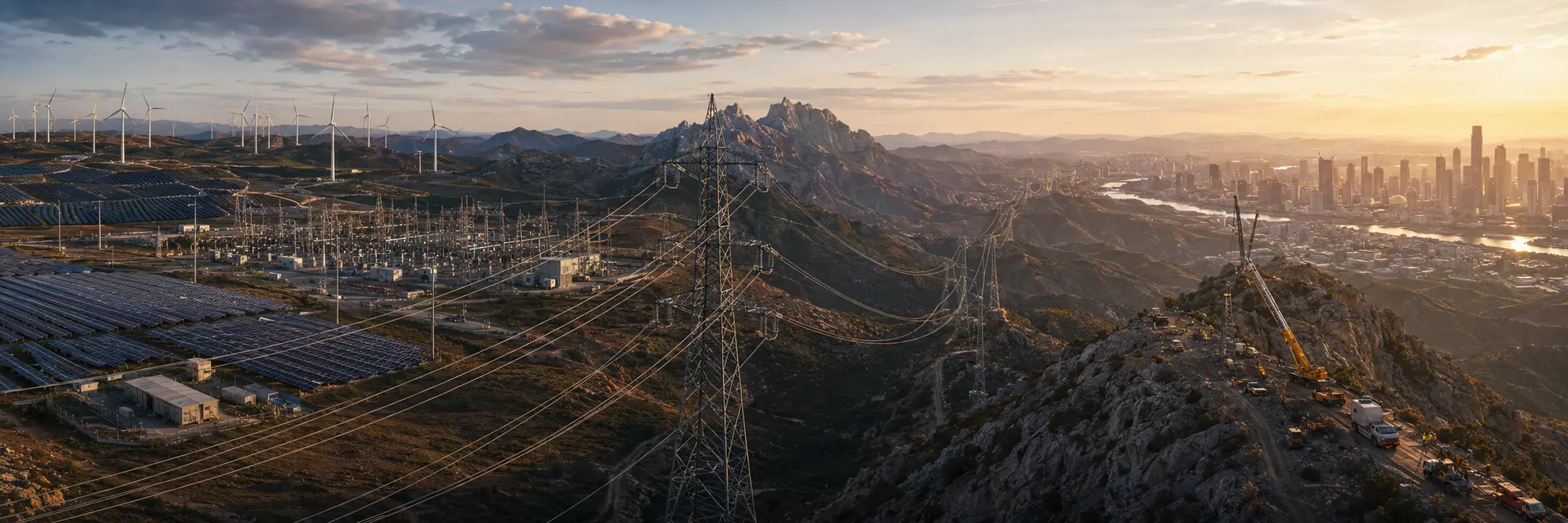
The constraint on renewable energy expansion has shifted from generation cost to transmission capacity — the physical grid infrastructure that determines whether generated energy can reach consumers.
The Structural Question
Public attention in energy transition focuses on generation: the cost of solar panels, the efficiency of wind turbines, the output of nuclear plants. But energy that is generated must reach consumers, and the infrastructure that accomplishes this — transmission lines, substations, and transformers — operates under constraints that are increasingly more binding than the generation technologies themselves.
A wind farm can be permitted, built, and commissioned in two to four years. The high-voltage transmission line needed to connect it to the grid may take seven to twelve years to permit, finance, and construct. A solar park can be built on existing agricultural land with minimal structural challenge. The substation and grid reinforcement needed to accommodate its output may require new equipment with one to three year lead times from a limited number of global manufacturers.
This asymmetry — generation capacity developing faster than the grid can absorb it — has created a structural bottleneck that shapes the pace and geography of energy transition. The question this article examines is how transmission infrastructure constrains energy systems, why these constraints are harder to resolve than generation constraints, and what structural implications this has for the trajectory of energy transition.
The Hidden Infrastructure: What the Grid Actually Consists Of
The electricity grid is a physical network of extraordinary scale and complexity. High-voltage transmission lines carry power over long distances from generation sources to load centers. Substations step voltage up for efficient long-distance transmission and down for local distribution. Transformers at multiple voltage levels convert between the different voltages needed at each stage. Protection equipment detects faults and isolates damaged sections to prevent cascading failures.
This infrastructure is largely invisible to the public. Transmission lines cross rural landscapes where few people see them. Substations occupy fenced lots that attract no attention. Transformers are housed in metal enclosures that reveal nothing of their complexity. The grid’s invisibility contributes to its neglect in energy transition discourse — it is easier to photograph a solar farm or wind turbine than a transformer.
The scale of existing grid infrastructure is enormous. The United States has approximately 600,000 miles of transmission lines and millions of transformers at various voltage levels. Europe’s grid spans a comparable scale with the additional complexity of crossing national borders with different regulatory regimes. China has built the world’s largest ultra-high-voltage transmission network to connect generation in the west with demand in the east, a continental-scale infrastructure project with few parallels.
Most of this infrastructure was built decades ago, designed for a specific purpose: carrying power from large central generation plants outward to distributed consumers. The grid topology — its physical layout and connection pattern — reflects this design intent. Power flows in one direction: from plant to consumer. The grid was not designed for the bidirectional flows, distributed generation connections, and long-distance renewable energy transport that the current transition requires.
Permitting: The Decade-Long Bottleneck
Transmission line permitting is the single most time-consuming element of grid expansion. A new high-voltage transmission line must navigate environmental review, land acquisition or easement negotiation, visual impact assessment, endangered species evaluation, cultural heritage review, and public comment processes that collectively take years to complete.
In the United States, a major new transmission line typically requires seven to twelve years from proposal to energization. Environmental review under the National Environmental Policy Act can take two to four years. State-level siting approvals add additional time. Land acquisition — negotiating easements with hundreds or thousands of individual landowners along a route that may span hundreds of miles — is labor-intensive and subject to legal challenge at every parcel.
European permitting timelines are comparable or longer. Cross-border interconnectors must navigate the regulatory regimes of multiple countries, each with its own permitting requirements, environmental standards, and public participation processes. A submarine cable connecting Norway to the UK, or Germany to Belgium, requires bilateral regulatory coordination that adds years beyond what a domestic line would require.
Public opposition adds further delay. Transmission lines cross visible landscapes, and communities along proposed routes frequently organize opposition based on visual impact, property value concerns, electromagnetic field concerns, and general resistance to industrial infrastructure. This opposition can delay projects by years through litigation, regulatory challenges, and political pressure on elected officials who control permitting decisions.
The permitting timeline asymmetry creates a structural mismatch. Renewable generation projects can be permitted and built in one to four years. The transmission needed to connect them takes seven to twelve years. The result is a growing queue of generation projects waiting for grid connection, a phenomenon now visible in virtually every major electricity market.
Queue Congestion: The Traffic Jam of Unbuilt Projects
In most electricity markets, a new generator cannot connect to the grid until the grid operator confirms that the transmission network has sufficient capacity to accommodate its output. This confirmation requires a study of power flows, stability, and fault conditions that takes months to years. The study queue — the backlog of projects waiting for this analysis — has become massively congested.
In the United States, the interconnection queue contained over 2,000 GW of proposed generation capacity as of 2024 — roughly double the country’s entire installed generation base. The average time from interconnection request to commercial operation has stretched to approximately five years, and many projects withdraw after years of waiting because the grid upgrade costs assigned to them prove prohibitive.
The queue congestion is not merely a bureaucratic problem. It reflects a physical reality: the existing grid lacks the capacity to connect all proposed generation. When a new generator requests connection, the grid operator must assess whether existing transmission lines can carry the additional power without overloading. If not, the grid must be upgraded — new lines built, transformers replaced, substations expanded. These upgrades must be designed, permitted, funded, and constructed before the generator can connect. The generator waits while the grid catches up.
The cost allocation for grid upgrades adds another constraint. When a new generator triggers the need for a transmission upgrade, who pays? In many markets, the first project to trigger the need bears the full cost of the upgrade, even though subsequent projects will also benefit. This creates a perverse incentive: no project wants to be first, because the first project subsidizes all future connections. Some markets have reformed cost allocation to spread upgrade costs more broadly, but the reform process itself takes years.
The Geographic Mismatch: Resources and Demand in Different Places
The best renewable energy resources are often in locations far from demand centers. The windiest plains are in sparsely populated regions. The sunniest deserts are remote from cities. Offshore wind resources are off coasts that may be hundreds of miles from industrial load centers. This geographic mismatch creates a transmission requirement that the original grid was not designed to serve.
The traditional grid was built to connect large power plants to nearby cities and industrial centers. Coal plants were sited near coal mines or rail lines. Gas plants were sited near pipelines and load centers. Nuclear plants were sited where cooling water was available, often near large bodies of water that also happened to be near population centers. The transmission distances were moderate — tens to hundreds of miles — and the grid was designed to handle these distances efficiently.
Renewable generation reverses this geographic logic. The best wind resources in the United States are in the Great Plains states — Kansas, Oklahoma, Texas, Iowa — hundreds of miles from the major demand centers of the coasts. The best solar resources are in the Desert Southwest, far from the Northeast and Midwest cities where much demand is concentrated. Connecting these resources to consumers requires transmission infrastructure on a scale and geography the existing grid does not serve.
Every mile of transmission line incurs cost and energy loss. High-voltage alternating current lines lose roughly three to five percent of power per thousand miles. High-voltage direct current (HVDC) lines lose roughly three percent per thousand miles — more efficient over long distances but requiring expensive converter stations at each end. The economic distance over which renewable energy can be transmitted profitably depends on the generation cost advantage of the remote site versus local alternatives, minus the transmission cost and energy loss.
The geographic mismatch also creates regional political tensions. States or regions that host transmission lines but do not receive the energy — serving only as transit corridors — may resist the visual and land-use impacts of infrastructure that benefits others. This creates permitting obstacles specific to long-distance transmission that do not affect local distribution infrastructure.
The Transformer Bottleneck: A Manufacturing Constraint
Large power transformers — the devices that step voltage up for long-distance transmission and down for local distribution — are among the most critical and least visible components of the grid. They are also among the most constrained.
Large power transformers are custom-built for specific applications. Each unit is designed for a particular voltage, power rating, and installation environment. Manufacturing one takes twelve to twenty-four months. Global manufacturing capacity is concentrated in a small number of facilities in a few countries. Demand for large transformers has surged as grids expand to accommodate renewable generation, data center loads, and electrification of transport and heating.
The supply-demand imbalance is acute. Lead times for large power transformers have stretched to two to four years in some markets. Utilities that need to replace aging transformers or install new ones for grid expansion face wait times that delay projects regardless of how quickly other components can be procured.
The aging of existing transformer fleets compounds the constraint. Many transformers in service were installed decades ago and are approaching or exceeding their design life. Replacing them requires new units from the same constrained supply chain. A failure of a large transformer in service — which can happen catastrophically, with no warning — can take a year or more to replace, leaving a gap in grid capacity that cannot be filled temporarily.
Grid Topology: Why Redesign Is Harder Than Expansion
The traditional grid follows a hub-and-spoke topology: large central generators at the hubs, radial distribution networks extending outward to consumers at the spokes. Power flows from hub to spoke. The grid was designed for this unidirectional flow pattern, and its protection systems, voltage regulation equipment, and control algorithms all assume this pattern.
Distributed generation — rooftop solar, small wind, community-scale renewables — introduces power flows that move from spoke to hub, reversing the assumed direction. This reversal creates technical challenges. Protection systems designed to detect faults in one direction may not function correctly when power flows the other way. Voltage levels at the edge of the distribution network, designed to be slightly lower than at the substation, may rise above acceptable limits when distributed generation pushes power back toward the substation.
Remote utility-scale renewables require a different topology entirely: long-distance point-to-point transmission connecting generation zones to demand zones, overlaid on the existing hub-and-spoke network. These overlay networks — often proposed as HVDC lines — must interface with the existing AC grid through converter stations, creating technical complexity and cost at the interconnection points.
Redesigning grid topology is harder than expanding existing capacity because it involves changing the fundamental architecture, not just adding more of the same. Expanding capacity means building more lines along existing routes. Redesigning topology means creating new routes, changing flow patterns, upgrading control systems, and retrofitting protection equipment — all while the grid continues to operate and serve demand. The grid cannot be taken offline for renovation.
Cross-Border Interconnection: Political Complexity at the Speed of Diplomacy
Linking national grids through cross-border interconnectors could smooth renewable variability across weather zones, allow countries with surplus generation to export to those with deficits, and increase the effective geographic diversification of intermittent generation. The technical case for interconnection is strong. The political process of achieving it moves at a different speed.
Each cross-border interconnector requires bilateral regulatory approval, cost-sharing agreements between countries, environmental assessments in multiple jurisdictions, and often submarine cable installation in internationally shared waters. The NordLink cable between Norway and Germany took over a decade from proposal to operation. The planned interconnectors between the UK and Morocco or Australia and Singapore would span thousands of miles and cross multiple jurisdictions.
Sovereignty concerns complicate interconnection. A country that depends on imported electricity through an interconnector is vulnerable to the exporting country’s policy decisions. If the exporting country restricts flows during its own supply shortage, the importing country faces a deficit it cannot independently resolve. This vulnerability creates political resistance to deep interconnection dependency, even when the economic and technical case is compelling.
Where This Appears Across Energy Systems
Transmission bottlenecks manifest differently across regions but create recognizably similar constraints.
In the United States, wind resources in the central plains and solar resources in the southwest remain partially stranded by insufficient transmission to coastal demand centers. Several proposed long-distance transmission projects — the Grain Belt Express, the SunZia line, the TransWest Express — have spent over a decade in permitting. Some are now advancing, but the elapsed time from proposal to construction illustrates the bottleneck’s severity.
In the United Kingdom, offshore wind farms in Scottish waters generate power that must reach demand in England. The transmission capacity between Scotland and England is insufficient, leading to curtailment of Scottish wind and constraint payments to wind farm operators for the energy they cannot deliver. The cost of these constraint payments is borne by electricity consumers through their bills.
In Australia, the best solar and wind resources are in remote interior regions, far from the coastal cities where most demand is concentrated. The proposed Marinus Link between Tasmania and Victoria, and the Renewable Energy Zones in New South Wales, require substantial transmission investment to connect generation to demand. The pace of transmission development will determine how quickly these resources can be utilized.
In India, renewable energy zones in Rajasthan and Gujarat produce surplus solar that must reach demand in the north and east. India has invested heavily in transmission infrastructure, including a national grid backbone, but the pace of renewable development continues to outstrip transmission capacity in some corridors.
Diagnostic Boundaries
This article describes transmission infrastructure as a structural bottleneck on energy transition. It does not resolve several questions that require analysis beyond this observation.
The article cannot determine whether permitting reform will accelerate transmission development. Permitting timelines reflect political processes — environmental protection, property rights, community consent — that serve purposes beyond energy transition. Whether societies will accept streamlined permitting depends on how they weigh energy transition urgency against these other values.
The article does not assess the cost of resolving the transmission bottleneck. Estimates of required grid investment vary widely depending on assumptions about generation mix, demand growth, storage deployment, and the extent to which distributed resources reduce transmission needs. The required investment is large by any estimate, but the specific magnitude is uncertain.
The article cannot evaluate whether alternative approaches — distributed generation with local storage, demand flexibility, or radically different grid architectures — could reduce the need for long-distance transmission. These alternatives address different aspects of the system and may complement rather than substitute for transmission expansion. The structural observation is that transmission is currently a binding constraint. Whether it remains binding depends on the development of alternatives that are themselves uncertain.
The observation that transmission infrastructure constrains energy transition more than generation technology is a structural identification of where the bottleneck currently lies. It does not prescribe how the bottleneck should be resolved or how quickly it can be.