 CompanyGraph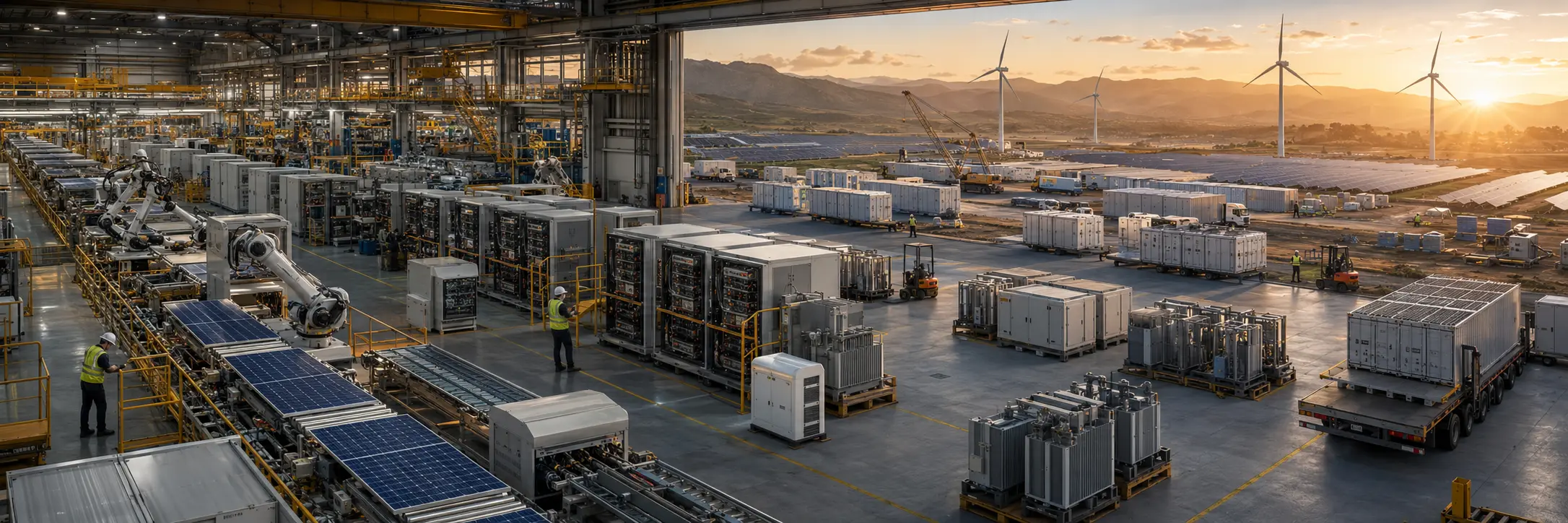
Whether an energy system can be assembled from interchangeable parts or requires bespoke engineering shapes how fast it scales, what it costs, and who controls it.
The Structural Question
Can the components of an energy system be manufactured in one place, shipped to another, and assembled without site-specific engineering? Or does each installation require custom design, unique components, and specialized integration? This question — the degree of modularity — has consequences that extend far beyond manufacturing efficiency. It determines how quickly a technology can scale, how competitive its supply chain becomes, how much coordination is required for deployment, and how much control any single supplier can maintain over the installed base.
Modularity is not a binary property. Energy systems exist on a spectrum from highly modular (standardized components, interchangeable between manufacturers, scalable in small increments) to fully bespoke (each installation a unique engineering project). Where a technology sits on this spectrum shapes its deployment trajectory in ways that are often more consequential than its raw energy efficiency.
The Modularity Spectrum
Solar photovoltaic technology sits at the highly modular end of the spectrum. Solar panels are manufactured in standardized dimensions, with standardized electrical characteristics, by dozens of manufacturers worldwide. A panel from one manufacturer can typically replace a panel from another. Installations can be scaled from a few panels on a residential rooftop to thousands of panels in a utility-scale array. The components — panels, inverters, racking, wiring — are largely commodity products that connect through standard interfaces. This modularity has enabled rapid scaling and dramatic cost reduction through manufacturing competition and economies of scale.
Wind energy is partially modular. While many components are standardized — generators, control systems, grid connection equipment — the turbines themselves are large, site-specific installations. Tower height, blade length, and generator capacity are selected based on local wind conditions. Foundations are engineered for specific soil and terrain conditions. Offshore installations require even more site-specific engineering. The result is a technology that benefits from manufacturing scale in component production but requires significant site-specific engineering for each deployment.
Natural gas plants occupy a middle position. Gas turbine generators are manufactured as standardized units by a small number of manufacturers, but the plant itself — cooling systems, emissions controls, grid connection, fuel supply infrastructure — requires site-specific engineering. Combined-cycle plants, which capture waste heat to drive additional turbines, add further complexity and customization.
Nuclear power sits at the bespoke end of the spectrum. Each conventional nuclear plant is a custom engineering project. Reactor design, containment structure, cooling systems, and safety systems are designed for the specific site, and the regulatory approval process treats each plant as a unique installation. This is a significant factor in nuclear's cost trajectory — while most energy technologies have seen costs decline with deployment, nuclear construction costs have historically increased, in part because each project is unique and cannot fully benefit from standardized manufacturing.
Standardization vs. Differentiation
Standardization improves system efficiency. When components are interchangeable, competition increases, costs decline, deployment accelerates, and the system as a whole becomes more efficient at delivering energy. This is the pattern observed in solar: standardized panels from competing manufacturers have driven costs down by over 90% in fifteen years.
But standardization also reduces differentiation. When one manufacturer's product is interchangeable with another's, margins compress. Products become commodities. Competitive advantage shifts from product design to manufacturing cost, and manufacturers compete on thin margins at high volume. This is financially efficient for buyers but financially painful for producers.
The tension between standardization and differentiation creates a structural dynamic: system efficiency (lower costs, faster deployment, better interoperability) pulls toward standardization, while financial incentive (higher margins, competitive moats, pricing power) pulls toward differentiation. Companies that can maintain proprietary interfaces, incompatible connectors, or locked-in ecosystems can sustain higher margins even when standardization would benefit the broader system.
The Compatibility Problem
When companies use proprietary interfaces, connectors, or protocols, their systems cannot interoperate with competitors' products. This creates vendor lock-in — once a customer has invested in one ecosystem, switching to another requires replacing not just the primary component but all the interfaces and connections around it. Lock-in increases the supplier's pricing power and reduces competitive pressure, sustaining margins at the cost of system-level efficiency.
The analogy to computing is instructive. Early personal computers used proprietary architectures — hardware from one manufacturer could not run software or accept peripherals from another. The IBM PC's open architecture, which allowed any manufacturer to produce compatible hardware, transformed the industry: competition drove costs down, deployment accelerated, and the ecosystem expanded rapidly. The manufacturers who benefited most from the proprietary era resisted standardization for exactly the reasons that made standardization beneficial to the system: it reduced their control and compressed their margins.
In energy systems, the compatibility problem appears at multiple levels. Inverter communication protocols vary between manufacturers, making monitoring and control systems vendor-specific. Battery management systems use proprietary interfaces that prevent mixing battery modules from different suppliers. Smart grid communication standards vary by region and utility, creating fragmentation that slows the integration of distributed energy resources.
Grid Interconnection as Coordination Friction
The rules governing how generation sources connect to the electrical grid vary by country, by state or province, by utility, and sometimes by individual substation. These interconnection standards determine the technical requirements, approval processes, and timelines for connecting new generation to the grid. The variation is not arbitrary — it reflects different grid architectures, regulatory histories, and technical conditions — but it creates coordination friction that slows deployment.
A solar installation in one utility's territory may face different interconnection requirements than an identical installation in the neighboring utility's territory. The technical specifications may differ, the approval process may differ, and the timeline may differ. Each variation requires the installer to adapt their approach, increasing cost and reducing the efficiency gains that modularity would otherwise provide. The hardware is standardized. The regulatory and grid interface is not.
This fragmentation is not primarily a technical problem. The technical requirements for safe grid interconnection are well understood and could be standardized. The fragmentation persists because each utility manages its own grid, each regulator sets its own rules, and the coordination required to standardize across jurisdictions faces institutional resistance from entities that have established their own procedures and have limited incentive to change them.
The EV Charging Standards Case
Electric vehicle charging standards provide a clear illustration of how standardization dynamics play out in energy-adjacent infrastructure. For years, multiple competing charging standards coexisted — CCS (Combined Charging System), CHAdeMO (developed by Japanese manufacturers), and Tesla's proprietary connector (later renamed NACS, North American Charging Standard). Each standard required its own physical connector, communication protocol, and billing system.
The result was predictable from a structural perspective: fragmented infrastructure. Charging stations had to support multiple standards or serve only a subset of vehicles. Drivers had to locate compatible stations. Infrastructure investment was split across competing ecosystems rather than concentrated on building coverage. The total investment in charging infrastructure was divided among three parallel networks instead of building one comprehensive network.
The eventual convergence toward NACS as a dominant standard in North America illustrates a pattern: the market did not produce standardization spontaneously. Tesla's network became dominant because of Tesla's market share and the network's reliability, and other manufacturers adopted its connector through a combination of market pressure and Tesla's decision to open the standard. Standardization required a coordination event that market competition alone did not produce — because each company's individual incentive was to promote its own ecosystem, even when a unified standard would have benefited EV adoption overall.
Small Modular Reactors: Attempting to Shift the Spectrum
Small Modular Reactors (SMRs) represent an explicit attempt to shift nuclear energy from the bespoke end of the modularity spectrum toward the standardized end. The concept is to design a reactor small enough to be manufactured in a factory, transported to a site, and installed with minimal site-specific engineering — applying the manufacturing model that has driven cost reductions in solar and wind to nuclear technology.
Whether this approach will succeed is not yet clear. The regulatory framework for nuclear power was built around large, site-specific installations and may not adapt smoothly to factory-manufactured units. The economic case depends on achieving manufacturing volumes that have not yet materialized. The safety case requires demonstrating that factory-built units maintain the same safety standards as custom-engineered plants. These are open questions, not conclusions.
What is structurally interesting about SMRs is that they represent a deliberate attempt to change a technology's position on the modularity spectrum — recognizing that nuclear's bespoke character is not an inherent property of nuclear physics but a consequence of how the technology was developed and regulated. Whether the attempt succeeds or fails, it illustrates that modularity is partly a design choice, not only a physical constraint.
Where This Appears Across Energy Systems
Solar: Highly modular. Standardized panels, standardized inverters, standardized racking. Competition among manufacturers has driven costs down dramatically. The main fragmentation is in monitoring and control software, where proprietary platforms create mild vendor lock-in.
Wind: Partially modular. Standardized generators and control systems, but site-specific tower and foundation engineering. Blade design varies significantly between manufacturers. Offshore wind requires particularly specialized, non-standardized installation equipment.
Battery storage: Increasingly modular at the cell level (standardized cell formats like cylindrical, prismatic, and pouch), but battery management systems and pack designs are highly proprietary. This limits interoperability between manufacturers and creates vendor lock-in at the system level.
Nuclear (conventional): Fully bespoke. Each plant is a unique engineering project. This has prevented the cost reductions that standardized manufacturing enables and is a structural factor in nuclear's rising construction costs.
Geothermal: Site-specific by nature — each installation depends on local geological conditions. Surface equipment (turbines, generators) is relatively standardized, but the subsurface system (wells, heat exchangers) is unique to each site.
Diagnostic Boundaries
Modularity and standardization describe how energy technologies are manufactured, deployed, and interconnected. They do not describe how well those technologies produce energy. A fully standardized, highly modular technology can still be intermittent, land-intensive, or material-intensive. A fully bespoke technology can still produce abundant, continuous, low-emission power. Modularity affects deployment speed and cost trajectory, not energy quality.
This concept also does not predict whether standardization will prevail over fragmentation in any specific case. Standardization requires coordination that may or may not emerge, depending on market structure, regulatory intervention, and the relative power of incumbents who benefit from fragmentation. The structural observation is that system efficiency favors standardization while financial incentive can favor fragmentation — and which force prevails is determined by specific circumstances, not by abstract principles.
What this concept makes visible is the relationship between modularity, cost trajectory, and the tension between system-level optimization and individual-firm optimization. A system of interchangeable, standardized components deploys faster and costs less. A system of proprietary, differentiated components generates higher margins for producers. Both dynamics are real, both are rational within their respective frames, and both shape how energy systems develop.