 CompanyGraph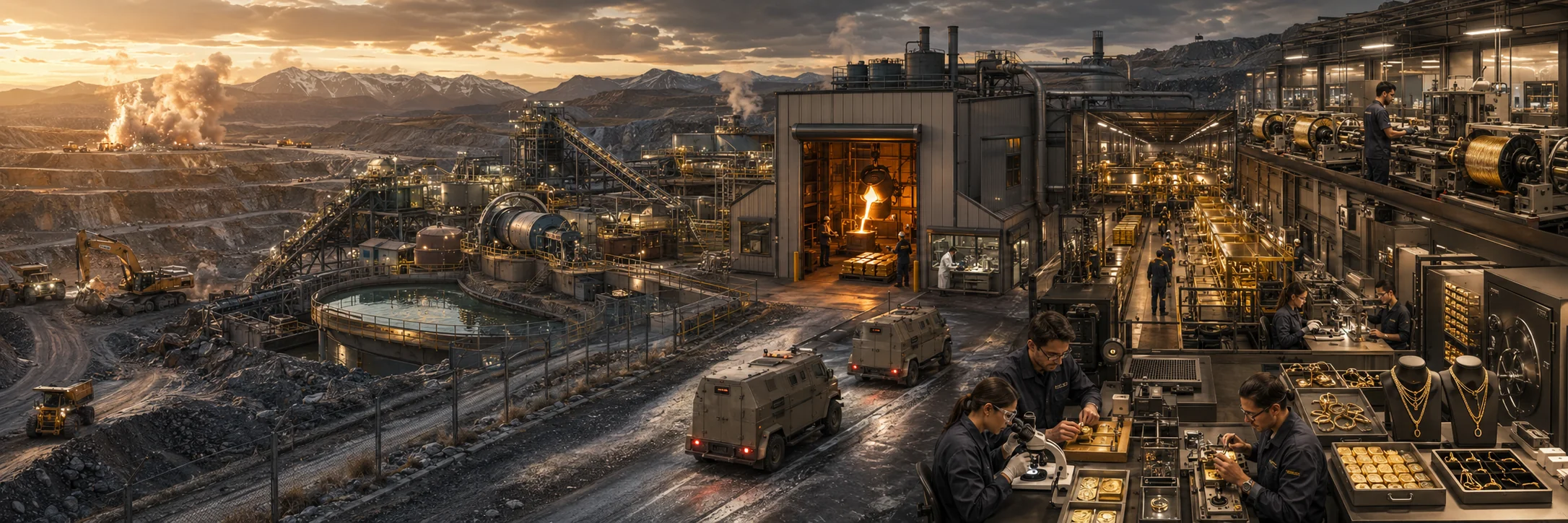
Follow gold from exploration and ore through processing, doré, refining, bars, jewelry, electronics, recycling, custody, and closure. The metal is durable, but usable supply still depends on grade, chemistry, identity, money, and whether a holder releases it.
Gold serves several physical and institutional purposes. Its resistance to corrosion, malleability, conductivity, and reliable contact behaviour support jewelry, electrical connectors, dentistry, coatings, and other products. Refined bars and coins also serve as assets held by central banks, funds, institutions, and households. Those holdings are not “consumed” in the same way as fuel, but gold can be dispersed into products, lost in waste, or kept out of a market while it remains chemically intact.
The World Gold Council describes mine production as the largest annual source of gold and recycling as the supply most responsive to prices and economic shocks. The physical chain therefore has to serve users who need a material and holders who want a transferable asset.
Ore carries only a trace of the metal
Exploration looks for a deposit whose grade, size, mineralogy, access, water, energy, permits, and expected recovery can support a mine. Gold may occur as visible grains, fine particles in sulfide minerals, or a byproduct of another metal deposit. A promising assay does not establish a mineable reserve or a permitted project.
Mining methods differ with depth, geometry, rock strength, grade distribution, and local conditions. Open pits move ore and waste separately; underground mines develop shafts, drifts, stopes, ventilation, and hoisting; artisanal and small-scale miners may use hand tools, sluices, mercury amalgamation, or small processing plants. UNEP identifies artisanal and small-scale gold mining as a major source of mercury releases to air, water, and land. The route determines what material is moved and what evidence of origin remains.
Processing turns rock into a payable product
Ore is crushed and ground so that gold-bearing particles can be separated. Gravity concentration, flotation, heap or tank leaching, and other steps may be combined. Refractory ore can require oxidation or pressure treatment before leaching. The plant produces tailings, process water, residues, and a gold-bearing concentrate or doré rather than a finished bar.
The U.S. Geological Survey’s Mineral Commodity Summaries provide production, reserves, and resources data for gold. Recovery depends on mineralogy, particle size, reagent conditions, residence time, water, energy, equipment, and the grade-control decisions made during mining and processing.
Grade changes the work required for each ounce
Grade varies between deposits and within a single mine. Lower grade can require more rock movement, crushing, grinding, water, energy, and tailings capacity for the same recovered gold, while refractory minerals can add another treatment stage. Higher grade is not automatically easier if the ore is difficult to access, dangerous to mine, or chemically complex.
Mine plans respond to price, equipment, labour, energy, water, royalties, debt, and the expected life of the deposit. A higher gold price can make a lower-grade zone, a deeper section, or a stockpile worth processing; a lower price can leave material in the ground without changing its geology. The decision is about what is physically and financially accessible at that time.
Doré must be assayed and refined
Many mines pour doré: a semi-refined alloy containing gold and usually silver and other residual elements. The mine weighs and samples the doré, but the final payable amount depends on an assay, agreed deductions, treatment and refining charges, and the refinery’s acceptance criteria.
Different mines produce doré with different gold and silver content, residual impurities, dimensions, and documentation. The refinery samples, melts, separates, and refines it before producing metal that meets a specified market or customer standard. The bar leaving the refinery has a refinery record and product identification.
Refining makes bars interchangeable within a market
Refining separates gold from silver and other elements, then casts or mints products for different users. A wholesale bar, a kilobar, a coin blank, a jewelry grain, and an electronic-plating feedstock have different dimensions, purity requirements, packaging, and customers.
LBMA Good Delivery specifications cover the weight, purity, appearance, and markings required for bars accepted in the London market. Acceptance also depends on the accredited refiner and the market’s custody and verification arrangements. LBMA’s responsible-sourcing programme is a related but separate system involving continuing checks, independent audits, and reporting.
One element serves material and monetary users
Jewelry makers buy workability, colour, alloy behaviour, appearance, and cultural meaning. Electronics manufacturers buy a dependable conductive or corrosion-resistant contact in very small quantities. Dentists and medical-device makers use specified alloys. Investors and central banks buy bars, coins, or accounts that can be valued, transferred, pledged, or held as reserves.
These uses draw on the same refined metal but create different forms of demand. A jewelry buyer may exchange or melt an existing piece; gold used in electronics can become dispersed through complex products and difficult to recover; a central bank may hold a bar without putting it into fabrication. A tonne of gold in one form is not automatically available to every other user without collection, refining, and money.
Above-ground gold can respond faster than new mines
Gold’s chemical durability means that much of the historical stock remains in jewelry, bars, coins, official reserves, industrial products, and waste. The World Gold Council notes that nearly all gold ever mined is theoretically still accessible in some form. The qualification matters: theoretical accessibility is not the same as a known location, a willing seller, an affordable recovery process, or a metal specification a buyer can use.
New mine output adds to that stock slowly, while recycling and released holdings can change market availability more quickly. A mine disruption may matter greatly to a project or refinery even when the global stock is large; conversely, a large above-ground stock may remain unavailable when owners prefer to hold it.
Recycling starts with collection and separation
Recycling routes differ by form. Old jewelry can be sorted, melted, assayed, and refined. Electronic scrap may require dismantling, concentration, and treatment of many other metals and hazardous materials before a small amount of gold is recovered. Dental alloys, plating solutions, and manufacturing residues each need their own collection and refining steps.
The World Gold Council reports that at least 90% of recycled gold comes from jewelry, with technology providing most of the remainder. Recycling can respond to prices and broader economic shocks, but high-value jewelry, official reserves, and dispersed electronics do not enter the stream at the same rate.
Money determines which gold can be recovered
Exploration and mine development require money years before a producing asset exists. Processors need working capital for ore, reagents, energy, labour, and inventory while assay and settlement are pending. Recyclers need collection networks, secure transport, separation equipment, and a price high enough to pay for recovery.
A jewelry holder who needs cash may sell or pledge metal; another holder may keep the same piece because its cultural or financial use is greater than its scrap price. A refinery may accept a doré lot only when its assay risk, compliance work, and treatment charge are covered. These are material decisions shaped by payment timing and access to money, not simply preferences about gold.
Records can weaken as gold changes hands
Gold changes hands among mines, traders, refiners, vaults, fabricators, dealers, funds, banks, and households. Each handoff can preserve or weaken the link between weight, purity, origin, owner, and responsible-sourcing evidence. A bar number and vault record identify an entry in a custody system; they do not observe every earlier extraction or transaction.
OECD due-diligence guidance covers mineral supply chains from mines to end users and asks companies to identify, mitigate, and account for risks such as conflict, corruption, and human-rights abuse. Mine-production data, assay results, vault statements, and recycling estimates each answer a limited question; due diligence can improve decisions and records, but it cannot turn an incomplete source observation into proof.
Closure leaves tailings and a site to manage
Gold mining can leave waste rock, tailings, process water, open pits, underground workings, roads, power systems, and chemical residues. Closure requires stable landforms, water management, monitoring, worker and community arrangements, and a decision about which infrastructure is removed, repurposed, or maintained.
Refining and recycling also leave slags, filters, spent reagents, contaminated equipment, and other outputs. Recovering the saleable gold does not discharge responsibility for these displaced materials. A mine can stop producing ounces while its physical and financial obligations continue.
Inside CompanyGraph
Explore mines, artisanal and small-scale miners, traders, assay laboratories, refiners, vaults, banks, central banks, manufacturers, recyclers, regulators, lenders, insurers, and closure contractors. CompanyGraph can map their handoffs; it cannot establish a bar’s location, a lot’s origin, a mine’s water condition, or the evidence needed to correct a failure.