 CompanyGraph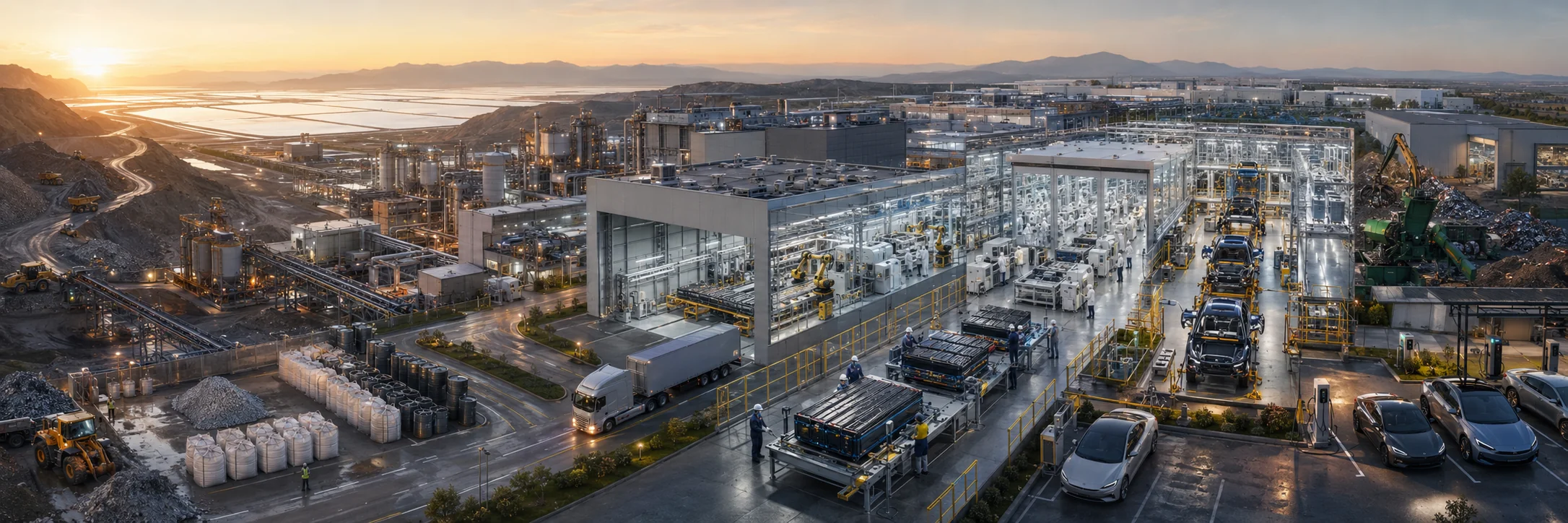
Follow an electric-vehicle battery from mined and refined materials through cell manufacture, pack integration, driving, repair, reuse, and recycling. The product is usable electrical energy for traction, not a mineral tonnage or a cell count.
An electric vehicle needs a battery that can accept charge, deliver power to the motor, provide the required range, remain within safe temperatures, and communicate its condition to the vehicle. A battery can be physically present while the vehicle is unavailable because its cells, cooling circuit, controls, charger, or software are incompatible or faulty.
The U.S. Department of Energy describes a rechargeable battery as a device in which electrons move through an external circuit while ions move through an electrolyte. The usable result depends on that coupled movement continuing within the limits of a particular design.
A cell is an electrochemical device
A lithium-ion cell contains an anode, a cathode, a separator, and an electrolyte inside a sealed container. During charging, electrical energy drives ions and electrons into a higher-energy arrangement; during discharge, ions move through the electrolyte and electrons through the external circuit. The separator prevents direct electronic contact while allowing ionic transport.
Charging and discharging do not reverse every change. Repeated cycling, high temperature, high state of charge, fast charging, mechanical damage, and time can alter electrodes and interfaces, reducing capacity or increasing risk. A cell therefore has a history of formation, use, temperature, current, and storage—not just a nominal capacity.
Chemistry determines which materials are needed
There is no single EV battery feedstock. NMC cathodes contain nickel, manganese, and cobalt; lithium-iron-phosphate cells use iron and phosphate instead of nickel and cobalt; sodium-ion cells replace lithium in the charge-carrying chemistry but still require an anode, separator, electrolyte, current collectors, and a qualified manufacturing route. Graphite remains the dominant anode material for lithium-ion batteries today, while hard-carbon routes are used in sodium-ion designs.
These chemistries trade energy density, power, cost, cycle life, thermal behaviour, charging performance, and material exposure. The IEA reports that LFP packs cost less and have lower energy density by mass than NMC packs, while NMC retains an energy-density advantage. A chemistry is selected for a vehicle or storage duty; it is not a universal ranking of batteries.
The mine does not produce battery-grade material
Mines produce ores, brines, concentrates, or graphite flake. Conversion plants then remove impurities and create battery-grade lithium chemicals, nickel or cobalt intermediates, manganese compounds, phosphate inputs, or spherical graphite. Particle size, purity, moisture, morphology, and consistency can matter as much as the named element.
The geography changes at each step. IEA data for 2023–24 show concentrated mining and even more concentrated refining and component production: China supplied most anode material and a large share of cathode materials, while the Democratic Republic of the Congo, Indonesia, Australia, and Chile dominate particular mined inputs. A deposit, a concentrate, and a qualified precursor are different products with different customers and processing queues.
That concentration does not mean every shortage is a shortage of the element itself. A battery maker may have access to a tonne of material that is the wrong chemical grade, arrives too late, lacks a qualifying supplier record, or belongs to a chemistry the line cannot process.
Electrodes are manufactured, not merely mixed
Battery manufacturing turns powders and liquids into controlled layers. Active materials, conductive additives, binders, and solvents are mixed into slurries; the anode and cathode slurries are coated onto copper and aluminium foils, dried, calendered to a specified thickness and porosity, slit, and cut. These operations set the paths through which ions and electrons will move.
A U.S. Department of Energy assessment of the proposed BlueOval SK plants gives one concrete NMC pouch-cell example: mixing, electrode manufacture, cell assembly, electrolyte filling, sealing, and formation. Other factories use different chemistries, formats, and equipment. Dry-room conditions, contamination control, coating uniformity, residual solvent, and alignment still determine whether a cell reaches its intended life or must be rejected.
Formation turns assembled parts into a qualified cell
After the electrodes and separator are wound or stacked, the cell is filled with electrolyte, sealed, and put through formation: controlled initial charging and discharging that establishes the electrochemical interfaces needed for normal operation. Cells are then aged, measured, sorted, and tested for capacity, resistance, leakage, dimensions, and other specified properties.
A cell that has passed an electrical test is not thereby proven safe under every temperature, current, vibration, or abuse condition. A production record can link it to a material lot and process settings; a sample test can reveal a population problem; neither observation alone is a complete account of every cell in a vehicle.
A factory produces qualified output, not just capacity
A building with coating machines does not by itself provide qualified production. The line needs qualified materials, dry rooms, calibrated equipment, trained staff, process controls, yield data, maintenance, and enough time to demonstrate repeatable cells. The IEA reported more than 3 TWh of global cell manufacturing capacity in 2024—about three times EV and battery-storage demand—while about 85% of that capacity was in China. Nameplate capacity therefore does not show that the exact chemistry, format, location, or customer qualification is available.
Financing must cover land, equipment, utilities, raw materials, wages, qualification runs, scrap during ramp-up, and the delay before accepted cells generate revenue. For example, a buyer that commits to volume or offers a prepayment can give lenders an expected customer, while a buyer that pays only after acceptance leaves the supplier carrying qualification scrap and inventory. The IEA identifies upstream investment and vertical integration as ways battery suppliers manage volatile mineral prices and production costs.
At any moment the chain contains mined material, refined chemicals, electrode rolls, cells in formation, accepted cells in inventory, packs awaiting vehicles, vehicles in service, and damaged or quarantined batteries. These categories cannot substitute freely. A surplus of LFP cells does not fill an NMC vehicle line, and a warehouse of cells does not provide a charged, cooled, software-compatible pack in a car. The IEA notes that LFP now supplies almost half of the global electric-car market and that its cathode and cell production is even more concentrated in China than nickel-based batteries. Chemistry changes can therefore redirect demand between mineral, precursor, equipment, and pack supply chains rather than simply adding interchangeable capacity.
Cells become a pack only after they are matched
Cells are grouped into modules or pack assemblies with busbars, fuses, contactors, sensors, cooling plates or channels, structural members, insulation, and a battery-management system. The pack must control voltage, current, temperature, and state of charge while surviving vibration, crash loads, water exposure, and repeated service.
A vehicle platform is designed around the pack’s dimensions, mass, voltage range, cooling connections, charge rate, and communication protocols. Replacing a cell chemistry or format can require new modules, controls, thermal hardware, crash validation, and software. A compatible-looking cell is not automatically an acceptable replacement.
Driving creates the battery’s service history
Road speed, payload, climate control, ambient temperature, charging power, state-of-charge window, storage time, and driving style determine the loads the pack experiences. The battery-management system estimates state of charge and state of health from sensors, models, and measured behaviour. Those estimates help protect the pack, but they are not direct measurements of every internal defect or future failure.
Service records, diagnostic data, warranty decisions, software updates, collision reports, and thermal events affect whether a pack’s condition can be established and whether repair or reuse is authorized. A dashboard range estimate, a capacity test, and a cell-level inspection answer different questions; one should not be used as proof of all the others.
End of vehicle use is not the end of the battery
A pack can leave a vehicle because its range no longer meets the owner’s need, because a module has failed, because the vehicle is retired, or because collision damage makes continued use unsafe. Before repair or reuse, testing must establish identity, insulation, thermal damage, and remaining performance. Transport requires separate controls for state of charge, damage, packaging, and route.
The U.S. Department of Energy notes that an EV battery may retain useful capacity for stationary applications, but transport, sorting, testing, certification, integration, and installation determine whether a second use is economically feasible. A battery with remaining electrical function is not automatically a safe or financeable second-life product.
Recycling preserves some materials, not the whole pack
When reuse or repair is unsuitable, packs are discharged or otherwise made safe, identified, disassembled or shredded, and processed into streams such as black mass, foils, steel, plastics, and electrolyte residues. Pyrometallurgical and hydrometallurgical routes recover different materials; direct-recycling approaches try to preserve more of the engineered cathode structure.
The U.S. Environmental Protection Agency explains that recycling routes and recovered materials vary by battery, and that direct recycling aims to preserve cathode structure while reducing new processing. The chemistry, pack design, damage condition, transport distance, and market price determine which route can be financed and used.
Feedstock also arrives late. EV packs placed on the road today will not all reach end of life together, and early recycling volumes reflect earlier, much smaller vehicle cohorts. The IEA expects feedstock limitations to delay recycling’s major effect on primary mineral demand for about a decade. Recycling can reduce future mining and retain materials, but it cannot supply newly built vehicles before the relevant batteries have been collected and processed.
A battery passport records specified information
Article 77 of the European Union Batteries Regulation requires an electronic battery record for electric-vehicle batteries placed on the EU market from 18 February 2027. Its model-level and battery-specific information can support identification, access, and later decisions, but the record remains a defined set of entries; it does not prove every present physical condition.
A battery’s condition must remain traceable
A dependable chain can identify the chemistry, production history, pack integration, operating history, and safe end-of-life route well enough for the next repair, reuse, or recycling decision. The record supports investigation; it does not substitute for a cell or pack test.
Inside CompanyGraph
Explore mines, chemical converters, cathode and anode producers, separator and electrolyte suppliers, cell factories, pack integrators, automakers, charging operators, service networks, insurers, dismantlers, second-life developers, recyclers, regulators, and material buyers. CompanyGraph can map the organizations and handoffs among them. It cannot by itself establish a particular pack’s state of health, crash damage, electrical safety, or who is authorized to inspect, repair, or retire the pack; those remain questions for the underlying tests, records, and people responsible for the battery.