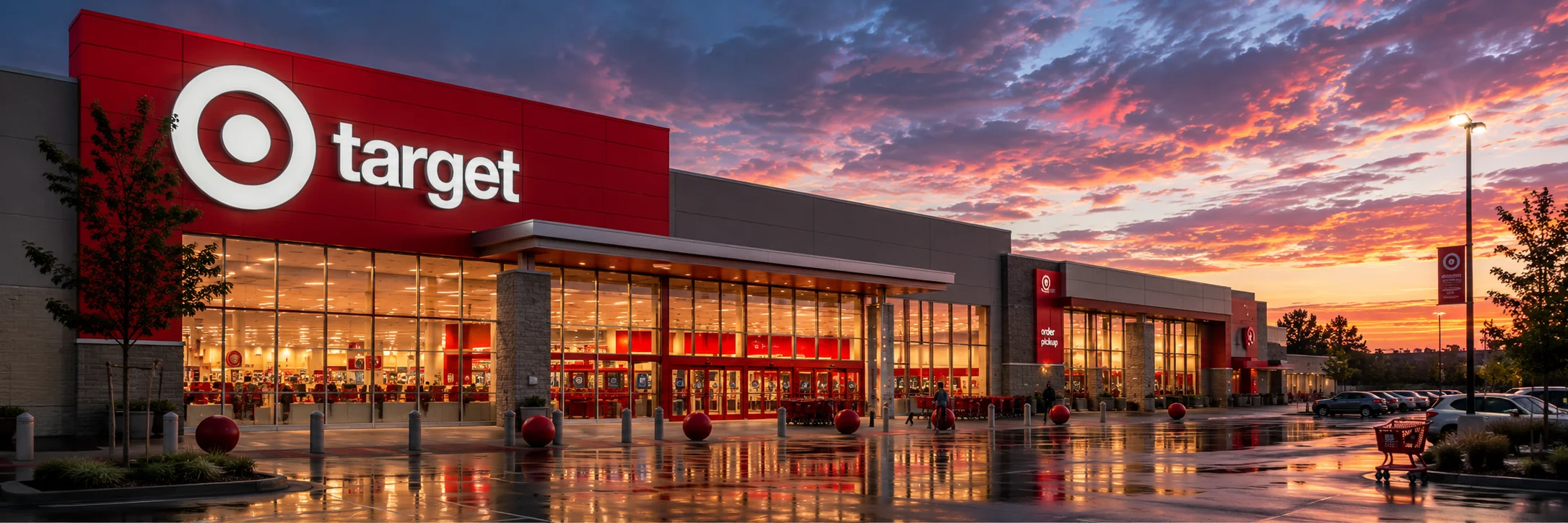
Positioning between pure discount and department store retail through private label brand development and store-as-hub fulfillment creates a differentiated coordination system where demographic targeting and in-store experience resist the margin compression that pure price competition produces.
A structural look at how a discount retailer occupies the narrow space between Walmart's cost leadership and department store curation through a coordination system that competitors have found difficult to replicate.
Introduction
Target (TGT) is commonly categorized as a discount retailer, placed alongside Walmart in the same competitive bucket. This categorization obscures the structural reality. Target operates a fundamentally different coordination system — one that optimizes for a specific intersection of price, aesthetics, and convenience that neither pure discounters nor department stores occupy. The company's signature positioning, often described as "cheap chic" or "expect more, pay less," is not a marketing slogan but a structural constraint that shapes every downstream decision: which products to carry, how stores are designed, which suppliers to partner with, and which customers to serve.
Understanding Target requires seeing it as a bounded system operating under a specific set of trade-offs. Walmart optimizes for absolute lowest cost. Department stores optimize for brand prestige and service. Amazon optimizes for selection breadth and delivery speed. Target optimizes for none of these individually. Instead, it occupies an interstitial position where curated product assortment, moderate pricing, pleasant shopping environments, and suburban accessibility combine to serve a demographic — primarily middle-income suburban households — that wants something better than Walmart without paying department store prices. This positioning is both Target's greatest structural advantage and its most persistent vulnerability, because the space it occupies is narrow and bounded on multiple sides by larger, better-capitalized competitors.
The company's multi-decade arc reveals a system that has repeatedly invested in maintaining this differentiated position — through designer collaborations, private label brand development, store remodels, and an ambitious store-based fulfillment model — while navigating the structural tensions inherent in serving a consumer segment that is highly sensitive to both economic conditions and cultural shifts. Target's story is not one of relentless expansion or platform dominance but of careful calibration within constraints — a coordination challenge that rewards precision and punishes miscalibration with unusual severity.
The Long-Term Arc
Target's evolution spans more than six decades, from its founding as a discount offshoot of a department store company to its current position as a differentiated mass retailer with a sophisticated omnichannel infrastructure. The structural patterns that define the business emerged gradually, with each era adding a layer of capability and complexity to a system that has remained recognizably consistent in its core positioning even as its operational model has transformed.
How did Target emerge from a department store company (1902 – 1990)?
Target's corporate ancestry traces to the Dayton Dry Goods Company, founded in Minneapolis in 1902. The Dayton family operated upscale department stores in the upper Midwest for decades before recognizing, in the early 1960s, that the discount retail format pioneered by companies like E.J. Korvette and later perfected by Walmart represented a structural shift in American retailing. The first Target store opened in 1962 in Roseville, Minnesota — the same year that Walmart, Kmart, and Woolco all launched their discount formats. This simultaneity was not coincidence — it reflected a structural moment when American consumer demographics, suburban expansion, and automobile culture converged to make large-format, low-cost retail viable at national scale.
What distinguished Target from the outset was the Dayton family's department store DNA. Where Walmart and Kmart optimized purely for low cost — sparse environments, minimal presentation, relentless price competition — Target's founders brought a sensibility shaped by decades of curated merchandising and attention to the shopping environment. The early Target stores were cleaner, brighter, and more organized than competitors. This was not incidental; it was a deliberate structural choice that traded some cost efficiency for a more pleasant customer experience, attracting a slightly different demographic than the pure discounters. The Dayton family understood from their department store experience that the physical environment of a store communicates a message to customers about who belongs there and what kind of value to expect. Target's early stores communicated: you can pay discount prices without feeling like you are shopping at a discount store.
Through the 1970s and 1980s, Target expanded steadily across the United States while its parent company — which became Dayton Hudson Corporation — continued operating department stores (Dayton's, Hudson's, Marshall Field's) alongside the discount format. This dual identity provided an unusual structural advantage: Target could observe and absorb merchandising practices from its department store siblings while maintaining the economics of a discount retailer. The aesthetic sensibility that would later become Target's defining characteristic was seeded during this period, when the company internalized the principle that discount pricing and attractive presentation were not mutually exclusive.
By the late 1980s, Target had grown to become the dominant revenue generator within the Dayton Hudson portfolio, eclipsing the department store operations that had historically been the company's prestige assets. This inversion — where the discount format outgrew the premium format — was itself a structural observation about where American retail was heading. Target's growth during this period was driven by suburban expansion, the same demographic force that powered Walmart's rise. But while Walmart pursued rural and exurban markets with relentless cost optimization, Target gravitated toward suburban locations near middle-income and upper-middle-income residential areas. This real estate strategy was not random; it was the physical expression of a positioning choice. Target was building its store footprint in the neighborhoods where its intended customer base lived — households with enough income to have choices about where to shop, and enough aspiration to prefer an environment that felt a step above pure discount.
What made Target's 'cheap chic' era so consequential (1990 – 2008)?
The 1990s and 2000s represent Target's most consequential structural period — the era when the company's differentiated positioning crystallized into a recognizable and defensible identity. Several interconnected developments converged to create what became known as the "Tarzhay" phenomenon, where a discount retailer achieved something approaching cultural cachet.
The designer collaboration strategy, launched in 1999 with architect Michael Graves, was the most visible structural innovation. Target partnered with high-profile designers to create exclusive, limited-edition product lines at mass-market prices. Graves designed housewares. Isaac Mizrahi designed apparel. Philippe Starck designed baby products. These collaborations accomplished something structurally novel in discount retail: they created event-driven traffic, generated media coverage that functioned as unpaid advertising, and — most importantly — signaled to consumers that Target was a place where design quality and low prices coexisted. The collaborations were not merely marketing tactics; they recalibrated consumer expectations about what a discount store could offer.
Simultaneously, Target invested in private label brand development, building a portfolio of owned brands that covered key categories — apparel, home goods, food, and household essentials. Unlike Walmart's private label strategy, which optimized primarily for price leadership (Great Value, Equate), Target's owned brands were designed to compete on a combination of quality, aesthetics, and value. The private label portfolio became a structural asset: it provided higher margins than national brands, created product differentiation that competitors could not replicate, and reinforced the "expect more, pay less" positioning by delivering design-forward products at accessible prices.
During this period, Target also divested its department store holdings — selling Marshall Field's and Mervyn's — to concentrate entirely on the discount format. This structural simplification, completed between 2004 and 2008, eliminated internal competition for capital and management attention. The company formally renamed itself Target Corporation in 2000, completing the identity transition from diversified retailer to focused discount operator. The divestiture was a signal: Target's leadership recognized that the differentiated discount model, not department store legacy, was the structural asset worth concentrating on.
The "cheap chic" era also established Target's distinctive approach to advertising and brand communication. The company invested in marketing that emphasized design, color, and lifestyle aspiration — advertising that looked more like a fashion magazine spread than a discount circular. The iconic bullseye logo became a cultural symbol, and Target's advertising won creative awards that no other discount retailer could claim. This marketing investment was not vanity; it was a necessary component of the positioning strategy. The aesthetic premium that Target charged over Walmart — small in absolute dollar terms but meaningful in brand perception — required continuous reinforcement through every customer touchpoint. The advertising told the same story as the store environment, the product assortment, and the designer collaborations: Target is where value and taste coexist.
Target's credit card business, launched through the Target REDcard, added another structural layer during this period. The REDcard offered a 5% discount on all Target purchases — a loyalty mechanism that rewarded repeat shopping while providing the company with valuable transaction-level data about customer behavior. The card program also generated meaningful revenue through interest and fees, creating a financial services profit stream attached to the retail operation. By the mid-2000s, the credit card business contributed a significant share of Target's operating income — a dependency that would later create vulnerability when consumer credit conditions deteriorated during the financial crisis.
How did the 2008 crisis expose Target's positioning (2008 – 2017)?
The financial crisis of 2008 exposed a structural vulnerability in Target's positioning. The company's core demographic — middle-income suburban households with discretionary spending capacity — was precisely the population segment most affected by the housing crisis and subsequent recession. Consumers traded down to Walmart or shifted spending to pure essentials, compressing Target's traffic and same-store sales. The system's dependence on consumer willingness to pay a modest premium for a better shopping experience revealed itself as a fragility during periods of economic stress.
Target's response included an ill-fated international expansion into Canada, launched in 2013 with the acquisition of Zellers lease locations. The Canadian venture became one of the most notable retail failures of the decade. Target attempted to open 124 stores simultaneously, converting former Zellers locations that were poorly suited to Target's format — many were too small, in wrong locations, or required extensive renovation. Supply chain systems failed to deliver adequate inventory, leaving shelves visibly empty. Pricing was perceived as uncompetitive compared to Canadian incumbents. The operation hemorrhaged approximately $7 billion in losses before Target announced a complete withdrawal in 2015, just two years after launch.
The Canada failure, while costly, produced a structural lesson that reshaped Target's subsequent strategy: the company's coordination system — its specific integration of merchandising, store format, supply chain, and customer experience — was not easily transplantable. The model depended on established supplier relationships, calibrated real estate selection, and operational systems tuned to a specific market context. Attempting to replicate the system wholesale in a new geography, under time pressure, without these foundational elements, produced catastrophic results. The lesson reinforced a constraint: Target's growth would need to come from deepening its position in existing markets rather than from geographic expansion into unfamiliar territory.
The 2013 data breach — in which hackers accessed payment card information for approximately 40 million customers during the holiday shopping season — compounded the period's difficulties. The breach was one of the largest retail data compromises in history, affecting not just card numbers but also customer names, addresses, and other personal information. The breach damaged consumer trust during the most critical selling period of the year, triggered leadership change (CEO Gregg Steinhafel departed in 2014), and drew regulatory scrutiny that resulted in an $18.5 million settlement with state attorneys general. The incident also exposed the structural vulnerability of maintaining a proprietary credit card operation: the REDcard that had been a profit center became a liability vector.
Brian Cornell, recruited from PepsiCo, became CEO in August 2014 and initiated a strategic recalibration that would define Target's next era. Cornell's early moves included exiting Canada, selling the pharmacy business to CVS Health for approximately $1.9 billion, and beginning the process of refocusing the organization on its core domestic retail operation. The pharmacy divestiture was characteristic of Cornell's approach: rather than operating a mediocre version of a business that CVS and Walgreens executed at scale, Target would exit the category and use the freed capital and floor space for purposes more aligned with its differentiated positioning. The pharmacy counters were converted to CVS-branded operations within Target stores — a concession of in-store territory that provided traffic and convenience without requiring Target to compete in a category where it had no structural advantage.
Why did Target bet $7 billion on its stores (2017 – 2022)?
In 2017, Target announced a multi-year, $7 billion capital investment plan that represented a fundamental bet on the store-as-hub fulfillment model. While competitors debated the future of physical retail in the age of Amazon, Target chose to double down on its existing store footprint — not as a liability to be minimized but as a strategic asset to be leveraged. The logic was structural: Target's approximately 1,900 stores, positioned predominantly in suburban locations within ten miles of the majority of the U.S. population, constituted a distributed fulfillment network that no pure e-commerce competitor could replicate without equivalent capital investment.
The investment flowed into three interconnected channels. First, comprehensive store remodels — updated layouts, improved lighting, dedicated areas for order pickup and drive-up, enhanced grocery sections, and modernized presentation throughout. Second, supply chain modernization — sortation centers, last-mile delivery capabilities, and inventory management systems designed to support ship-from-store and same-day fulfillment. Third, digital platform development — the Target app, integration with Shipt (acquired in 2017 for $550 million), and the Drive Up service that allowed customers to place orders via app and have them loaded into their vehicles in the store parking lot.
The store-as-hub model produced measurable structural advantages that became increasingly visible as digital sales grew. Orders fulfilled from stores cost approximately 40% less to deliver than orders shipped from dedicated fulfillment centers, because the inventory was already positioned near the customer and the fixed costs of the building, labor base, and inventory were already being absorbed by in-store sales. The marginal cost of fulfilling a digital order from an existing store was a fraction of the fully loaded cost of operating a dedicated e-commerce warehouse — a structural advantage that improved as digital volume grew, because the fixed-cost base was shared across more fulfillment channels. Same-day services — Drive Up, Order Pickup, and Shipt delivery — grew from negligible to representing a substantial portion of digital sales. The COVID-19 pandemic in 2020 dramatically accelerated adoption of these services, as consumers sought contactless shopping options. Target's digital sales grew by nearly 145% in 2020, with the vast majority fulfilled from stores. The capital investment made years earlier had created infrastructure that proved precisely suited to pandemic-era consumer behavior.
The transformation also included experimentation with smaller store formats. Target opened small-format locations — typically 30,000 to 40,000 square feet compared to the standard 130,000 square feet — in urban neighborhoods, near college campuses, and in dense suburban areas where full-size stores were not feasible. These small-format stores carried curated assortments tailored to their specific locations: a store near a university emphasized dorm essentials and grab-and-go food; a store in a dense urban neighborhood emphasized grocery and household basics. The small-format strategy extended Target's reach into geographies where its traditional suburban big-box format could not operate, adding incremental traffic and brand exposure without requiring the capital commitment of full-size locations. By the early 2020s, Target operated over 150 small-format stores, and the format consistently delivered higher sales per square foot than the full-size fleet — a signal that the curated, localized approach resonated with customers in these markets.
Target's grocery strategy evolved significantly during this period as well. Grocery had historically been a weakness for Target relative to Walmart and dedicated grocers — the assortment was limited, the fresh offering was mediocre, and customers did not associate Target with food shopping. The remodel program addressed this directly, with expanded and upgraded grocery sections featuring better fresh produce, enhanced prepared food, and improved refrigeration and presentation. The launch of Good & Gather in 2019 — which rapidly became a multi-billion-dollar brand — signaled Target's commitment to making grocery a credible destination category. The strategic logic was clear: grocery drives visit frequency. Customers who come to Target weekly for milk, bread, and produce are present in the store to make discretionary purchases in apparel, home, and beauty. The grocery investment was not primarily about grocery margins — which are thin across the industry — but about traffic generation that feeds the higher-margin discretionary categories where Target's positioning provides structural advantage.
This period also saw significant expansion of Target's private label portfolio beyond grocery. New brands launched in rapid succession: Good & Gather (food and beverage, 2019), All in Motion (activewear, 2020), Favorite Day (specialty food, 2021), and Dealworthy (opening price point essentials, 2024), joining established brands like Cat & Jack (children's apparel), Threshold (home furnishings), and A New Day (women's apparel). Several of these brands exceeded $1 billion in annual sales — Cat & Jack and Good & Gather among them — making them individually larger than many standalone consumer brands. The private label portfolio became the system's primary differentiation engine: products available nowhere else, at margins structurally higher than national brand equivalents.
What did Target's inventory crisis expose (2022 — Present)?
The period from late 2021 through 2022 delivered Target's most severe operational stress since the Canada withdrawal. The sequence of events exposed structural vulnerabilities in the company's coordination between demand forecasting, inventory management, and category mix — and provided a case study in how quickly a well-functioning retail system can become misaligned.
During the pandemic, Target benefited from a surge in consumer spending on discretionary categories — home furnishings, electronics, apparel, outdoor living. The company ordered aggressively to meet this demand, building inventory in categories where margins were attractive and consumer appetite appeared strong. When consumer spending patterns shifted abruptly in 2022 — driven by inflation redirecting household budgets toward food and essentials, the end of pandemic stimulus payments, and a rotation of spending from goods back to services — Target found itself holding massive excess inventory in precisely the categories where demand had evaporated.
The resulting inventory correction was painful and public. Target took approximately $1.7 billion in markdowns and inventory write-downs over several quarters. Operating margins, which had reached approximately 8.4% during the pandemic peak, collapsed to below 4% in the affected quarters. The stock price declined by roughly 35% in a single trading session following the first earnings report that revealed the scope of the problem — one of the largest single-day declines in Target's history.
The inventory crisis was not a random event but a structural consequence of Target's category mix. Approximately one-third of Target's sales come from discretionary categories — apparel, home, hardlines — compared to a much smaller discretionary share at Walmart, which is weighted heavily toward groceries and consumable essentials. This category composition gives Target higher margins in favorable environments but creates amplified volatility when consumer discretionary spending contracts. The same product mix that produces the "cheap chic" differentiation also produces heightened sensitivity to macroeconomic conditions. This is a structural trade-off embedded in the system's design, not a management failure — though the severity of the 2022 episode suggested that forecasting and inventory controls had not adequately accounted for the speed at which demand patterns could reverse.
Since the crisis, Target has recalibrated its approach to inventory management, reducing order quantities, shortening planning horizons, and implementing more responsive replenishment systems. The company has also invested more aggressively in its grocery and essentials categories — attempting to increase the share of needs-based traffic that provides stability regardless of macroeconomic conditions. The introduction of Dealworthy, an opening-price-point brand launched in 2024, signaled a further adaptation: Target acknowledged that a segment of its customer base was trading down under inflationary pressure and needed a value tier that the company had not previously offered. Dealworthy occupied a different position in the private label portfolio than Good & Gather or Threshold — it competed on price rather than design — reflecting the structural tension between maintaining the "expect more" brand identity and serving customers whose budgets increasingly demanded "pay less" above all else.
The company's response to the post-2022 environment also included a renewed emphasis on the beauty category, where Target invested in expanded floor space, upgraded fixtures, and partnerships with prestige and emerging beauty brands through its Ulta Beauty at Target shop-in-shop concept. Beauty offered structural advantages that aligned with Target's positioning: the category carried high margins, drove frequency, attracted a younger demographic, and provided an experience-oriented shopping occasion that e-commerce could not fully replicate. The beauty investment illustrated Target's ongoing adaptation — finding categories where its curated, aesthetically-oriented approach provided genuine differentiation rather than competing head-on with Walmart on commodity essentials or with Amazon on convenience and selection breadth.
Whether the combined rebalancing — more grocery, more beauty, more value-tier private label, tighter inventory controls — can meaningfully shift Target's structural risk profile without diluting the differentiated positioning that defines the brand remains an open structural question. The system's identity and its vulnerabilities emerge from the same source: the interstitial position that makes Target distinctive also makes it inherently sensitive to the economic conditions of its core consumer base.