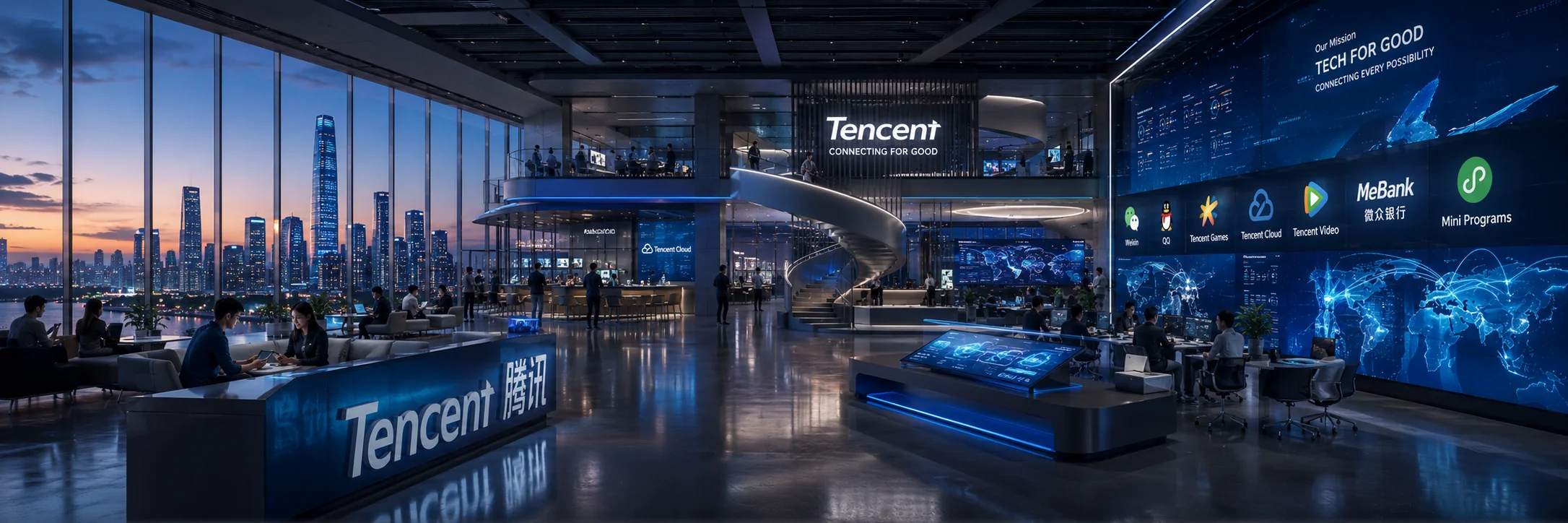
Social connectivity as the foundational layer creates a platform where gaming, payments, and strategic investments each reinforce user engagement with the others, generating ecosystem effects across a billion-user base that individual product competitors cannot replicate.
A structural look at how a messaging company became the connective tissue of China's digital economy through layered ecosystems and strategic investment.
Introduction
Tencent (TCEHY)'s trajectory from a small Shenzhen startup running an instant messaging client to one of the world's most valuable companies is a study in ecosystem layering. Each phase of the company's evolution added a new structural layer—communication, entertainment, payments, investment—that reinforced the layers beneath it. The result is a business where hundreds of millions of daily interactions flow through interconnected surfaces that Tencent either owns or has significant stakes in.
Viewing Tencent as a "social media company" or a "gaming company" misses the structural reality. Tencent operates as a platform of platforms—a connective layer that sits between users and an enormous range of digital services. Social connectivity is the root system. Everything else grows from it. Gaming generates cash. Payments capture transaction flow. Investments extend reach into sectors Tencent does not operate directly. Each layer feeds the others in reinforcing loops.
Understanding Tencent's arc reveals how structural patterns—social graph ownership, ecosystem layering, capital deployment as strategy—can transform a single communication tool into the infrastructure of an entire digital economy.
The Long-Term Arc
How did QQ build Tencent's early user base?
Tencent launched QQ in 1999 as an instant messaging service modeled on ICQ. The product spread rapidly across China's emerging internet population. QQ was free, lightweight, and social—three properties that drove viral adoption in a market where internet access was expanding quickly but disposable income for digital services remained low. By the mid-2000s, QQ had accumulated hundreds of millions of registered accounts.
The critical structural insight was not the messaging product itself but what it created: a social graph. Tencent owned the connections between people—who knew whom, who talked to whom, who was online when. This social graph became the foundation for everything that followed. QQ was not just a product; it was an identity layer and a distribution channel. New features, games, and services could be pushed to an existing user base through existing social connections, dramatically reducing customer acquisition costs.
Monetization in this early phase came through virtual goods—digital avatars, decorations, and status symbols sold within QQ. This was structurally significant. Tencent learned to monetize attention and social interaction without advertising, establishing a commercial model where users paid for social expression. The virtual goods economy demonstrated that digital scarcity and social signaling could generate real revenue at scale.
How did gaming transform Tencent's business?
Tencent's entry into gaming transformed the company's financial profile. Rather than building game studios from scratch, Tencent pursued a hybrid approach: developing some titles internally, licensing others, and—critically—acquiring stakes in game developers worldwide. The acquisition of Riot Games, the creator of League of Legends, marked a turning point. Tencent gained ownership of one of the world's most popular games and—more importantly—deep expertise in live-service game operations.
The gaming business created a powerful cash generation engine. Games produced high margins and recurring spending from players who purchased in-game items. Tencent's social infrastructure provided a distribution advantage: games spread through friend networks on QQ and later WeChat, reducing marketing costs and increasing player retention through social ties. The feedback loop between social connectivity and gaming engagement proved remarkably durable.
Over time, Tencent assembled the largest gaming portfolio in the world through investments and acquisitions spanning Supercell, Epic Games, Activision Blizzard, and dozens of smaller studios. This portfolio approach diversified gaming revenue across genres, geographies, and platforms while providing Tencent with insight into global gaming trends and talent.
Why was WeChat Tencent's most consequential shift?
WeChat's launch in 2011 represented Tencent's most consequential structural shift. Where QQ was a desktop-era messaging tool, WeChat was designed for mobile from inception. It rapidly absorbed China's smartphone-adopting population and evolved beyond messaging into a super-app—a single interface through which users could message, share social updates, pay for goods, hail taxis, book appointments, access government services, and interact with businesses through Mini Programs.
The super-app architecture created a fundamentally different kind of platform. WeChat became an operating system layer sitting on top of iOS and Android. Mini Programs—lightweight applications running within WeChat—meant that businesses and developers built on Tencent's platform rather than distributing standalone apps. This created an ecosystem where Tencent controlled discovery, distribution, and increasingly the payment rails through which transactions settled.
WeChat Pay emerged as a natural extension of the super-app model. By integrating payments into the messaging experience—red envelopes sent between friends during holidays became a viral adoption mechanism—Tencent captured an enormous share of China's digital payment flow. Payments transformed Tencent's relationship with users from attention-based to transaction-based, inserting the company into the financial infrastructure of daily life.
How did Tencent expand through strategic investment?
Tencent's most distinctive structural evolution has been its transformation into a strategic investor across the Chinese and global internet economy. Rather than building every service internally, Tencent deployed capital into companies that occupied adjacent positions—e-commerce, food delivery, ride-hailing, education, healthcare. JD.com, Meituan, Pinduoduo, Sea Limited, and hundreds of other companies received Tencent investment, often alongside integration with the WeChat ecosystem.
This investment approach served multiple structural functions simultaneously. It extended Tencent's reach without the operational complexity of running diverse businesses directly. It provided WeChat users with services accessible through the super-app, increasing platform stickiness. It generated financial returns as portfolio companies grew. And it created a network of aligned companies that reinforced Tencent's ecosystem position. The investment portfolio was not separate from the platform strategy—it was an extension of it.